
- Last Updated:
The Complete Guide to Legal Hold Best Practices
CONTENTS
Introduction: Why Legal Holds Matter More Than Ever
Legal holds are no longer rare legal events, they are an ongoing operational responsibility. What once surfaced only during major lawsuits has become a routine requirement for organizations navigating constant data growth and regulatory scrutiny.
Yet despite their importance, many organizations struggle with legal hold execution. The risk is severe: failure to properly implement a legal hold can result in court sanctions, adverse inferences, and litigation losses that dwarf the cost of proper data preservation.
This comprehensive guide provides everything you need to implement, manage, and release legal holds effectively and introduces you to Venio legal hold technology solutions that automate and streamline the entire process. Whether you’re managing holds manually today or looking to modernize your approach, this guide will help you build a defensible, efficient legal hold program.
See How Venio Automates Legal Holds
What is a Legal Hold? The Fundamentals
A legal hold, also called a litigation hold, is a formal instruction to preserve all potentially relevant information when litigation is reasonably anticipated or has commenced.
Under Federal Rule of Civil Procedure 37(e), parties must take ‘reasonable steps’ to preserve electronically stored information (ESI) when litigation is reasonably anticipated. Failure to do so can result in sanctions ranging from case dismissal to monetary fines.
The concept dates back centuries – the 1722 case of Armory v. Delamirie established that parties cannot profit from destroying evidence, a principle called ‘spoliation.’ Today, digital spoliation is taken as seriously by courts as physical document destruction.
Why Legal Holds Matter
- Evidence Preservation: Ensures critical data isn't deleted before litigation begins
- Legal Defensibility: Proves you took reasonable steps to preserve evidence
- Cost Reduction: Early preservation can prevent expensive document reconstruction
- Compliance Protection: Demonstrates good faith to courts and opposing counsel
Venio's Automated Hold Tracking
The Complete Litigation Hold Process Lifecycle
Successful legal hold management requires understanding all five phases of the hold lifecycle. This section walks through each phase with practical guidance and shows how modern technology can automate and streamline each step.
Phase 1: Trigger & Assessment
The triggering event for a legal hold occurs when litigation is reasonably anticipated, such as demand letters, government inquiries, or executive-level dispute discussions.
- Assess the situation and gather preliminary facts
- Identify key stakeholders and decision-makers
- Determine preliminary scope (people, data types, time periods)
- Brief legal counsel on immediate next steps
- Review existing hold policies and procedures
Common Mistake:
Waiting too long. The moment you have ‘reasonable anticipation’ of litigation is the moment to act. Waiting for the formal service of a complaint risks evidence loss.
With Venio Systems:
The trigger event can be immediately logged in the platform, ensuring compliance tracking begins from day one.
Phase 2: Issuing the Legal Hold Notice
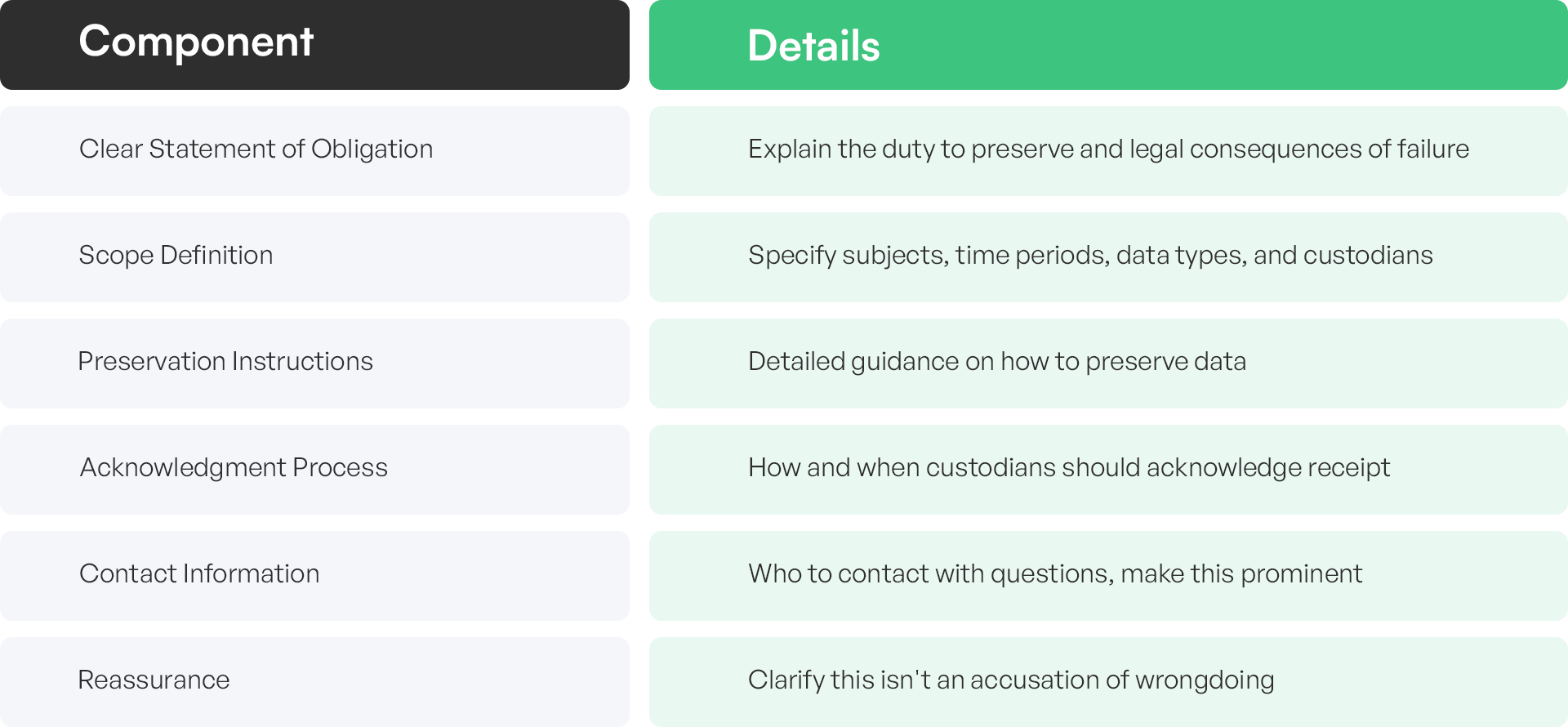
A clear legal hold notice defines scope, preservation duties, acknowledgment steps, and contact information. A well-drafted legal hold notice reduces confusion and strengthens compliance.
Essential components of a strong legal hold notice:
💡 Venio’s Pre-Built Notice Templates
Venio provides pre-approved legal hold notice templates that your counsel has already reviewed. Deploy them instantly, customize for your matter, and automatically track delivery to all custodians with digital confirmation.
Phase 3: Implementation & Monitoring
This phase ensures the requirement of the legal hold process is fulfilled through IT controls, acknowledgment tracking, and system audits.
Implementation checklist:
- Confirm IT team receipt and understanding of the hold
- Identify specific data custodians and their systems
- Deploy preservation controls (suspension of auto-delete, backup procedures)
- Track custodian acknowledgments and document them
- Conduct sample verification of data preservation
- Follow up with non-responsive custodians within 48 hours
💡 Venio’s custodian portal makes this phase dramatically simpler.
Custodians receive notifications, can acknowledge directly in the portal, ask questions via integrated chat, and Venio automatically tracks all interactions. No spreadsheets. No lost emails.
Phase 4: Ongoing Maintenance (Duration of Litigation)
Legal holds can last months or years. The longer a hold remains in place, the greater the risk of inadvertent data loss. Regular reminders, scope adjustments, and compliance audits are part of sustained legal hold compliance.
Maintenance responsibilities:
- Periodic Reminders: Send reminder notices every 6 months to ensure compliance
- System Changes: Track software updates and new employee onboarding that might affect the hold
- Custodian Changes: Remove new custodians, add departing employees with relevant data
- Scope Adjustments: Modify the hold scope as litigation progresses
- Compliance Audits: Random checks to verify that data is actually being preserved
- Documentation: Maintain detailed records of all hold activities
💡 Venio handles maintenance automatically.
The platform sends reminder notices on your schedule, tracks all organizational changes, logs every modification, and provides audit reports at a click. This is where Venio saves organizations thousands of hours of manual work.
Phase 5: Release & Return to Normal (Post-Litigation)
When litigation concludes or legal counsel determines the hold is no longer necessary, you must release it properly. Many organizations neglect this phase, creating unnecessary storage costs and compliance risks.
Release best practices:
- Obtain written authorization from legal counsel
- Issue a formal release notice to all custodians
- Notify IT to resume normal retention policies
- Document the release process thoroughly
- Archive hold documentation for potential future need
- Identify and restore deleted data if applicable
💡 Venio automatically notifies all custodians
Legal counsel approves the release in the platform, Venio automatically notifies all custodians, IT systems are updated, and complete release documentation is archived automatically.
Building a Defensible Legal Hold Process
Organizations that succeed treat the ediscovery legal hold process as a repeatable governance discipline rather than an ad-hoc legal reaction. This section provides a step-by-step blueprint for building your process.
Step 1: Establish a Written Legal Hold Policy
A formal litigation hold policy clarifies responsibilities, approval authority, timelines, escalation procedures, and other key components of legal hold requirements. Courts look favorably on organizations with documented policies that demonstrate ‘reasonable steps.’
Your policy should cover:
- Trigger event definitions - what qualifies as 'reasonable anticipation'?
- Approval authority - who can authorize an ediscovery legal hold?
- Legal Hold Notice requirements - timeline for issuing notices?
- Exception handling - how are sensitive matters handled?
- Custodian roles and responsibilities
- IT roles and responsibilities
- Monitoring and audit procedures
- Release procedures
Step 2: Define Clear Roles and Responsibilities
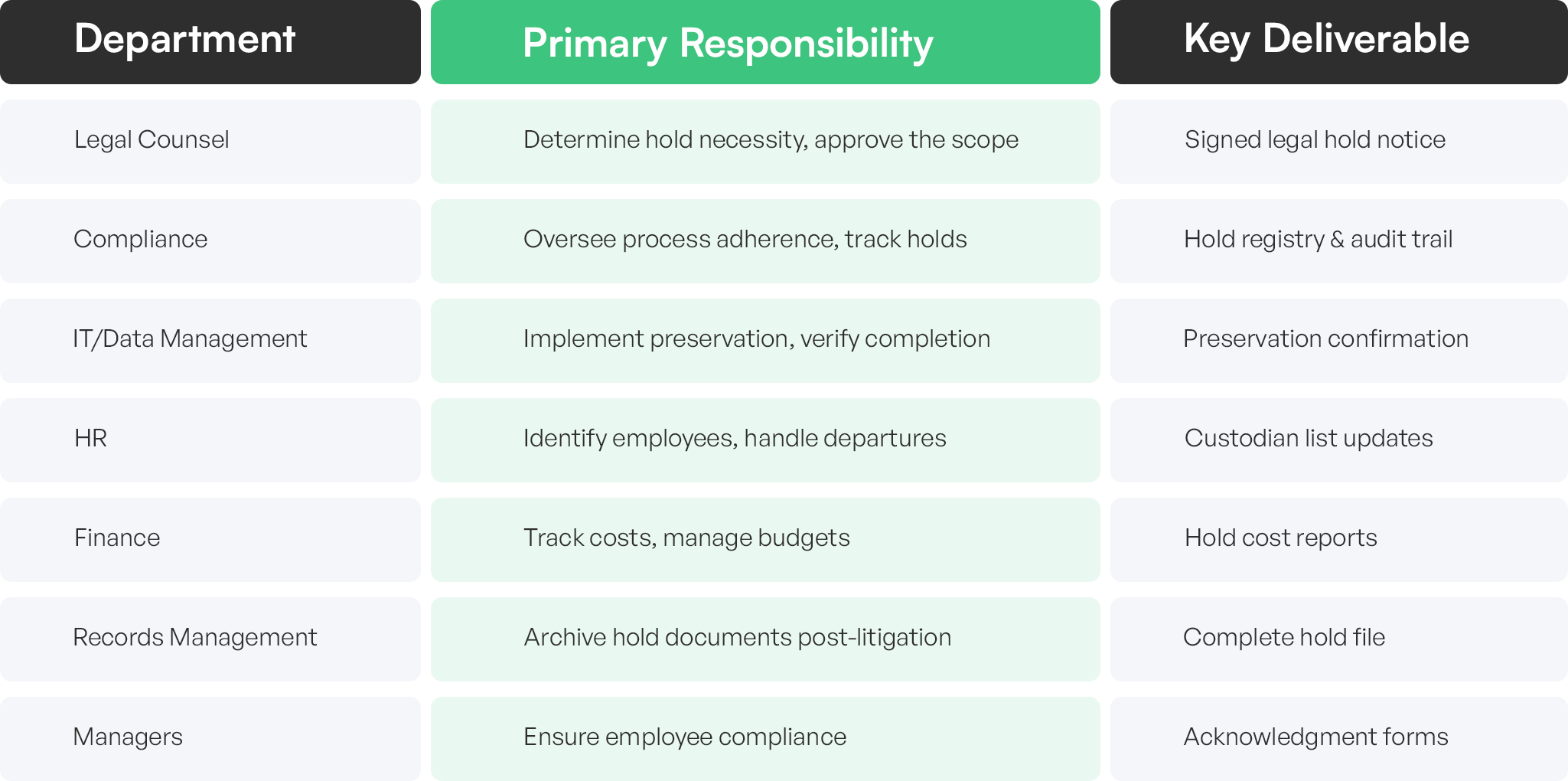
Clear ownership across Legal, IT, HR, Compliance, and Records Management ensures accountability within the litigation hold process and eliminates any ambiguity ,which leads to costly mistakes.
💡 Venio’s Pre-Built Notice Templates
Venio provides pre-approved legal hold notice templates that your counsel has already reviewed. Deploy them instantly, customize for your matter, and automatically track delivery to all custodians with digital confirmation.
Step 3: Create Templates and Standardize Communications
Templates accelerate deployment and improve legal hold compliance consistency. You should create templates for:
- Initial legal hold notice
- Reminder notices
- Hold release notice
- Custodian acknowledgment forms
- Data preservation confirmation template
- Hold modification notice
Each template should include legal hold requirements, your organization’s specific procedures, and space for required documentation. Have your legal counsel review templates before deployment.
Step 4: Implement Technology Solutions
Manual spreadsheets cannot scale. Dedicated legal hold software automates delivery, acknowledgment tracking, audit trails, and reporting. You need technology to handle the complexity at scale. Even a single misdirected notice or missed custodian can cause significant problems.
Critical technology capabilities:
- Automated Notice Delivery: Send notices directly to custodians with confirmation tracking
- Custodian Portal: Central location for custodians to acknowledge and ask questions
- Integration with Email/Chat: Preserve data across Slack, Teams, email, Drive, etc.
- Data Discovery: Identify relevant ESI across all enterprise systems
- Hold Registry: Centralized tracking of all active holds
- Audit Trail: Complete documentation of the hold lifecycle for defensibility
💡 Why Venio Systems for Legal Holds
Venio provides all six capabilities above in one integrated platform. Unlike disconnected tools, Venio handles the complete hold lifecycle- from notice issuance to custodian acknowledgment to data preservation tracking to final release with complete audit trails that courts recognize as best-practice compliance.
Step 5: Train Your Team
Even great processes fail if people don’t understand them. Annual training on your legal hold procedures should be mandatory for:
- All custodians (what they must preserve, how to acknowledge)
- IT staff (how to implement preservation controls)
- HR and managers (their role in custodian identification)
- Finance (cost tracking and budget implications)
Consider making legal hold training part of your annual compliance training and new employee onboarding.
💡 Venio provides guided training
Venio provides guided training for all user roles, reducing your training burden and ensuring consistent adoption.
Common Legal Hold Pitfalls and How to Avoid Them
Recognizing the common gaps in the litigation hold process and applying proven litigation hold best practices helps prevent costly errors
Pitfall #1: Delayed Triggering Event for a Legal Hold
The Problem: Many organizations wait for formal litigation to be served. By then, automatic deletion of emails and messages may have already destroyed relevant data.
The Solution: Define ‘reasonable anticipation’ clearly in your policy. Common triggers: formal demand letter, cease-and-desist notice, C-suite discussion of potential disputes, government inquiry, public threat of legal action.
Why This Matters: Data loss before a hold is in place = spoliation = court sanctions
How Venio Helps: Venio’s litigation hold trigger tracking helps you capture the moment ‘reasonable anticipation’ begins, with timestamped evidence of when the hold was initiated.
Pitfall #2: Weak or Vague Legal Hold Notice
The Problem: Legal hold notices that don’t clearly specify what to preserve create confusion. Custodians either over-preserve (creating massive costs) or under-preserve (missing relevant data).
The Solution: Provide specific examples. Instead of ‘preserve all communications,’ say ‘preserve all emails with subject line containing [topic], all Slack messages in channels [list], all documents modified between [dates].’
Why This Matters: Incomplete preservation or unnecessary costs
How Venio Helps: Venio’s scope definition tool provides structured guidance with examples, ensuring your notice is crystal clear and reducing custodian confusion.
Pitfall #3: Failing to Track Acknowledgments
The Problem: If you can’t prove custodians received the notice and understood their obligations, courts question the defensibility of your process.
The Solution: Require written acknowledgment. Track who acknowledged, when, and any questions raised. Use a centralized log or spreadsheet.
Why This Matters: Credibility challenges in litigation
How Venio Helps: Venio tracks every custodian interaction & notice delivery, acknowledgment receipt, questions asked, responses provided, all with timestamps and digital signatures.
Pitfall #4: Overlooking Cloud and Third-Party Data
The Problem: Organizations focus on email and company computers, missing data stored in Slack, Salesforce, SharePoint, Google Drive, Box, etc.
The Solution: Conduct a data audit. Identify all systems storing potentially relevant data. Work with IT and vendors to understand preservation capabilities.
Why This Matters: Missing crucial evidence
How Venio Helps: Venio integrates with multiple cloud and SaaS platforms (Slack, Teams, Salesforce, Workday, etc.), automatically identifying and preserving relevant data without manual intervention.
Pitfall #5: Lack of Ongoing Legal Hold Compliance
The Problem: Placing a hold and assuming it will function without attention. System changes, employee turnover, and data growth all affect preservation.
The Solution: Establish a maintenance schedule. Send reminder notices every 6 months. Audit preservation controls quarterly. Track organizational changes.
Why This Matters: Inadvertent data loss, challenged evidence integrity
How Venio Helps: Venio automatically handles hold maintenance, sending scheduled reminders, tracking system changes, logging all modifications, and alerting you to potential compliance issues.
Pitfall #6: Ignoring Privacy and Compliance Laws
The Problem: GDPR, CCPA, HIPAA, and other regulations restrict data retention. Legal holds can conflict with privacy obligations.
The Solution: Consult with privacy counsel. Document the legal hold’s justification under applicable privacy laws. Consider limiting preservation scope to essential data.
Why This Matters: Privacy violations, regulatory fines
How Venio Helps: Venio helps document the legal basis for your hold, supporting GDPR ‘lawful basis’ requirements and other legal obligations.
Legal Hold Cost-Benefit Analysis
Many organizations view legal holds as pure cost. In reality, proper legal hold management is one of the best ROI investments you can make.
The True Cost of Inadequate Legal Holds

ROI Calculation
Let’s take a scenario to give you a better understanding of legal hold ROI. Consider a typical mid-sized company:
- 500 potential custodians × $100 per custodian for notices and tracking = $50,000
- IT implementation and verification = $30,000
- Ongoing monitoring for 18-month litigation = $20,000
- Total legal hold investment: ~$100,000
Compare to:
- Spoliation sanctions (even partial): $500,000+ in fines alone
- Additional eDiscovery costs from disorganized data: $250,000+
- Risk of adverse inferences: Potential case loss
In this scenario, a $100,000 investment prevents potential costs exceeding $750,000+. That’s a 7.5:1 return on investment.
Technology Solutions & Implementation Guide
Successfully managing ediscovery legal holds at scale requires technology. This section evaluates different approaches and provides a selection framework.
Technology Approaches Compared
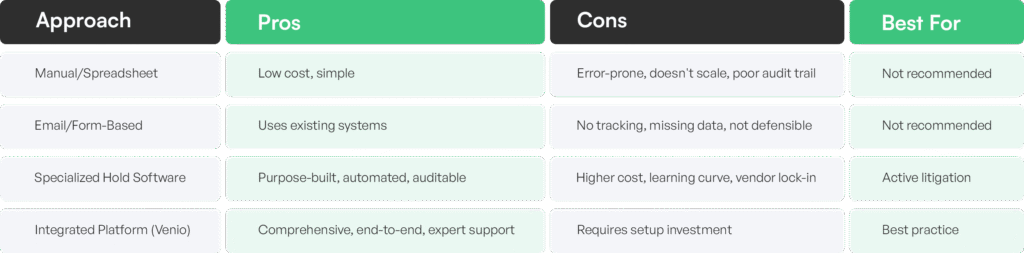
Recommended Approach: Integrated Legal Hold Platform
A dedicated legal hold platform that integrates with your existing email and collaboration tools. This provides:
- Automated notice delivery to custodians
- Tracking of custodian acknowledgments
- Data preservation across email, chat, and files
- Integrated audit trail for defensibility
- Reporting and hold status dashboards
- Scalable to hundreds of custodians and multiple simultaneous holds
💡 Venio Systems: Purpose-Built for Legal Holds
Venio was designed specifically for legal hold management. Unlike general eDiscovery platforms that treat holds as one feature among many, Venio’s entire platform is optimized for the entire legal hold lifecycle. This focus delivers superior compliance, better user experience, and significant cost savings compared to general-purpose alternatives.
Implementation Timeline with Venio
Typical implementation timeline for Venio legal hold platform:
- Week 1: Planning: Assess needs, define requirements, Venio onboarding call
- Week 2: Configuration: Custodian setup, notice templates, integration testing
- Week 3-4: Testing: Pilot hold with small group, feedback, and adjustments
- Week 5: Training: Comprehensive training for all user groups (provided by Venio)
- Week 6: Soft Launch: Deploy first real hold with Venio support
- Week 7: Full Production: Complete adoption across all legal hold matters
See Venio Legal Hold in Action
Multi-Jurisdiction Legal Hold Requirements & Compliance Considerations
If your organization operates internationally or has employees in multiple countries, legal hold obligations vary significantly. Failing to account for these differences can create serious compliance problems.
Key Regulatory Frameworks
United States (Federal)
Applicable Rules:
- Federal Rule of Civil Procedure 37(e)
- Take reasonable steps to preserve ESI
💡 Potential Sanctions: Case dismissal, monetary sanctions, adverse inferences
European Union (GDPR)
Applicable Rules:
- Right to be forgotten
- Data retention limitations
- Purpose limitation
💡 Potential Sanctions: Up to 4% of global revenue, €20M fine
California (CCPA)
Applicable Rules:
- Right to deletion
- Data minimization
- Purpose limitation
💡 Potential Sanctions: Up to $7,500 per violation
Best Practices for Multi-Jurisdiction Holds
- Consult with local counsel in each jurisdiction before issuing a hold
- Document the legal basis for the hold in each jurisdiction
- Consider narrower scope in privacy-strict jurisdictions (EU, Canada)
- Implement separate preservation processes for different jurisdictions
- Review tax and labor law impacts of international holds
💡 Venio supports multi-jurisdiction holds with configurable privacy rules per jurisdiction and documentation of legal basis required for GDPR compliance.
Legal Hold Release - Often Forgotten, Never Trivial
Organizations often obsess over placing holds correctly but neglect the release process. This is a mistake. Failing to release a hold properly can result in needless storage costs, privacy violations, and compliance problems.
The Release Process
A proper release process includes:
- Obtain Authorization: Written instruction from legal counsel that the hold is no longer necessary
- Issue Release Notice: Formal communication to all custodians and IT that the hold is lifted
- Document the Decision: The file shows the reason for the release and the date it became effective
- Resume Normal Retention: IT resumes applying standard retention policies
- Archive Hold Records: Complete hold file is archived for future reference
💡Venio automates the release process end-to-end, from counsel approval to custodian notification to IT system updates to complete documentation and archival. A process that typically takes days in manual systems is completed in minutes with Venio.
Special Release Situations
Partial Release: When litigation continues, but the hold scope narrows
Issue a modified hold notice that clearly describes what is still preserved and what has been released. Update your hold register to reflect the new scope.
Appellate Holds: When the case is appealed
Do not release the hold until the appeals period expires or the court issues an order releasing the hold. Even minor holds should remain in place during appeals.
Government Investigations: When a regulatory hold continues
Litigation may end, but regulatory investigations can continue. Consult with counsel before releasing. When the regulatory hold ends, implement a separate notice and release process.
Venio Legal Hold - A Complete Solution to eDiscovery Hold
Throughout this guide, we’ve covered the legal hold best practices that keep organizations compliant and protected. Now, let’s explore how Venio Systems integrates these practices into one powerful platform.
What Venio Systems Does for Legal Holds
- Hold Issuance: Pre-built, legally reviewed notice templates. Customize and deploy to all custodians in minutes. Track delivery with digital confirmation.
- Custodian Management: Dedicated custodian portal where they can acknowledge holds, ask questions, upload preserved data, and see their compliance status.
- Notice & Reminder Automation: Automatically send reminder notices on your schedule. No manual tracking or email management needed.
- Data Preservation Tracking: Integrated with numerous cloud and SaaS platforms. Automatically identify and preserve relevant data without manual intervention.
- Audit Trail Documentation: Complete timestamped record of every action: notice issuance, custodian acknowledgment, scope modifications, data preservation, and release. Courts recognize Venio’s audit trails as best-practice compliance.
- Hold Registry & Reporting: Centralized dashboard showing all active holds, custodian status, data volumes, costs, and upcoming milestones.
- Release Management: Streamlined release workflow from legal counsel approval through custodian notification and IT system updates.
- Compliance Verification: Automated compliance audits showing which custodians preserved data, which data sources were covered, and potential gaps.
Why Organizations Choose Venio
- Purpose-Built: Designed specifically for legal hold management, not a general eDiscovery tool trying to do legal holds as one feature.
- Proven Compliance: Venio’s approach to legal hold management is recognized by courts and regulators as best-practice compliance.
- Significant Time Savings: Eliminates excessive working hours of manual work per year for mid-sized organizations.
- Cost Reduction: Reduces legal hold costs by 40% on average compared to manual processes.
- Expert Support: Venio’s team includes legal hold specialists and compliance experts available to guide your process.
- Easy Integration: Connects with your existing email, chat, file storage, and IT systems. No data migration required.
- Scalability: Handles 1 simultaneous hold or 100. Same platform, same efficiency, same audit trails.
Try Venio Legal Hold Platform
Practical Checklists and Tools
Pre-Hold Checklist
☐ Reasonableness of litigation anticipation confirmed
☐ Legal counsel is involved and approves the scope
☐ Custodians identified and contacted
☐ IT notified of hold scope and timeline
☐ Existing retention policies reviewed
☐ Data sources identified (email, chat, files, databases, etc.)
☐ Legal hold notice drafted and reviewed
☐ Acknowledgment process defined
☐ Budget approved
Initial Hold Deployment (Days 1-7)
☐ Hold notice issued to all custodians
☐ IT notified with detailed preservation instructions
☐ Backup procedures established
☐ Data preservation begins
☐ Acknowledgment tracking begins
☐ Follow-up with non-responsive custodians initiated
☐ Initial compliance verification completed
☐ Hold details documented in register
☐ Budget tracking initiated
Ongoing Maintenance Checklist
☐ Quarterly: Compliance audit (sample 10% of custodians)
☐ Quarterly: System change assessment (new software, hardware changes)
☐ Semi-annually: Send reminder notices to all custodians
☐ As needed: Add/remove custodians due to employee changes
☐ Semi-annually: Review hold scope with legal counsel
☐ Quarterly: Review costs and budget forecast
☐ Annually: Train IT staff on preservation procedures
☐ Annually: Update hold policy based on legal changes
Conclusion: Legal Holds as Competitive Advantage
Legal holds are no longer a rare legal procedure, they’re a core competency for organizations operating in litigious industries. The organizations that excel at legal hold management demonstrate competence, reduce litigation costs, and protect themselves from devastating sanctions.
The challenge is that manual legal hold processes are error-prone, costly, and don’t scale. Organizations that continue managing holds with spreadsheets and emails are at significant risk and are spending far more than necessary.
This is where modern legal hold technology becomes a competitive advantage. Organizations using platforms like Venio Systems execute holds faster, more completely, and with perfect compliance documentation. They also reduce costs by 40% and free up staff to focus on higher-value work.
Your next steps:
☐ Review your current legal hold process against the checklist provided
☐ Identify gaps and risks in your current approach
☐ Consider whether your organization would benefit from automation
☐ Get a Venio Legal Hold demo and see the difference for yourself
☐ Consult with your legal counsel to update your hold policies
Ready to Transform Your Legal Hold Process?
Frequently Asked Questions About Legal Holds
What exactly triggers a legal hold? Do I need a complaint to be filed?
No. Litigation must be ‘reasonably anticipated,’ but a formal complaint isn’t required. Triggers include formal demand letters, C-suite discussions of potential disputes, government inquiries, or public announcements of legal action. The key is honest assessment: would a reasonable person anticipate litigation?
How long must I maintain a legal hold?
Until the matter is fully resolved, including any appeals period. For regulatory matters, this can extend beyond litigation. When litigation concludes, don’t release the hold until legal counsel confirms the appeals deadline has passed.
Do I need to preserve social media data?
Yes, if potentially relevant to the matter. Social media may contain communications about the disputed issue. Social media data is often overlooked and creates defensibility gaps. Venio integrates with major social platforms to ensure this data is captured and preserved.
What about data from departed employees?
Departed employees’ data must be preserved if under a legal hold. Before termination, work with IT and legal to ensure their data is moved to a preservation-controlled location. Many organizations delete departed employees’ data automatically as this can cause spoliation.
Can I automatically delete older data to reduce costs?
Only after the hold is formally released. During a hold, you must preserve data in its existing form. Using automatic deletion to reduce storage costs could be considered intentional spoliation.
What if I discover data wasn't preserved during a hold?
Immediately notify legal counsel. Determine what was lost, when, and why. Document your discovery and investigation findings. Courts care less about the loss itself than your good-faith response. Attempting to cover up the loss is far worse.
Do I need to preserve data from contractors and vendors?
If they have relevant data, yes. This is often overlooked. Work with your procurement team to ensure contracts include legal hold obligations and preservation capabilities. Venio can help manage third-party holds through its custodian portal.
What's the difference between a legal hold and records retention?
Records retention applies routinely and destroys old records. Legal holds suspend destruction and preserve everything within scope. Holds override retention policies and retention resumes only after the hold is lifted.
Who is liable for failing to maintain a legal hold?
The organization faces court sanctions. Individuals (in-house counsel, IT staff) could face professional consequences or employment termination. This is why documentation and clear processes are critical. Venio’s complete audit trails protect both the organization and individuals by documenting compliance efforts.
Can a legal hold ever end before litigation is resolved?
Yes, in limited circumstances. If the scope of litigation narrows significantly, or if a settlement agreement permits release, the hold can be modified or lifted. But this requires written authorization from legal counsel and clear documentation.