What is EDRM? The Definitive Guide to the Electronic Discovery Reference Model (EDRM Stages & Strategy)

Ready to get started?
built for clarity, control, and scale.
Share
Introduction: Mastering the Modern Data Challenge
How do legal teams take millions of unorganized, disparate digital files and transform them into legally defensible evidence in court? The volume of Electronically Stored Information (ESI) is doubling every few years, turning the eDiscovery process into a potential chaos-filled scramble.
The answer lies in the Electronic Discovery Reference Model (EDRM)—a proven, systematic framework that breaks the eDiscovery lifecycle into practical, repeatable, and defensible steps.

The EDRM provides the structure needed to manage eDiscovery with precision, compliance, and cost-efficiency. In this definitive guide, we will break down what the EDRM is, explore its nine core stages, analyze its true value (and limitations), and provide practical tips for applying it to master your organization’s legal and regulatory obligations.
What is the Electronic Discovery Reference Model (EDRM)?
The Electronic Discovery Reference Model (EDRM) is a structured framework that outlines how digital data is handled, from creation to final presentation, during litigation, investigations, and regulatory matters.
First introduced in 2005 by industry thought leaders George Socha, Jr., and Tom Gelbmann, the EDRM was created to standardize the fragmented eDiscovery industry. It quickly became the industry standard for legal, technical, and compliance teams.
It is critical to understand that the term EDRM refers to two things:
- The Model: A conceptual, non-linear diagram mapping the nine stages of the eDiscovery process.
- The Organization/Community: The professional community (EDRM, Inc.) that maintains the framework and develops guidelines and best practices for the industry.
The model ensures that legal electronic discovery is not just about gathering data, but about doing so in a way that adheres to legal standards, maintains data integrity, and manages soaring costs. (For more information, you can visit the official EDRM website).
The EDRM Visual Logic: Understanding the Triangles
The EDRM diagram is not just a linear flowchart; it is a conceptual map that defines the primary objectives of the process. The two triangles behind the nine boxes are the most important visual element:
- The Yellow Triangle (Data Volume Reduction): This triangle is widest on the left and narrows dramatically to the right. It represents the massive volume of ESI at the outset that must be systematically culled and filtered down to a manageable and relevant set of documents.
- The Green Triangle (Relevance & Value Increase): This triangle is narrow on the left and widens to the right. It illustrates how the proportional relevance and value of the remaining data increases at every stage.
This visual strategy emphasizes the principle of proportionality: the process is designed to reduce the overall data volume while continuously increasing the quality and relevance of the evidence heading toward the courtroom.
The 9-Step EDRM Process: Key Stages Explained
Electronic Discovery Reference Model (EDRM) was designed to bring structure to the often overwhelming ediscovery process. Instead of treating data management as one big task, the model breaks it into the following nine stages of eDiscovery:

The EDRM was designed to bring structure to the overwhelming eDiscovery process. While the stages are often shown in sequence, the model is iterative and recursive, meaning teams often cycle back to earlier stages (e.g., analysis may lead to new data identification).
1. Information Governance
Good cases start with good data hygiene. Information governance within the EDRM framework is the foundational stage where organizations create policies on how ESI is managed, organized, retained, and ultimately disposed of. Without a solid foundation here, costs and risks can skyrocket later.
Key Integration: This stage is so vital that the EDRM has formally incorporated principles from the separate Information Governance Reference Model (IGRM) to ensure proactive data management and risk reduction.
2. Identification
In this stage, legal and IT teams work to determine the scope, location, and nature of potentially relevant ESI. The goal is to prevent blind spots and ensure no critical data is missed.
Key Action: This involves Data Mapping (identifying all systems and data repositories) and conducting in-depth Custodian Interviews to understand where key employees store information.
3. Preservation
Legal accountability takes centre stage here. Once relevant data is identified, it must be protected from alteration or destruction, known as spoliation.
Key Action: The primary mechanism for preservation is the immediate issuance of a legally defensible Legal Hold (or Litigation Hold) to all relevant custodians.
4. Collection
Collection is the defensible, forensically sound gathering of preserved ESI. The goal is to collect just the right amount of information to minimize downstream review costs, while ensuring data integrity.
Key Action: Modern eDiscovery solutions use forensics-grade tools to capture data accurately, while maintaining a robust, unbroken Chain of Custody to ensure courtroom admissibility.
5. Processing
Raw digital evidence is rarely ready for review. This is the data refinement stage, where raw files are culled, filtered, and converted into reviewable formats.
Key Action: Essential steps include de-duplication, de-NISTing (removing system files), and applying date or keyword filters to drastically shrink the data set loaded for review.
6. Review
The review stage is the most resource-intensive—and often the most expensive—part of the entire eDiscovery lifecycle. Attorneys and litigation support teams assess documents for three criteria: relevance, privilege, and responsiveness.
Critical Metric: Document review can account for up to 80% of total eDiscovery costs. To mitigate this, legal teams increasingly utilize Technology Assisted Review (TAR) and predictive coding powered by AI to prioritize, code, and flag relevant material, saving significant time and cost.
7. Analysis
Analysis digs deeper than basic document review. It involves evaluating the ESI for content, context, and key patterns. This stage moves beyond document-by-document relevance to uncover the story behind the data.
Key Action: Analysis focuses on building timelines, identifying behavioural patterns, and linking communication threads across multiple platforms to guide case strategy.
8. Production
Production formalizes the work by packaging responsive, non-privileged documents into the agreed-upon format (PDFs, TIFFs, or native files). Transparency and defensibility are paramount.
Key Action: Production requires ensuring all associated metadata is intact and correct, as metadata proves the authenticity and integrity of the digital evidence.
9. Presentation
The final stage of the EDRM is displaying the evidence in a way that is authentic, traceable, and persuasive to the court, jury, or opposing counsel during depositions, hearings, or trials.
Key Action: Legal teams must leverage technology to present digital evidence (emails, social media, texts) in a clear, compelling manner that withstands technical scrutiny and is easily understood by a layperson.
Benefits and Limitations of the EDRM Framework
The EDRM is not a rigid checklist, but a vital strategic guide. Understanding its pros and cons is essential for effective implementation.
EDRM ImpactBenefits for Legal TeamsLimitations & ChallengesStandardizationCreates a common language between legal, IT, and external vendors, reducing confusion.Can be treated as a rigid checklist, stifling creative problem-solving in complex or unusual cases.EfficiencyProvides structure for early data culling and prioritization, speeding up cases.Following all nine steps can be resource-intensive, requiring specialized tools and staffing.DefensibilityAdherence documents every action, minimizing the risk of sanctions for spoliation or errors.The model, by itself, does not solve technology problems; it requires pairing with modern eDiscovery software.StrategyEarly case assessment and analysis uncover strategic insights and risks that shape litigation strategy.Difficult to apply to rapidly evolving data sources (e.g., temporary messaging apps) without constant internal updates.
Practical Tips for EDRM Implementation
Implementing the EDRM effectively requires a commitment to proactive planning and technology.
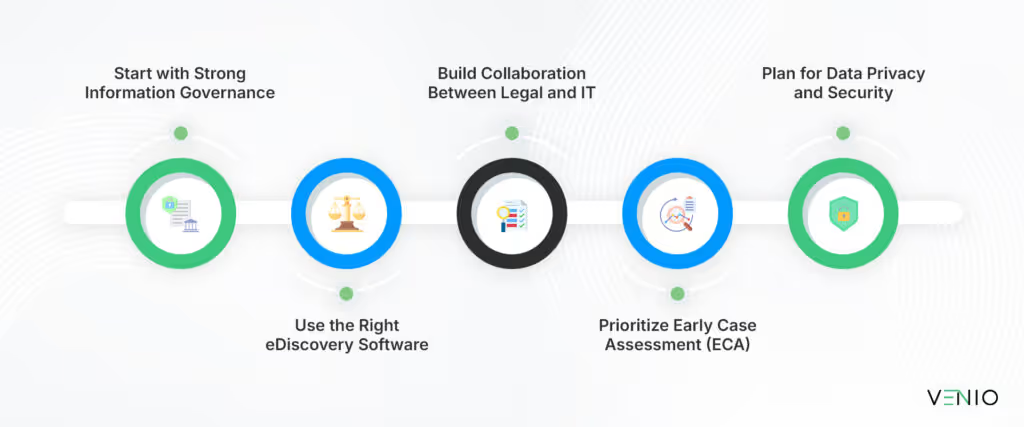
- Prioritize Proactive Information Governance: The EDRM starts on the left side with IG for a reason. Establish clear data retention policies, conduct routine data audits, and defensibly delete ROT (Redundant, Obsolete, Trivial) data before litigation starts.
- Invest in Integrated eDiscovery Software: Relying on manual processes for legal hold, collection, and processing leads to delays and errors. Choosing a unified platform simplifies the workflow across the EDRM stages, ensuring consistent security and defensibility.
- Mandate Legal-IT Collaboration: Successful eDiscovery depends on a seamless partnership. Legal brings case knowledge, while IT manages system access. Establish clear lines of communication for issuing holds and managing data collection.
- Prioritize Early Case Assessment (ECA): The stages of Identification and Processing are the most powerful levers for cost control. Utilize ECA features to quickly review a small sample of data, cull irrelevant material, and dramatically reduce the final volume sent to expensive attorney review.
- Plan for Data Privacy: With global regulations like GDPR and CCPA, ensure your eDiscovery process has built-in features for encryption, role-based access, and the ability to handle cross-border data transfer requirements without compromising the investigation.
Conclusion: Streamline Your eDiscovery Strategy
The Electronic Discovery Reference Model (EDRM) is more than just a framework—it’s a proven strategy for mastering the complexities of modern digital evidence. By adhering to the EDRM’s iterative structure, organizations can confidently manage risk, control costs (especially in the costly Review stage), and build a legally defensible eDiscovery process.
Ready to see how an integrated, AI-powered solution can help you execute every stage of the EDRM more efficiently and defensibly?

Whether you’re managing complex eDiscovery investigations or routine compliance needs, Venio empowers legal teams with advanced technology and seamless collaboration. Ready to simplify the ediscovery lifecycle? Contact us to see how we can help.
FAQs About the EDRM and eDiscovery Lifecycle
What is EDRM 2.0?
EDRM 2.0 is the modern evolution of the Electronic Discovery Reference Model, updating the framework to align with today’s technologies and legal challenges. It emphasizes stronger information governance, better integration with modern eDiscovery software, and adaptability to new, cloud-based data sources.
Is EDRM integrating IGRM into it?
Yes. The EDRM has formally incorporated the principles of the Information Governance Reference Model (IGRM) to highlight the essential link between proactive data governance and a smooth eDiscovery process. This integration ensures that organizations manage Electronically Stored Information (ESI) efficiently from its creation, which dramatically reduces risks when eDiscovery is triggered.
Why eDiscovery is Considered as a Dynamic Process?
Legal electronic discovery is dynamic because data sources (like new collaboration apps), legal regulations, and technology are constantly evolving. The EDRM acknowledges this by illustrating that the process is iterative and recursive, not a rigid, linear “waterfall” model. Teams must be ready to cycle back to earlier stages (e.g., from Analysis back to Identification) as new evidence is uncovered.
Related Articles
Internal Investigations: Getting the Facts Without Blowing the Matter Open
An internal investigation offers no court schedule and no second chance at prese
Read Article
eDiscovery Data Analytics & Visualization for Trial Preparation
Most litigation teams don’t lose at trial because they lack evidence. They lose
Read Article
What to Ask in an eDiscovery Demo Before You Sign
Twenty questions that make an eDiscovery vendor prove processing, AI, security a
Read Article