eDiscovery continues to rank among the top cost drivers for legal departments, and the pressure to rein it in is mounting. According to the 2025 EY Law General Counsel Study, 80% of general counsel say cost reduction remains a priority, even as 90% anticipate rising budgets in the year ahead.
In this environment, mastering eDiscovery cost control is no longer optional, it’s essential. While caseloads swell and data volumes explode, the cost of eDiscovery can easily spiral without a disciplined strategy. Legal teams must therefore adopt smarter approaches to reducing eDiscovery cost across every phase of litigation: from collection through review.
In what follows, we’ll explore how progressive organizations are rethinking processes, leveraging technology, and deploying cost-management tactics to strengthen their control over eDiscovery spend, without sacrificing quality or defensibility.
What Is Driving High Costs in eDiscovery?
The most significant driver of eDiscovery cost is still the review process. According to ComplexDiscovery’s 2025 market update, review accounts for 52% of total eDiscovery spend, while processing represents 22% and collection 15%. Even with technology advancements, review continues to dominate overall costs.
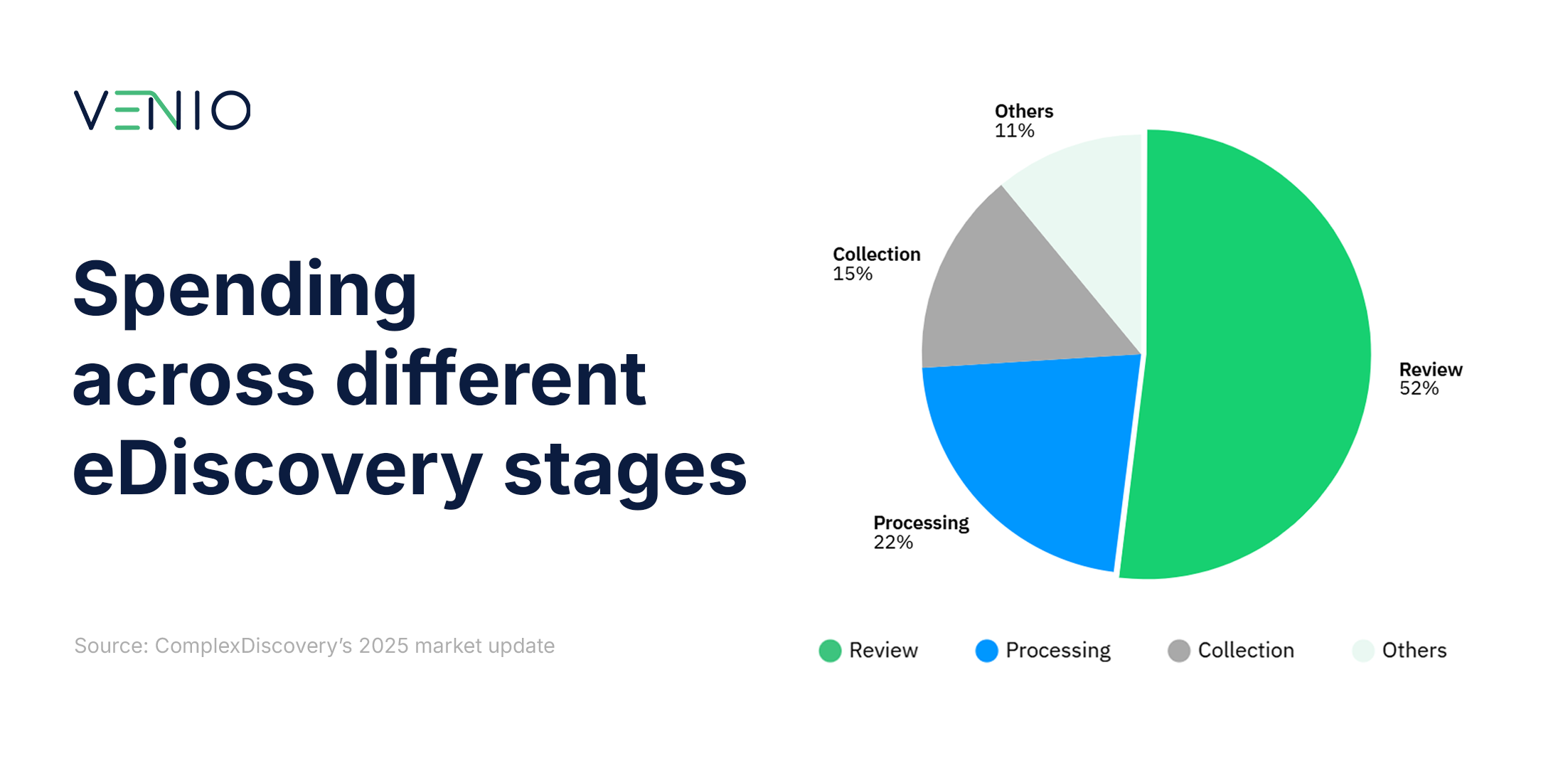
Because review is the bulk of expenses, effective eDiscovery cost control starts here. Leveraging AI-powered review tools and advanced filtering can dramatically reduce the volume of documents requiring human review, thereby reducing eDiscovery cost.
Beyond these foundational costs, clients also face additional expenses related to governance, compliance, and legal oversight, making smart strategies even more critical.

How Can You Control Costs During eDiscovery?
Controlling the cost of eDiscovery requires a mix of smart planning, technology, and process discipline. Here are four proven strategies to strengthen eDiscovery cost control while improving efficiency.
1. Understand the Scope of Your Data
Data volumes continue to surge across emails, chat apps, cloud platforms, and mobile devices. Simply collecting and processing everything drives up the cost of eDiscovery, as both the volume and type of data are major cost factors.
Assessing the scope of your data is a key step in reducing eDiscovery cost. Consider these actions:
- Identify the types of data you handle most and the challenges posed by unstructured or complex formats.
- Evaluate how data volume, collection, processing, and storage affect overall expenses.
- Use eDiscovery software to map and plan your data efficiently, improving eDiscovery cost control.
2. Automate Key Steps of Your Workflow.
Automation is essential for reducing eDiscovery cost without compromising quality. It ensures consistent, predictable outcomes while minimizing manual effort across the eDiscovery lifecycle.
By automating tasks like (electronically stored Information) ESI collection, organization, and review, your team can focus on areas that require human judgment, boosting productivity, often by 10x. Critical automation capabilities include:
- New case creation
- Tagging and coding setup
- Review set generation
- Imports, exports, and production
Modern eDiscovery software also allows workflow templates, enabling consistent, efficient processes that strengthen overall eDiscovery cost control.
3. Lower Review Costs With AI-Powered Assisted Review.
Even after optimizing data scope and automating workflows, review often remains the largest driver of eDiscovery cost. AI-assisted review provides a cost-effective solution by augmenting human efforts and reducing manual workload.
Tools like technology-assisted review (TAR) and continuous active learning (CAL) enable auto-collection, logical tagging for tiered review, email thread analysis, native redaction, and mobile data visualization. On average, these technologies can reduce the volume of data for review by up to 90%, significantly supporting eDiscovery cost control.
4. Leverage Cloud-Based Resources.
Using a cloud-based eDiscovery platform can significantly lower the cost of eDiscovery compared to on-premises setups. On-prem solutions carry capital expenses for hardware and servers, ongoing software license fees, and additional costs for space and energy.
Cloud platforms, in contrast, are purely operating expenses you pay only for what you use. Teams can access cases securely from anywhere, improving efficiency while reducing infrastructure costs. This flexibility makes cloud adoption a smart strategy for eDiscovery cost control.

Reduce Your eDiscovery Costs With Venio Systems
Venio Systems is a complete, end-to-end eDiscovery SaaS platform designed to help legal teams control eDiscovery costs. Check out our pricing page to understand how Venio structures pricing and the factors that influence costs.
With powerful automation, AI-assisted review, and unlimited throughput, Venio gives you the tools to streamline workflows and reduce eDiscovery cost across every stage of the process.
Request a demo today to see how Venio can help your team save time, cut expenses, and stay defensible.