
In eDiscovery, finding the right documents isn’t just about searching, it’s about how you search. The methodology you choose directly impacts what you find, what you miss, and how defensible your process is under scrutiny.
Two primary approaches dominate modern eDiscovery workflows: keyword search and conceptual search. One relies on exact word matching and structured queries. The other focuses on meaning, context, and relationships between terms. Both are widely used. Both are court-accepted. And both can be highly effective when applied in the right context.
The challenge is not choosing one over the other. It’s understanding where each method excels, where it falls short, and how those differences play out across real-world data sets.
This guide breaks down both approaches, compares them across the factors that matter most: recall, precision, cost, and defensibility, and gives you a practical framework for deciding when to use each.
What Is Keyword Search in eDiscovery?
Keyword search is the foundational search methodology in eDiscovery. At its core, it instructs the search engine to scan a collection of electronically stored information (ESI) and return every document that contains a specific word or phrase. If the word is in the document, the document is returned. If the word is not there, the document is not.
Most attorneys encounter keyword search in its Boolean form, the version taught in law school. Boolean eDiscovery keyword search uses logical operators to build more sophisticated queries:
- AND: Returns documents containing both terms. ‘merger AND acquisition’ returns only docs with both words.
- OR: Returns documents containing either term. ‘terminated OR dismissed OR fired’ casts a wider net.
- NOT: Excludes documents containing a term. ‘contract NOT expired’ removes stale agreements.
- Proximity (W/n): Finds terms within a set distance of each other. ‘John W/3 Smith’ captures ‘John R. Smith’ and ‘Smith, John.’
- Wildcards (*): Expands to word variants. ‘terminat*’ captures ‘terminate,’ ‘terminated,’ ‘termination.’
ESI search terms work at the character-string level. The engine does not interpret meaning it just matches patterns. Type in ‘fired,’ and it returns every document containing those five letters in that sequence, regardless of context.
eDiscovery Keyword Search Examples: Where It Works
eDiscovery keyword search examples that work well include: searching for a specific product serial number mentioned in every relevant email, finding all documents referencing a named external party, or retrieving everything sent on a specific date.
When the relevant information has a predictable, fixed form: a contract number, a person’s name, a regulatory code; that is where keyword search is fast, auditable, and cost-effective.
Where eDiscovery Keyword Search Breaks Down
The problems begin the moment human language does what it always does: vary. There are two core linguistic phenomena that make keyword-based search methodologies unreliable for large, unstructured ESI collections:
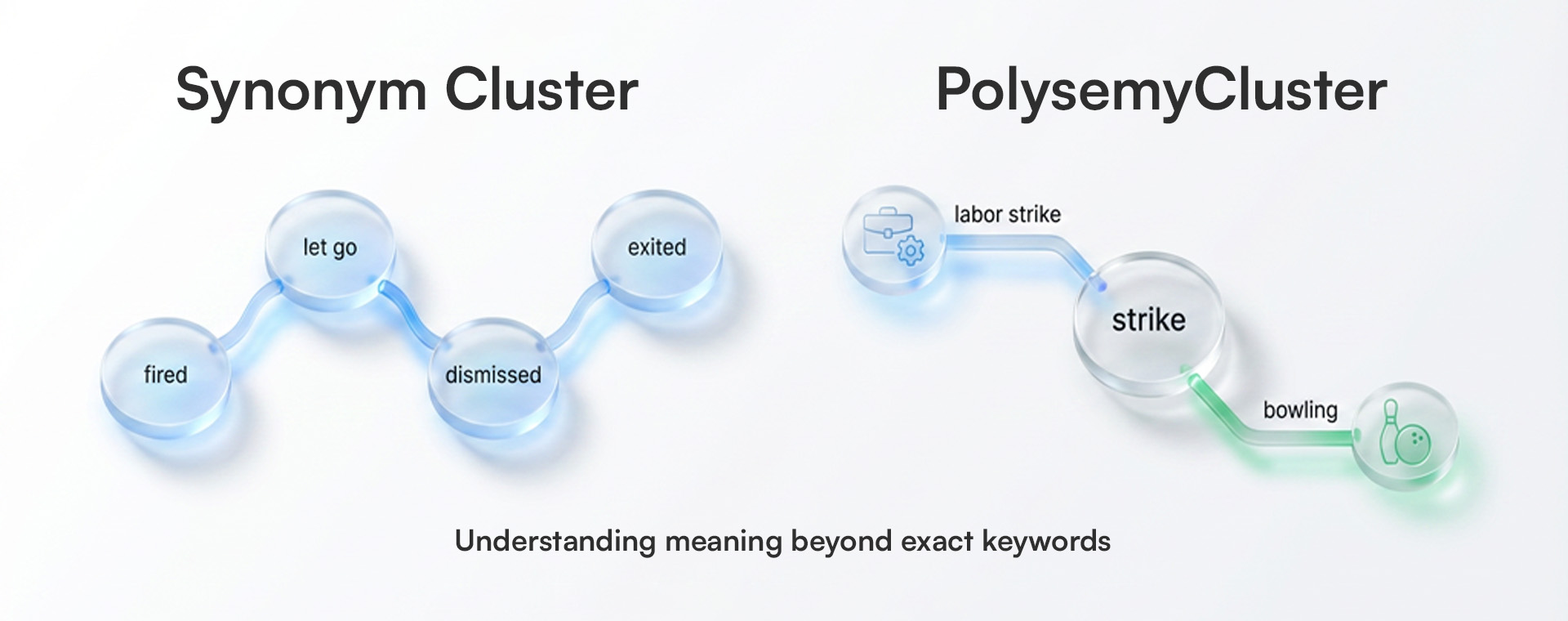
- Synonymy: Multiple words share the same meaning. ‘Fired,’ ‘let go,’ ‘separated,’ ‘transitioned,’ ‘parted ways,’ ‘exited the company,’ ‘released’ — all describe the same event. A keyword search for ‘terminated’ misses every single one of those variations unless you explicitly add each synonym to your query. And you cannot add what you do not know to look for.
- Polysemy: One word carries multiple meanings. Search for ‘strike’ in an employment dispute and you will retrieve both labor strikes and references to bowling. Search for ‘apple’ in a technology contract case and you will pull documents about the fruit alongside documents about the company.
Beyond synonymy and polysemy, eDiscovery keyword search is vulnerable to misspellings, OCR errors from scanned documents, company-internal jargon and abbreviations, the abbreviated language of text messages and instant messages, and the simple reality that people describing the same event rarely use exactly the same words.
The practical result is two distinct failure modes that drive up cost and risk simultaneously:
- False positives (over-inclusion): Documents returned by the search that are not actually relevant. These waste review time and inflate costs.
- False negatives (under-inclusion): Relevant documents that keywords miss entirely. These are the liabilities. A court will not accept ‘our keyword list was incomplete’ as a defense for an inadequate production.
What Is Conceptual Search in eDiscovery?
Conceptual search is an automated information retrieval method that searches electronically stored unstructured text for information that is conceptually similar to the query and not just textually identical to it. Where keyword search asks ‘does this document contain this word?’, conceptual search asks ‘does this document discuss this idea?’
The distinction sounds subtle. The practical difference is enormous.
The Technology Behind It (Without the Math Degree)
Most conceptual search engines in eDiscovery platforms are built on Latent Semantic Indexing (LSI), a statistical technique first developed at Bell Labs in the late 1980s. LSI analyzes patterns of word co-occurrence across a large corpus of documents to build a mathematical model of how words relate to each other in meaning.
The engine does not work word by word. It constructs a multi-dimensional map of the conceptual space across your entire ESI collection, positioning documents that discuss similar topics close to each other in that space, regardless of the specific vocabulary used. A query then searches that conceptual map rather than the raw text.
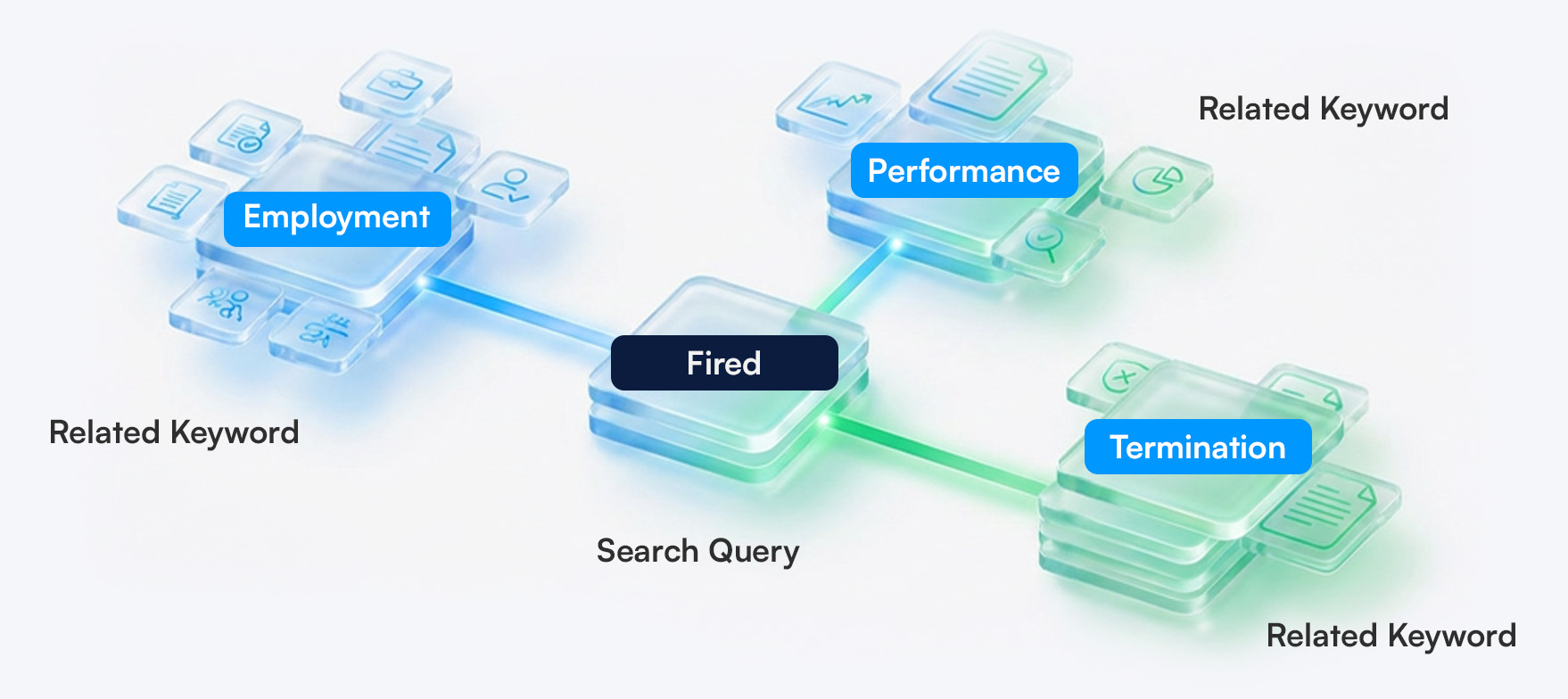
What this means in practice: if your query contains the word ‘fired,’ the system understands that ‘let go,’ ‘terminated,’ ‘separated,’ and ‘dismissed’ occupy the same conceptual neighborhood. It retrieves documents that express the idea, not just documents that use the exact word.
The conceptual search difference illustrated
Keyword search for ‘football’: finds Document A (‘The football game was canceled due to weather’). Misses Document B (‘The quarterback threw three touchdowns in the fourth quarter before the safety scored’). Both documents are clearly about football. A conceptual search finds both, because it recognizes the shared conceptual domain through the relationships between terms like quarterback, touchdown, safety, and fourth quarter, even without the word ‘football’ appearing.
What Conceptual Search Finds That Keywords Miss
The real value of conceptual search in eDiscovery shows up in five specific situations that keyword-based search handles poorly:
- Synonym-rich communications: Informal email language, slang, and euphemisms that describe relevant events without using the expected legal or corporate vocabulary.
- OCR-imperfect documents: Scanned documents that optical character recognition has rendered imperfectly, a ‘misspelled’ word in the index that no keyword would match.
- Jargon and abbreviations: Industry-specific shorthand or internal company codes that counsel outside the company would not know to search for.
- Early case assessment with an unknown custodian universe: When you do not yet know the language this organization uses, conceptual search reveals the vocabulary for you.
- Large matters with aggressive timelines: Concept clustering is an extension of conceptual search that groups the entire ESI collection into thematic buckets, letting review teams focus effort on the most relevant clusters first.
What Does Conceptual Search Actually Look Like in Practice?
See how AI-powered clustering, TAR, and analytics surface relevant documents faster.
Read MoreHead-to-Head: eDiscovery Keyword Search vs. Conceptual Search
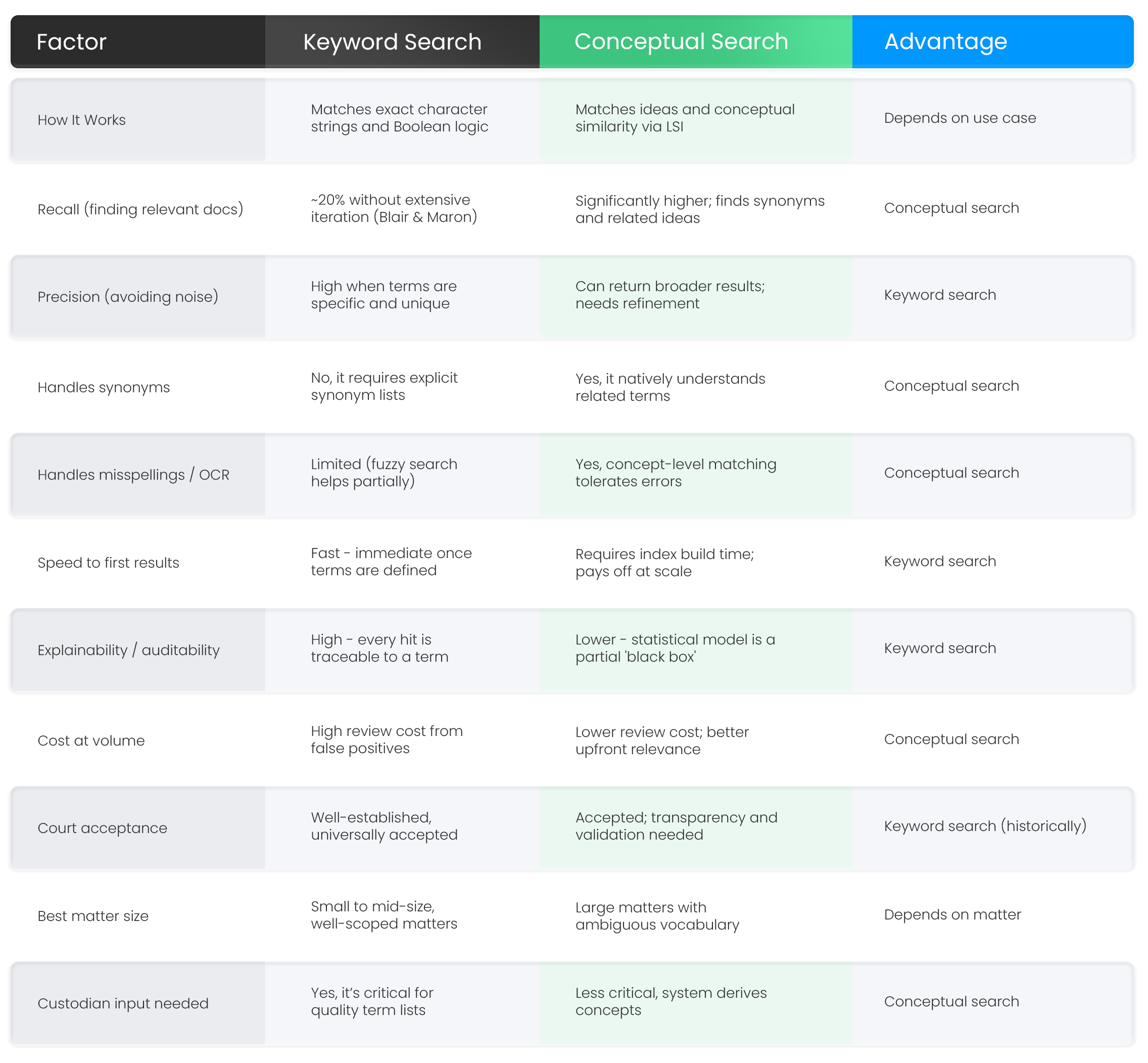
The table below compares both search methodologies across the dimensions that matter most in a real eDiscovery matter.
The 20% Problem: What You Are Leaving on the Table
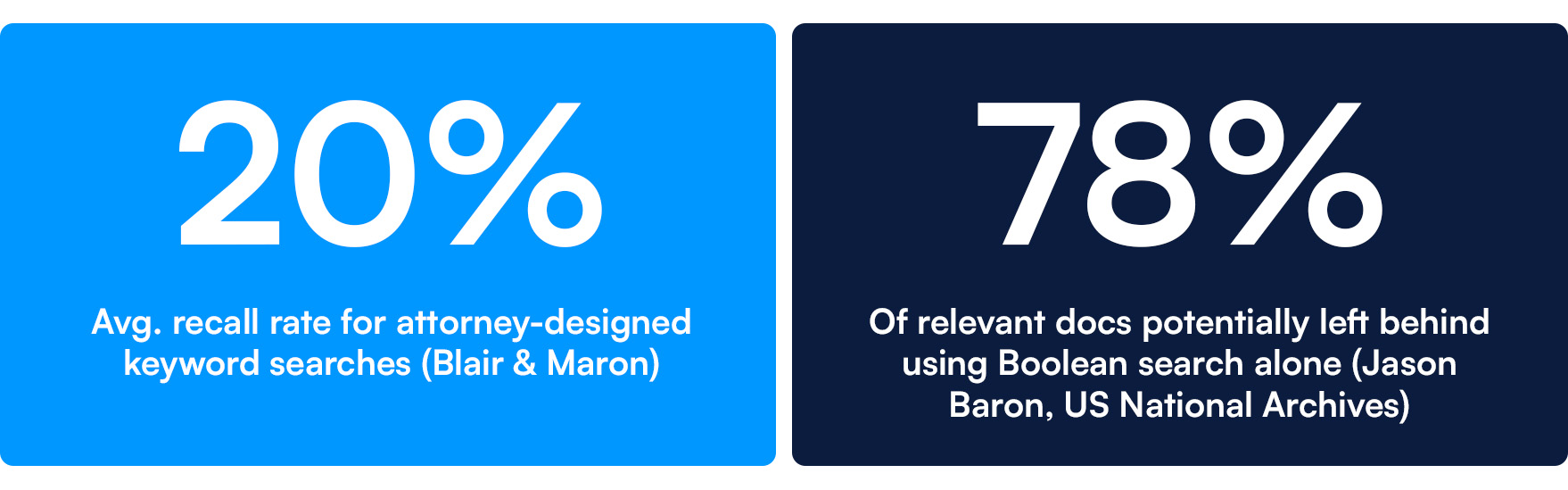
The Blair and Maron study is the most-cited research in eDiscovery, and for good reason. Experienced attorneys who believed they were conducting thorough keyword searches were, on average, only recovering around one in five relevant documents.
The other four were missed, not because the documents did not exist, but because the search terms the attorneys used did not match the vocabulary the documents actually contained.
This finding was reinforced by Jason R. Baron, then-Director of Litigation at the U.S. National Archives, who found that pure Boolean search could leave as much as 78% of relevant material undiscovered.
Judges have noticed. In 2009, Magistrate Judge Andrew J. Peck issued what he himself called a ‘wake-up call’ to the legal community about keyword search quality, writing that in too many cases ‘the way lawyers choose keywords is the equivalent of the child’s game of Go Fish.’ His language was pointed by design: the most sophisticated profession in the country was, in eDiscovery, guessing.
More recently, in a 2023–2024 ruling in the Northern District of Illinois (City of Rockford), Judge Iain Johnston held that a party using keyword search must test its effectiveness by sampling documents that did not contain any of the search terms, what is known as the ‘null set’ or ‘elusion rate’ test. The court established that objective metrics, not attorney assurances, are what makes a search methodology defensible.
What this means for your next matter
If you are relying solely on eDiscovery keyword search without iterative testing, elusion sampling, or supplemental review methodologies, you are almost certainly missing relevant documents. The question is no longer whether this is possible, courts have established that it is. The question is whether your process is defensible enough to withstand scrutiny.
When to Use eDiscovery Keyword Search (It Is Not Dead)
Let the record show: keyword search is not obsolete. For the right use case, it remains the fastest, most transparent, and most easily defensible approach to identifying ESI search terms.
The lawyers who have gotten keyword search wrong have not been using the wrong tool, they have been using the right tool in the wrong situation, without the testing and iteration that makes it defensible.
Keyword search is still the best choice when:
- The relevant terms are unique and specific: Contract numbers, employee IDs, product codes, regulatory citations, and vocabulary that virtually no one else would use in a different context.
- The matter is small and well-scoped: Under 50,000 documents, with a clear custodian universe and a well-understood set of key events.
- Opposing counsel negotiations require transparency: Courts regularly require disclosure of search terms in negotiated ESI protocols. Keywords are easy to list and defend. Statistical models are not.
- The custodians are available and cooperative: When you can interview data custodians to learn the exact jargon, abbreviations, and nicknames used internally, keyword search with custodian input can be highly effective.
- You need fast results for early case assessment: Before a full document review, a quick keyword run gives a near-immediate estimate of data volume and relevant custodians.
Best practice note: Regardless of matter size, keyword search in eDiscovery requires 3–5 iterations to finalize a term list, quality control testing to eliminate false positives, and null-set sampling to measure false negatives. These steps are no longer optional, they are what courts expect.
When Conceptual Search Wins the Argument
Conceptual search earns its seat at the table in the specific scenarios where keyword search structurally fails. These are not edge cases, they describe the majority of complex litigation matters today.
Large data volumes with unknown vocabulary
When your ESI collection exceeds hundreds of thousands of documents and you are stepping into an unfamiliar organization’s communication patterns, conceptual search surfaces the language of the collection before you can even write a keyword list.
Employment and HR matters
The language of interpersonal conflict is uniquely varied. People describe adverse employment actions, hostile environments, and retaliation through idiom, euphemism, and narrative description rather than clinical terminology.
Early case assessment and issue spotting
Concept clustering is an extension of conceptual search, automatically groups your entire ESI collection into thematic buckets without a single query. You can see the conceptual shape of the case before you know what to look for.
Matters with cross-language or cross-cultural ESI
Conceptual search handles vocabulary translation and cultural variation in communication style that keyword lists cannot anticipate.
Supplementing TAR workflows
Technology-Assisted Review (TAR) uses conceptual similarity as a core mechanism. Layering explicit conceptual search alongside TAR creates a more complete, layered discovery net.
Is Your eDiscovery Workflow Actually Defensible?
Run a quick self-check to identify gaps in your legal hold and discovery process.
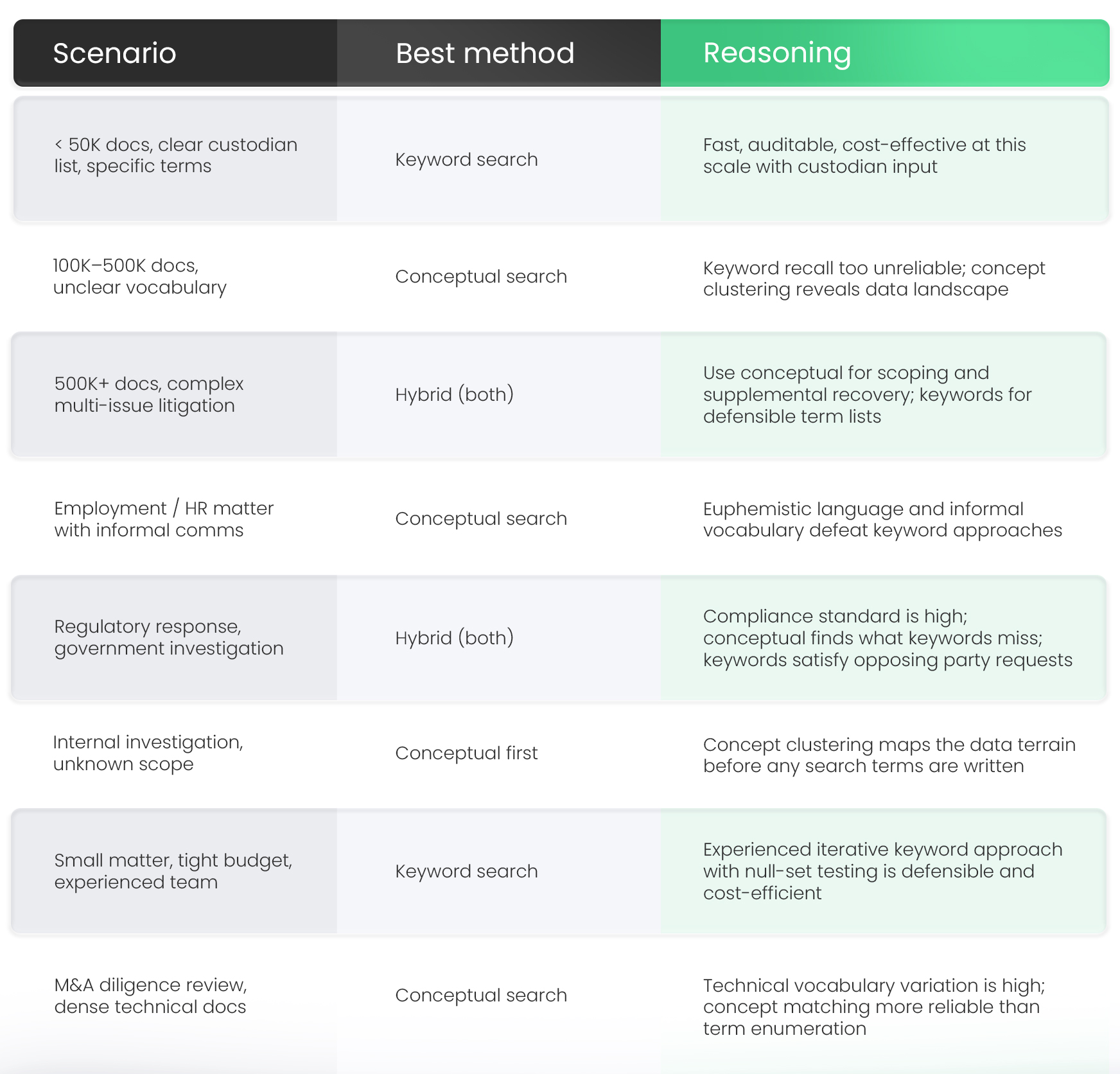
Get the Legal Hold ChecklistDecision Framework: Choosing the Right Search Methodology
Use this framework when planning your eDiscovery search strategy for a new matter. There is no single right answer, the decision depends on the specific characteristics of the case.
Can You Use Both? The Case for a Hybrid Approach
Yes, and in complex matters, you should. The false choice between ‘keyword search or conceptual search’ has been replaced by a more sophisticated question: how do you layer search methodologies to maximize recall while maintaining defensibility and controlling cost?
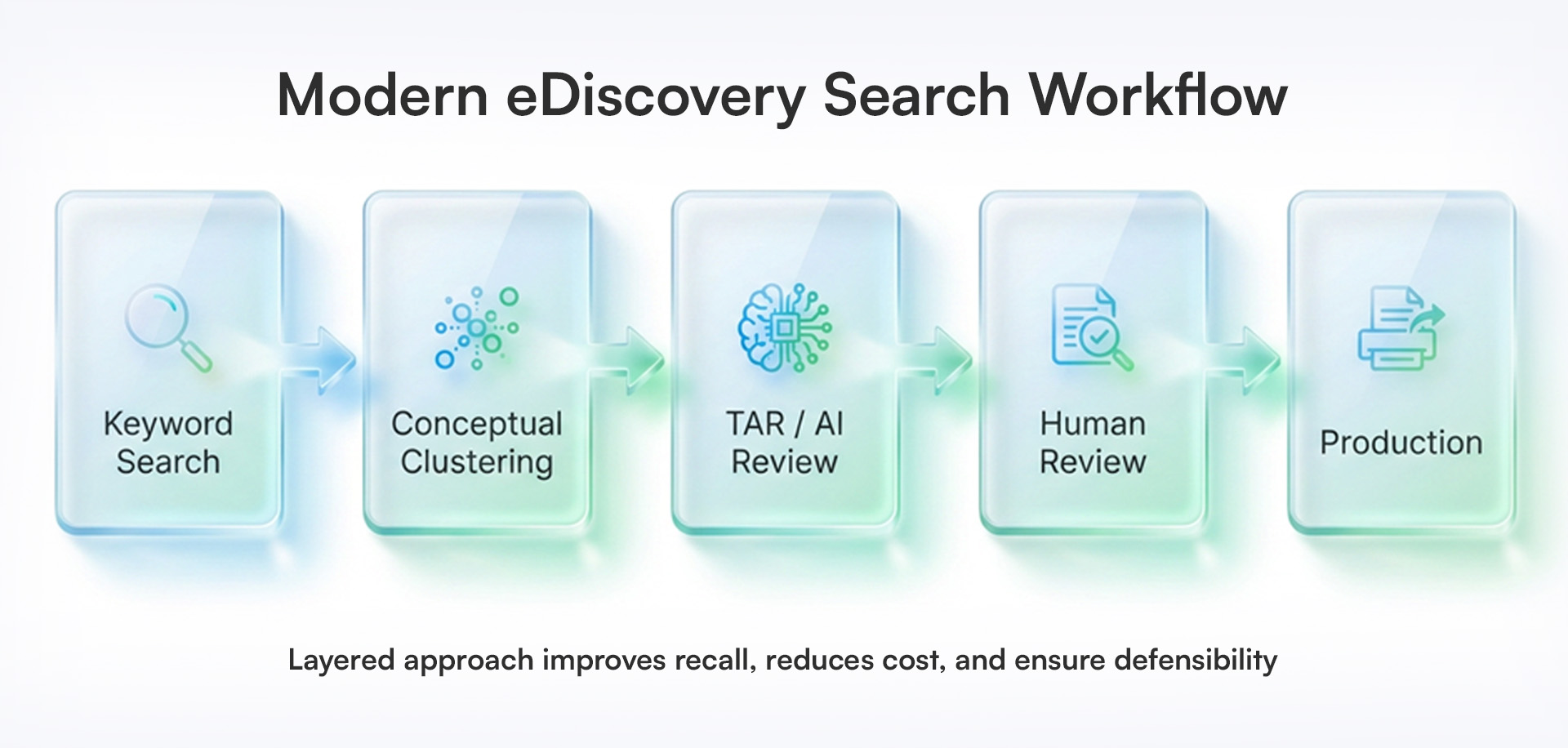
The most defensible eDiscovery search workflows increasingly combine all of the following:
Keyword search for initial culling and privilege identification
Use keyword and Boolean ESI search terms to eliminate obvious non-responsive material, apply date and custodian filters, and run privilege term lists before the main review begins.
Conceptual search or clustering for early case assessment
Run a concept cluster analysis on the post-cull collection to understand its thematic shape. Identify which clusters require priority review and which can be deprioritized.
TAR / predictive coding for the main review
Technology-Assisted Review uses conceptual similarity as one of its core signals. A well-seeded TAR workflow, running on a collection that has already been refined by keyword and conceptual search, achieves the highest recall rates at the lowest per-document cost.
Null-set sampling for validation
After any search methodology, sample the documents that were not returned to measure the elusion rate, the percentage of responsive documents your search failed to find. Courts now expect this metric.
This layered approach is not theoretically ideal, it is what courts have begun to expect. The Nuvasive ruling explicitly stated that electronic discovery has moved well beyond search terms, and that search terms alone may not be suited to all productions. The direction of travel is clear: richer methodologies, validated by objective metrics.
Defensibility: What Courts Say About Both Methods
Defensibility is not a bonus consideration in eDiscovery, it is the entire game. A search methodology that cannot be explained and supported is an invitation for sanctions, adverse inference instructions, or the cost of a complete re-review.
For keyword search:
Courts have consistently upheld keyword search when it is accompanied by: iterative refinement with testing, cooperation and transparency with opposing counsel, and objective validation through sampling. The 2024 Ravin Crossbows ruling (E.D. Ohio) rejected an overbroad keyword list precisely because there was no evidence of custodian cooperation or testing. Courts are not hostile to keywords, they are hostile to undisciplined keyword practice.
A 2024 Q1 ruling in California required disclosure of search terms used by the producing party and confirmed that each party may use different methodologies, as long as they can explain and validate them, including providing end-to-end recall metrics.
For conceptual search:
Conceptual search and its close relatives (TAR, predictive coding) have been court-accepted since the landmark Da Silva Moore v. Publicis Groupe ruling in 2012, where Magistrate Judge Andrew J. Peck approved computer-assisted review as ‘an acceptable way to search for relevant ESI in appropriate cases.’
That acceptance has deepened, the primary ongoing legal debate is not whether AI-assisted search is valid, but how much transparency parties must show about their methodology.
The practical guidance from current case law: document your methodology in detail, validate with sampling, be prepared to disclose metrics, and ensure human oversight at every stage. Conceptual search is defensible. Unexplained and unvalidated conceptual search is not.
Key defensibility principle
The method is less important than the documentation. Whether you use keyword search, conceptual search, TAR, or a hybrid, courts expect you to be able to explain what you did, why you did it, and how you know it worked. Validation metrics, precision, recall, F1 score, elusion rate are no longer the language of statisticians. They are the language of discovery motions.
See How Venio Promotes Two Tools, One Strategy
Keyword search and conceptual search are not competing approaches, they’re complementary tools. The difference between missing critical documents and finding them often comes down to how well these methods are combined, validated, and applied to real-world data.
High-performing legal teams don’t rely on a single technique. They layer keyword precision with conceptual understanding, validate results with measurable metrics, and continuously refine their approach as the case evolves.
Venio Systems combines keyword precision with AI-powered conceptual search in a single, unified platform so you can improve recall, reduce review volume, and maintain full defensibility without stitching together multiple tools.
Run both methods side-by-side, validate results in real time, and see what changes using your own data. Contact us today to get more information.
Want to see the difference for yourself?
Explore how Venio combines keyword precision with AI-powered conceptual search to deliver higher recall at lower review cost. See it in action with your own data.
Schedule a Demo