eDiscovery Data Analytics & Visualization for Trial Preparation
Ready to get started?
built for clarity, control, and scale.
Share
Most litigation teams don’t lose at trial because they lack evidence. They lose because they never fully understood it.
Modern discovery surfaces everything: emails, chats, cloud files, timelines of activity, and yet trial teams still walk into the courtroom struggling to connect the dots. The problem isn’t access. It’s interpretation.
eDiscovery data visualization changes that. This is where eDiscovery data visualization changes the game. Modern analytics platforms don’t just organize documents, they surface patterns, relationships, and timelines that transform raw electronically stored information (ESI) into a coherent case narrative.
The difference between a well-prepared trial team and an overwhelmed one increasingly comes down to which analytics features they know how to use, and when.
This guide breaks down the essential eDiscovery analytics features that matter most for trial preparation: what they do, how they work, and how litigation attorneys use them to build stronger cases before they ever walk into a courtroom.
Why eDiscovery Data Visualization Is Now a Trial Prep Necessity
In a case from a decade ago, discovery might have meant reviewing thousands of pages of printed documents. Today, a single complex commercial litigation matter can generate terabytes of ESI from dozens of data sources: Microsoft Teams, Gmail, Slack, SharePoint, iCloud, and countless other platforms that attorneys never had to contend with before.

The Scale Problem Hiding in Plain Sight
More than 70% of eDiscovery projects now involve cloud-sourced data, and that number continues to climb. That shift has fundamentally changed what it means to “review” documents.
Linear keyword search, i.e., running search terms across a corpus and reviewing every hit, was designed for a world of emails and PDFs. It breaks down at the scale of modern ESI.
The result? Attorneys often reach trial with a discovery record that is technically complete but practically unusable. They know the documents are there. They just can’t see the story the documents tell.
The Gap Between Finding Evidence and Using It
eDiscovery data analysis has traditionally been framed as a cost-and-efficiency problem: how do we review fewer documents faster? But the more important question for trial teams is different: how do we understand what we have well enough to build a winning case narrative?
Visualization closes this gap. When attorneys can see communication patterns, timeline anomalies, and thematic document clusters, they’re not just reviewing evidence, they’re developing the theory of the case.
What Effective eDiscovery Data Analysis Looks Like in a Trial Context
For trial prep purposes, effective litigation data analytics produces four things: patterns (who communicated with whom, and when), timelines (the sequence of events as the documents actually record them), relationships (which custodians were central to key decisions), and anomalies (what changed, stopped, or was conspicuously absent at critical moments). The analytics features below are built to surface exactly these four elements.
Early Case Assessment: Where eDiscovery Data Analytics and Trial Strategy Begin
Early case assessment (ECA) is often described as a cost-control measure. That framing undersells it entirely. When used correctly, ECA analytics are the first place a trial attorney’s case theory takes shape, long before a single document has been coded for relevance.

ECA dashboards give litigation teams an immediate, visual overview of the discovery landscape: how much data exists, which custodians hold the most material, which date ranges are most active, what file types are present, and how data is distributed across sources. This isn’t just useful for budgeting, it’s the first map of the case.
What File Analysis for eDiscovery Actually Surfaces
A robust ECA module breaks down ESI by custodian, date range, communication channel, file type, and data source, all before any document-level review begins.
Venio’s ECA software is purpose-built for exactly this: processing data from file systems, digital communications, endpoints, and cloud sources, including Microsoft 365 and Slack, and delivering instant visual breakdowns.
This file analysis for eDiscovery serves multiple trial prep functions:
- Which individuals generated the most activity around the key events in the case?
- When did the relevant conduct actually occur, and what changed before and after?
- Are there gaps in production suggesting missing data, deleted communications, or custodians not yet identified?
- How large is the corpus, and what review strategy is appropriate?
How ECA Dashboards Shape Trial Narrative Early
For litigation teams, the most powerful use of ECA analytics isn’t the efficiency gain, it’s the narrative shaping. When a custodian shows a dramatic spike in email volume in the two weeks before a key contract dispute, that’s not just a review prioritization signal.
That’s a potential exhibit. When a communications gap appears between two custodians who should have been in constant contact, that’s a cross-examination thread.
Venio’s ECA software is available standalone or as part of the unified Venio eDiscovery platform, the only stand-alone ECA solution that can reduce data volumes by up to 90%. That means fewer documents in review, but more importantly, a much sharper focus on the documents that matter most for trial.
Venio ECA
See the Case Before You Review It
Cut through the data volume. Venio ECA surfaces what matters - before full review begins. The only standalone ECA solution that reduces data volumes by up to 90%.
Explore Venio ECA
Communication Analysis: Reading the Story Between the Lines of eDiscovery Data
If early case assessment is the map, communication analysis is the territory. This is where eDiscovery analytics stops being about document management and starts being about understanding human behavior, which is ultimately what every trial is about.

Email Thread Visualization and Custodian Communication Mapping
Traditional document review treats every email as an independent object. Thread visualization treats it as what it actually is: a conversation. By reconstructing email threads chronologically with full context, all participants, and every attachment, attorneys can read communications the way they were meant to be read, rather than as disconnected fragments.
This matters enormously for trial prep. Cross-examination sequences often hinge on the precise order in which information was shared and decisions were made.
Venio surfaces email thread views as a core platform capability, also extending this to Microsoft Teams, Slack, and social media communications, the modern channels where the most revealing conversations increasingly happen.
Social Network Analysis: Who Was Central, Who Was Peripheral, Who Went Silent

Social network analysis (SNA) in eDiscovery builds on custodian communication mapping to identify structural patterns across the entire data corpus. Venio’s platform generates social network diagrams that answer the questions trial attorneys need answered: who were the key nodes in the decision-making network? Who was copied but never responded? Who communicated with everyone in the organization, except the CEO, at the moment the critical decision was made?
These aren’t just questions about review prioritization. They’re cross-examination questions. An attorney who knows that a key witness was suddenly excluded from communications in the two weeks leading up to an alleged fraud event has a powerful impeachment tool, and social network analysis within Venio is what surfaces it.
Concept Clustering and AI-Powered Document Review Analytics
Modern eDiscovery platforms use machine learning to group documents by conceptual similarity, a capability that fundamentally changes how attorneys navigate large document sets. Rather than searching for specific keywords and hoping they catch every relevant document, concept clustering allows review teams to explore the entire corpus thematically.

Thematic Clustering: Seeing the Corpus as a Whole
Venio’s AI-powered concept clustering automatically groups documents by theme or topic across the entire corpus, giving attorneys an immediate sense of what subjects dominate the record, which concepts cluster together (suggesting related issues), and which small thematic groups may contain highly specific and highly significant documents that keyword search would never have surfaced.
For trial prep, this is transformative. An attorney preparing for a patent dispute can immediately identify every document cluster that touches on the specific technical claim at issue, rather than relying on keyword combinations to catch every relevant document. A cluster that the keyword search missed may contain the most probative evidence in the case.
AI-Powered eDiscovery Analytics: TAR and Continuous Active Learning
Technology-assisted review (TAR) and Continuous Active Learning (CAL) are among the most well-established AI-powered eDiscovery analytics applications, and both are built into Venio’s platform.
By training a model on a seed set of documents coded by an experienced attorney, TAR can rank the entire corpus by relevance, dramatically accelerating review and ensuring that the most relevant documents rise to the top of the queue.
The trial prep application of TAR extends beyond cost efficiency. A well-run TAR or CAL workflow doesn’t just find relevant documents, it identifies the strongest, most central documents in the corpus.
These are precisely the documents an attorney needs to anchor their trial narrative: the internal memo that contradicts a witness’s testimony, the contract clause that was deliberately removed in a later version, the communication that proves knowledge of a defect.
Near-Duplicate Detection: Why Document Variants Matter at Trial
Near-duplicate detection identifies documents that are substantially similar but not identical, like different versions of the same memo, slightly edited contracts, and forwarded emails with added commentary.
Venio’s platform includes near-duplicate detection as a core feature, reducing redundant review time while doing something more strategically important: revealing the evolution of documents.
When a key contract went through multiple draft revisions and the disputed clause only appeared in version nine before disappearing in version ten, near-duplicate detection makes that visible. When an internal memo was forwarded with an annotation stripped from the final version, near-duplicates capture it.
These document families are powerful cross-examination tools precisely because they show what changed and what someone may have wanted to obscure.
Venio Review
Let AI Surface What Matters Most
TAR, CAL, and concept clustering - built into one platform. Stop chasing keywords. Let Venio's AI show you what the corpus actually contains.
See AI Review in Action
Timeline Visualization: Building the Chronology That Wins Cases
If there is a single eDiscovery analytics feature that is most underused in trial prep and most consequential at trial, it is timeline visualization. Every case has a chronology. The attorney who controls that chronology controls the narrative.
Integrated Case Timelines for Litigation and Evidence Review
Venio’s platform includes integrated case timelines as a native feature for attorneys, allowing trial teams to visualize conversations, patterns, and events across time and quickly build case narratives while identifying gaps.
Rather than reconstructing a chronology manually from documents spread across review folders, Venio maps the discovery record chronologically, filterable by custodian, communication channel, issue, or keyword.
The trial prep applications are extensive. Opening statements are more persuasive when anchored to a clear, document-driven chronology. Deposition preparation becomes more surgical when an attorney can visualize exactly what a witness knew and when they knew it. Cross-examination becomes more effective when the attorney can map a witness’s testimony against the document record in real time.
Using eDiscovery Timeline Analytics to Identify Critical Event Windows
Beyond the overall chronology, timeline analytics can zoom in on critical event windows: the 48 hours before a key decision, the two-week period following a triggering event, the gap between when information was received and when it was acted upon.
These windows are where intent, knowledge, and notice are established, and Venio’s timeline visualization makes them visible from within the same platform attorneys use for review, without exporting data to a separate tool.
For cases involving questions of when a party first learned of a defect, a fraud, or a breach, this capability can be the difference between proving and merely alleging a fact.
From eDiscovery Timeline to Case Narrative: Bridging the Gap
Venio’s integrated workflow, from legal hold through ECA, review, and production, means that the chronological intelligence built during document review doesn’t live in a silo. It informs the broader litigation strategy.
Trial teams evaluating eDiscovery platforms should specifically look for this workflow integration: the ability to build a case timeline during review and carry it forward into trial preparation, rather than rebuilding the chronology from scratch at a later stage.
eDiscovery Analytics Dashboards: The Nerve Center of Trial-Ready Case Management
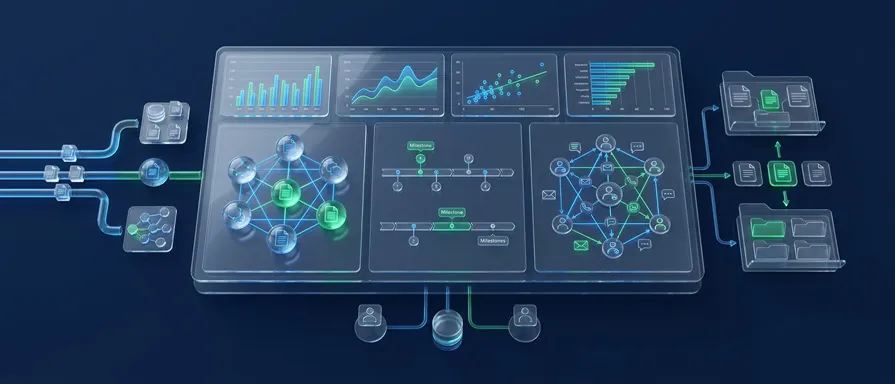
All of the analytics features described above: ECA, communication analysis, concept clustering, TAR/CAL, and timeline visualization generate data. A well-designed eDiscovery analytics dashboard is where that data becomes actionable. For trial teams, the dashboard is the command center.
What a Trial Prep Dashboard Should Show
Venio’s configurable real-time dashboards are built to give legal teams immediate visibility across the entire case. For trial preparation, the most valuable dashboard elements include:
- Review progress and completion rates by issue and custodian
- Hot document identification, which key documents are flagged, reviewed, and cleared for use
- Outstanding privilege and redaction issues and log completion status
- Custodian activity profiles organized by witness or deposition schedule
- Timeline status – are all key events in the chronology document supported?
Venio’s dashboards are available across both its cloud and on-premises deployments, ensuring that whether a firm manages its eDiscovery internally or through outside counsel, the trial team maintains consistent visibility into case status without switching platforms.
Identifying Activity Patterns with Data Trend Analytics
Venio’s ECA module includes communication maps and data trend visualizations, surfaced through intuitive bar charts, pie charts, and tables, all accessible from the dashboard without additional configuration.
For trial prep, a clear spike in communications among three custodians in the 30 days surrounding a key corporate decision isn’t just a data point, it’s a starting point for witness examination.
These data trends can be filtered by custodian, keyword, and time period simultaneously, enabling precise identification of activity clusters that are both temporally and contextually significant.
With features like saved dashboard layouts and bulk tag/untag capabilities, teams can quickly organize and revisit key insights, supporting a more structured, focused approach to cross-examination.
GenAI and the Next Generation of eDiscovery Data Visualization
Generative AI has been described as the single most significant development in eDiscovery history, and that assessment is becoming harder to dispute with each passing year.
In 2025 and 2026, large language models (LLMs) are extending analytics capabilities in ways that go well beyond predictive coding and concept clustering.
How AI-Powered eDiscovery Analytics Are Evolving for Trial Prep
Venio has been building its GenAI integration into the EDRM workflow, with published guidance on where and how to apply GenAI across the eDiscovery lifecycle. The most significant near-term applications for trial prep include:
- Attorneys can ask plain-English questions of a corpus and receive document-level responses, without constructing boolean search strings.
- Documents are prioritized and grouped by the model’s understanding of case issues, not just keyword hits.
- Venio’s AI flags sensitive content for attorney review, dramatically reducing one of the most time-consuming pre-trial tasks.
These capabilities don’t replace attorney judgment, they extend it. The output that used to require days of manual review can now be generated in hours, leaving trial teams more time for the strategic analysis that only human judgment can provide.
The Admissibility Caution: What GenAI Analytics Cannot Do
For all their power, AI-generated eDiscovery outputs carry a critical warning for trial teams. In Kohls v. Ellison (D. Minn. 2025), an expert witness was excluded from trial after AI-generated citations in their report were found to be hallucinated, a landmark reminder that AI outputs require rigorous attorney validation before they can be used in any trial context.
The rule for AI-powered eDiscovery analytics in trial prep is clear: use AI to find and surface, use attorneys to verify and decide. Venio is designed with this principle built in, its platform maintains human control for all final decisions, with full audit trails that document every action taken during the review process.
Any visualization, chronology, or summary generated by an AI tool must be reviewed by counsel before it is relied upon for case strategy.
How to Choose eDiscovery Analytics Features for Trial Prep
Not every eDiscovery platform offers the same analytics depth, and not every case demands the same feature set. When evaluating e-discovery services with advanced data analytics capabilities for trial preparation, litigation teams should assess platforms against these criteria:
- Can it break down ESI by custodian, date range, source, and file type simultaneously?
- Does it cover email threads, social network visualization, custodian mapping, and modern channels like Teams and Slack?
- Does it support TAR, CAL, and GenAI querying? What is the vendor’s AI validation track record?
- Is the timeline integrated into the review workflow and filterable by custodian, issue, and channel?
- Can it be customized for trial prep workflows, or is it a generic review progress tracker?
- Does the platform support both cloud and on-premises deployment for firms with strict data residency requirements?

Venio’s ediscovery platform is built to answer yes to each of these questions by combining ECA, AI-powered review, communication analysis, timeline visualization, and configurable dashboards in a single unified system that works from legal hold all the way through production.
Available in cloud, on-premises, and on-demand configurations, it’s built for the full range of litigation practice environments.
Still Comparing eDiscovery Platforms?
Not all platforms are built for trial. See how the top 10 eDiscovery vendors stack up on the analytics features that matter most for litigation.
Your Trial Narrative Doesn’t Start in Court. It Starts in Venio.
The trial preparation advantage that eDiscovery analytics delivers isn’t abstract. It’s the difference between an attorney who knows a witness’s document record and one who hopes their keywords caught everything.
It’s the difference between a chronology built from memory and one built from every communication the discovery record contains. It’s the difference between seeing a communication anomaly during review and discovering it for the first time during cross-examination.
The right eDiscovery analytics platform should do more than organize documents. It should help you see the case the way the evidence actually tells it – patterns, relationships, timelines, and all, then help you translate that picture into a trial narrative that a judge and jury can follow.
Venio’s unified eDiscovery platform brings together every one of these capabilities, from legal hold and ECA to AI-powered review, communication analysis, timeline visualization, and configurable dashboards in a single unified system designed for the demands of complex litigation.
Want experts to handle your data? Then contact us today!
Want experts to handle your data?
See exactly how Venio operationalizes AI across every stage of eDiscovery. No fluff, no generic pitch just a demo built around your workflow.
Related Articles
Consolidating Your eDiscovery Stack Without Disrupting Active Matters
How to consolidate eDiscovery tools without disrupting live matters, and why a f
Read Article
What to Ask in an eDiscovery Demo Before You Sign
Twenty questions that make an eDiscovery vendor prove processing, AI, security a
Read Article
Internal Investigations: Getting the Facts Without Blowing the Matter Open
An internal investigation offers no court schedule and no second chance at prese
Read Article