eDiscovery for Small Law Firms: The Risk of Doing It Alone

Share
The majority of American law is practiced in small rooms. Nearly half of all private-practice lawyers in the U.S. are solo practitioners, and firms with fewer than six attorneys make up over 75% of all law firms in the country.
They handle real litigation. They face the same electronic evidence obligations as their counterparts at 500-lawyer firms. And yet, the technology gap between the two groups has never been wider.
According to the ABA’s 2024 Legal Technology Survey Report, only 27% of solo attorneys use litigation support software, compared to 73% at large firms. Only 11% use predictive coding. Just 29% use AI-assisted search. The tools exist. The pricing has dropped dramatically. The ethical obligations have quietly expanded. So why are small firms still going it alone?
This post makes the case for why eDiscovery software for small law firms is no longer optional and what to look for when you’re ready to choose one.
The Myth That “eDiscovery Is Only for Big Cases.”
Most solo attorneys carry a version of the same mental model: eDiscovery is for bet-the-company litigation, massive document productions, and firms with dedicated litigation support staff. For a two-attorney firm handling a commercial dispute, an employment matter, or a family business case, it just doesn’t apply.

This assumption is both understandable and increasingly dangerous.
Under the Federal Rules of Civil Procedure, the duty to preserve electronically stored information (ESI) is triggered the moment litigation is reasonably anticipated and not when the case is filed, nor when a court orders it. For small firms whose clients use Gmail, store contracts on Google Drive, or communicate over WhatsApp, that trigger arrives early and quietly.
The consequences of missing it are real. In Safelite Group v. Jape (S.D. Ohio, 2024), the defendant was sanctioned after failing to disable auto-delete on a key custodian’s phone. The court imposed an adverse inference instruction, a case-altering outcome that had nothing to do with the underlying merits. And the volume threshold that triggered those obligations? Not 100,000 documents. Just 500 emails and a shared Dropbox folder.
Your Ethical Obligation: ABA Rule 1.1 and Technology Competence
Here’s what most small-firm CLE courses underemphasize: failing to manage eDiscovery competently may not just cost your client the case, it may even expose you to a disciplinary complaint.
Comment 8 to ABA Model Rule 1.1 (Competence), amended in 2012, requires attorneys to keep pace with “the benefits and risks associated with relevant technology.” As of 2025, 40 states have adopted some version of this technology competence standard.
In an eDiscovery legal software context, that means:
- Knowing what ESI exists and where it lives in your client’s environment
- Implementing a legal hold that actually prevents auto-deletion
- Discussing ESI scope meaningfully at a Rule 26(f) conference
- Understanding proportionality arguments requires knowing what review actually costs
- Conducting document review in a defensible, documented way
None of these requires you to be a technologist. They do require that you have a system. And today, that system is purpose-built legal software for small firms.
Is Your Legal Hold Process Actually Defensible?
5 Reasons Small Firms Need eDiscovery Software in 2025
1. Time: AI Review Cuts Document Review Hours by Up to 80%
Document review is the silent killer of small-firm profitability. A mid-size commercial case can produce 20,000 to 50,000 documents. At a conservative pace of 50 documents per hour, that is 400 to 1,000 attorney hours, with no paralegal support to absorb the load.
Technology-Assisted Review (TAR), specifically Continuous Active Learning (CAL) changes that math entirely. CAL-powered eDiscovery software can reduce the reviewable document population by 70–80% before a single attorney opens a file. For a solo practitioner, that difference is not incremental. It’s existential.
2. Cost: The Real Bill Is in What You’re Not Measuring
The sticker price of eDiscovery software is visible. The cost of not having it isn’t until it’s too late. Manual review eats paralegal hours, associate time, and creates exposure every time opposing counsel serves a 50,000-document production with a 30-day clock.
Venio Systems customers report eDiscovery cost reductions of up to 70% compared to traditional review workflows. When you factor in risk-adjusted cost, including sanctions exposure or an undefended motion to compel, the ROI of the best eDiscovery software for small law firms is compelling even for firms billing 20 cases a year.
3. Modern Data Sources: Your Clients Live in the Cloud

The 2015 version of eDiscovery meant collecting Outlook PSTs. The 2025 version means Slack channels, Microsoft Teams conversations, WhatsApp threads, Google Workspace shared drives, hyperlinked OneDrive attachments, and mobile device data.
Courts have consistently held that all of these are discoverable ESI. Collecting them manually is a logistical nightmare, and missing them is a sanctions risk. Purpose-built eDiscovery software for small law firms includes native connectors for these sources, ingesting them with metadata intact and making them instantly searchable. Without a tool, you’re hoping nothing important lives in a Teams thread.
4. Defensibility: Audit Trails That Protect You and Your Client
In a contested production, the question isn’t just what you produced, it’s how you decided what to produce. A reproducible, documented review workflow with timestamped decisions, custodian chain-of-custody logs, and a clean privilege log is what stands between your client and a successful sanctions motion.
Manual review using spreadsheets and shared folders creates none of that. Legal hold software for small law firms like Venio creates all of it automatically, as a byproduct of normal use.
5. Competitive Parity: Opposing Counsel Already Has Enterprise Tools
When a solo plaintiff’s attorney faces a corporate defendant backed by a large firm’s litigation support team, that team is already using automated tools to flag gaps in the opposing production, identify inconsistencies in document families, and build a data-driven case strategy. Reviewing documents in a shared folder is operating with a fundamental information disadvantage.
Modern cloud-based eDiscovery for small law firms gives solos and small firms access to the same analytical capabilities at a fraction of enterprise cost. The playing field isn’t level yet, but it’s closer than it has ever been.
How AI-Powered Review Actually Works (No IT Team Required)

When attorneys hear “AI” and “machine learning” in a document review context, the reflex is: that’s for firms with data scientists. It’s not. Here is how Continuous Active Learning (CAL) actually works in practice:
You code a small batch of documents, typically 50 to 200, as relevant or not relevant. The system immediately identifies the linguistic patterns that distinguish your responsive documents from the rest. It then ranks every remaining document by predicted relevance, prioritizing the most likely candidates at the top of your queue.
As you review and confirm or correct predictions, the model continuously refines. Eventually, it identifies a statistically defensible stopping point, the moment at which additional review is unlikely to surface new responsive material.
The result: instead of reviewing 40,000 documents, you might review 4,000 to 6,000 with a documented, court-defensible rationale for why that was sufficient.
Venio’s platform includes CAL as a core feature, accessible directly from the review interface. No configuration. No training data setup. No technical expertise required. You code documents; the system learns.
What Does eDiscovery Software Actually Cost vs. Doing It Manually?
One of the most persistent myths about eDiscovery software is that it is priced for large firms. This was true in 2010. It has not been true for several years. Here is an honest comparison:

Cloud-based eDiscovery platforms, such as Venio Systems, are increasingly offered on a pay-per-GB or flexible subscription model. For a firm handling 10 to 20 litigation matters per year, the annual cost of a purpose-built eDiscovery tool is often less than the hourly cost of a single sanctions motion response.
What to Look for in eDiscovery Software for Small Law Firms
Not all platforms are built for small firms. Some are enterprise tools with a small-firm pricing layer bolted on. The checklist that actually matters:
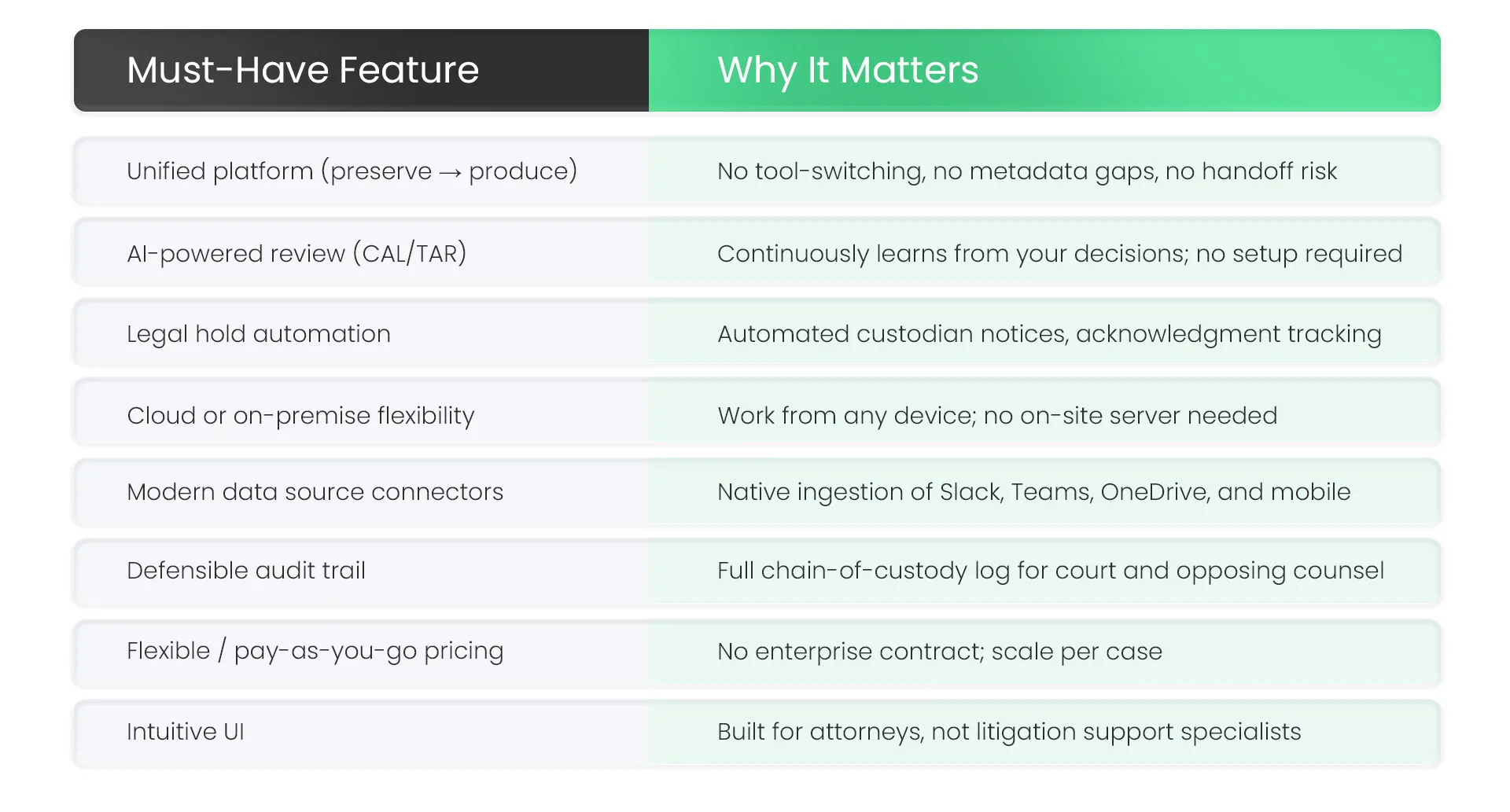
One differentiator worth highlighting: unified platform architecture. Many small-firm workflows piece together separate tools for legal holds, processing, review, and production. Each handoff creates data loss risk, metadata integrity problems, and audit trail gaps.
Venio Systems is built as a single integrated platform covering the complete EDRM lifecycle, eliminating those handoffs entirely. For a solo attorney with no litigation support staff, that’s not a nice-to-have. It’s essential.
Related Articles

Top Six eDiscovery Market Trends in 2026
By 2029, the eDiscovery market will surge past $25 billion, a staggering leap fr
Read Article
How to Choose the Right eDiscovery Software for Your Legal Team
If you’ve ever felt overwhelmed by the sheer amount of digital evidence in a cas
Read Article
What is eDiscovery Software?
In a world where business communication is overwhelmingly digital, these trails
Read Article