How to Run a Custodian Interview
Ready to get started?
built for clarity, control, and scale.
Share
In 2012, an electronic cigarette company sued a competitor over a trademark. The dispute itself was ordinary. What followed was not.
Defense counsel accepted the client's word that everything relevant sat on four hard drives. Nobody interviewed the custodians to test that answer. Nobody asked about the web-based email accounts or the chat application the client used every day, and auto-delete kept running the entire time.
Nine years later, Judge Iain Johnston issued a 256-page sanctions opinion in DR Distributors, LLC v. 21 Century Smoking, Inc. He found that counsel had failed to make the reasonable inquiry Rule 26(g) requires, and he stated the standard in a single line: with regard to ESI, “reasonable inquiry necessitates a proper custodian interview.” The court awarded fees and costs against both the client and its former counsel.
eDiscovery has never had more technology behind it. AI ranks documents by relevance, analytics map who talked to whom, and collection tools reach nearly every platform an employee touches. Yet the step that prevents the most preservation failures is still a conversation between two people.
A custodian interview sits at the point where every downstream cost is still controllable. Run it well, and the hold scope, the collection plan, and the review budget all get sharper. Run it poorly, and no amount of technology can recover the sources nobody identified.
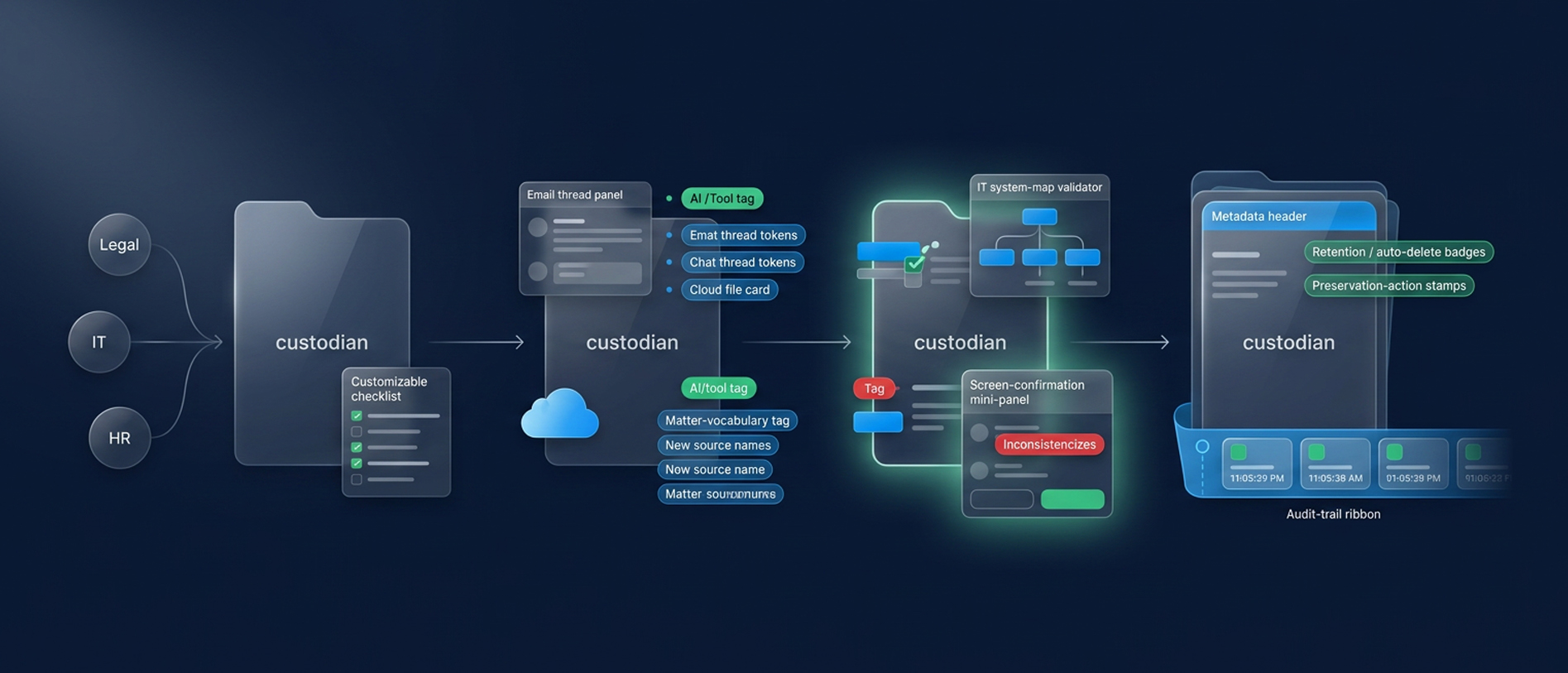
This guide covers the full custodial interview lifecycle in four parts, moving through preparation, the custodian interview questions that actually surface evidence, verification, and documentation. Together, those four parts turn the interview into the most defensible step in your legal hold process.
What is a Custodian Interview?
A custodian interview is a structured conversation with a person who holds potentially relevant data, conducted to identify where that data lives, how long it survives, and who else may hold more of it. It converts a preservation duty into an accurate map of the sources that duty actually covers.
No rule names the custodian interview explicitly. The obligation arrives instead through Rule 26(g), which certifies that counsel made a reasonable inquiry before responding to discovery, and through Rule 37(e), which governs what happens when ESI that should have been preserved is lost. DR Distributors connected those two rules to the interview directly, and courts have followed that reasoning since.
The distinction that matters in practice is between a legal hold custodian and an ESI custodian. A legal hold custodian is any person formally instructed to preserve information for a matter. An ESI custodian is anyone who creates, receives, or controls relevant electronically stored information, whether or not they have been notified yet. The interview is how the second group becomes the first, and how custodial legal holds stop being a list of names and start being a defensible scope.
1. Prepare for the Interview
Preparation decides most of the interview's outcome before anyone joins the call. These steps matter more than the rest.
Know Which Type of Custodian You Are Interviewing
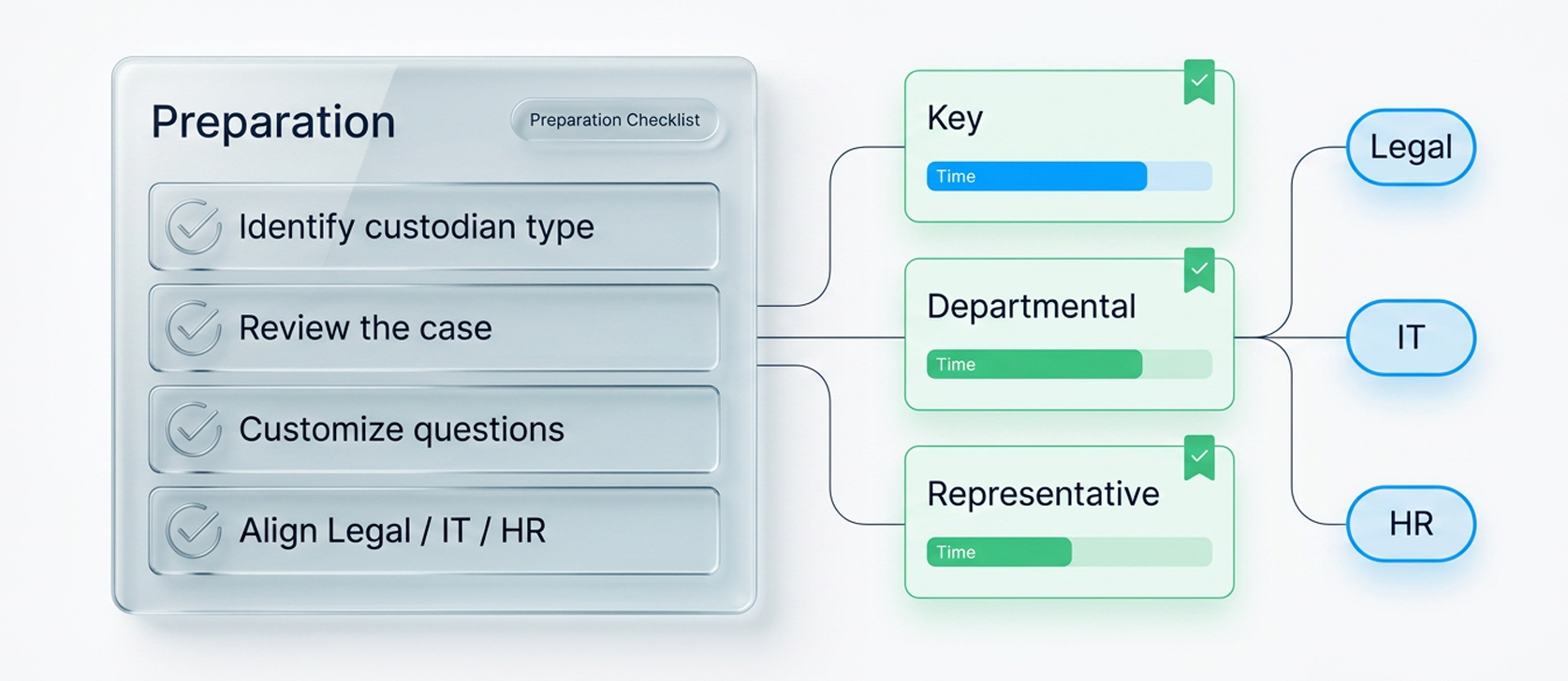
An ESI custodian is anyone who creates, receives, or controls electronically stored information relevant to a matter. That single definition hides three very different interview subjects, and each one deserves a different share of your time.
- Key custodians. They sit closest to the dispute and often become witnesses, so their interviews run longest and deepest.
- Departmental custodians. They control shared systems such as HR records, finance ledgers, or CRM data for entire teams.
- Representative custodians. They stand in for larger groups when interviewing every member would cost more than it returns.
Classify each person before scheduling anything. The classification decides how much interview time each one deserves, and it gives you a proportionality argument you can defend later if the scope is ever challenged.
Build the Plan Around the Case, Not a Static Template
A template gives you a floor to stand on, but it should never become the interview itself. Generic questions produce generic answers, and generic answers miss the sources that decide cases.
Before each session, review the custodian's role, the core facts in dispute, and the platforms their team uses. Then adapt your question set so every line connects to something this specific matter actually needs. The template is a safety net, not a script.
Align Legal, IT, and HR Before the First Conversation
Each function brings something the interview cannot succeed without. IT supplies the system map, retention schedules, and backup rotations you will later test answers against. HR flags the departures, leaves, and role changes that quietly reshape who holds relevant data. Legal frames the scope and identifies where privilege concerns might complicate specific custodial questions.
When those three functions align early, the interview tests reality instead of guessing at it. When they do not, you learn about the departed employee's mailbox after it has already been purged.
2. Ask the Right Questions
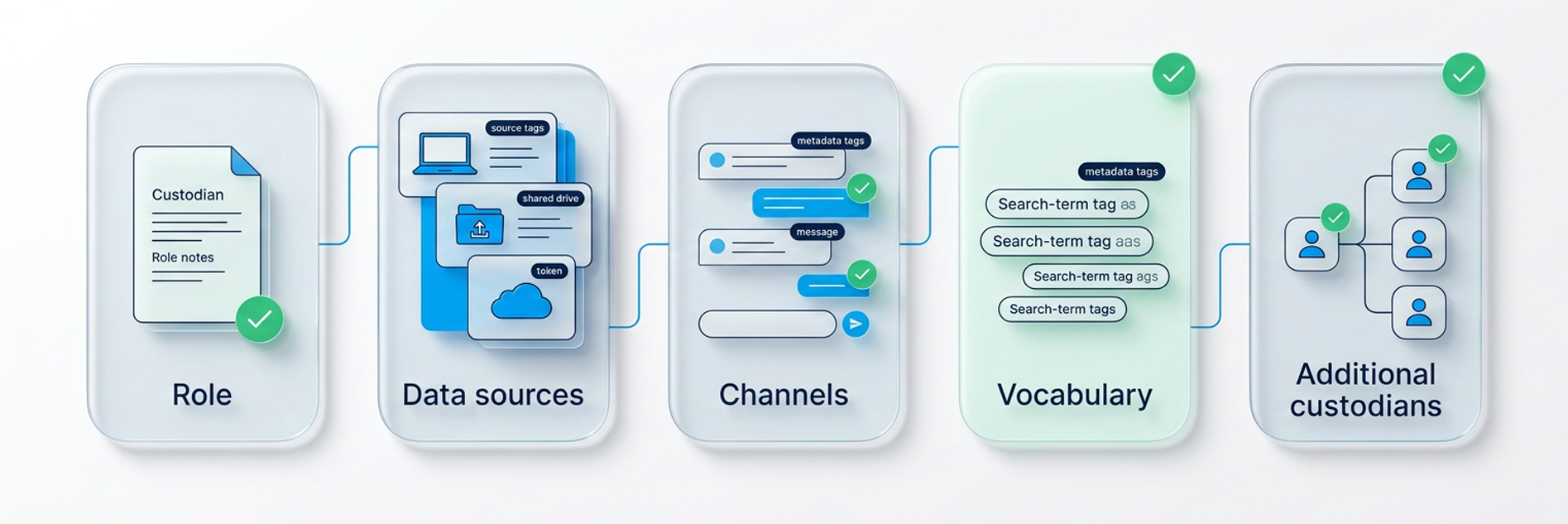
A strong custodial interview follows an arc, moving from the person to the platforms to the people around them. The custodian interview questions below follow that arc, with samples you can adapt to any matter.
Start With Role and Data Footprint
Open with the custodian's day-to-day world before you touch a single piece of technology. Ask what they work on, who they work with, and what they create or receive along the way. Then map where all of it lands, from laptops and phones to shared drives and archives.
Simple openers such as walking through a typical week reveal more sources than any checklist. The footprint you build here becomes the baseline for every ESI custodian answer you verify later.
Walk Through Every Channel, Not Just Email
Email now holds a shrinking share of the evidence that decides modern disputes. This stage should move channel by channel, without assuming any platform sits outside the matter. Collaboration tools deserve particular attention, because native preservation in those systems leaves gaps that a custodian can often describe better than an admin console can. Our guide to legal holds for Slack and Teams covers where those gaps typically open. Sample questions worth adapting:
- Which chat platforms do you use for work, and do relevant conversations sit in private channels or direct messages?
- Do you ever use text messages, WhatsApp, or a personal device or email account for work?
- Where do your files live, including OneDrive, Google Drive, or any personal cloud folders?
- Have you used AI tools such as Copilot or ChatGPT for anything connected to this matter?
- Do any of these tools delete messages automatically, and do you know the retention setting?
That final open question matters most. It surfaces the unsanctioned apps that formal custodial questions never quite reach, and it is the closest thing an interview has to a catch-all.
Capture the Vocabulary of the Matter
Every project develops a private language of code names, acronyms, and nicknames for people and initiatives. Ask for that vocabulary explicitly, along with file naming habits and the dates that frame the dispute. The answers convert directly into search terms, date filters, and review strategies. A ten-minute vocabulary discussion routinely pays for itself many times over during early case assessment.
Always End by Widening the Net
The last custodian interview questions should point outward, toward people and systems you have not found yet. Ask who else worked on the issue and which shared repositories the wider team relied on.
More new custodians and data sources surface through this closing question than through any other, so log every name mentioned before the session ends. Each one becomes a decision you make deliberately, rather than a gap opposing counsel finds for you.
3. Verify What You Are Told
Courts expect counsel to make a reasonable inquiry, and taking answers at face value does not qualify. That was the precise failure in DR Distributors, where counsel accepted a client's account of where the data lived and never tested it. A custodial interview earns its defensibility in the verification step, not in the questions alone.
Cross-Check Answers Against the IT System Map
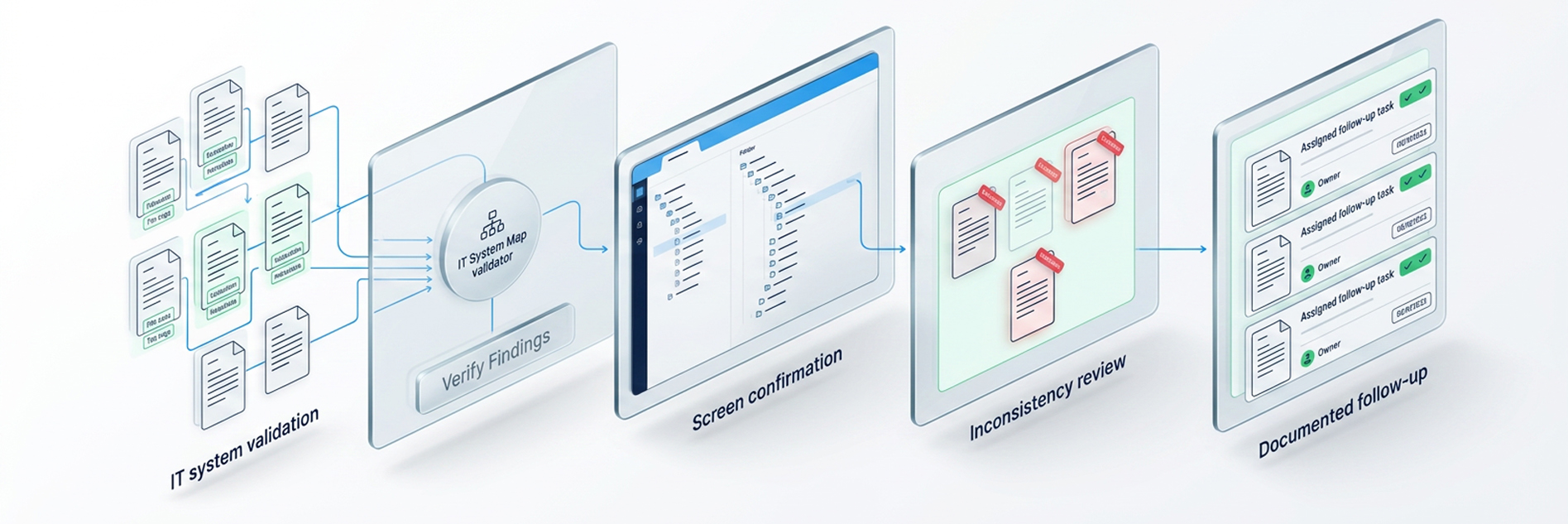
Policy and practice drift apart in every organization, and the gap between them is where evidence disappears. IT may report that all email lives on the server, while the custodian keeps local archives anyway. Investigate every mismatch before moving forward, and write down how each one resolved.
Ask to See, Not Just Hear
Have the custodian share a screen and open the folders they just described. Watching them navigate confirms the source exists, reveals ones they forgot, and shortens the gap between identification and preservation. A chat thread confirmed on screen today cannot quietly expire before collection begins.
Treat Inconsistencies as Leads, Not Noise
A central player with a suspiciously light mailbox deserves a second and more pointed conversation. So does a casual mention of deleting old files, or an answer that contradicts a colleague's account. Follow each one until it resolves, and record exactly how you resolved it.
4. Document Like a Court Will Read It
Assume that one day a judge, or opposing counsel, will read your interview record line by line. Under FRCP 37(e), the difference between a curative measure and a sanction often comes down to what a party can prove it did. A complete record of every custodial interview should capture:
- The basics of the session, including the custodian's name, role, date, format, and who conducted the interview.
- Confirmation that the custodian acknowledged the hold notice and understood their preservation obligations.
- Every device, account, platform, and repository named, along with its retention behavior and auto-delete settings.
- Preservation steps already taken, plus any data loss or deletion the custodian mentioned.
- New custodians or sources identified, and every follow-up with an assigned owner and deadline.
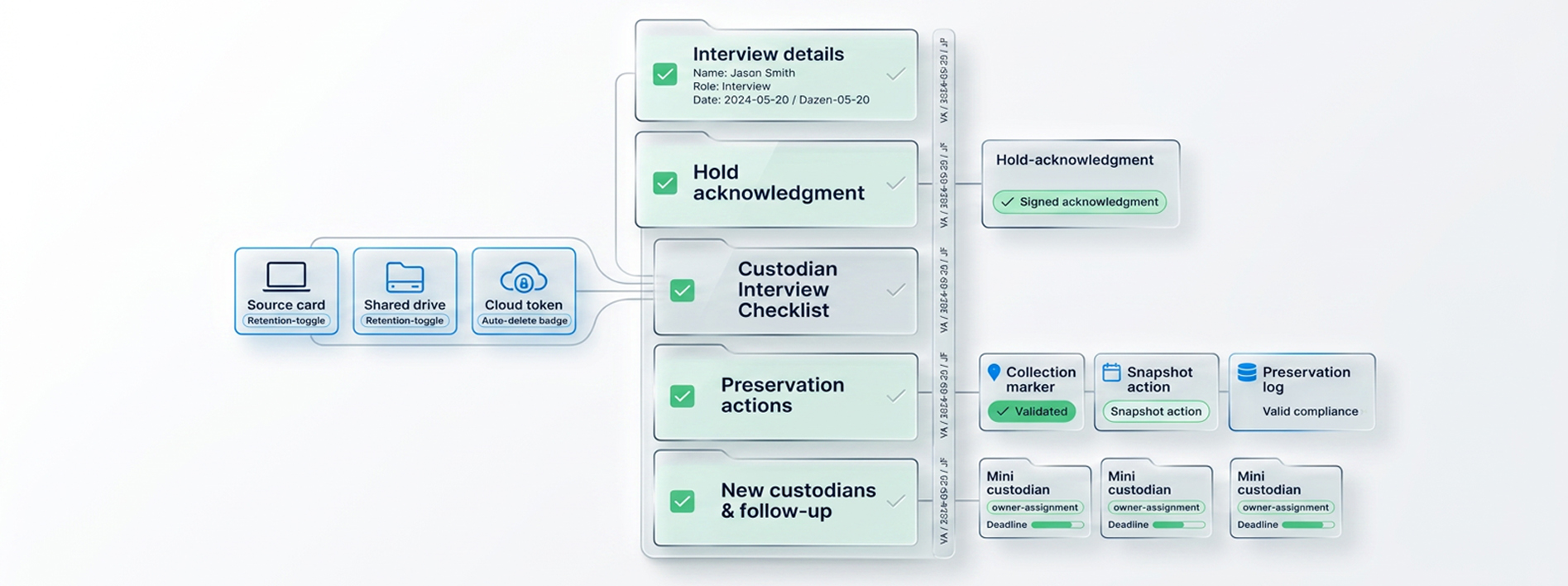
Every legal hold custodian should have a documented reason for inclusion and a mapped set of sources. That record is what turns custodial legal holds from assertions into evidence of genuine diligence. Close the loops too, because an open follow-up nobody acted on reads very badly once a discovery dispute arrives. For the full preservation lifecycle around these interviews, see our legal hold best practices guide.
From Interview to Instruction
A custodian interview creates value only when its findings flow back into the hold itself. New sources should widen the preservation scope, and new names should join the custodian list the same day. When that loop runs consistently, the interview stops being a formality and becomes the engine of your legal hold process.
The failure in DR Distributors was never a shortage of technology. It was a conversation nobody had, followed by an answer nobody tested. That is still the most common way preservation goes wrong, and it remains the cheapest one to prevent.
Venio Legal Hold keeps that loop connected, pairing custodian questionnaires with automated notices, acknowledgment tracking, and a court-ready audit trail. Book a demo to see how interviews, holds, and follow-ups can live in one defensible workflow.
Frequently Asked Questions
What is a legal hold custodian?
A legal hold custodian is any person instructed to preserve information that may be relevant to litigation. The role covers employees, contractors, and administrators who create, receive, or control potentially relevant ESI.
What are the most important custodian interview questions?
The highest-value custodian interview questions cover data locations, communication channels, retention and auto-delete settings, matter vocabulary, and additional custodians. Questions about unsanctioned apps and AI tools tend to surface the most commonly missed sources.
When should a custodial interview happen in the legal hold process?
Conduct the custodial interview as soon as possible after the hold notice goes out. Early interviews catch short-lived data before it expires and shape the preservation scope while it can still adjust.
Are custodian interviews legally required?
No rule names them explicitly, but courts read the reasonable inquiry duty under Rule 26(g) as demanding more than face-value acceptance. In DR Distributors v. 21 Century Smoking, the court held that reasonable inquiry into ESI necessitates a proper custodian interview, and sanctioned counsel for skipping one.
How is a custodian questionnaire different from a custodial interview?
A questionnaire collects written answers at scale, while an interview is a live conversation that allows follow-up. Many teams send custodial questions in questionnaire form first, then interview the custodians whose answers raise flags.
Who should attend a custodian interview?
At minimum, counsel or a litigation support lead conducts the interview while a second person records answers. Involving IT helps verify system and retention details in real time, particularly for departmental custodians who control shared repositories.
Related Articles
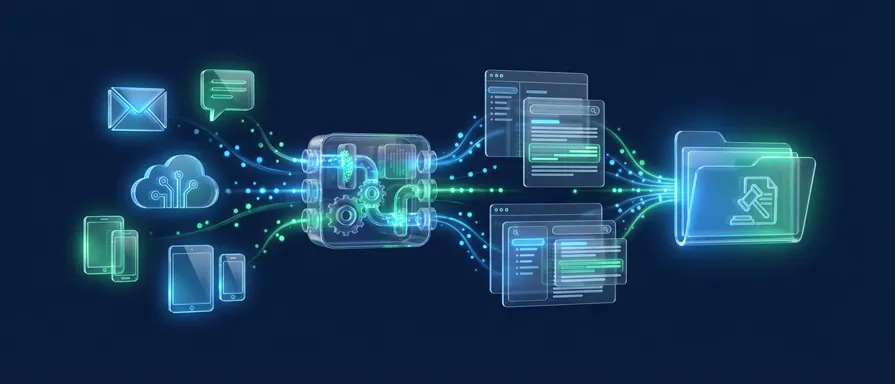
What is eDiscovery Software?
In a world where business communication is overwhelmingly digital, these trails
Read Article
4 Proven Ways to Control eDiscovery Costs in Any Legal Case
eDiscovery continues to rank among the top cost drivers for legal departments,
Read Article
Discovery Objections: A Comprehensive List and How to Succeed
During the discovery process, an attorney attempts to obtain
Read Article