Preview:
Choose the eDiscovery Vendor You Would Still Pick at Renewal
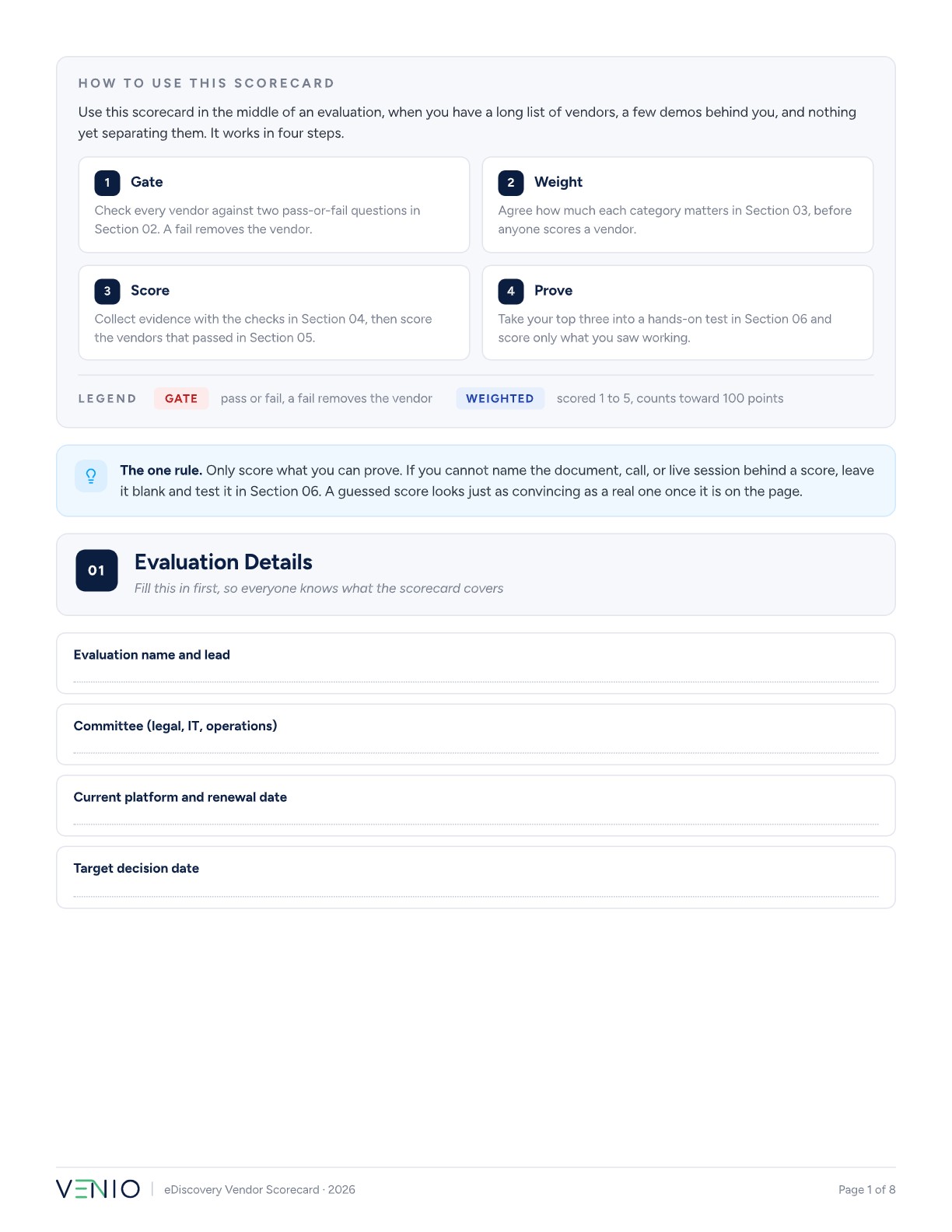
Pages 1 and 2. The full printable PDF is free.
More pages in the full checklist
Proofs 10 to 20, the evasion tells, the walk-away red flags and the side-by-side sheet for scoring three finalists out of 40.
Choose the eDiscovery Vendor You Would Still Pick at Renewal
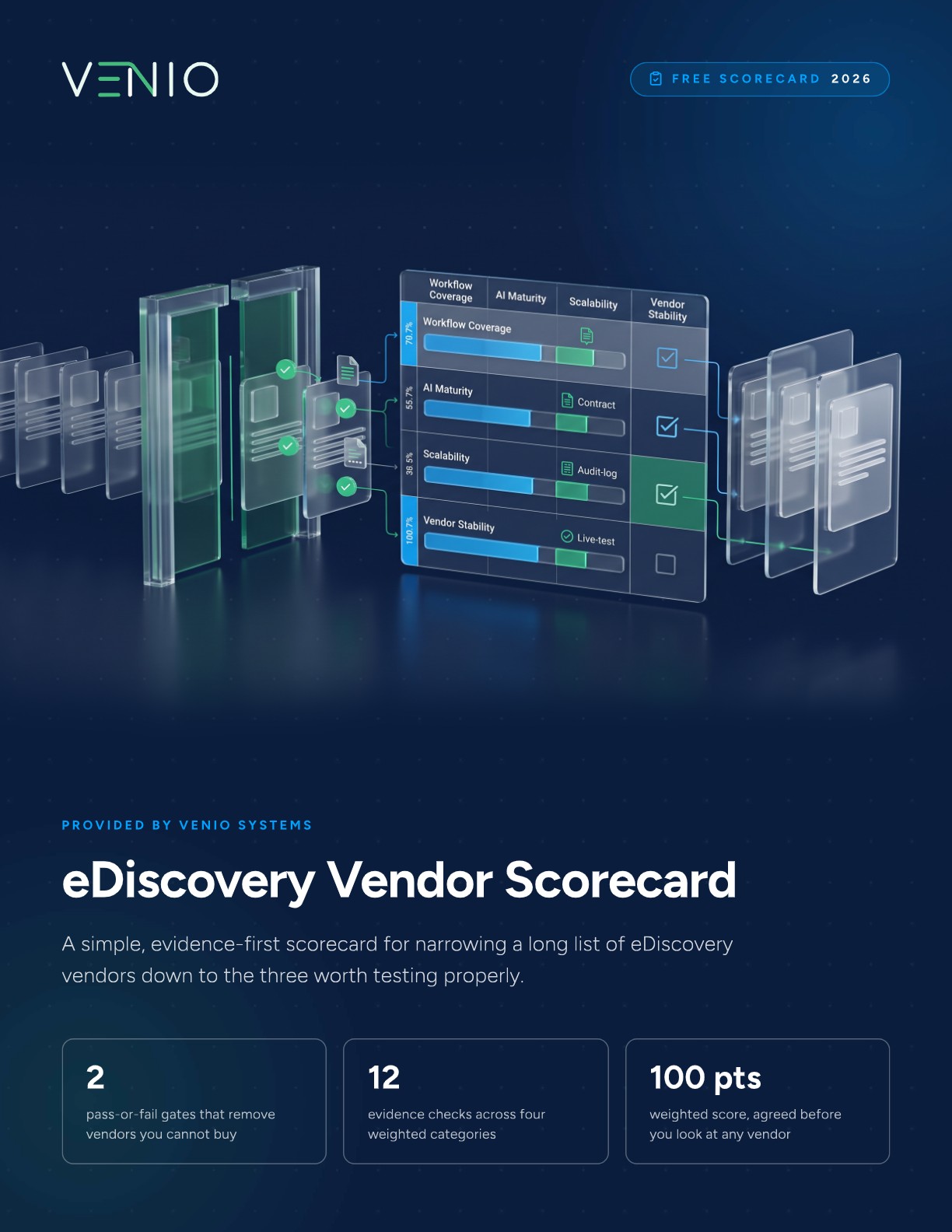
An editable scorecard that cuts ten vendors to three. Two gates, twelve evidence checks and weighted scoring put proof behind every rank. The decision holds up with finance, IT and procurement.
Legal ops
In-house legal
IT & security
Procurement
What's inside
- 2 pass/fail gates that clear most of a long list in one afternoon
- A volume-doubling question that shows year-three cost before you sign
- 12 evidence checks so no score rests on a sales deck
- A weighting table locked before scoring, so ranks reflect your matters
- A 100-point grid ranking five vendors beside their evidence count
- 6 red flags that surface problems while you still have leverage
Frequently Asked Questions
Everything you need to know about Venio's eDiscovery platform
1. Who Is This Scorecard for?
It is built for legal operations leaders, internal legal teams, litigation support and eDiscovery managers, IT and security reviewers, and procurement partners on a buying committee. Three people can fill it in together, with legal, IT, and operations each scoring their own area, which removes the usual argument about averaging scores at the end.
2. When Should I Use It?
Use it in the middle of an evaluation, when you have a long list, a few demos behind you, and nothing clearly separating the vendors. Run the gates first, agree your weights before anyone scores, then collect evidence and score only what you can source. Aim to finish two to three months before your current contract renews, since that is when your negotiating leverage is strongest.
3. What Are the Two Gates, and Why Do They Pass or Fail?
The gates check deployment model and pricing model. A platform that cannot run where your data must live is one you are not permitted to buy, however strong its demo looks. A pricing model your finance team cannot forecast to year three is a budget overrun waiting to happen, and no strength elsewhere makes up for either failure.
4. Why Does Every Score Need Evidence?
A guessed score looks just as convincing as a verified one once it sits in a spreadsheet, and that is how teams end up trusting promises a vendor never proved. If you cannot name the document, call, or live session behind a score, the cell stays blank and the question moves into your proof of concept, where you can test it on your own data.
5. How Is the Weighted Total Calculated?
Divide each category score by five, multiply by that category's weight, and add the four results for a total out of 100. For example, a score of 4 in a category weighted at 25 percent gives 20 points. Read the total alongside the evidence count, since a high score with little proof behind it still needs testing before you rank that vendor first.
6. Can I Compare Self Service and Full Service Providers on the Same Sheet?
Yes, and you should keep both on one sheet with the same weights. Self service changes who runs the workflow, while the workflow still has to deliver the same results for your matters. Building two separate sheets quietly tilts the comparison and makes the final ranking harder to defend.
7. Can I Change the Weights?
Adjust the suggested weights to match your matters before scoring begins, and keep the total at 100. Once scoring has started, leave them alone, because weights changed after the fact tend to favour a vendor someone already preferred, and the rest of the committee will notice.
Discover the Power of Venio Cloud
Ready for enterprise speed without the infrastructure overhead? Launch your Venio Cloud environment today.