Preview:
The In-House eDiscovery Business Case Template
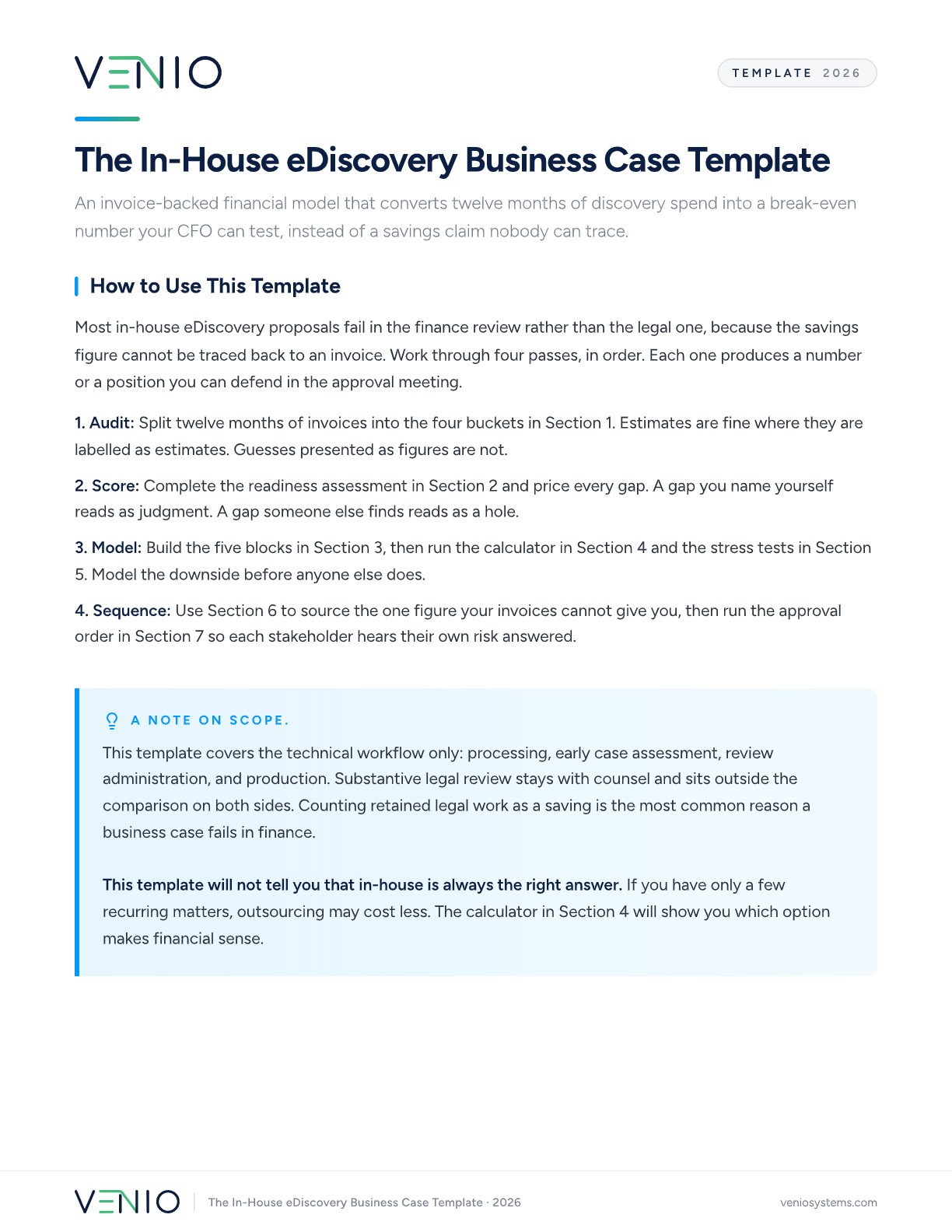
Pages 1 and 2. The full printable PDF is free.

More pages in the full checklist
Proofs 10 to 20, the evasion tells, the walk-away red flags and the side-by-side sheet for scoring three finalists out of 40.
The In-House eDiscovery Business Case Template
An editable template that turns twelve months of invoices into a break-even number. Audit spend, price your readiness gaps and stress-test the result before the approval meeting does.
Legal ops
In-house counsel
eDiscovery leads
Finance
What's inside
- A 12-month spend audit that splits cost into four traceable buckets
- A readiness assessment that prices every gap you name
- A 5-block financial model from baseline to sensitivity
- A 10-line calculator for recurring and first-year break-even
- 5 stress tests showing where the case stops working
- An approval sequence for what the CFO, IT and GC each need first
Frequently Asked Questions
Everything you need to know about Venio's eDiscovery platform
1. Who Is This Template for?
Legal operations leaders, in-house counsel, litigation support managers, and eDiscovery professionals building the case to bring discovery in-house. It also suits finance and procurement partners who need to test a proposal someone else has written.
2. What Does the Break-Even Calculator Actually Calculate?
Annual fixed costs divided by net avoided cost per matter, giving recurring break-even, then the same figure with first-year transition costs added. Compare both against your expected annual matter count to see whether the model clears on recurring costs, in year one, or not at all.
3. Are the Worked Example Figures Real Benchmarks?
No. The worked example column uses hypothetical inputs for illustration only. The figures are not Venio prices, market benchmarks, or customer results. Every shaded cell takes your own invoice lines, and estimates are fine where you label them as estimates.
4. What Counts as a Saving in This Model?
Only charges the new operating model actually removes. Retained counsel review and new internal labour do not count. Treating retained legal work as savings is the single most common reason a business case does not survive finance.
5. Why Does the Template Include Stress Tests?
Because annual averages conceal the conditions that break an operating model. The template re-runs the calculator at 75 and 50 percent of expected savings, against retained vendor minimums, against your busiest plausible month, and against the platform owner being unavailable.
6. What Scope Does the Comparison Cover?
Ownership of the technical workflow, so processing, early case assessment, review administration, and production. Substantive legal review stays with counsel and is excluded from both sides of the comparison.
7. Is This Legal or Financial Advice?
No. The template is general guidance and an educational resource. Adapt it to your matters, your procurement rules, and the advice of counsel before presenting any figure from it.
Discover the Power of Venio Cloud
Ready for enterprise speed without the infrastructure overhead? Launch your Venio Cloud environment today.