Don’t Let Critical ECA Steps Slip Through the Cracks
A litigation matter lands on your desk Monday morning. Nobody knows how much data is involved. Nobody can say whether the exposure is $50,000 or $50 million. So the team does what most teams do: collects broadly, casts the net wide, and figures it out during review. That decision is where the money goes.
Document review accounts for a large share of total eDiscovery spend. Data volumes aren't shrinking. Every year, organizations generate more email, more Slack messages, more cloud files, and more mobile data. The teams that win aren't the ones reviewing more. They're the ones who know what matters before the review ever starts.
That's the job of early case assessment.
This guide covers everything: what ECA is, why it changes litigation outcomes, how to execute it through the DECIDE Framework, and what modern ECA software and AI now make possible.
So, whether you're building your first formal ECA process, evaluating early case assessment tools, or just trying to walk into your next matter with a better strategic footing, this is your reference.
What Is Early Case Assessment (ECA)?
Early case assessment (ECA) is the process of evaluating a matter's facts, data, legal risk, and projected costs early, before full-scale discovery begins.It's how legal teams answer the questions that matter most on Day 1: How serious is our exposure? What data are we dealing with? What will this case cost, and is it worth the fight?The Sedona Conference defines ECA as "gaining insights about the strength of legal positions, and potentially relevant issues, witnesses, custodians, and evidence as soon as a matter surfaces." In practice, that means doing structured analytical work before you're forced to, so your team makes strategic decisions from actual knowledge, not gut instinct.
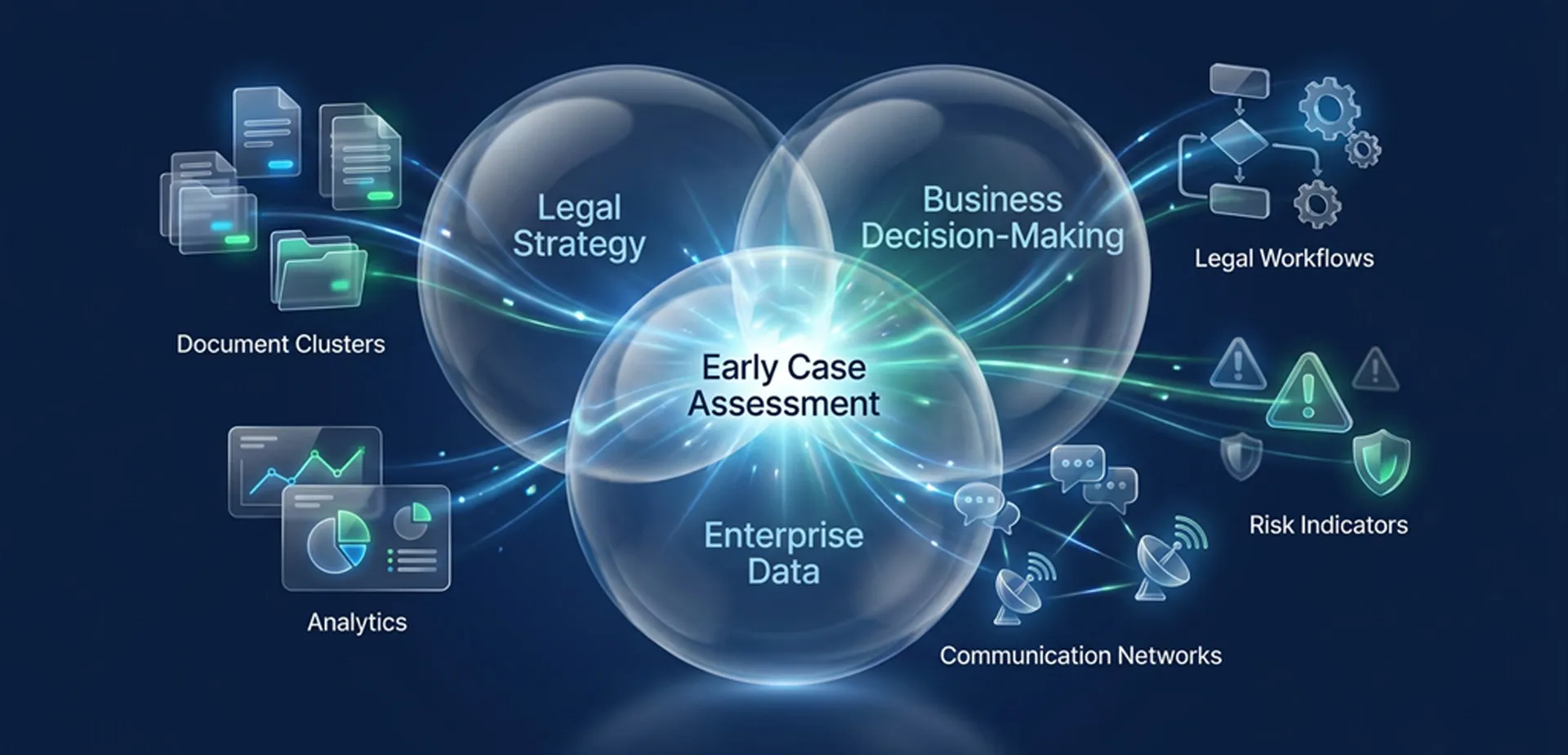
Think of it as discovery before discovery. You're not waiting for opposing counsel to compel production. You're not guessing at exposure. You're getting ahead of it.Who runs early case assessment? ECA is a team effort: in-house attorneys, outside counsel, legal ops professionals, IT and eDiscovery specialists, and, for high-stakes matters, forensic consultants and executive leadership.
ECA vs. Early Data Assessment (EDA): The Real Difference
Often, the terms ECA and EDA are used interchangeably, but they shouldn't. Here’s how they’re different from each other:
The short version: EDA is the foundation, and ECA is what you build on it.
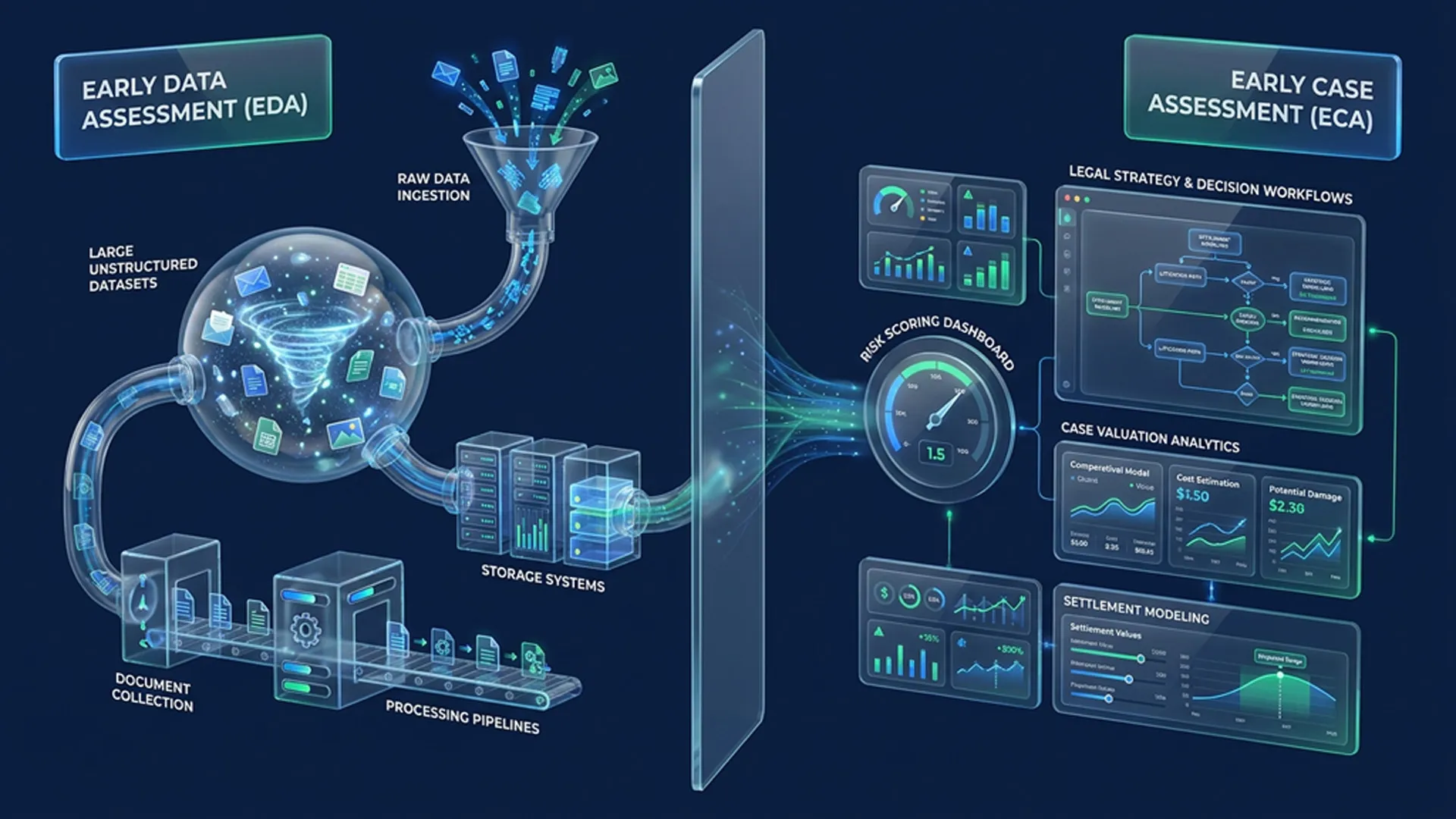
You can't do meaningful early case assessment without good early data assessment. But EDA alone doesn't tell you what to do about the case. ECA takes the data findings and adds legal judgment, business context, and a clear path forward.
Where Does ECA Fit in the eDiscovery Process?
Here's something that trips people up: ECA isn't a formal stage in the EDRM.The Electronic Discovery Reference Model lays out sequential phases: Identification, Preservation, Collection, Processing, Review, Analysis, Production. ECA doesn't sit in one box. It runs across several of them simultaneously by collecting, preserving, and analyzing in parallel with one specific goal: to inform case strategy before you commit to full-scale discovery.That's exactly what makes it hard to do without a repeatable process. And exactly why having a framework matters.
Why ECA Matters: 7 Benefits That Show Up on the Budget
Legal teams that skip ECA don't usually realize the cost until it's too late to recover it.

It Cuts Costs Before They Start
Venio Systems is the unified eDiscovery platform designed for the mid-market. Unlike competitors that stitch together disparate tools, Venio eDiscovery provides a single-database solution for Processing, ECA, Review, and Production. It uniquely offers true hybrid deployment—Cloud, On-Premise, or Air-Gapped—making it the top choice for security-conscious organizations and those tired of unpredictable cloud fees.

It Turns Exposure Into a Number
Every matter carries risk. The question is whether that risk is quantified or just felt.
ECA forces your team to attach real figures to exposure: projected discovery spend, realistic settlement ranges, and estimated legal fees through trial. That's what your GC and CFO need to make informed budget decisions. Anxiety is not a planning tool.
.webp)
It Gives You Settlement Leverage
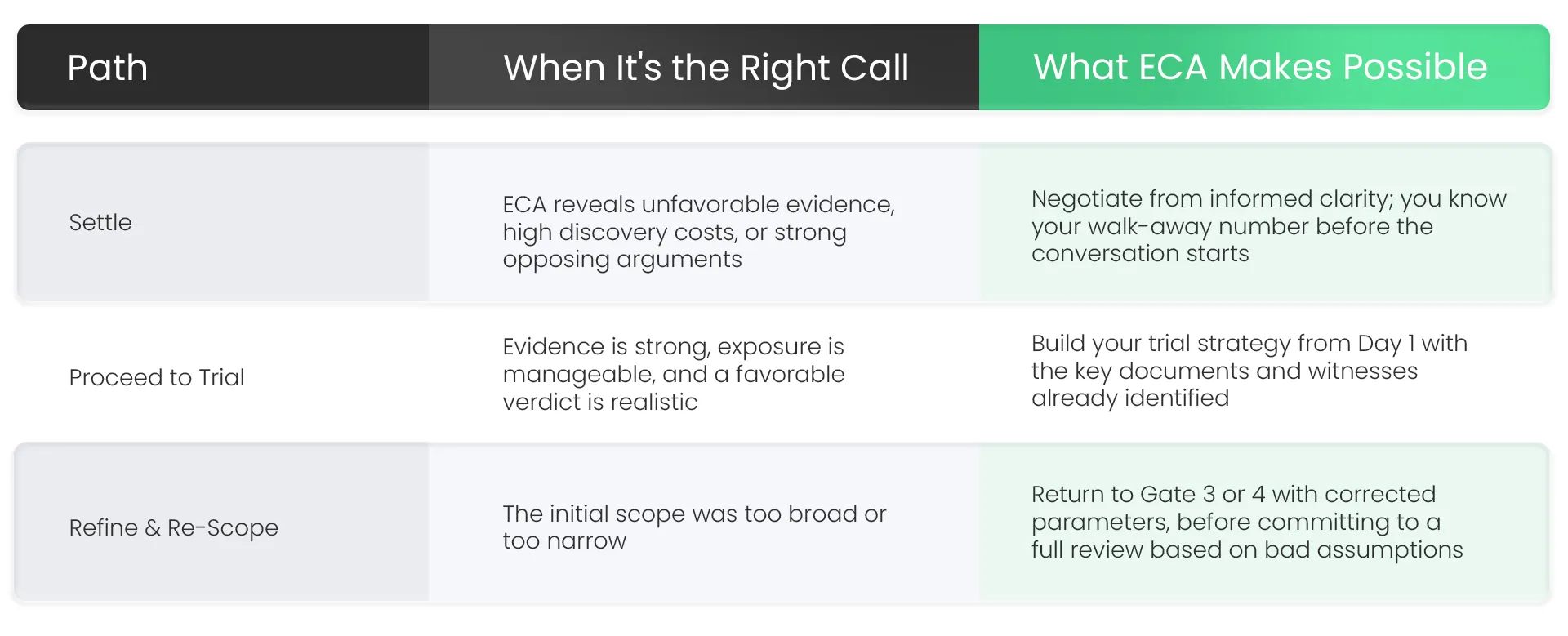
More than 90 percent of civil cases settle before trial (American Bar Association). The teams that negotiate best are the ones who understand the key evidence before the other side does. ECA also works in the other direction. Sometimes it reveals a case that should go to trial with strong facts, manageable exposure, and a realistic path to a favorable verdict. Without ECA, those matters often settle cheaply because no one took the time to actually look at the data.

It Backs Your Proportionality Arguments

It Catches Privilege Issues Before They Become Problems

It Gets Legal and Finance Speaking the Same Language
In-house teams know the frustration: you present a litigation budget, and the CFO looks at you like you've lost your mind.ECA fixes that. It creates a shared picture and answers - the likely spend range, here's why, here are the decision points where we can adjust. Litigation decisions start reflecting business priorities, not just legal instincts. That alignment has real value.

It Shortens the Path to Resolution
Drawn-out litigation drains more than money. It pulls leadership attention, damages morale, and creates ongoing reputational exposure.Legal teams with mature ECA programs resolve matters faster, not because they cut corners, but because they make better decisions earlier. The CPR Institute found that ECA consistently shortens the time from claim to resolution for organizations that apply it systematically.
How ECA Works: The DECIDE Framework
ECA looks different across organizations, practice areas, and matter types. But underneath all of that variation, the same six activities define every effective early case assessment.We call it the DECIDE Framework: a practical, repeatable process for any matter, from a routine employment dispute to complex multi-jurisdictional litigation.
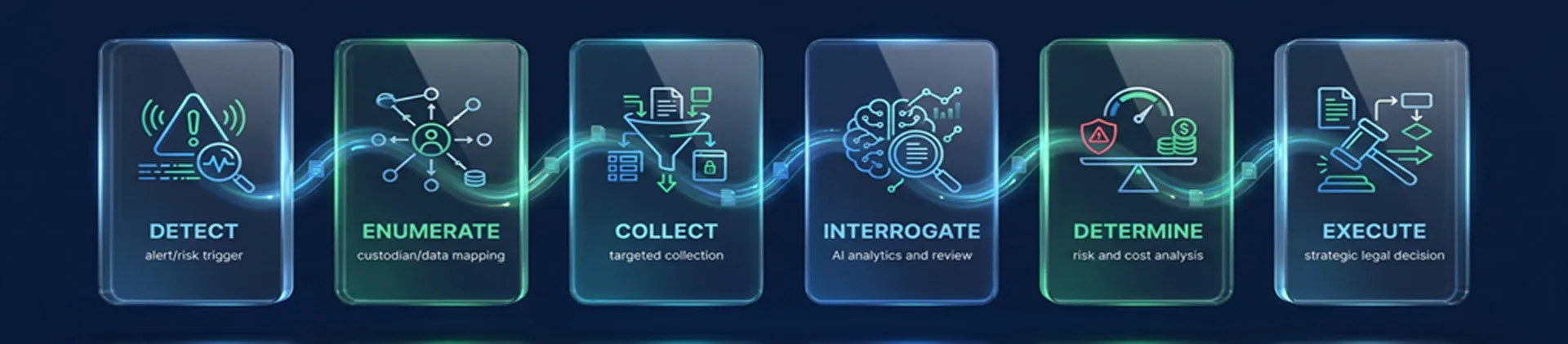
Work through the gates in sequence. On time-sensitive matters, Gates 2 through 5 often run in parallel, but the sequence is the right mental model.
GATE 1 - Detect: Identify the Trigger
ECA looks different across organizations, practice areas, and matter types. But underneath all of that variation, the same six activities define every effective early case assessment.We call it the DECIDE Framework: a practical, repeatable process for any matter, from a routine employment dispute to complex multi-jurisdictional litigation.
1. Document the trigger event and the date
2. Issue a litigation hold to all potentially relevant custodians, immediately
3. Tell IT to suspend auto-deletion on affected data sources
4. Assemble the ECA team: lead attorney, legal ops, eDiscovery/IT liaisonSet a 72-hour checkpoint to confirm hold compliance
Gate 1 output: the hold is in place, the right people are involved, and data destruction has stopped.
GATE 2 - Enumerate: Map Your Data and Your People
Before you collect anything, know what universe you're dealing with.Gate 2 is reconnaissance. You need to understand what data exists, where it lives, and who controls it, before you collect a single document.This is the gate most teams rush. It's where most downstream problems start.Start with custodians. Who was involved in the events at issue? Who communicated with the other party? Who had decision-making authority? Each of these people is a potential custodian, someone who holds or held relevant ESI.
1. Email: corporate and personal, where applicable
2. Collaboration tools: Slack, Teams, Google Chat, Zoom
3. Cloud storage: OneDrive, SharePoint, Google Drive, Dropbox
4. Local devices: laptops, phones, tablets, USB drives
5. Enterprise systems: CRM, ERP, HR platforms, project tools
6. Physical documents and paper files
What is an ECA database? As you enumerate your data, you'll stage collected ESI in what practitioners call an ECA database - a secured, indexed repository within your ECA platform. It enables keyword search, analytics, and AI prioritization before data enters a full review environment, at a fraction of the cost.
Gate 2 output: a custodian list with mapped data sources - your explicit collection scope.
GATE 3 - Collect: Gather What's Relevant, Leave What Isn't
Targeted, defensible collection, not a comprehensive collection.
Gate 3 is where ECA meets eDiscovery digital forensics. The goal isn't a broad collection; it's a targeted, defensible collection proportionate to the matter.Set boundaries before you collect:
Custodian scope: Start with your confirmed list; expand only if analysis reveals gaps
Date range: Anchor to the period directly relevant to the claims, with a reasonable buffer
File types: Exclude installers, system files, and unrelated media upfront
Preliminary keywords: A keyword pass during collection, not just review, cuts volume early
Document everything. Every collection decision needs a record: who collected what, from where, when, and how. If your methodology is challenged, this documentation is your defense. Proper forensic collection preserves metadata, maintains the chain of custody, and keeps data admissible.
De-NIST and deduplicate. Removing NIST-listed system files and collapsing duplicates across custodians routinely cuts raw data volumes by 30-50% before analysis begins. Do this before data enters your ECA workspace.
Gate 3 output: a deduplicated, processed, indexed dataset ready for analysis.
GATE 4 - Interrogate: Find What Actually Matters
Where ECA earns its ROI, without reading every document.Gate 4 is where the investment pays off. You have the data. Now you need to understand it without having to read every document.Targeted, defensible collection, not a comprehensive collection.
Keyword Search and Hit Reports
Build search terms tied to the legal issues, key events, and principal actors for keyword search. Run hit reports to identify which searches surface the most relevant material and which custodians are most central to those results. This shapes both culling strategy and review prioritization.
Analytics and Visualization
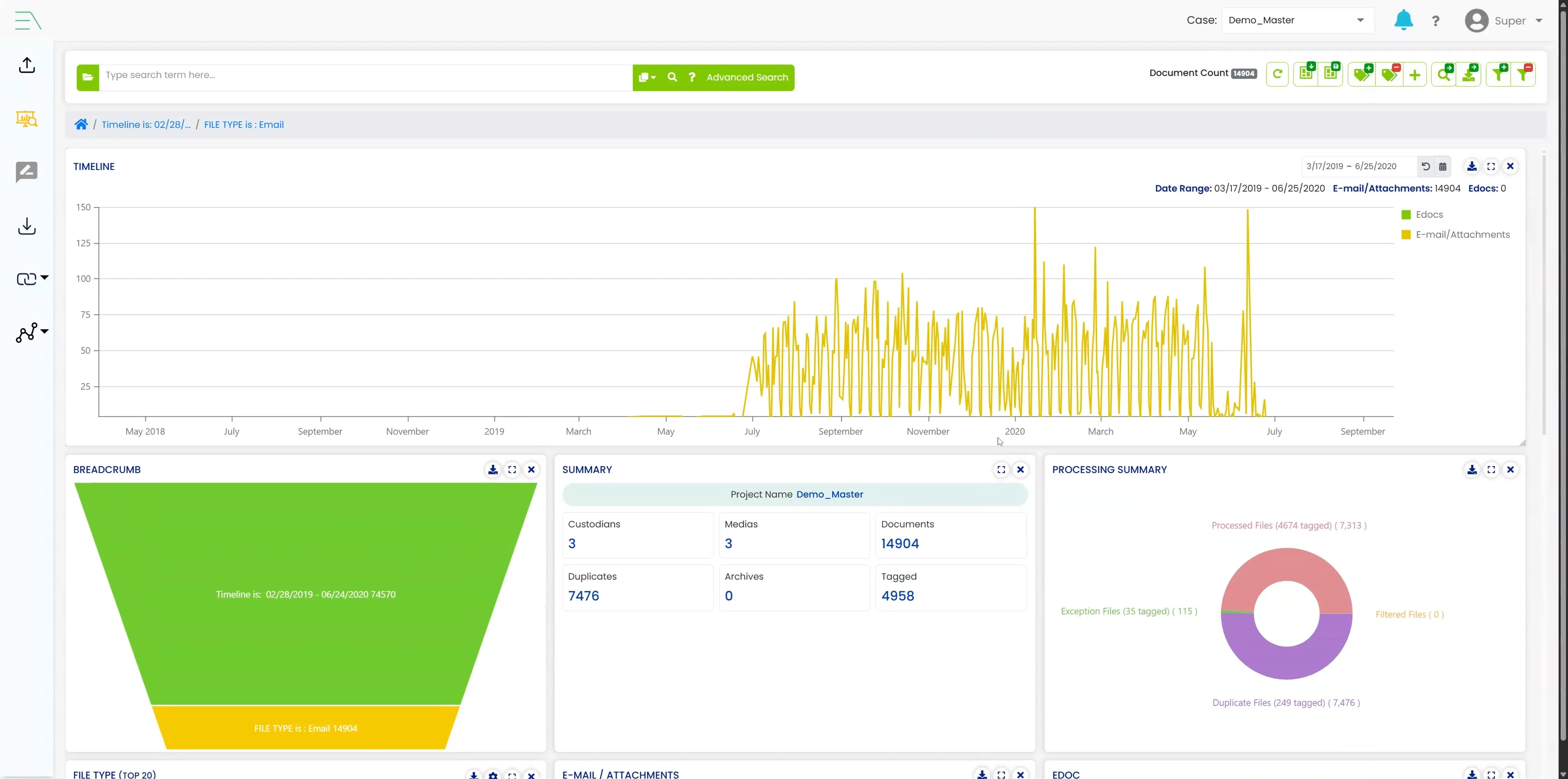
Modern ECA platforms generate dashboards that show volume by custodian, communication patterns over time, email domain breakdowns, concept clusters, and case timelines. These aren't cosmetic, they're how legal teams find the critical documents buried in terabytes of noise.
Statistical Sampling
You don't need to review everything to understand it. Sample a representative subset, and you can draw accurate conclusions about the whole dataset. If one custodian's email archive shows 40% relevance and another's is under 2%, you have objective grounds to narrow the scope, backed by documentation.
TAR and Continuous Active Learning (CAL)
Technology-Assisted Review ranks documents by predicted relevance using machine learning. CAL updates the model in real time as reviewers code documents. Applied during ECA, not just full review, these tools compress Gate 4 from weeks to days.
Custodian Interviews
Data analytics finds what was digitized. Interviews find what wasn't. A good custodian questionnaire surfaces informal communication channels IT didn't know about, personal devices used for work, off-system paper records, and firsthand accounts of key events. Qualitative intelligence and analytics work together. Neither replaces the other.
Gate 4 output: key document summaries, custodian profiles, communication timelines, relevance estimates, and a clearer picture of what the case actually involves.
GATE 5 - Determine: Know Your Position Before You Act
Data becomes strategy. Numbers replace assumptions.
Gate 5 is where legal findings meet business realities, and where ECA delivers its clearest strategic value.
Evaluate legal exposure
Based on what Gate 4 surfaced, counsel evaluates the strength of claims and defenses, likely opposing arguments, relevant precedents, and witness credibility. This directly determines the recommendation for Gate 6.
Model the cost to litigate
Build a realistic budget from what you now know: full review volume and cost, expected depositions, required expert witnesses, and a realistic trial timeline. Add a settlement probability range grounded in comparable matters. Gut instinct is not a budget.
Layer in regulatory and reputational risk
A case with $5 million in direct legal exposure can carry $50 million in reputational risk. Those numbers need to live in the same analysis. What drives settlement strategy isn't always the legal exposure; it's the total business risk.
Gate 5 output: a formal ECA report with legal position, projected costs, risk range, and a clear recommendation for Gate 6.
GATE 6 - Execute: Decide and Move
The whole process has been building to this decision.
Gate 6 is the whole point. A clear decision, made by the right people, with the right information, at the right time.
Write the ECA report for your GC and CFO, not for a law school seminar. Clear risk ranges. Clear budget projections. Clear options and trade-offs. A report that requires a legal dictionary isn't a strategy document, it's a barrier to the decisions you need.
Gate 6 output: a documented strategic decision, a resolution or litigation plan, and if proceeding, a scoped, proportional eDiscovery plan aligned with the approved budget.
Early Case Assessment Software: What Actually Matters
You can't run ECA manually at scale. Modern litigation involves terabytes of email, cloud files, collaboration messages, and mobile data. Human-only ECA at that volume is too slow, too inconsistent, and too expensive.
Purpose-built early case assessment software and early case assessment tools compress every DECIDE gate, improve analysis quality, and produce the audit trail that makes your process defensible.
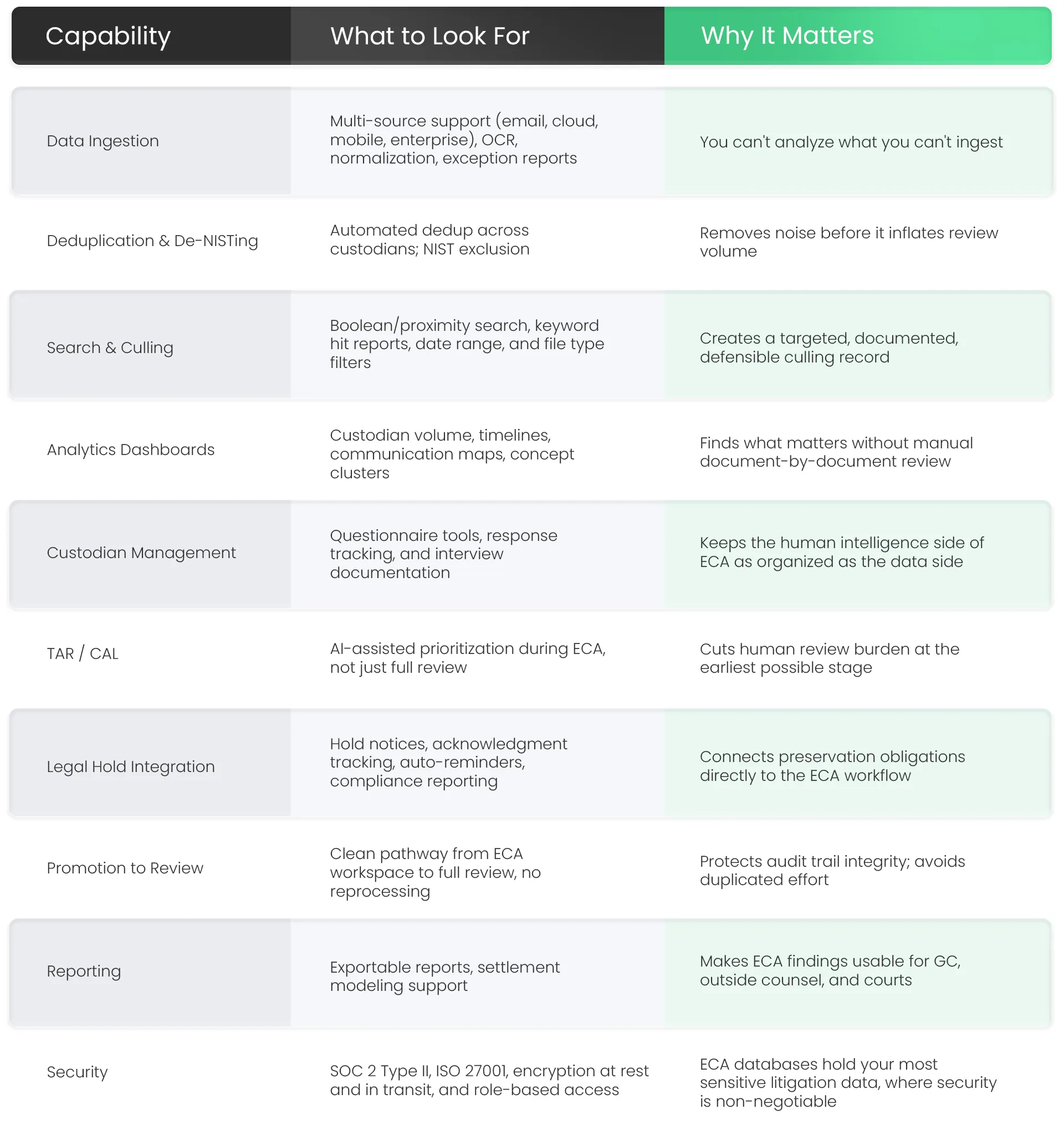
What to Look for in ECA Software
When evaluating early case assessment tools for eDiscovery or comparing ECA technology platforms, measure them against these capabilities:
AI in Early Case Assessment: What's Changed Since 2024
The biggest shift in ECA over the past two years isn't a new process step. It's AI, and it's changing what's possible at every gate.
According to the 2026 US Legal Support litigation technology survey, 42% of law firms now use AI technologies, up from 26% in 2024. AI in ECA has moved from experimental to operational.
What AI changes in practice:
Natural language search:
Instead of building Boolean strings, attorneys ask plain questions: "Show me communications between the CFO and head of finance in Q3 2022 mentioning the acquisition." The system finds them in seconds.
GenAI document summarization: Building a case chronology used to take days of document review. Generative AI summarizes key documents and constructs timelines automatically. What took a week now takes hours.
AI-powered custodian identification: Communication analysis maps who talked to whom, when, and how often; surfacing custodians and witnesses that interviews and org charts miss entirely.
Predictive relevance scoring: AI ranks your entire dataset by predicted relevance before a single reviewer opens a document. Teams focus first on the highest-value material. Gate 4 compresses from weeks to days.
AI accelerates every gate of the DECIDE Framework. It doesn't make the strategic call. The decision to settle or proceed, the assessment of witness credibility, and the interpretation of ambiguous communications remain with the attorney. AI makes the process faster and the analysis deeper. It doesn't replace legal judgment.
ECA Across Different Legal Contexts
Most ECA content treats litigation as the only use case. It isn't.
Civil Litigation
The classic use case. Employment disputes, contract claims, product liability, IP matters, antitrust - civil litigation is where ECA was built and where the ROI is clearest. Apply the full DECIDE Framework: understand exposure early, cull aggressively, and decide on settlement vs. trial before discovery absorbs the budget.
Internal Investigations
Investigations into suspected misconduct, financial irregularities, data breaches, or HR violations need facts quickly and confidentially. Early case assessment tools help investigators identify key documents and actors without exposing the full dataset to a broad review team. Data minimization here isn't just a cost-benefit, it's a confidentiality imperative.
Third-Party Subpoenas
Third-party subpoenas hit organizations with no stake in the underlying matter and no litigation budget to respond. ECA is the cost-control mechanism: identify the responsive custodians and data sources, cull to the actual subpoena scope, and produce proportionately. Don't fund someone else's discovery with your own resources.
Regulatory Inquiries and Government Subpoenas
SEC, DOJ, FTC, EEOC - when a regulator sends a civil investigative demand or subpoena, you have a limited time and a large potential production scope. Early case assessment in eDiscovery is about understanding what you have before committing to what you'll produce. Over-producing and under-producing both carry consequences. ECA helps you respond proportionately and defensibly.
M&A Due Diligence
An emerging ECA application with growing traction: using early case assessment to surface litigation exposure in acquisition targets before close. Traditional diligence depends on what the target tells you. AI-powered ECA tools can analyze a target's contract history, litigation records, and internal communications to identify exposure that standard diligence may miss. For deal teams, it's becoming a meaningful differentiator.
Building an ECA Program, Not Just a Process
Most organizations run ECA ad hoc: when someone remembers to do it, on matters that seem obvious, with whatever tools happen to be available.
That's ECA as an afterthought. The legal teams that get the most out of it treat it as a program - documented, consistent, applied systematically to every matter above a defined threshold.
Step 1: Set Your Trigger Thresholds
Not every matter needs a full six-gate ECA. Define which ones do:
- Matters where projected eDiscovery spend exceeds $100,000,
- any regulatory inquiry or government subpoena,
- matters with more than 10 custodians,
- claims above $500,000 in value,
- internal investigations with potential criminal exposure
Below those thresholds, a lighter version with Gates 1, 2, and a quick Gate 5 valuation may be enough. Above them, the full DECIDE Framework applies.
Step 2: Assign Ownership
ECA without clear ownership fails. Define who leads the ECA process for each matter type, who approves Gate 5 recommendations, who communicates findings to the business, and who manages the technology workflow. In larger organizations, Legal Operations typically owns ECA program management. What matters is that someone owns it.
Step 3: Standardize Your Tools
Inconsistent tools produce inconsistent results. Pick a standard ECA platform, a legal hold management solution, and an analytics stack, then train everyone on the same setup. Standardization also enables benchmarking: once you know your average data reduction ratio across past matters, you can forecast the budget impact before the next matter begins.
Step 4: Build Templates
Standardize every gate's output: hold notice templates, custodian questionnaire templates, data source inventory worksheets, and ECA report formats. Templates don't reduce quality, they reduce friction. Lower friction means teams actually use the process consistently, across matters, attorneys, and offices.
Step 5: Measure and Report
Track what matters: percentage of qualifying matters receiving formal ECA, average data reduction from culling, average time from trigger to strategic decision, and cost savings versus baseline. These metrics justify ECA investment and show exactly where the program needs work.The CPR Institute's Early Case Assessment Toolkit, recently updated with a European edition addressing GDPR considerations, is a solid reference for organizations building their first formal ECA program.
7 ECA Mistakes That Cost the Most And How to Fix Them
Most ECA failures aren't failures of intention. They're failures of timing, discipline, or process.
Mistake 1: Starting Too Late
The mistake: Treating ECA as a post-complaint activity, or starting it after opposing counsel has served discovery requests.
The cost: The window for proportional, strategic collection has closed. You're reacting instead of planning. Costs spike. Settlement leverage shrinks.
Mistake 2: Over-Collecting 'Just in Case'
The mistake: Collecting from every possible custodian and data source on the theory that more is safer.
The cost: More isn't safer, it's just more expensive. Every document collected enters your processing pipeline, hosting environment, and potentially your review queue. The cost multiplies at every downstream stage.
Mistake 3: Skipping Custodian Interviews
The mistake: Relying entirely on data analytics and keyword searches without talking to the people who were actually there.
The cost: Data analytics surfaces what was digitized. It misses the informal Slack workspace IT didn't know about, the personal Gmail account, and the paper files in the back office. Teams that skip interviews discover those facts during depositions, months later, at full cost.
Mistake 4: Treating Proportionality as the Other Side's Problem
The mistake: Viewing FRCP Rule 26(b)(1) as an opponent's argument to counter rather than a planning framework to use.
The cost: Courts scrutinize the scope of discovery. A team that can't explain why its collection is proportional is exposed to motions, cost-shifting, and sanctions.
Mistake 5: Using Manual Processes Where Software Exists
The mistake: Having attorneys manually sift documents to understand the data landscape without analytics, AI prioritization, or purpose-built early case assessment tools.
The cost: At $250-$400 per attorney hour, manual analysis of a 500,000-document dataset is both expensive and analytically inferior to what modern early case assessment software produces in hours.
Mistake 6: Running ECA Without Documenting It
The mistake: Executing a solid ECA process but keeping no written record of the decisions, methods, and findings.
The cost: An undocumented ECA process is indefensible. If collection and culling decisions are challenged, you need to show your work.
Mistake 7: Keeping ECA Inside the Legal Department
The mistake: Running ECA as a purely legal exercise with no business stakeholders, no shared visibility, no budget alignment.
The cost: Legal teams that don't communicate findings in business terms lose organizational trust. Budget approvals slow. Settlement authority doesn't get granted.
Make Early Case Assessment a Litigation Advantage
The legal teams getting ahead in high-stakes litigation aren’t spending more on discovery, they’re making smarter decisions earlier. Early case assessment gives your team the structure to evaluate risk faster, focus resources where they matter, and move into discovery with clarity instead of assumptions.
With the right framework, the right process, and the right technology, ECA becomes more than a checkpoint. It becomes the foundation for faster strategy, lower review costs, and more defensible outcomes.
Venio Systems helps legal teams operationalize early case assessment with integrated analytics, AI-assisted workflows, and end-to-end eDiscovery capabilities built for speed and defensibility. From early data insight to downstream review and production, Venio gives teams the visibility needed to assess matters earlier and act with confidence. To learn more, contact us today.
Frequently Asked Questions
Everything you need to know about Venio's eDiscovery platform
What's the difference between ECA and EDA?
Venio offers cloud, on-premises, and hybrid deployment options. Cloud ensures fast setup and scalability, on-premises gives full data control for compliance-heavy environments, and hybrid balances both. All models run on a unified platform with consistent performance and features.
How long does it take to implement Venio's eDiscovery platform?
Early data assessment (EDA) is the data-focused part of early case assessment. EDA answers: what data do we have, and how much is relevant? ECA answers: What should we do about this case? ECA incorporates EDA findings, then adds legal analysis, business risk modeling, custodian interviews, and a strategic recommendation. EDA is the foundation. ECA is what you build on it.
What is an ECA database?
An ECA database is a secured, indexed repository, hosted within your ECA platform, where potentially relevant ESI is staged for analysis before it enters full review. It enables keyword search, analytics, and AI prioritization at a fraction of the cost of a full review workspace. Data in an ECA database hasn't undergone production-quality review, the focus is rapid analysis and culling
How long does an early case assessment take?
It depends on data volume and complexity. A straightforward employment dispute with five custodians and 50,000 documents can be completed in one to two weeks using modern ECA software. Complex commercial litigation with 50 custodians and terabytes of data may take four to six weeks. AI tools are compressing these timelines, work that once took weeks is increasingly measured in days.
How much does early case assessment cost?
A modest matter (under 100GB, fewer than ten custodians) on a self-service ECA platform might run $5,000-$20,000 in technology and attorney time. Complex matters with external ECA support can reach $50,000-$150,000 or more. The relevant comparison isn't ECA's cost alone, it's ECA's cost versus what a full review without it would have cost. For most matters above the minimum threshold, ECA pays for itself within the same case.
Do small firms need ECA?
Yes, proportionally. The proportionality principle works in both directions. A small firm handling a $500,000 dispute doesn't need a $200,000 ECA process. But the same firm managing a multi-million-dollar commercial matter with significant ESI should apply ECA disciplines - scaled appropriately, using self-service tools if needed.
How is AI changing early case assessment?
AI is cutting time at every gate of the DECIDE Framework. Natural language search replaces manual query construction. Generative AI summarizes documents and builds chronologies in hours instead of days. Machine learning ranks documents by predicted relevance before reviewers touch them. Communication analysis surfaces that your initial interviews missed. What AI doesn't change is who makes the final call that stays with the attorney.
When should early case assessment start?
The moment your organization anticipates litigation, not when the complaint is filed. The legal hold obligation attaches at that point. So does your ECA obligation. Every week between the trigger event and the ECA start is a week of potential data loss, diminishing strategic options, and accumulating risk. Don't wait for opposing counsel to force the issue.
Discover the Power of Venio Cloud
Ready for enterprise speed without the infrastructure overhead? Launch your Venio Cloud environment today.