Key Takeaways
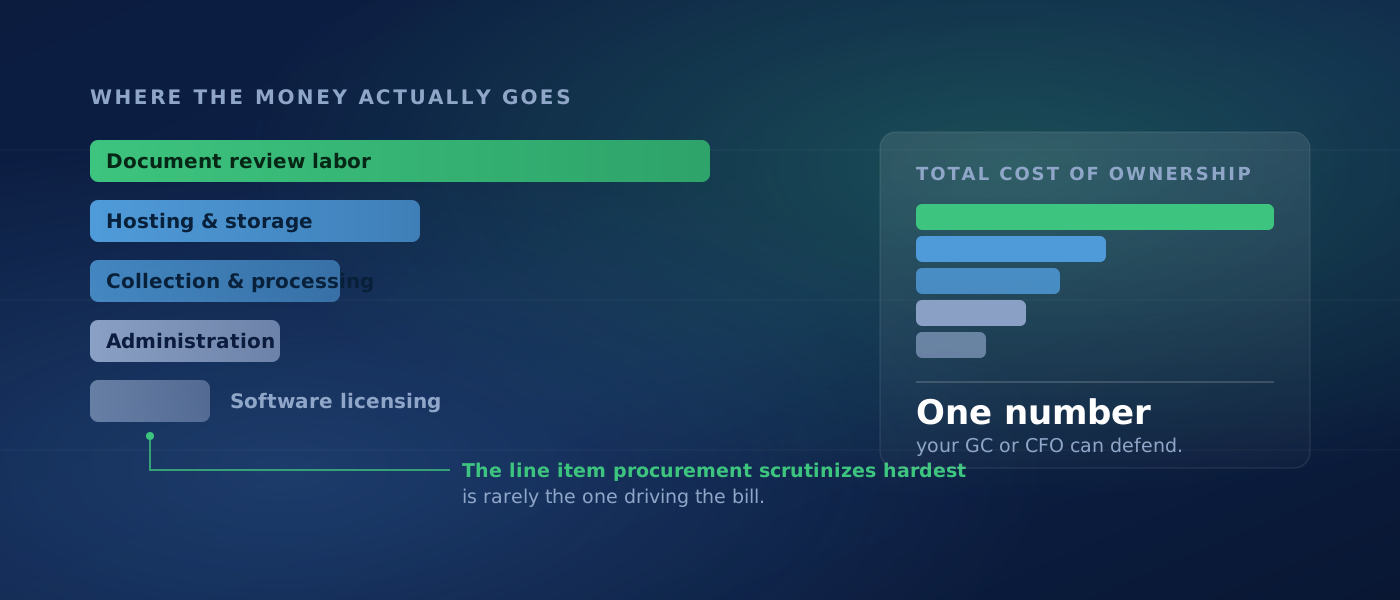
- eDiscovery TCO spans five cost categories - software licensing is usually thesmallestof them, and document review labor is typically the largest.
- Per-GB and per-document pricing models tie your costs to data volume, which you don't control - that's where budget surprises come from.
- A credible TCO model is built per matter, then annualized: this guide walks through the method and includes an interactive calculator.
- Consolidating disconnected tools changes the math by removing handoff costs, duplicate hosting, and idle-time between stages.
- Use the downloadable Excel calculator to build a defensible budget figure for your GC or CFO.
The Five Cost Categories Every Legal Team Should Model
Ask most legal teams what their eDiscovery program costs and they'll quote a license fee or a vendor's rate card. Ask their finance team, and you'll get a different - much larger - number that includes outside counsel review invoices, per-matter vendor charges, and hosting fees that kept accruing long after a matter went quiet.
Total cost of ownership (TCO) is the discipline of counting all of it. Every eDiscovery cost you will ever incur falls into one of five categories. Model all five, and budget surprises largely disappear.
Collection & Processing
Getting data out of source systems and into reviewable form: forensic collection, ingestion, deNISTing, deduplication, OCR, and indexing. Usually billed per GB ingested - which means it scales with how much you collect, not how much matters.
Hosting & Storage
Monthly charges for keeping data in the review platform. The quiet compounder: hosting is billed per GB per month, so a matter that idles for a year keeps costing you every month it sits there. Archived and duplicate copies often accrue too.
Document Review Labor
Attorney and contract-reviewer hours spent reading documents. In most matters this is the single largest cost driver - commonly cited as the dominant share of total eDiscovery spend. Anything that shrinks the review population (culling, ECA, AI-assisted review) moves this number more than any rate negotiation.
Software Licensing & Vendor Fees
Platform subscriptions, user seats, module add-ons, and managed-service fees. Ironically the line item procurement scrutinizes hardest is often among the smallest in the total model and squeezing it can inflate the other four.
Administration & Hidden Overhead
The costs that never appear on an eDiscovery invoice: project-management time, IT support for on-prem infrastructure or data transfers, training and onboarding for each disconnected tool, exports and load-file preparation between systems, and the internal hours spent reconciling data across platforms. Teams that skip this category typically understate their TCO substantially - it's real spend, just distributed across payroll instead of invoices.
Why the split matters: the five categories respond to different levers. Rate negotiation touches categories 1–2. Culling and AI-assisted review attack category 3. Platform consolidation attacks categories 2, 4, and 5 at once. If you don't know your split, you can't pick the right lever.
Where Hidden Costs Live in Per-GB and Per-Document Pricing Models
Almost every eDiscovery pricing model is defensible on paper. The problems appear in the interaction between the pricing unit and the way litigation actually behaves: data volumes grow mid-matter, timelines slip, and matters idle. A pricing model is really a risk-allocation model — the question is who absorbs volume risk: you or the vendor.
| Pricing model | What the quote shows | Where hidden costs live |
|---|---|---|
| Per-GB ingested | A clean rate per GB processed | You pay for everything you collect, including the 40–70% of data that culling later removes. Over-collection - the safe legal choice - is punished financially. |
| Per-GB hosted / month | A modest monthly rate | Costs compound with time, not activity. Stayed matters, appeals, and slow meet-and-confers keep the meter running. Deleting data early to save money creates defensibility risk. |
| Per-document / per-page | Fractions of a cent per unit | Modern data types explode the unit count: a single chat export or spreadsheet family can become thousands of billable units. Costs track document count, not legal complexity. |
| Per-user seat | Predictable seat price | Review is bursty. You either pay year-round for peak-load seats or renegotiate mid-matter - at the moment you have the least leverage. |
| Bundled managed service | One consolidated rate | Line-item visibility disappears, so you can't see which category is growing or benchmark against alternatives. Switching costs concentrate in one vendor relationship. |
| Flat / subscription pricing | A fixed annual figure | The honest trade-off: you pay the same in quiet months as in busy ones. Hidden costs are lowest here - the risk is paying for capacity you don't use, which the TCO model below lets you test. |
This table compares cost models, not vendors - actual rates vary by provider, volume, and negotiation. Use the calculator below to test how each structure behaves against your own matter profile.
Three questions that expose hidden costs in any quote
Whatever pricing model a vendor proposes, three questions will surface most of what the quote doesn't show:
- "What happens to my cost if collected volume doubles mid-matter?" - If the answer is “it doubles,” you're carrying the volume risk. Ask what culling happens before billable units are counted, and who controls it.
- "What am I charged while a matter is idle?" - Stays, appeals, and slow negotiations are normal litigation. A model that bills the same during idle months as active ones is a hosting annuity for the vendor.
- "What does it cost to get my data out?"- Export fees, production charges, and end-of-engagement data-return costs are the classic last-page surprise. Get them in writing before you load a single GB.
The pattern to notice: volume-based pricing puts the volume risk on you. Litigation data volumes have grown relentlessly - chat platforms, collaboration tools, and mobile data mean the same lawsuit collects more GB every year. A pricing unit tied to volume is a cost curve that bends upward on its own.
Building Your Own TCO Model
A defensible TCO model is built per matter, then annualized. You need seven inputs, all of which your last three or four matters can supply:
- 1Matter volume - how many matters with a discovery component you handle per year.
- 2Data collected per matter - average GB collected, before any culling.
- 3Culling rate - the share of collected data eliminated before review (deNISTing, dedup, date filters, search terms, ECA).
- 4Document density - documents per GB in your data mix. This varies widely by data type: email-heavy collections behave differently from chat or file-share data, so use your own processing reports.
- 5Review speed and cost - documents per reviewer-hour, and the blended hourly cost of your review team.
- 6Unit rates - what you currently pay per GB for processing and per GB/month for hosting, plus annual platform licensing.
- 7Overhead factor- a percentage for the administration category. If you've never measured it, start conservatively and refine.
Multiply through, and each matter produces a cost in every category from Section 1. The calculator below does the arithmetic - the defaults are illustrative placeholders, not benchmarks: replace every one with your own numbers before treating the output as meaningful.
A worked example
Take the calculator's illustrative defaults: 12 matters a year, 100 GB collected per matter, 60% culled before review. Processing 1,200 GB at the placeholder rate comes to $30,000 a year, and hosting the post-cull data for nine months adds about $43,000. Then comes review: 40 GB per matter at 3,000 documents per GB is 120,000 documents - 2,400 reviewer-hours per matter at the placeholder review speed. Across twelve matters, that's over $1.1 million in review labor against a $100,000 platform license.
The exact figures are placeholders; theshapeis the point. In this illustrative profile, review labor is roughly three-quarters of total spend, and the license fee - the number procurement negotiates hardest - is under 7%. When you run your own numbers, watch the shape as much as the total: it tells you which lever to pull first. Two teams with identical totals might need entirely different fix- one needs earlier culling, the other is bleeding hosting fees on idle matters.
Take the TCO Calculator With You
The Excel version of this calculator adds what a web page can't: side-by-side scenario comparison, a current-state vs. consolidated-platform view, and a summary sheet formatted for a budget conversation with your GC or CFO.
- All five cost categories, formula-driven — every assumption editable
- Three pre-built scenario tabs: small firm, mid-market corporate, legal service provider
- Current state vs. consolidated platform comparison view
- One-page summary sheet for internal business-case decks
Get the Excel Calculator
At Venio, we're committed to your privacy. For details on how we process your data, please review our Privacy Policy.
How Platform Consolidation Changes the Math
Run the calculator above for your current setup and one thing usually jumps out: the categories that dominate - review labor, hosting, admin - are exactly the ones that a fragmented tool stack inflates.
A typical eDiscovery operation runs on four to six disconnected tools: a legal hold system, a collection tool, a processing engine, a review platform, and a production tool. Every arrow between them is a cost:
Each handoff generates duplicate data copies (hosted and paid for twice), load-file preparation and QC hours (admin overhead), idle days while data moves between vendors (hosting months), and chain-of-custody documentation across system boundaries (risk and labor). None of these appear as a line item called "handoff cost" - they hide inside categories 2 and 5, which is why fragmented stacks consistently model worse than their individual tool prices suggest.
A unified platform collapses the arrows:
In TCO terms, consolidation acts on four of the five categories at once: one hosted copy of the data instead of several (category 2), one license instead of four to six (category 4), no load-file engineering or cross-system reconciliation (category 5), and - because early case assessment and AI-assisted review happen in the same system as processing - a smaller review population reaching human reviewers (category 3, the biggest lever of all).
To model it: re-run your numbers with a higher culling rate, a lower hosting footprint, a single licensing line, and a reduced admin percentage.
How Venio fits:Venio eDiscovery is an end-to-end platform - legal hold through production in one system, with AI-assisted review integrated directly in the workflow (no data export to external AI tools) and predictable pricing rather than per-GB metering. That combination is aimed squarely at the three categories this section describes. It's introduced properly in the Venio section below; the framework above works whichever platform you evaluate.
Sample TCO Scenarios
Three common organizational profiles, and where their TCO concentrates. These are qualitative patterns to help you locate your own situation - plug your real numbers into the calculator to quantify yours.
A handful of matters, outsourced everything
- Typical profile
- 3–10 matters/year, vendor-managed processing and hosting, review by firm associates or small contract teams.
- Where TCO concentrates
- Per-matter vendor fees and associate review hours. Hosting quietly accumulates on matters that settle slowly.
- What the model usually reveals
- Per-unit rates look small but stack up across vendors; the firm pays volume-risk premiums on every matter without volume leverage.
Biggest lever: consolidated, predictable per-matter costs - and culling earlier so associates review less.
Recurring litigation, mixed insourcing
- Typical profile
- 10–50 matters/year, some in-house tooling plus outside counsel review, multiple vendors across matter types.
- Where TCO concentrates
- Outside counsel review invoices dominate; duplicate hosting across vendor platforms and internal admin coordination follow.
- What the model usually reveals
- The same document is often paid for several times - processed by one vendor, hosted by another, reviewed by outside counsel on a third platform.
Biggest lever: platform consolidation plus in-house ECA, shrinking both the review population and the number of paid copies.
Volume economics, margin per client
- Typical profile
- Dozens of concurrent client matters, high processing throughput, platform costs passed through or marked up.
- Where TCO concentrates
- Platform licensing and per-GB fees are direct margin erosion; idle hosted data on closed client matters is pure cost.
- What the model usually reveals
- Volume-metered platform pricing scales costs in lockstep with revenue - margin only improves if the platform's unit economics beat the LSP's own pricing to clients.
Biggest lever: predictable platform pricing that decouples cost from billable volume, turning growth into margin instead of pass-through.
Predictable eDiscovery Costs with Venio eDiscovery
Venio was built around the cost structure this guide describes: one platform across the whole workflow, pricing designed to be predictable rather than volume-metered, and deployment options that fit your infrastructure - cloud, on-premises, or hybrid.
One platform, zero handoffs
Legal hold, collection, processing, early case assessment, review, and production in a single system - the handoff costs in Section 4 simply don't occur.
Predictable pricing
Pricing built for budget certainty instead of per-GB metering - so your costs don't scale automatically with every GB opposing counsel sends you.
AI inside the workflow
AI-assisted review integrated directly in the platform - attacking review labor, the largest cost category, without exporting data to external tools.
Frequently Asked Questions
Everything you need to know about eDiscovery total cost of ownership (TCO)
What is total cost of ownership (TCO) in eDiscovery?
eDiscovery TCO is the full cost of running your discovery program - not just software licensing, but collection and processing fees, monthly hosting charges, document review labor, and internal administration overhead. Modeling all five categories together is what makes budgets defensible, because review labor and hosting usually dwarf the license fee that gets the most procurement attention.
Why do per-GB pricing models produce unpredictable costs?
Per-GB pricing ties your spend to data volume - a variable you don't control. Opposing counsel's production, a new chat platform in scope, or one over-collected custodian can move your costs materially, mid-matter, with no change in legal strategy. Volume-based pricing effectively transfers data-growth risk from the vendor to you.
What is typically the largest eDiscovery cost category?
Document review labor, in most matters. Human review hours are widely recognized as the dominant share of eDiscovery spend, which is why culling, early case assessment, and AI-assisted review are the highest-impact cost levers - they shrink the number of documents a person has to read.
How do I calculate my eDiscovery cost per GB?
Divide your total annual eDiscovery spend - all five categories, including internal labor - by the total GB you collected that year. Most teams only count vendor invoices, which understates the true figure. The calculator on this page computes an all-in cost per GB from your own inputs, and the downloadable Excel version lets you compare scenarios.
How does platform consolidation reduce eDiscovery TCO?
Consolidation removes the costs created by moving data between tools: duplicate hosted copies, load-file preparation, cross-system QC, and idle hosting time while data sits in transit. It also enables earlier culling and integrated AI review, which shrink the review population before it reaches human reviewers - attacking the largest cost category directly.
Is cloud or on-premises eDiscovery cheaper?
Neither, universally - it depends on your matter volume, existing infrastructure, and security requirements. Cloud shifts costs to operating expense and scales elastically; on-premises can win on TCO for organizations with steady high volumes, existing infrastructure, or regulatory constraints that would otherwise force expensive workarounds. The right approach is to run the five-category model for each deployment option - which is easier to do with a platform that offers cloud, on-premises, and hybrid on the same terms, so the comparison is apples to apples.
How does Venio's pricing work?
Venio's pricing is designed for predictability - built around your program rather than metering every GB. The specifics depend on your deployment model (cloud, on-premises, or hybrid) and matter profile, so the fastest route to a real number is to request pricing or book a demo and walk through your calculator inputs with our team.