Key Takeaways
- On August 17, 2026, Venio completed the integration of Case Insight™ - eDiscovery AI's Early Case Intelligence™ solution - delivering a key events timeline, key people profiles, a case narrative, and full-corpus document triage within the first hours of a matter.
- The integration is built on secure APIs and delivers results natively inside Venio - no data export, no external tools, and no re-ingestion step between AI and review.
- AI assists at every stage from ECA through production, but it assists: every model output is a ranking, grouping, or suggestion that a human reviewer confirms, refines, or overrides.
- Defensibility is procedural, not promised: recall, precision, and elusion metrics, chain of custody, and role-based access produce an audit-ready record of how the review was run.
- The practical difference between integrated and bolt-on AI is where your data goes and how decisions are logged - this guide shows how to evaluate both.
What Changed in August 2026: The Case Insight Integration
Venio's platform has carried native AI for years - a suite that includes continuous active learning, predictive coding, concept clustering, email threading, smart search with sentiment analysis, and AI redaction with PII detection, all operating on a single shared index. What it did not have, until August 2026, was generative early case intelligence: the ability to hand a case team a narrative understanding of a matter before human review begins.
On August 17, 2026, Venio announced the completed integration of Case Insight™, eDiscovery AI's Early Case Intelligence™ solution, into the platform. The integration adds two things:
Case Insight: Early Case Intelligence
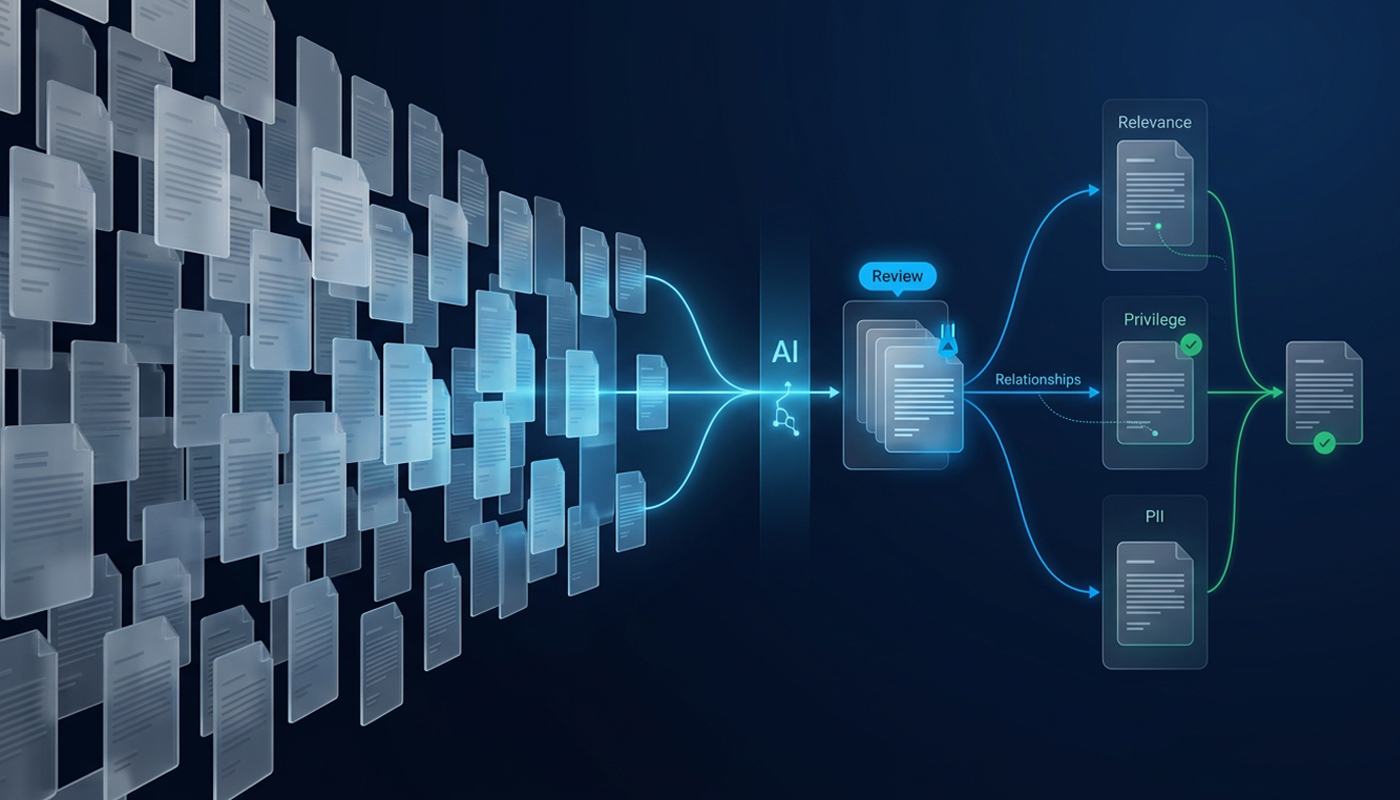
Within the first hours of a matter, Case Insight generates a key events timeline, key people profiles, a case narrative, and a triage of all documents into categories and relevance - before a single human review decision has been made. The case team starts review already knowing what the matter is about.
Review Suite: AI Relevance + Privilege
AI-driven relevance review paired with rigorous privilege identification, review, and logging -targeting the two most resource-intensive stages of discovery: first-pass relevance and the privilege workflow that follows it.
How the integration is built
Architecturally, the integration runs on eDiscovery AI's secure REST APIs. The operative design decision is what doesn't happen: there is no export step. Data is processed and results are delivered natively within Venio — in the vendor's words, "without requiring data export or external tools, keeping all activity within the platform." The corpus stays in the same governed environment that holds it from legal hold through production, and the integration is available to Venio's eDiscovery customers now.
That single decision -results delivered inside the platform rather than in a separate tool - is what the rest of this guide unpacks, because it changes three things that matter to technical and functional evaluators: where your data travels, how fast the AI feedback loop runs, and what your audit trail looks like when someone challenges the review.
Why the timing matters for evaluators: early case intelligence has historically forced a trade-off - either export data to a specialist AI tool (with the custody and security questions that raises) or wait for human review to surface the story of the case. An integration that produces the narrative inside the review platform, in the first hours of a matter, removes that trade-off. If AI capability is a purchase criterion in your current evaluation, this is the architecture question to put to every vendor on your shortlist.
Where AI Assists Across the Venio Workflow
The clearest way to understand integrated AI is stage by stage. Venio's workflow runs from legal hold through production in one system; AI participates at each stage after ingestion, and every stage's AI output feeds the next without a format conversion or transfer in between - because processing, ECA, review, redaction, and production share the same index.
One platform, one index
| Workflow stage | What the AI does | What the human does |
|---|---|---|
| Processing | Email threading collapses sprawling chains into their inclusive messages; near-duplicate detection groups near-identical files so each concept is reviewed once, not forty times. | Sets processing specifications, confirms deduplication scope, and validates exception reports before anything moves forward. |
| Early Case Intelligence | Case Insight builds the key events timeline, key people profiles, case narrative, and full-corpus triage into categories and relevance. Concept clustering groups documents by theme; predictive coding ranks millions of documents by relevance. | Reads the narrative critically, tests it against what the legal team knows, sets scope and search strategy, and decides what enters the review population. |
| Review | Continuous active learning re-ranks the review set after every tagging decision, continuously pushing likely-relevant documents to the front of the queue. AI-driven relevance review suggests coding; smart search and sentiment analysis let reviewers interrogate the data directly. | Makes every coding call. Reviewer decisions are the training signal - each tag teaches the model, and disagreement with an AI suggestion retrains rather than argues. |
| Privilege | Privilege identification flags candidate documents and supports privilege review and logging as a structured workflow rather than a spreadsheet exercise. | Attorneys make the privilege determination - a judgment call AI can queue but never make - and own the final privilege log. |
| Redaction & QC | AI redaction and PII detection automatically finds sensitive and personal information across the production set. | Verifies redactions, resolves flagged edge cases, and signs off on the QC pass before anything is stamped. |
| Production | Validation metrics - recall, precision, and elusion - quantify how complete the review was, on demand. | Certifies the production, armed with the statistics and the audit record to defend it. |
Capability names in this table are Venio's published feature set; the division of labor between AI and reviewer reflects the platform's stated design principle that models assist reviewers rather than replace their judgment.
The shared index is the whole trick: processing, ECA, review, redaction, and production share the same index in Venio - no exports, no re-ingestion, no friction between tools. That is why a tagging decision made at 2:14 pm can re-rank the queue at 2:14 pm, and why the triage Case Insight builds during ECA is still attached to the same documents when they reach production QC.
How Human Control Is Maintained at Every Step
Venio's stated first principle for AI is blunt: "AI accelerates the work; your team makes the calls. Every model assists reviewers - it never replaces their judgment." For a technical evaluator, the useful question is what enforces that principle structurally - what in the architecture makes human control the default rather than a policy hope.
Three structural properties do the work:
- AI outputs are rankings and suggestions, not dispositions. Predictive coding ranks; clustering groups; Case Insight triages and narrates; relevance review suggests. None of these outputs is a final coding decision. A document leaves the workflow coded the way a person coded it.
- The feedback loop runs through reviewers, not around them. Continuous active learning re-ranks the set after every tagging decision - which means the model's behavior is a running consequence of human judgment. A reviewer who disagrees with the machine doesn't file a ticket; they tag the document, and the model updates.
- Access is role-based. Who can train models, accept batch suggestions, apply redactions, or certify validation is a permissions question, controlled the same way every other privileged action in the platform is controlled.
Control points, stage by stage
ECA
The narrative is a hypothesis, not a finding. Case Insight's timeline, people profiles, and case narrative give the team a starting map in hours the case team validates it against pleadings, custodian interviews, and counsel's own knowledge before it shapes strategy.
Scoping
Humans set the review population. AI triage informs which documents enter review; the case team decides - culling criteria, date ranges, and custodian scope remain protocol decisions made and documented by people.
Review
Every coding decision is a human decision. AI suggestions accelerate first-pass review; the reviewer's tag is what the record shows, and every tag simultaneously retrains the ranking model.
Privilege
Attorneys own privilege. AI flags candidates and structures the log; the privilege determination itself - the judgment a court will scrutinize hardest - is made by counsel, document by document.
Validation
People decide when review is done. Recall, precision, and elusion metrics inform the stopping decision; the case team makes it, against the defensibility standard the matter demands.
A useful demo test: ask any vendor - Venio included - to show you a reviewer disagreeing with the AI. Watch what happens next: does the override take effect immediately, does the model learn from it, and does the audit trail show who overrode what and when? Platforms differ more on this one interaction than on any accuracy claim.
Defensibility: How AI Decisions Are Logged and Auditable
Courts have accepted technology-assisted review for over a decade - the question in 2026 is no longer whether you may use AI in review, but whether you can show how you used it. Defensibility is not a property a platform has; it is a record a workflow produces. What a platform can do is make that record automatic.
Venio's approach rests on measurement plus custody. On the measurement side, the platform tracks the three statistics that anchor every serious TAR protocol:
Recall
"Of everything relevant, how much did we find?"
The completeness statistic - the one opposing counsel and courts care about most. Estimated by sampling, it answers whether the review found the relevant material that exists in the corpus.
Precision
"Of what we flagged, how much was actually relevant?"
The efficiency statistic. Low precision means humans are reviewing noise; tracking it shows the model is concentrating reviewer attention where it belongs.
Elusion
"What's hiding in the discard pile?"
The stopping-point statistic. An elusion test samples the documents the review will not produce, to confirm relevant material is not slipping through - the standard evidence that a review stopped defensibly.
On the custody side, the same governed environment that measures the review also records it: full chain of custody on the data, role-based access on every action, and - because hold through production happens in one system - no cross-vendor boundary where the record fragments. The result, in Venio's words, is an audit-ready record: who trained what, who coded what, who overrode what, and what the validation statistics were when the team certified completion.
What a defensible AI review record contains
Whatever platform you run, a record that survives a meet-and-confer challenge has the same skeleton. An integrated platform generates most of it as a by-product of the work rather than as an after-the-fact reconstruction:A prompt describing what responsive means on this matter drives the classification, and every document returns with one of four tags.
- The protocol - a written description of how AI was used: which tools, at which stages, with what thresholds and workflow.
- The training record - who made the coding decisions the models learned from, and when.
- The validation statistics - recall, precision, and elusion at the point the team declared review complete, with the sampling method documented.
- The exception log - overrides, escalations, and privilege determinations, attributable to named, authorized people.
- The custody chain - proof the data never left the governed environment between hold and production.
That last item is where architecture becomes defensibility: a workflow with no export step has no export to explain.
The AI Review Defensibility Checklist
A working document for your next AI-assisted matter - the questions to answer before review starts, the metrics to capture while it runs, and the record to have in hand when the protocol is challenged.
- Pre-review protocol questions to settle (and document) before training begins
- A validation log template covering recall, precision, and elusion
- Meet-and-confer preparation: what to disclose about your AI workflow, and when
- An architecture question set for evaluating any vendor's AI integration
Get the Checklist (PDF)
At Venio, we're committed to your privacy. For details on how we process your data, please review our Privacy Policy.
Validating and Overriding AI Suggestions
Trust in an AI review workflow is earned the same way trust in a human review team is earned: by checking the work. In practice that means two disciplines - a validation loop that measures the model against human judgment, and an override path that makes disagreeing with the model cheap, immediate, and recorded.
The validation loop
A sound AI-assisted review validates continuously rather than once at the end:
- 1Baseline with a human-coded sample. Before relying on any ranking, code a random sample by hand. It estimates richness (how much relevant material the corpus holds) and gives the model - and the team - a ground truth to be measured against.
- 2Watch the ranking behave. As reviewers tag and continuous active learning re-ranks, the proportion of relevant documents at the front of the queue should climb. A model that isn't concentrating relevance is telling you something about the data or the protocol - investigate before proceeding.
- 3Sample what the AI would set aside. Periodically review a sample from the low-ranked population. This is the working form of the elusion test, run during review rather than only at the end.
- 4Run the formal stopping test. When the team believes review is complete, an elusion sample of the un-reviewed population plus final recall and precision estimates turn "we think we're done" into a documented, statistical stopping decision.
- 5Record everything as you go. Each of the four steps above produces numbers and decisions - captured inside the platform, they become the validation section of your defensibility record with no reconstruction effort.
The override path
Overriding is not an exception flow - it is the normal operating mode of a human-controlled system. Three properties make overrides meaningful rather than cosmetic:
- Immediate effect: a reviewer's tag is the document's coding, full stop. There is no queue where a human decision waits for machine approval.
- The model learns from the disagreement: because reviewer decisions are the training signal, an override doesn't just fix one document - it steers the ranking for every similar document still in the queue.
- The disagreement is part of the record: overrides, second-pass reversals, and privilege escalations are attributable actions in the audit trail - evidence of supervision, which is precisely what a court challenging an AI workflow wants to see.
Reframe overrides for your team: a review protocol where humans never disagree with the AI is not a sign of a great model - it's a sign nobody is checking. Healthy AI-assisted reviews show a visible, declining disagreement rate as the model converges on the team's judgment. That curve is itself defensibility evidence.
How This Differs from Bolt-On AI Architectures
Most AI in eDiscovery today arrives as a bolt-on: a capable, often excellent tool that lives outside the review platform. The workflow it imposes is familiar - export a document set, transfer it to the AI tool, process, then re-import results and reconcile them against the review database. Each of those arrows is the same kind of handoff cost a fragmented processing-and-review stack creates, applied to the most sensitive data in the matter:
Bolt-on AI workflow
Integrated AI workflow
| Dimension | Bolt-on AI | Integrated AI (Venio's architecture) |
|---|---|---|
| Data movement | Document sets leave the review environment for processing - every transfer is a security review, an access grant, and a custody event. | Data is processed and results are delivered inside the platform - no export step exists to secure, approve, or explain. |
| Chain of custody | The record fragments at each system boundary; reconstructing an end-to-end account means stitching logs from multiple vendors. | One governed environment from hold through production produces one continuous, audit-ready record. |
| Feedback loop | Batch cadence: export, process, re-import - model improvement arrives in rounds, often days apart. | Continuous cadence: the ranking updates after every tagging decision, because model and review queue share one index. |
| Version drift | The AI tool's copy and the review database diverge the moment review continues during processing - reconciliation is a recurring QC task. | There is one copy. AI outputs attach to the same documents reviewers are working, with nothing to reconcile. |
| Privilege exposure | Potentially privileged material transits and rests in an additional system, expanding the surface a privilege-protection protocol must cover. | Privilege candidates are identified, reviewed, and logged where the documents already live, inside existing access controls. |
| Cost behavior | A second license, a second hosted copy, and the admin hours of every export/import cycle - costs that recur per matter. | AI rides the platform's existing licensing and hosting; the handoff labor simply does not occur. |
This table compares architectures, not vendors - bolt-on deployments vary, and the pattern is described generically. Evaluate any specific tool against its own current documentation.
What Your Record Contains
Honesty matters here: bolt-on AI is not a design mistake. Specialist tools can be genuinely best-of-breed at a narrow task, and a team running one matter type on a stable platform may find the boundary tolerable. The bolt-on model earns its keep when the AI task is occasional, self-contained, and worth the transfer overhead. It breaks down when AI-assisted review is the everyday operating mode - because then every matter pays the export tax, the custody seams multiply, and the batch feedback loop throttles the very iteration speed that makes active learning effective. If AI review is becoming your default rather than your exception, the architecture question stops being optional.
AI Inside the Platform, Not Bolted Onto It
Everything this guide describes ships in one system: Venio's native AI suite and the Case Insight integration operate on the same index that runs legal hold, processing, ECA, review, and production - with human control and an audit-ready record as the default, not an add-on.
Day-one case intelligence
Case Insight delivers the key events timeline, key people profiles, case narrative, and full-corpus triage within the first hours of a matter - natively, with no data leaving the platform.
AI review with human control
AI-driven relevance review, continuous active learning, and privilege identification accelerate the work - while every coding and privilege call stays with your reviewers, by design.
A record that accrues
Recall, precision, and elusion tracking, full chain of custody, and role-based access produce the audit-ready record - in one governed environment from hold to production.
Frequently Asked Questions
Everything you need to know about Venio AI Capabilities
What is Case Insight in Venio?
Case Insight™ is eDiscovery AI's Early Case Intelligence™ solution, integrated into the Venio platform as of August 17, 2026. Within the first hours of a matter it generates a key events timeline, key people profiles, a case narrative, and a triage of all documents into categories and relevance - delivered natively inside Venio, so the case team starts review already understanding the matter.
Does Venio's AI send my data to an external tool?
No. The integration is built on secure APIs and delivers results within the Venio platform - without requiring data export or external tools. Your documents stay in the same governed environment that manages them from legal hold through production, under the platform's existing chain of custody and role-based access controls.
Is AI-assisted document review defensible in court?
Technology-assisted review has been judicially accepted for over a decade; what courts scrutinize is the process - how the AI was used, supervised, and validated. A defensible workflow documents its protocol, tracks recall, precision, and elusion, and can attribute every decision and override to a named, authorized person. Venio's platform is built to generate that record as a by-product of the review rather than an after-the-fact reconstruction.
Can reviewers override the AI's suggestions?
Yes - and overriding is the system's normal operating mode, not an exception. AI outputs in Venio are rankings and suggestions; the reviewer's coding decision is what the record shows. Because continuous active learning retrains on every tagging decision, an override also steers the model for every similar document still in the queue, and the disagreement itself becomes part of the audit trail.
What AI capabilities are built into the Venio platform?
Venio's native AI suite includes continuous active learning, predictive coding, concept clustering, email threading with near-duplicate detection, smart search with sentiment analysis, and AI redaction with PII detection - all operating on the same shared index as processing, ECA, review, and production. The August 2026 Case Insight integration adds early case intelligence and an AI relevance-and-privilege review suite on top of that foundation.
How is an AI-assisted review validated?
Through sampling statistics measured against human judgment: recall (of everything relevant, how much was found), precision (of what was flagged, how much was actually relevant), and elusion (how much relevant material remains in the un-reviewed population). Venio tracks these metrics in the platform, so the stopping decision - declaring review complete - is a documented statistical judgment rather than a hunch.
Is the Case Insight integration available now, and what does it cost?
The integration is available to Venio's eDiscovery customers now. Commercial terms depend on your deployment and matter profile - the fastest route to specifics is to book a demo and walk through your use case, or request pricing.