Data Subject Access Request: Beyond the Deadline
Ready to get started?
built for clarity, control, and scale.
Share
Most privacy compliance teams measure a data subject access request by one number: did we respond in time? It is the obvious yardstick, and it is only half of what gets judged.
The deadline is fixed. Most US state privacy laws give you around 45 days to fulfill a verified request, and GDPR gives you one calendar month. That window stays the same whether the request touches one mailbox or a hundred gigabytes spread across a dozen systems.
But hitting the date is not the same as satisfying a regulator. When an authority reviews your response, it rarely stops at the timestamp. It asks how you got there: what you searched, what you found, what you produced, and whether anything you deleted is actually gone.
This blog covers the two things that decide a DSAR outcome long after the clock starts: where your compliance data lives today, and what defensible really means.
The DSAR Clock is Fixed. Your Data Isn't.
A few years ago, a data subject access request meant searching email and maybe a shared drive. The data sat in a couple of predictable places. That world is gone.
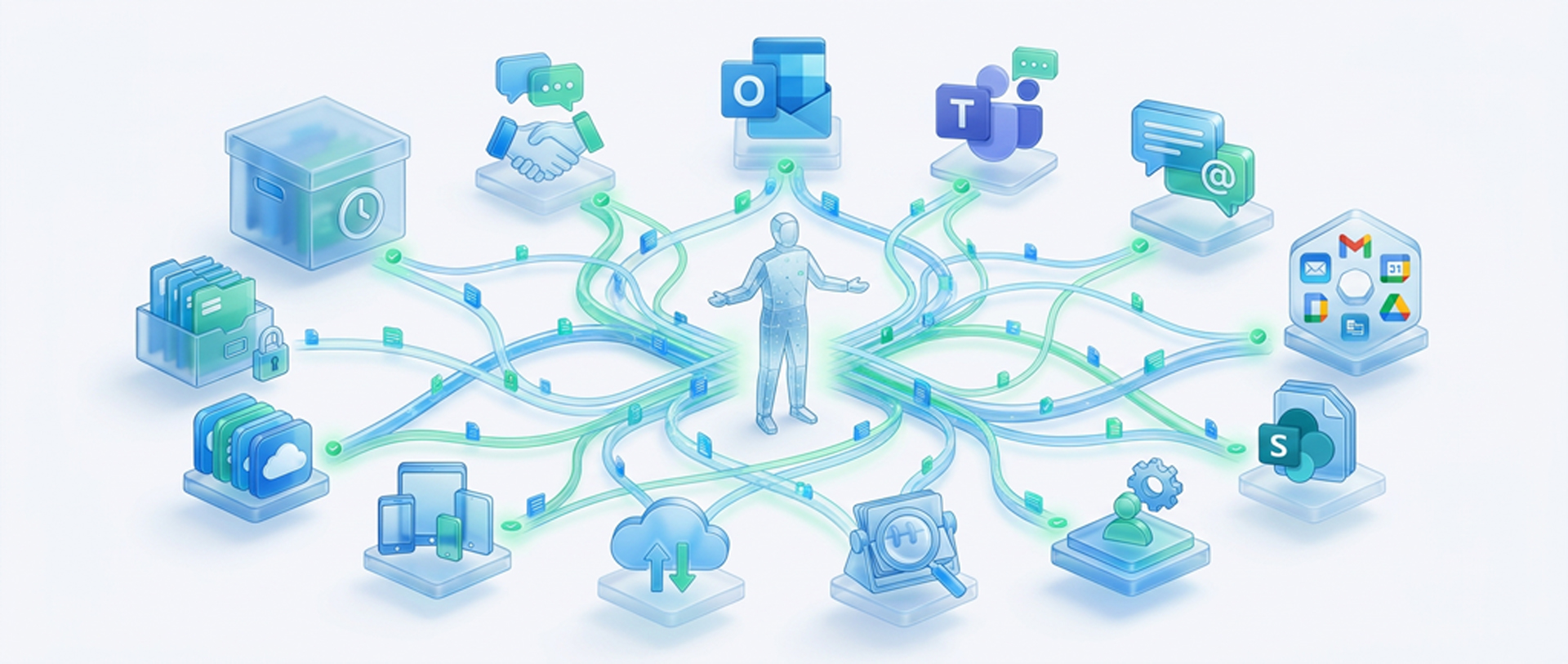
Today, the information a single request touches is scattered across the tools your organization actually works in. Slack and Teams threads, Google Drive and SharePoint, the HR system, the CRM, and a long tail of SaaS apps nobody mapped. One person's personal data can live in a dozen systems owned by a dozen teams.
The requests keep climbing, too. Privacy requests have risen steadily, and most organizations still handle them in-house, spread across legal, IT, compliance, and HR.
Where Compliance Data Actually Hides
The new sources are not just more numerous. They behave in ways email never did, and each trait works against a clean response.
They were not built to be searched or exported cleanly, so pulling defensible data out of a collaboration tool is a project, not a click. They also change in real time. Messages get edited and deleted, so capturing an accurate record depends on capturing them correctly rather than exporting them after the fact.
Context lives in the thread. A single message rarely tells the whole story, and stripping away the surrounding conversation costs you both the meaning and the defensibility. Miss the wrong fragment, and you do not just have an incomplete response. You have a gap you cannot defend later.
Treating modern eDiscovery data sources as a search problem rather than an export problem is the first decision that separates a clean response from a scramble.
What Regulators Look for in a DSAR Response
When a regulator examines a response, it is rarely just confirming that something went out on time. It examines how you arrived at the result. Can you show what you searched and what you found?
Did you produce everything responsive, and is there anything you should not have? Is the deleted data genuinely gone, everywhere it lived?
A response that arrives on time but cannot be explained is a weak response. The teams that hold up under scrutiny are not always the fastest; they can account for every step. This is the heart of DSAR compliance, and it is where many organizations are exposed.
Most data compliance failures that regulators act on are not sophisticated breaches. They are process failures: a missed deadline, an incomplete search, a step nobody can reconstruct.
What Defensible Data Privacy Compliance Means
Defensibility is not something you assemble after the fact. It is built into the way privacy work is performed every day.
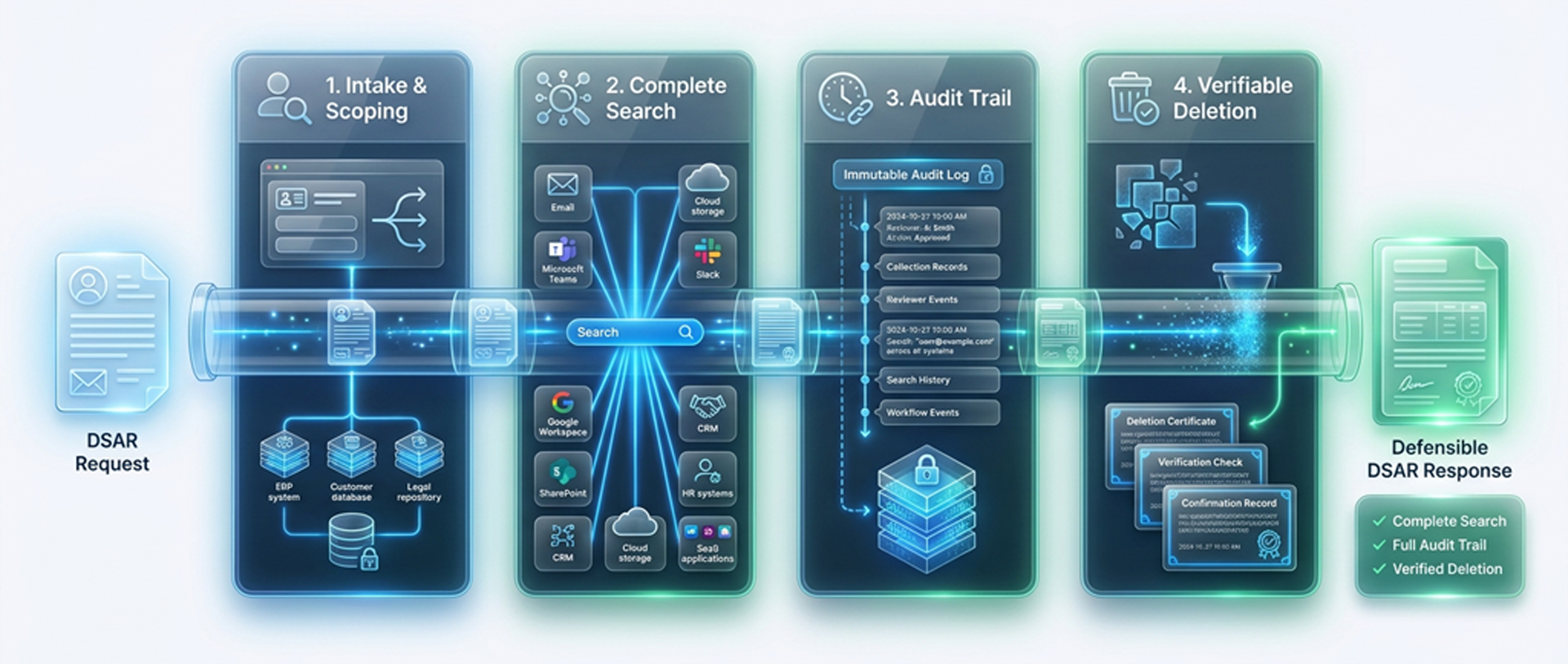
It rests on four foundations:
- A documented intake and scoping process so every request is handled consistently.
- An audit trail that records who searched, what was found, and what was produced or deleted.
- Completeness you can demonstrate, not simply assume.
- Proportionate identity verification that protects personal data without creating unnecessary barriers for legitimate requesters.
Defensible data collection begins at the source. When these foundations are missing, a single mishandled request can create much larger compliance and legal risks.
Those risks are becoming more costly. GDPR penalties can reach €20 million or 4% of global annual turnover, whichever is higher. At the same time, enforcement activity in the United States is increasing as more states adopt comprehensive privacy laws.
The cost of a process you cannot defend is rising faster than the cost of building one you can.
Three Questions to Pressure-Test Your DSAR Process
Being more careful is not a strategy. The teams that stay out of trouble make the defensible path the default path, so every request is scoped, searched, produced, and documented the same way, with the trail captured automatically.
When you evaluate your own DSAR process, three questions matter more than the rest:
- Can you search across all your sources, email, files, chat, and cloud apps, from one place instead of system by system?
- When you pull collaboration data, does it keep its context and threading, or arrive as disconnected fragments?
- Can you produce an end-to-end record of any request, including defensible deletion that proves the data is gone, without scrambling to reconstruct it?
If any answer is no, that is where your next defensibility gap is hiding. This is the layer Venio is built around: a single platform where collection, search, review, redaction, production, and defensible deletion run in one place, with every step captured in an auditable trail.
It collects data from modern sources like Slack, Teams, and Google Workspace, preserving threading and context, so that your work becomes part of doing the work.
The DSAR Test Most Teams Don't Prepare For
A data subject access request is more than a deadline-driven exercise. It is a test of whether your organization can locate personal data wherever it lives, preserve the context around it, and prove every step taken from collection through production or deletion.
The challenge is not the request itself. It is the growing complexity of the systems where personal data resides. As collaboration platforms, cloud repositories, and SaaS applications become part of everyday work, defensibility depends on having a process that is repeatable, auditable, and complete across all of them.
Organizations that respond confidently are not relying on manual searches and disconnected workflows. They have built a process that makes defensibility part of the work itself.
Venio helps privacy, legal, and compliance teams search modern data sources from a single platform, preserve context from tools like Slack and Teams, and maintain a complete audit trail from request intake through production and defensible deletion.
Contact us and see how Venio helps turn DSAR compliance into a defensible, repeatable workflow.
FAQs
What is a Data Subject Access Request?
A data subject access request, often shortened to DSAR, is a formal request from an individual to see the personal data an organization holds about them. It is a core right under GDPR, and most US state privacy laws, and a complete response includes the data plus context such as why it is processed and who it has been shared with.
How Long do You have to Respond to a Data Subject Access Request?
Under GDPR, you generally have one calendar month from receipt, extendable by two further months for complex requests if you notify the individual in time. Under the CCPA, businesses respond within 45 calendar days, with one 45-day extension permitted. Verifying identity does not pause that clock.
Do You have to Search Chat Tools Like Slack and Teams?
If responsive personal data lives there, yes. Privacy rights apply to the data, not the platform, so collaboration tools, cloud storage, and SaaS apps are all in scope. Skipping a source because it is hard to search does not make the response complete, and an incomplete search is a common defensibility gap.
What Makes a DSAR Response Defensible?
Defensibility comes from a repeatable process you can prove: documented scoping, a search across every relevant source, an audit trail of who did what, demonstrable completeness, and verifiable deletion. A response is defensible when you can reconstruct every step on demand, not just show that it shipped on time.
Related Articles
What is eDiscovery Software?
In a world where business communication is overwhelmingly digital, these trails
Read Article
4 Proven Ways to Control eDiscovery Costs in Any Legal Case
eDiscovery continues to rank among the top cost drivers for legal departments,
Read Article
Discovery Objections: A Comprehensive List and How to Succeed
During the discovery process, an attorney attempts to obtain
Read Article