How to Write an eDiscovery RFP (with Free RFP Template)
Ready to get started?
built for clarity, control, and scale.
Share
Most eDiscovery RFPs produce a thick stack of proposals and a thin basis for deciding. Every vendor answers "yes" to every capability question, the pricing arrives in five different formats, and the team picks the platform with the best slide deck.
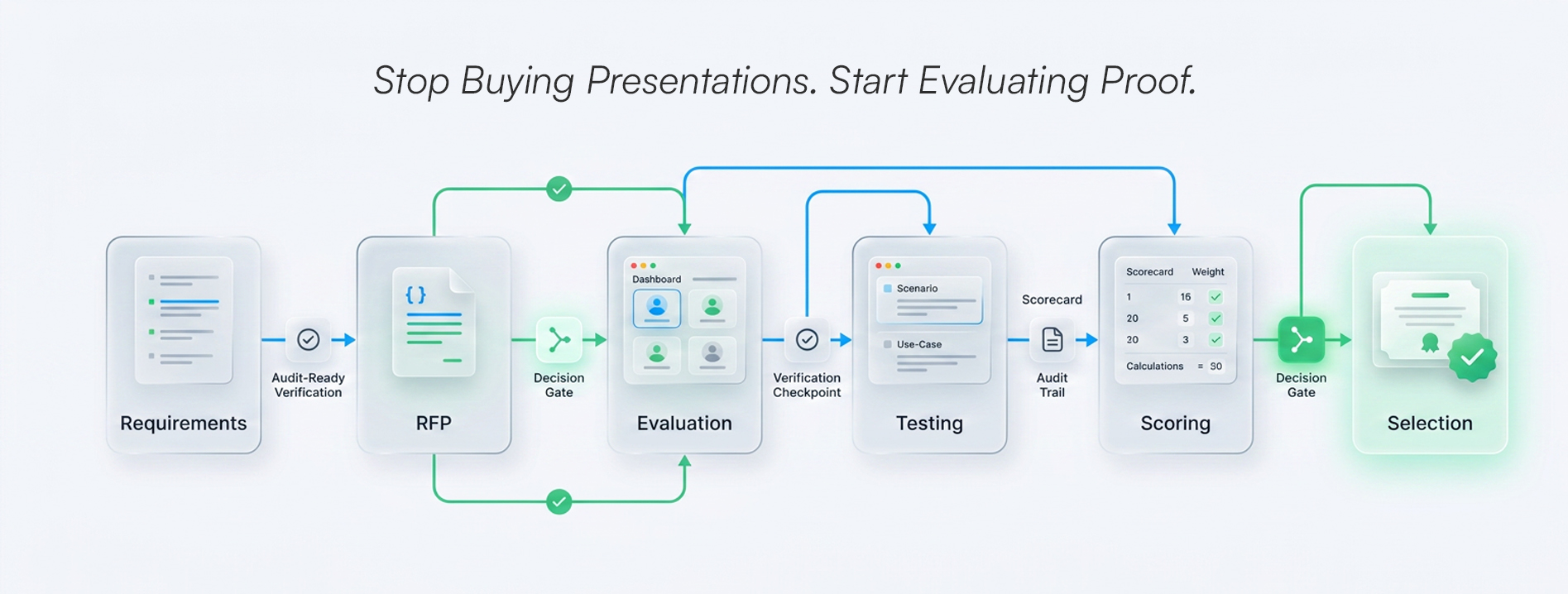
This guide fixes that. It shows how to write an eDiscovery RFP that forces vendors to prove what they claim, so eDiscovery software procurement becomes a decision you can defend later, not a popularity contest. You will get a clear method, the eDiscovery RFP tips that actually matter, the requirement categories that separate platforms, and a free, vendor-neutral RFP template with a built-in scorecard.
It is written for the people who own the outcome: eDiscovery managers, litigation support leads, legal operations, and the procurement partners who run the process with them.
What an eDiscovery RFP (Request for Proposal) Is, and What It Is Not
A Request for Proposal (RFP) is a formal document you send to eDiscovery vendors that describes your needs and asks each one to propose how they would meet them, at what price. An eDiscovery RFP is the backbone of structured eDiscovery vendor selection.
One quick clarification, because the acronym is overloaded. In litigation, RFP often means Request for Production of documents. This guide is about the procurement sense: the Request for Proposal you use to choose a software or services partner.
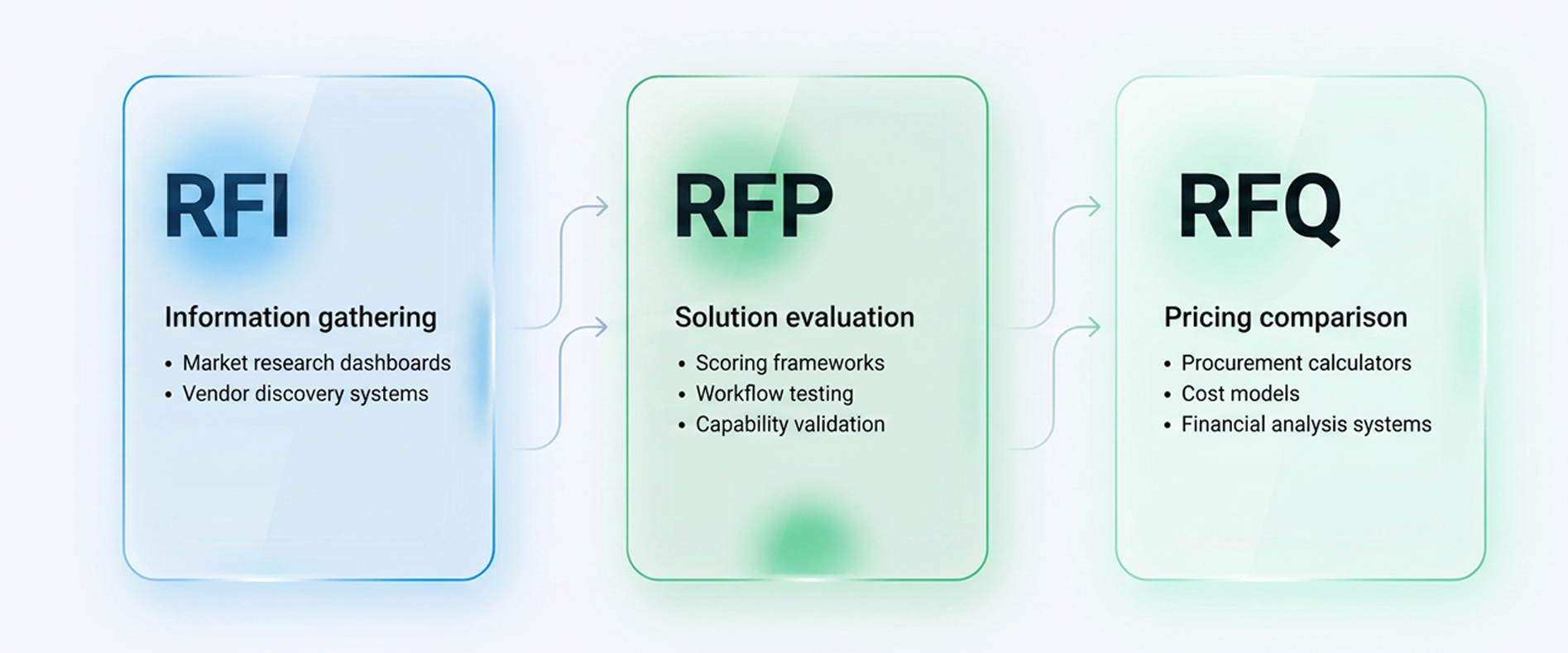
It also helps to separate three related documents. An RFP asks vendors to propose a full solution when you are still shaping your approach. A Request for Information (RFI) gathers high-level detail to build a shortlist. A Request for Quotation (RFQ) asks for a price when you already know exactly what you want. If you are still comparing platforms, you want an RFP.
Why Most eDiscovery RFPs Fail
Here is the uncomfortable truth. The typical eDiscovery RFP fails before a single response arrives because of how the questions are written.
Ask a vendor, "Can your platform handle large data volumes?" and the answer is always yes. Ask, "Do you support on-premises deployment?" Again, yes. Closed, self-graded questions hand every vendor a perfect score and tell you nothing about how they actually perform under pressure.
The strongest RFPs flip this. They treat every important claim as something to be demonstrated, not asserted. They define which eDiscovery requirements are mandatory versus desired, attach a weight to each category, and reserve the final decision for vendors who can show the workflow live.
That shift, from collecting answers to demanding proof, is the single biggest improvement you can make to your eDiscovery RFP process.
Before You Write Your eDiscovery RFP: Define Scope Against the EDRM
A good RFP starts with a precise picture of the work. The clearest shared language for that is the Electronic Discovery Reference Model, the nine-stage framework that maps the discovery lifecycle from information governance through presentation.
Walk your scope through each relevant stage. Which sources will you identify and preserve? How will you collect from modern data like chat and collaboration tools? What volumes do you expect at a typical matter and at peak?
Mapping scope this way stops vendors from quoting only the phases they are strongest in, and it stops you from discovering a gap after the contract is signed.
You also need to decide your deployment reality up front. A regulated organization with data sovereignty rules has very different needs from a firm that wants to spin matters up quickly in the cloud. Knowing this before you draft your RFP for eDiscovery services keeps the document honest.
How to Write an eDiscovery RFP, Step by Step
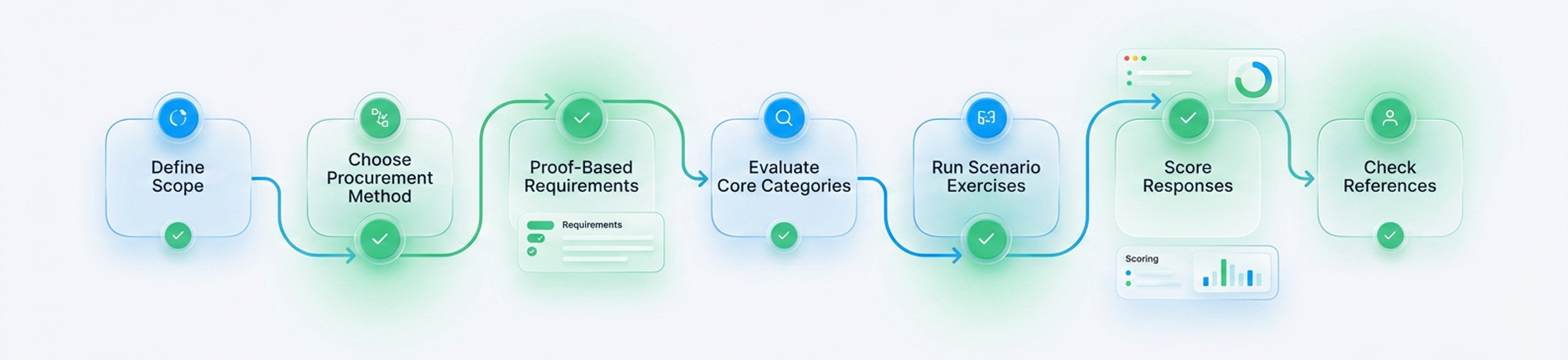
The mechanics of how to write a request for proposal are much the same in any procurement. What changes for eDiscovery is which requirements you weigh and how hard you press for proof. Work through the seven steps below.
Step 1: Establish the Stakes and Scope
Open the RFP with who you are, why you are buying, and what success looks like. State your industry, regulatory environment, team size, expected data volumes, and target go-live date. When you issue an RFP for eDiscovery services, vague background invites vague pricing, so be specific from the first line.
Step 2: Choose Between an RFP, RFI, or RFQ
Confirm you actually want a Request for Proposal. If you only need to build a shortlist, send an RFI first. If you know exactly what you want and only need a price, an RFQ is faster.
Step 3: Write Requirements That Demand Proof
For each requirement, mark it Mandatory or Desired, and never leave a closed question to stand alone. Where you ask "do you support X," add "describe how, and attach evidence." Evidence can be a document, a screenshot, a reference, or a live demonstration. A platform that cannot show it usually cannot do it.
Step 4: Cover the Categories That Differentiate eDiscovery Platforms
Generic templates ask about company size and call it a day. The categories below are where eDiscovery platforms genuinely diverge, so weight them accordingly.
Deployment and Data Residency
Ask which deployment models the vendor truly supports: cloud, on-premises, private cloud, and hybrid. The sharper question is whether all models run on a single codebase or differ in features and release schedule. The ability to keep a sensitive matter on-premises while scaling a high-volume matter in the cloud, all from one platform, is a real differentiator.
Security and compliance
Require current attestations such as SOC 2 Type II, ISO 27001, and FedRAMP status, plus encryption, role-based access, and a complete chain of custody you can report on.
Processing and performance
Ask for sustained and peak throughput in plain numbers. A platform built for speed should process high volumes without re-platforming when a matter spikes.
Review, AI, and analytics
Ask whether AI features like predictive coding and clustering are native or bolted on through plugins that add cost and move your data around. Native capability on a unified eDiscovery platform keeps workflows and spend under control.
Legal hold and preservation
Ask whether legal hold is built in or a separate product, and how holds, custodians, and acknowledgments are tracked and audited for defensibility.
Production, integrations, and support
Cover production formats and quality control, native connectors to sources like Microsoft 365 and Slack, and exactly who supports your team during onboarding.
Step 5: Add Scenario-Based Exercises
This is the step competitors skip. Give each finalist two or three realistic scenarios and ask them to respond in writing and demonstrate the workflow live. A volume-spike scenario, a cross-border sensitive-matter scenario, and a defensibility-audit scenario will tell you more in an hour than a hundred closed questions.
Step 6: Score Your eDiscovery RFP With a Weighted Rubric
Agree your weights before any proposal arrives. Score each category from 1 to 5, multiply by its weight, and sum. Weighting the rubric toward deployment fit, security, performance, and defensibility keeps the decision objective and easy to explain to leadership.
Step 7: Run Demos and Check References
Score the proposals, invite the top vendors to the scenario demos, and check references of similar size and matter profile. The award should reflect total value across capability, defensibility, deployment fit, and total cost of ownership, not list price alone.
eDiscovery RFP Questions That Reveal the Truth
Strong eDiscovery RFP questions are specific, evidence-seeking, and tied to how you actually work. A few examples that outperform their closed cousins:
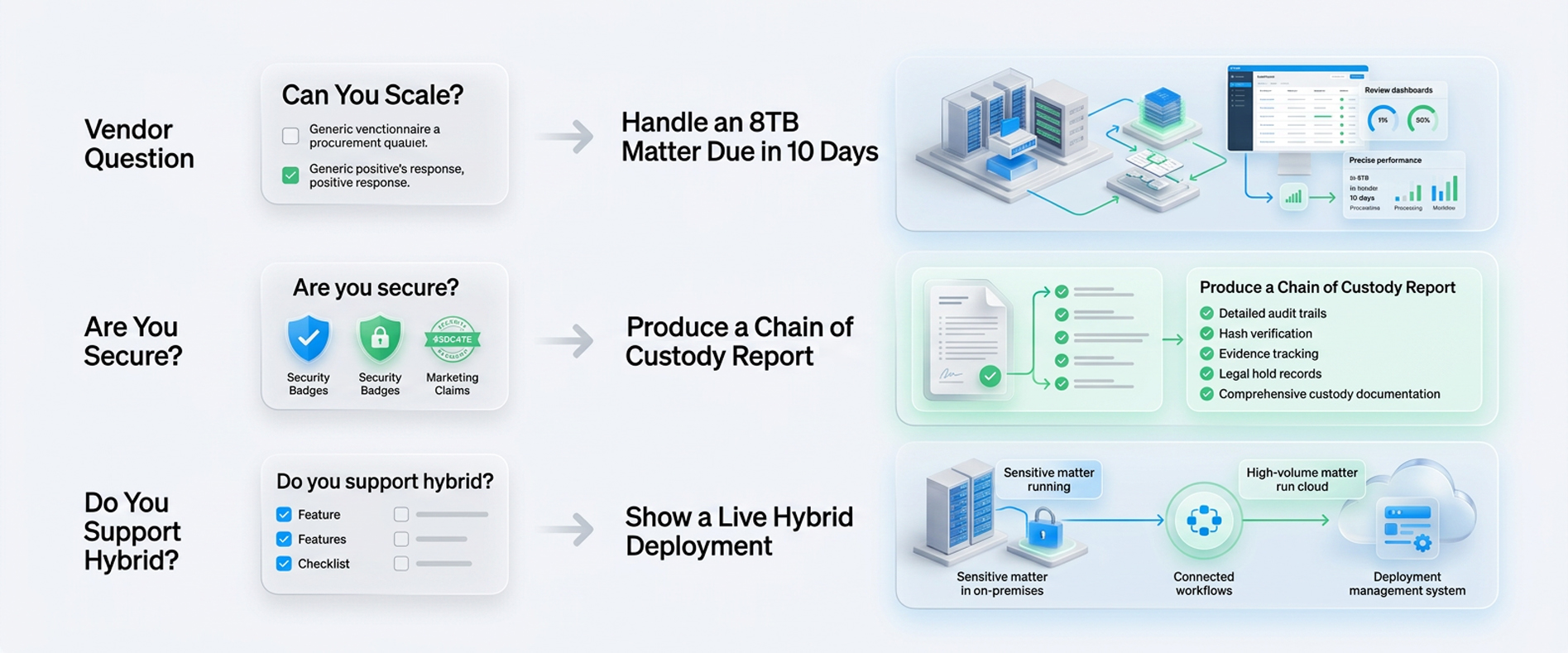
Instead of "Do you scale?", ask "How does the platform handle a sudden eight-terabyte matter due for review in ten days, and what does it cost under your pricing model?"
Instead of "Are you secure?", ask "Produce a complete chain-of-custody and audit trail for a custodian from legal hold through production."
Instead of "Do you support hybrid?", ask "Show a sensitive matter running on-premises and a high-volume matter running in the cloud at the same time, and confirm where each data set physically resides."
The eDiscovery RFP Pricing Trap: Per-Gigabyte vs Flat-Rate
Pricing is where eDiscovery budgets quietly break. Many vendors bill per gigabyte hosted, which looks affordable on a small matter, and then climbs without warning when the matter grows.
Ask every vendor for a worked example: what happens to the bill when a matter becomes ten times larger than planned? Ask them to list every chargeable item beyond hosted data, including processing, exports, training, and overage fees, and to provide a three-year total cost of ownership.
Flat-rate and subscription models exist precisely to remove that uncertainty, letting teams process what a matter needs without watching the meter. Whatever model you prefer, force the comparison into the same format so you are comparing like for like.
eDiscovery RFP Tips: Build a Request for Proposal That Decides for You
A good eDiscovery RFP is not a longer list of questions. It is a sharper method. The best eDiscovery RFP tips all share one idea: treat every important claim as something a vendor must prove rather than assert, and map your scope to the discovery lifecycle before you write a single requirement.
From there, weight your rubric toward what actually separates platforms, namely deployment fit, security, performance, and defensibility, and use scenario exercises to watch the workflow run instead of taking a vendor's word for it. Then force every price into one format so the total cost of ownership is finally comparable across proposals. Do that, and the winning proposal will be obvious to you and easy to defend to leadership.
If you are evaluating platforms against a request for proposal built this way, see how a single, deployment-flexible system answers every requirement category in one place. Contact Venio for a demo and bring your hardest scenario. We would rather show you than tell you.
Frequently Asked Questions
What is an eDiscovery RFP?
An eDiscovery RFP is a Request for Proposal sent to vendors that describes your discovery needs and asks each one to propose a solution and price. It is the structured way to compare platforms during eDiscovery vendor selection, distinct from a Request for Production used in litigation.
What should an eDiscovery RFP include?
At minimum: an organization and project overview, a scope mapped to the discovery lifecycle, requirements marked Mandatory or Desired, scenario-based exercises, a weighted scoring rubric, pricing questions that expose total cost, and a clear submission timeline.
How do you write a request for proposal for eDiscovery services?
Start by mapping scope to the discovery lifecycle, then write requirements that demand proof rather than yes-or-no answers, add realistic scenario exercises, and score every response against a weighted rubric agreed before proposals arrive. That method turns an RFP for eDiscovery services into a defensible decision.
How long does the eDiscovery RFP process take?
It varies, but a typical process runs four to eight weeks from issuing the RFP to award, allowing time for vendor questions, proposals, scenario demonstrations, and reference checks. Complex or regulated procurements take longer.
What is the difference between an RFP, an RFI, and an RFQ?
An RFP asks vendors to propose a full solution when you are still shaping your approach. An RFI gathers high-level information to build a shortlist. An RFQ asks for price when your requirements are already fixed.
How many vendors should I include in an eDiscovery RFP?
Three to five is a practical range. Enough to give you real comparison and negotiating leverage, few enough to evaluate each one properly through scenario demos and reference checks.
Related Articles
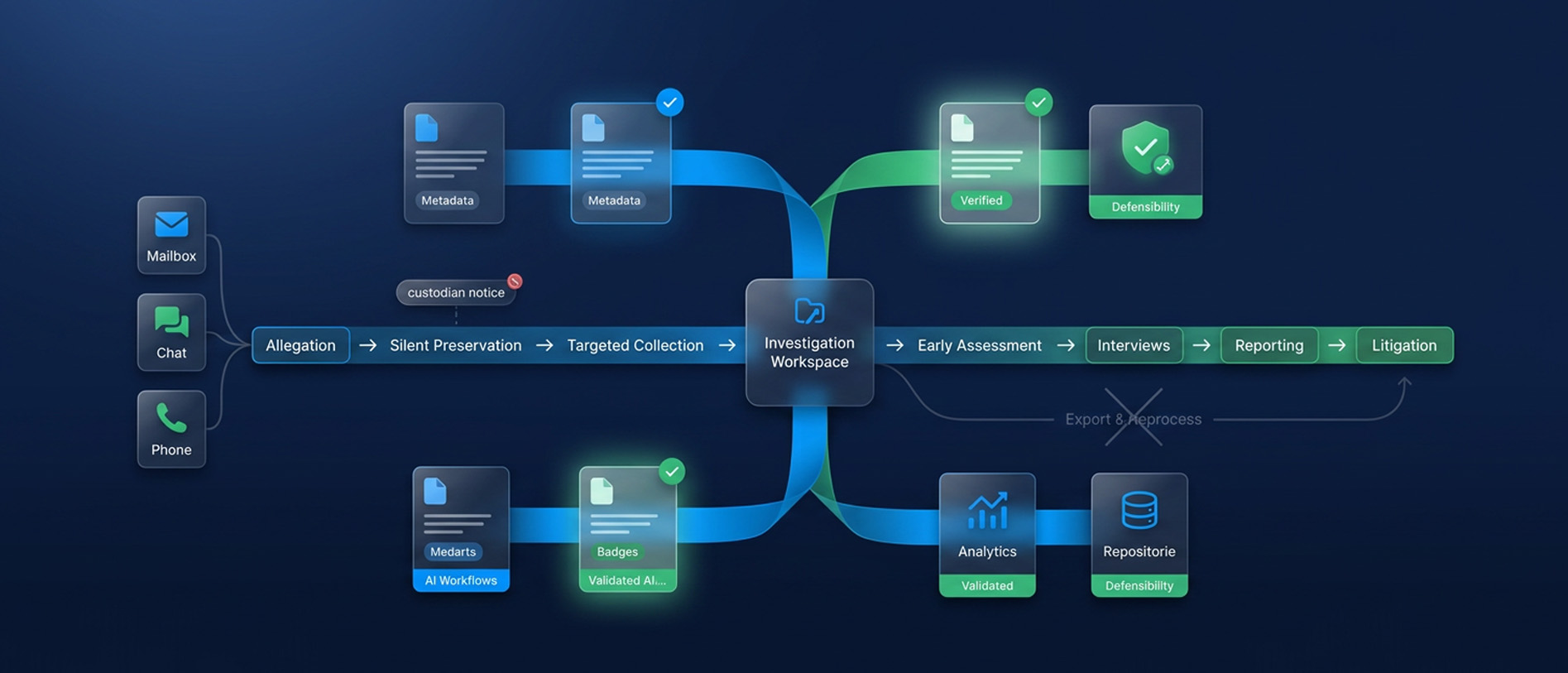
Internal Investigations: Getting the Facts Without Blowing the Matter Open
An internal investigation offers no court schedule and no second chance at prese
Read Article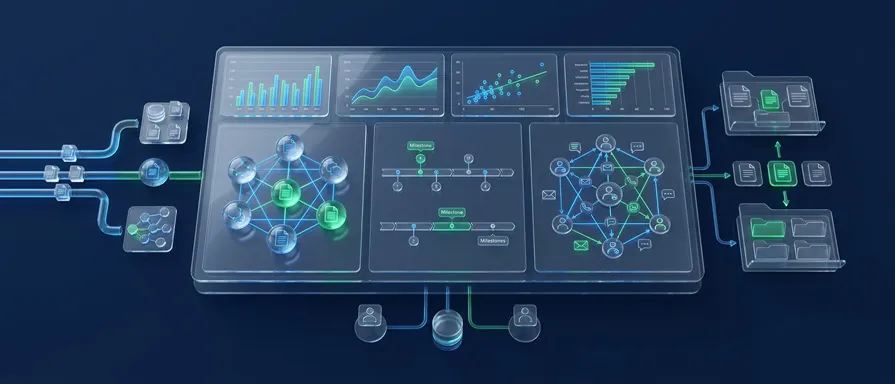
eDiscovery Data Analytics & Visualization for Trial Preparation
Most litigation teams don’t lose at trial because they lack evidence. They lose
Read Article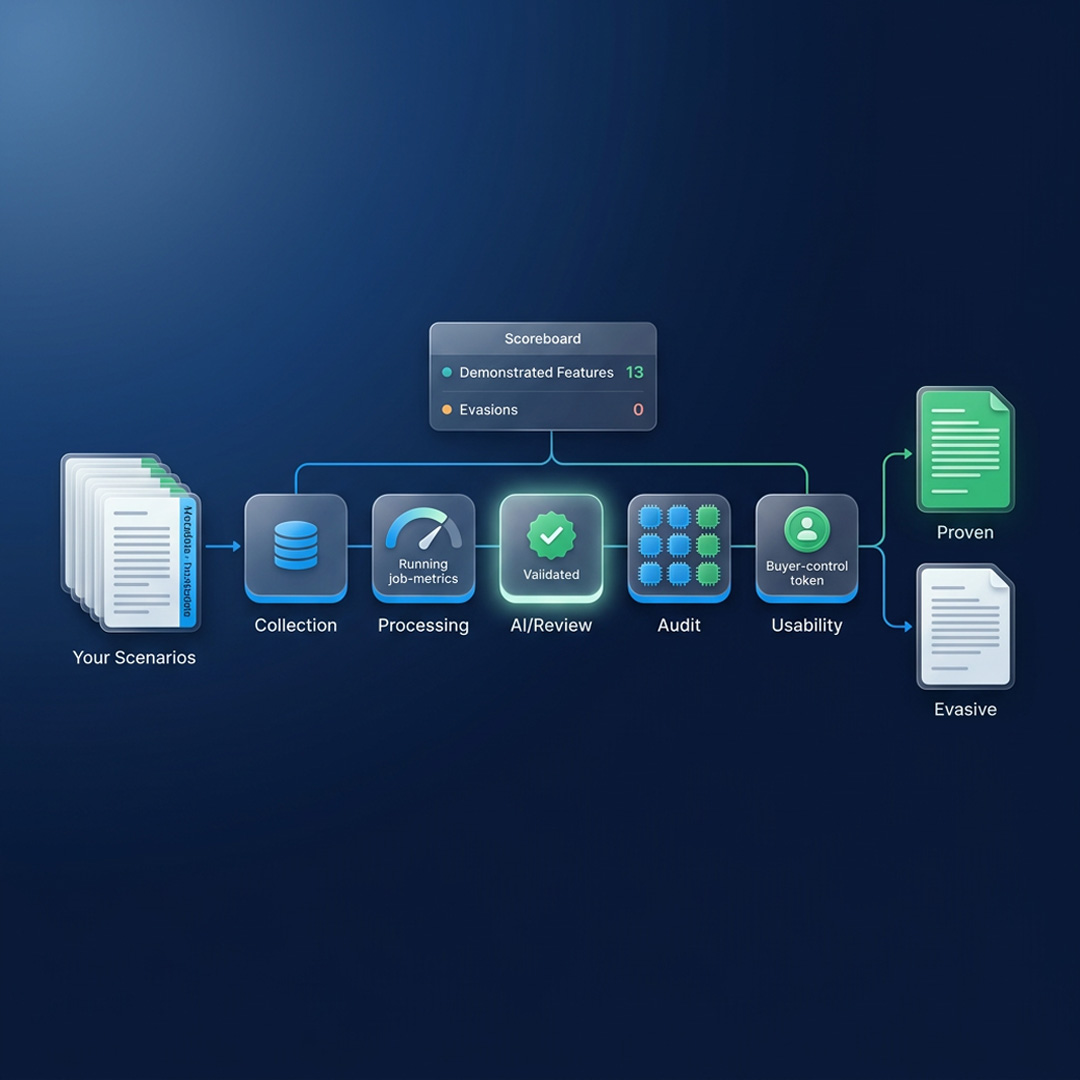
What to Ask in an eDiscovery Demo Before You Sign
Twenty questions that make an eDiscovery vendor prove processing, AI, security a
Read Article