7 Common Legal Hold Mistakes And How to Fix Them

Ready to get started?
built for clarity, control, and scale.
Share
A legal hold notice went out, yet the sanctions motion still succeeded months later. The real failure was proof, since nobody could confirm who received it or when.
That gap is far more common than most legal teams expect. A litigation hold is usually treated as a routine memo, not a document under real scrutiny. In practice, courts examine it closely the moment data goes missing. Small process gaps inside it create real exposure long before anyone acts in bad faith.
Courts do not need to find intent to order sanctions under Rule 37(e)(1). Prejudice from lost data is often enough on its own. That lower bar is met by ordinary mistakes far more often than by dramatic misconduct. Below are seven of the most common legal hold mistakes, along with a practical fix for each one.
Where These Gaps Get Exposed In Real Litigation
A litigation hold rarely fails quietly. It tends to fail in front of a judge, usually at a predictable point in the case. These are the three checkpoints where a weak hold usually gets found out.
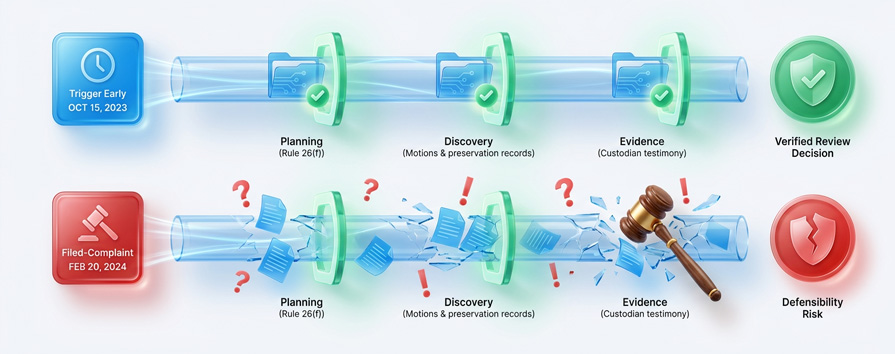
1. The Meet and Confer Under Rule 26(f)
Parties must confer as soon as practicable, generally at least 21 days before the scheduling conference begins. Opposing counsel routinely asks when the hold was issued and who received it. Vague answers here shape how the rest of the case unfolds.
2. A Motion To Compel Or Spoliation Motion
Courts often request the actual hold notice, acknowledgment records, and internal preservation communications during this stage. Gaps in that paper trail are usually what turn a routine discovery dispute into a full sanctions fight.
3. A Custodian Deposition
Opposing counsel asks custodians directly what they were told to preserve and when. An unclear legal hold notice tends to produce inconsistent answers, and inconsistent answers invite further scrutiny from the court.
Each mistake below tends to surface at one of these three points. That is often well after the hold was first issued and largely forgotten. That gap in time is exactly why documentation ends up mattering more than intent once a dispute reaches a judge.
Mistake 1: Waiting For The Complaint Instead Of The Real Trigger
Many legal teams still wait for a formal complaint before issuing a litigation hold. Courts do not use that standard at all. The duty to preserve begins once litigation is reasonably anticipated, not once a complaint is actually filed.
A demand letter, a regulatory inquiry, or a credible internal threat can all start that clock running. Waiting for formal service often means the clock has already been running for weeks. This narrows the window to preserve data before it disappears.
The fix: Train legal and HR teams to recognize trigger events as they happen. Do not wait for a lawsuit to land on someone's desk. Document the exact date each litigation hold decision is made, since that record becomes strong evidence of good faith later. Our guide on what a litigation hold is and what to do breaks down these trigger points in more detail.
Mistake 2: Sending A Vague Legal Hold Notice
A legal hold notice that fails to name specific systems gives custodians room to guess. That guess is rarely the correct one. In one widely cited matter, Franklin v. Howard Brown Health Center, a company's own assumption about how long a messaging platform retained data turned out to be wrong. That single gap became the basis for court ordered curative measures.
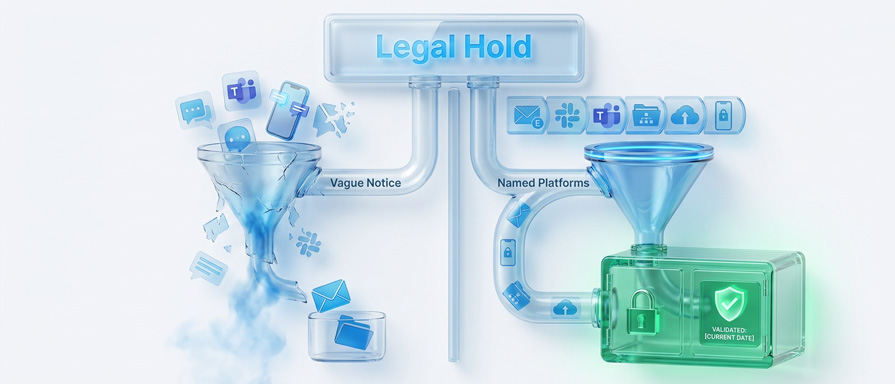
The fix: Name the exact platforms in scope, and state the preservation window in plain, unambiguous language. A useful test is handing the draft to someone outside the legal department entirely. If they cannot list what to preserve after one read, the notice needs another pass before it goes out.
Mistake 3: Skipping Custodian Acknowledgment And Tracking
A notice that nobody confirms receiving is close to a notice that was never really sent. Courts routinely ask for proof of receipt, not assumptions, once preservation itself is challenged.
Legal teams relying on email chains and spreadsheets often cannot answer basic questions when pushed on this point. Who actually received the notice, who read it, and who never responded at all? Without a clear record, the organization ends up defending its process from memory instead of documentation.
The fix: Build a simple escalation cadence into every notice you send out. Send a reminder after five business days, and loop in the custodian's manager after ten. Flag repeats non responders to counsel directly. This is one of the fastest legal hold best practices to adopt. It closes most silent gaps before they matter.
Mistake 4: Ignoring Modern And Ephemeral Data Sources
Legal holds written for an email and file share world often miss where business conversations actually happen today. Slack, Microsoft Teams, and disappearing message apps now carry discussions that used to live entirely inside email.
Regulators have caught up to this shift rather quickly. In January 2024, the FTC and DOJ updated their preservation letters to name collaboration tools and ephemeral messaging platforms. That update closed a gap many companies had quietly leaned on for years.
The fix: Name these platforms directly inside every notice you issue, without exception. Do not forget personal devices either, since work and personal messaging often mix on the very same app. If a system is left unnamed, custodians will usually treat it as out of scope.
Mistake 5: Failing To Loop In IT To Suspend Auto Delete
A legal hold that lives only in a memo, with no technical action behind it, protects nothing on its own. Legal can send out a strong notice and still lose the data if IT never receives matching instructions to act.
Culhane v. Wal-Mart Supercenter is a clear example of exactly this gap in practice. A documented policy required preservation of specific footage, and a request had already been made for it directly. The footage was still overwritten before anyone actually intervened. The court treated that failure as serious enough to warrant one of the harshest sanctions available.
The fix: Require a joint sign off between legal and IT on every single hold. Legal confirms what must be preserved, while IT confirms in writing which systems were actually locked down. That second confirmation is what turns a memo into a genuinely defensible action.
Mistake 6: Treating The Hold As A One Time Notice
A litigation hold is never just a single email sent once and then forgotten. It is an ongoing obligation that has to survive personnel changes, system migrations, and matters that stretch on for years.
Custodians leave the company, change roles, or simply stop paying attention after the first week passes. Without scheduled reminders and periodic reissuance, a hold that looked solid on day one can quietly fail by month six.
The fix: Treat every custodian departure as an automatic trigger for review. HR should notify legal the moment anyone on an active hold resigns or is terminated from the company. Devices and accounts need to be preserved before normal offboarding runs its usual course. Our Top 10 Strategies for a Defensible Legal Hold Process covers how ongoing monitoring supports compliance across long running matters.
Mistake 7: Failing To Release The Hold Properly
Releasing a legal hold gets far less attention than issuing one. Skipping this step still creates its own real risk. Organizations that leave holds active long after a matter closes accumulate unnecessary storage costs and needless exposure.
Data kept past its useful life under frameworks like GDPR can itself become a liability rather than a safeguard. Releasing a legal hold deserves the same discipline as starting one. It should never be an afterthought once the matter fades from view.
The fix: Before releasing anyone, confirm the matter has genuinely closed on every front. Cross check the custodian against every other open hold list the organization is tracking. Then issue a formal written release notice with the date and scope clearly recorded for your files.
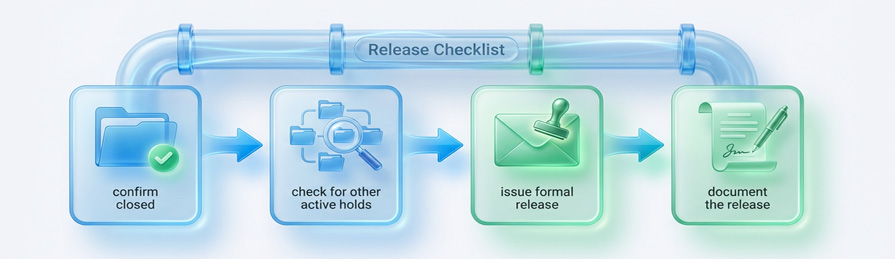
Fixing these seven individually helps. Fixing the process that produced them helps more — most of these mistakes trace back to the same root cause, which is a hold programme assembled matter-by-matter rather than defined once. Our complete legal hold process, phase by phase sets out the policy, roles and documentation that stop them recurring.
Building A Litigation Hold Process That Actually Holds Up
Every mistake above traces back to the same root cause, whether the case involves a single custodian or several hundred. A litigation hold that lives in someone's inbox instead of a tracked system cannot prove what it did months later.
Venio Legal Hold Software automates notice delivery, acknowledgment tracking, escalation, and release documentation inside a single platform. Every action is logged automatically, so your process can withstand scrutiny long after the original notice was sent.
Schedule a Meeting today to see how a documented, defensible legal hold process protects your organization from the mistakes above.
Frequently Asked Questions
1. What triggers the duty to issue a litigation hold?
Litigation is reasonably anticipated once there is a demand letter, a regulatory inquiry, or a credible internal threat. The duty begins at that point, not when a complaint is formally filed.
2. What should a legal hold notice include?
It should name the matter and define the preservation window in plain language. It should also list every relevant data source, including collaboration and messaging platforms by name.
3. How do you know when it is safe to release a legal hold?
Confirm the matter is genuinely resolved first. Then check that the custodian is not subject to any other active litigation hold before releasing them.
Related Articles

eDiscovery Data Analytics & Visualization for Trial Preparation
Most litigation teams don’t lose at trial because they lack evidence. They lose
Read Article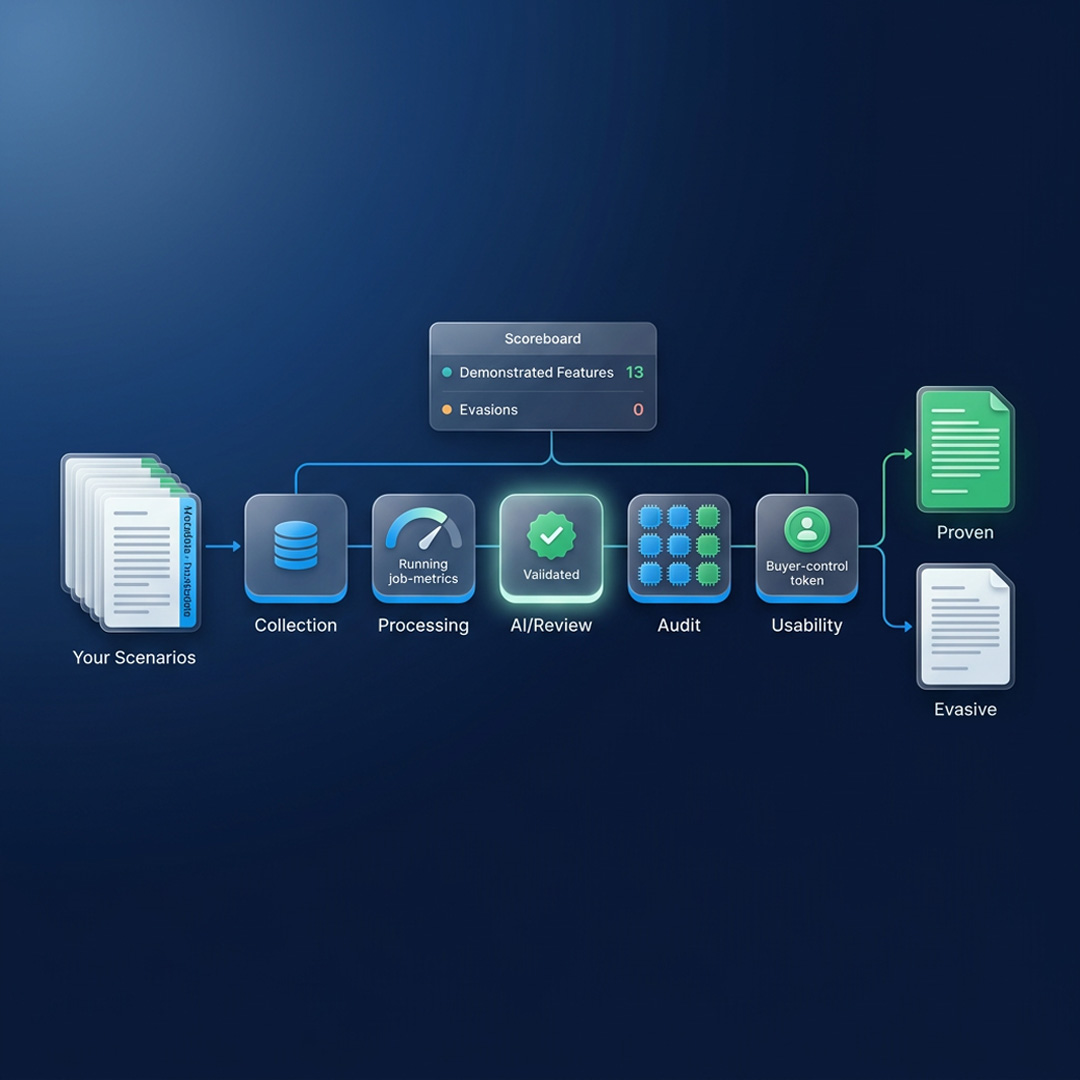
What to Ask in an eDiscovery Demo Before You Sign
Twenty questions that make an eDiscovery vendor prove processing, AI, security a
Read Article
Consolidating Your eDiscovery Stack Without Disrupting Active Matters
How to consolidate eDiscovery tools without disrupting live matters, and why a f
Read Article