Key Takeaways
- The platform is the smaller half of the decision. The larger half is a workflow, and it lasts as long as the contract does.
- 38 questions across eight sections: deployment and architecture, workflow coverage, AI and analytics, security and governance, pricing and TCO, implementation and support, scalability and portfolio, and vendor viability.
- Demos show screens. Screens do not reveal boundaries, and boundaries are where the cost, the delay and the chain of custody exposure accumulate.
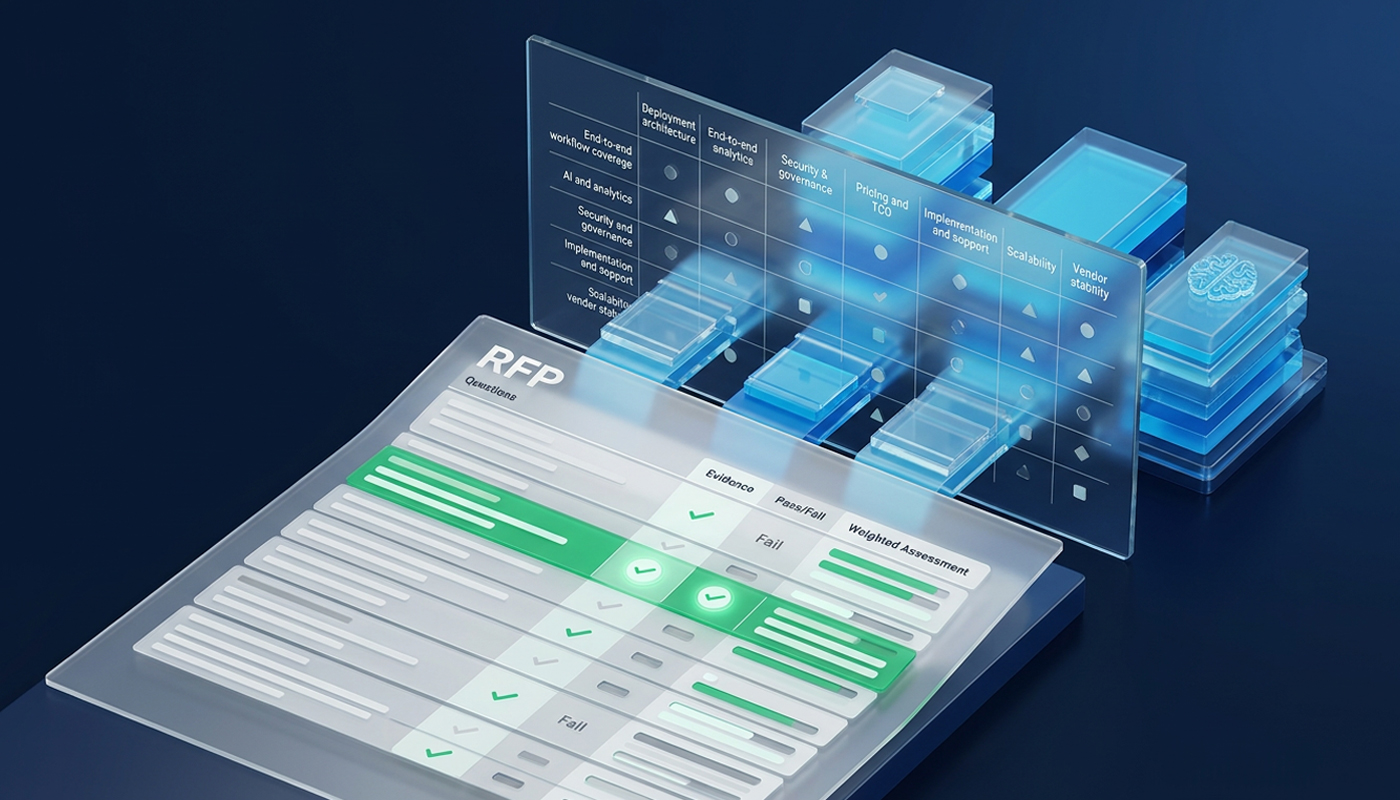
- Set your category weights before responses arrive, and treat mandatory requirements as pass or fail gates rather than scores.
- A structured evaluation runs eight to twelve weeks end to end. Compressing it usually moves the time rather than saving it.
Before You Write the RFP
The eDiscovery platform is the smaller half of what you are choosing. The larger half is a workflow, and it lasts as long as the contract does.Where data enters. How many times it moves. Who touches it at each stage. What gets rebuilt by hand because two systems do not talk. Those patterns get set in the first month of implementation and then they are simply how the team works, every matter, for years.
Demos show screens. Screens do not reveal boundaries, and boundaries are where the cost, the delay and the chain of custody exposure accumulate.Getting them visible before you sign takes a written process. This guide is that document, working as both an eDiscovery buyers guide and a practical eDiscovery checklist: 38 questions across eight sections, what a strong answer sounds like on each one, and a weighted scoring model that turns the responses into a recommendation you can defend.The most common reason an eDiscovery RFP produces a weak result is that it went out before anyone agreed what the organization actually needed. Four things are worth settling first.
Define the Scope
Are you buying for one matter or building a standing capability? Standard documents only, or audio, video, mobile and collaboration data? One jurisdiction or several?
The answers change which questions are mandatory and which are merely useful. They also change who should be in the room.
Gather the Requirements Nobody Volunteered
The eDiscovery manager knows the daily pain points. IT and security know the constraints. The budget owner knows what the last three years actually cost.
Ask each group for their known use cases and their edge cases separately, then reconcile. Write the eDiscovery requirements down as one list and circulate it before the RFP goes out, because requirements that surface afterwards cannot be scored.
Build Your Matter Profile
Attorney and contract-reviewer hours spent reading documents. In most matters this is the single largest cost driver - commonly cited as the dominant share of total eDiscovery spend. Anything that shrinks the review population (culling, ECA, AI-assisted review) moves this number more than any rate negotiation.
Mark Your Mandatory Requirements
A handful of these questions will pass or fail for your organization: a required deployment model, a required certification, a hard data residency constraint.
Flag them before you send them. A vendor that fails a mandatory requirement leaves the evaluation whatever their total score.
RFP, RFQ or RFI
The three documents answer different questions, and choosing the wrong one wastes a round of vendor time.
| Document | Use it when | What you get back |
|---|---|---|
| RFI, request for information | You are mapping the market and do not yet know what is available or what it should cost. | Capability overviews and rough pricing bands. Useful for building a long list. |
| RFP, request for proposal | You know your requirements but want vendors to propose how they would meet them. | Detailed, comparable responses covering capability, approach and price. This guide is an RFP. |
| RFQ, request for quotation | Your requirements are fixed and specified, and price is the remaining variable. | Priced quotations against an identical specification. Fastest, but only works when the spec is genuinely complete. |
Most eDiscovery software evaluations want an RFP. The requirements are known but the approaches differ enough that how a vendor would solve the problem is part of what you are buying.
How to Use This Template
The question set below runs to 38 questions across eight sections. Under each one is a note on what to listen for, separating a strong answer from a deflection, so the person running the evaluation does not need to be an expert in every category.
Three ground rules make it work.
- 1Send The Same Document To Every Vendor: The value of an RFP is comparability. If vendors answer different questions you are comparing marketing decks, not platforms.
- 2Set Your Category Weights Before Responses Arrive: Deciding what matters after reading a persuasive response is how evaluations get reverse-engineered around a favorite.
- 3Score By Section Owner: The eDiscovery or litigation support manager owns Sections 2, 3 and 7. IT and security own 1 and 4. The budget owner owns 5. Vendor viability in Section 8 usually sits with procurement.
Legend: navy question number = scored question. Red question number = common pass or fail candidate, to be marked mandatory rather than scored.
Section 1 - Deployment and Architecture
Deployment is first because it's the criterion that eliminates the most vendors the fastest. Many eDiscovery platforms are cloud-only. If your organization — or your clients, or your regulators — requires on-premises or private-cloud deployment, no feature list compensates. And even for cloud-comfortable teams, architecture questions reveal how much control you'll actually have over your own data.
Which deployment models do you offer - cloud, on-premises, hybrid - and is the platform functionally identical in each?
What to listen for: feature parity. Some vendors technically offer on-prem but ship it a version behind, without AI features, or through a partner. "Available" and "equivalent" are different answers.
Where is our data physically stored, can we choose the region or infrastructure, and what happens if our residency requirements change mid-contract?
What to listen for: whether residency is a configuration choice or a contract renegotiation. Client mandates and regulations change faster than three-year agreements.
If a client or regulator requires data to remain in our environment, describe exactly how you support that - is it a standard offering or an exception process?
What to listen for: specifics. A vendor that does this routinely will describe reference architectures and named customers; a vendor that doesn't will describe a "conversation with our team."
How are upgrades and patches delivered in each deployment model, and who controls the timing?
What to listen for: whether an upgrade can land mid-trial. Teams with active matters need the ability to defer changes; cloud platforms that push updates universally can't offer it.
What infrastructure, licensing, and staffing prerequisites does each deployment model require from us?
What to listen for: the honest cost of on-prem. A good answer quantifies servers, databases, and admin time — inputs you'll need for the TCO section anyway.
Why this section leads: deployment answers are structural — a cloud-only vendor cannot become deployable on-premises during your contract, no matter how the relationship goes. Ask these five questions first and your long list often becomes a shortlist on its own.
Section 2 - Workflow Coverage
This is the heaviest section because it is the workflow half of the decision. The question behind all nine items is where the platform ends and other tools begin.
Vendors label themselves differently, as eDiscovery software, as litigation support software, or as a review platform. The label tells you almost nothing. What the platform does natively, and where it hands off, tells you everything.
Every boundary between tools is a data export, a load file, a chain of custody document and a delay. None of those appear in a feature comparison.
Which stages of the EDRM does your platform cover natively, from legal hold through production, and which require third-party tools or separately priced modules?
What to listen for: the word integration. Integrations are boundaries. Ask for the list of steps where data physically moves between systems.
Describe your legal hold workflow: notice issuance, reminders and escalations, custodian acknowledgment tracking, and defensible release.
What to listen for: whether hold data connects to collection. A hold system that does not feed the collection tool means custodian lists get rebuilt by hand, twice.
Do you support preservation in place, and for which data sources? Describe what is preserved, how it is monitored, and how preservation is evidenced.
What to listen for: scope and evidence. Preservation in place reduces collection cost significantly, but it is only worth having if the platform can prove afterwards that it worked.
Which data sources can you collect from natively, including M365, Google Workspace, Slack, Teams, mobile, file shares and forensic images, and how are chat formats rendered for review?
What to listen for: chat handling. Collaboration data is where collections are growing. A platform that turns a Slack thread into a thousand one-line documents inflates your review costs.
Describe your processing engine: supported file types, throughput, deNISTing, deduplication scope, and exception handling.
What to listen for: what happens to exceptions. Corrupt, encrypted and unsupported files are routine, and a platform without a visible exception workflow leaves them as silent gaps in your production.
Can we run early case assessment, including filtering, search-term testing and concept analysis, before promoting data to review, in the same system and without re-processing?
What to listen for: the phrase in the same system. ECA in a separate tool means paying to process data twice and hosting two copies.
Describe the review environment: batching, coding layouts, privilege workflows, redaction including native-file and spreadsheet redaction, and QC sampling.
What to listen for: the phrase in the same system. ECA in a separate tool means paying to process data twice and hosting two copies.
Describe production capabilities: formats, Bates numbering, privilege log generation, and how re-productions and clawbacks are handled.
What to listen for: the re-production workflow. Productions are rarely one and done, and a platform that treats each as a from-scratch export burns hours every supplemental round.
For any workflow stage involving a handoff, between your own modules or to another tool, how is chain of custody documented across the boundary?
What to listen for: automatic rather than manual documentation. If the audit trail across a boundary is a person keeping a spreadsheet, that is your defensibility exposure. For the mechanics of what a complete custody record contains, see Venio's guide to chain of custody in eDiscovery.
Scoring hint Vendors answer this section with feature lists. Score the boundaries instead. Count how many times data leaves one system for another in their described workflow, because fewer boundaries means less cost, less delay and less documentation.
Section 3 - AI and Analytics
Every vendor now claims AI, so the useful question is not whether they have it. It is where your data goes when AI processes it, how humans stay in control, and what it costs.
Which AI capabilities are native to the platform and which rely on third-party services? For each, does our data, or any extracted text from it, leave your environment to be processed?
What to listen for: precision about what leaves. Many platforms transmit extracted text to a model provider even when native files stay put. Both are answerable, but only one is usually volunteered.
Which technology assisted review workflows do you support, including TAR 1.0 and continuous active learning, and what documentation supports their defensibility?
What to listen for: whether they can produce the statistical validation, meaning recall estimates and elusion testing, that a court or opposing counsel would expect.
For generative AI features, which models are used, where are they hosted, and is our data used to train any model?
What to listen for: a written no-training commitment and a named hosting arrangement. Enterprise-grade AI without both is an unanswered question.
How do reviewers validate, correct and override AI suggestions, and do human decisions always take precedence?
What to listen for: concrete mechanics such as sampling workflows and override logging, not philosophy. Human control should be visible in the interface rather than stated as a value.
How are AI-assisted decisions logged and audited? Can we produce a complete record of what the AI did and what humans changed, for a specific matter?
What to listen for: a matter-level audit export. If defending your process means asking the vendor to query their logs, the defensibility is theirs rather than yours.
How are AI features priced, included or metered separately, and what would the AI line item have been for a matter matching our profile?
What to listen for: separately metered AI. If AI review is priced per document or per GB, the cost-saving feature has its own cost curve. Model it in Section 5.
Know what good looks like before you score the AI answers These six responses will be the hardest in the pack to compare. The AI Governance Playbook, built by Venio with eDiscovery AI, sets out the oversight, privilege and risk positions a legal team should expect a vendor to meet, so you are scoring against a standard rather than against each other.
Section 2 - Workflow Coverage
This is the heaviest section because it is the workflow half of the decision. The question behind all nine items is where the platform ends and other tools begin.
Vendors label themselves differently, as eDiscovery software, as litigation support software, or as a review platform. The label tells you almost nothing. What the platform does natively, and where it hands off, tells you everything.
Every boundary between tools is a data export, a load file, a chain of custody document and a delay. None of those appear in a feature comparison.
Which stages of the EDRM does your platform cover natively, from legal hold through production, and which require third-party tools or separately priced modules?
What to listen for: the word integration. Integrations are boundaries. Ask for the list of steps where data physically moves between systems.
Describe your legal hold workflow: notice issuance, reminders and escalations, custodian acknowledgment tracking, and defensible release.
What to listen for: whether hold data connects to collection. A hold system that does not feed the collection tool means custodian lists get rebuilt by hand, twice.
Do you support preservation in place, and for which data sources? Describe what is preserved, how it is monitored, and how preservation is evidenced.
What to listen for: scope and evidence. Preservation in place reduces collection cost significantly, but it is only worth having if the platform can prove afterwards that it worked.
Which data sources can you collect from natively, including M365, Google Workspace, Slack, Teams, mobile, file shares and forensic images, and how are chat formats rendered for review?
What to listen for: chat handling. Collaboration data is where collections are growing. A platform that turns a Slack thread into a thousand one-line documents inflates your review costs.
Describe your processing engine: supported file types, throughput, deNISTing, deduplication scope, and exception handling.
What to listen for: what happens to exceptions. Corrupt, encrypted and unsupported files are routine, and a platform without a visible exception workflow leaves them as silent gaps in your production.
Can we run early case assessment, including filtering, search-term testing and concept analysis, before promoting data to review, in the same system and without re-processing?
What to listen for: the phrase in the same system. ECA in a separate tool means paying to process data twice and hosting two copies.
Describe the review environment: batching, coding layouts, privilege workflows, redaction including native-file and spreadsheet redaction, and QC sampling.
What to listen for: the phrase in the same system. ECA in a separate tool means paying to process data twice and hosting two copies.
Describe production capabilities: formats, Bates numbering, privilege log generation, and how re-productions and clawbacks are handled.
What to listen for: the re-production workflow. Productions are rarely one and done, and a platform that treats each as a from-scratch export burns hours every supplemental round.
For any workflow stage involving a handoff, between your own modules or to another tool, how is chain of custody documented across the boundary?
What to listen for: automatic rather than manual documentation. If the audit trail across a boundary is a person keeping a spreadsheet, that is your defensibility exposure. For the mechanics of what a complete custody record contains, see Venio's guide to chain of custody in eDiscovery.
Scoring hint Vendors answer this section with feature lists. Score the boundaries instead. Count how many times data leaves one system for another in their described workflow, because fewer boundaries means less cost, less delay and less documentation.
Section 3 - AI and Analytics
Every vendor now claims AI, so the useful question is not whether they have it. It is where your data goes when AI processes it, how humans stay in control, and what it costs.
Which AI capabilities are native to the platform and which rely on third-party services? For each, does our data, or any extracted text from it, leave your environment to be processed?
What to listen for: precision about what leaves. Many platforms transmit extracted text to a model provider even when native files stay put. Both are answerable, but only one is usually volunteered.
Which technology assisted review workflows do you support, including TAR 1.0 and continuous active learning, and what documentation supports their defensibility?
What to listen for: whether they can produce the statistical validation, meaning recall estimates and elusion testing, that a court or opposing counsel would expect.
For generative AI features, which models are used, where are they hosted, and is our data used to train any model?
What to listen for: a written no-training commitment and a named hosting arrangement. Enterprise-grade AI without both is an unanswered question.
How do reviewers validate, correct and override AI suggestions, and do human decisions always take precedence?
What to listen for: concrete mechanics such as sampling workflows and override logging, not philosophy. Human control should be visible in the interface rather than stated as a value.
How are AI-assisted decisions logged and audited? Can we produce a complete record of what the AI did and what humans changed, for a specific matter?
What to listen for: a matter-level audit export. If defending your process means asking the vendor to query their logs, the defensibility is theirs rather than yours.
How are AI features priced, included or metered separately, and what would the AI line item have been for a matter matching our profile?
What to listen for: separately metered AI. If AI review is priced per document or per GB, the cost-saving feature has its own cost curve. Model it in Section 5.
Know what good looks like before you score the AI answers These six responses will be the hardest in the pack to compare. The AI Governance Playbook, built by Venio with eDiscovery AI, sets out the oversight, privilege and risk positions a legal team should expect a vendor to meet, so you are scoring against a standard rather than against each other.
Get the eDiscovery RFP Template and Vendor Scorecard
Everything on this page is packaged to send: the full 38-question RFP as an editable Word document, ready for your matter profile and your deadlines, plus an Excel scorecard that applies the weighted scoring model and flags mandatory-requirement failures automatically.
- Editable Word RFP with all 38 questions and a matter-profile section for vendors to price against
- Excel scorecard that compares three vendors at once with adjustable category weights
- Mandatory-requirement flags that surface disqualifiers automatically
- A weighted-total summary formatted for the recommendation meeting
Get the Template Pack
The 38 questions, the scoring model and the scorecard, ready to send.
At Venio, we're committed to your privacy. For details on how we process your data, please review our Privacy Policy.
Section 4 - Security and Governance
Discovery data is by definition the data your organization least wants exposed. Your security team will have its own questionnaire, and these five questions cover what the legal evaluation needs to establish.
Which security certifications and audit reports do you hold, and will you provide current reports under NDA?
What to listen for: current reports rather than logos. A certification page is a claim, a dated audit report is evidence. Verify anything material with the issuing body.
Describe your access control model: role granularity, matter-level and document-level permissions, SSO and MFA support, and how access reviews are performed.
What to listen for: whether outside counsel and co-counsel can be scoped to a single matter cleanly. Multi-party litigation makes this a weekly task rather than an edge case.
How is data encrypted at rest and in transit, who manages the keys, and do you support customer-managed keys?
What to listen for: scope and evidence. Preservation in place reduces collection cost significantly, but it is only worth having if the platform can prove afterwards that it worked.
How is data belonging to different matters, or different clients, separated architecturally, and has that separation been independently tested?
What to listen for: logical against physical separation, and evidence of testing. For law firms and eDiscovery service providers, client data separation is an ethical obligation.
Describe your incident response and breach notification commitments, and at end of engagement the process, timeline and cost for returning and certifiably destroying our data.
What to listen for: the exit half of the question. Notification windows get negotiated, but data return terms often do not come up until you need them.
Pass or fail candidates live here If your organization requires a specific certification, deployment model or key custody arrangement, mark those questions mandatory rather than scoring them.
Section 5 - Pricing and TCO
Four questions that decide budgets for years. The goal is to force every vendor's pricing into a comparable shape, with every billable unit disclosed and behavior under volume growth specified.
Provide your complete pricing model, including every billable unit and every charge that could appear on an invoice.
What to listen for: completeness. The phrase additional fees may apply is a red flag by design, and this question exists to eliminate it.
Using the matter profile attached to this RFP, what happens to our annual cost if collected data volume doubles, and what are we charged while a matter is stayed or idle?
What to listen for: whether cost scales with a variable you do not control. Per-GB models transfer data growth risk to you, and this question makes the transfer visible before you sign.
What does it cost to get our data out, both production exports during the engagement and full data return at termination?
What to listen for: egress fees. Exit costs are switching costs, and a vendor confident in its platform does not need to make leaving expensive.
Provide a three-year total cost projection for the attached matter profile, itemized by year and category, stating every assumption.
What to listen for: the stated assumptions. The projection will be optimistic, but the assumptions tell you where it breaks. Compare vendors on identical profiles or not at all.
Section 6 - Implementation and Support
Two questions with long tails. The platform you choose is also the vendor relationship you choose, and the migration project you are signing up for if you are switching.
Describe a typical implementation for an organization of our profile, including timeline, milestones, who does the work, and how active matters transition if we are migrating.
What to listen for: the migration answer. We have a services team is not a plan. A real answer describes phased cutover, parallel running, and what happens to work products in transit.
Describe your support model, including tiers, hours, response SLAs and named contacts, alongside your training resources. Which are included and which are billed?
What to listen for: what is billed. Support that is excellent but metered shows up in your pricing model, and training that is a PDF library shows up in your adoption rate.
Section 6 - Implementation and Support
Two questions with long tails. The platform you choose is also the vendor relationship you choose, and the migration project you are signing up for if you are switching.
Describe a typical implementation for an organization of our profile, including timeline, milestones, who does the work, and how active matters transition if we are migrating.
What to listen for: the migration answer. We have a services team is not a plan. A real answer describes phased cutover, parallel running, and what happens to work products in transit.
Describe your support model, including tiers, hours, response SLAs and named contacts, alongside your training resources. Which are included and which are billed?
What to listen for: what is billed. Support that is excellent but metered shows up in your pricing model, and training that is a PDF library shows up in your adoption rate.
Section 7 - Scalability and Portfolio
You are not buying a platform for your average matter. You are buying it for your worst one, and for the portfolio of everything running at once.
What is the largest matter by data volume and document count the platform currently supports in production use, and can you provide a reference customer at that scale?
What to listen for: the reference. Benchmark numbers are lab conditions and a customer running at your worst-case scale is proof. Call the reference.
How does the platform support managing many matters at once, including matter templates, cross-matter search, work product reuse and portfolio reporting?
What to listen for: reuse. Re-coding the same document in every matter it appears in is invisible, repeated spend, and this is where mature platforms separate from scaled-up point tools.
Section 8 - Vendor Viability
The section most eDiscovery RFPs skip. You are signing a multi-year agreement for custody of your most sensitive data, which makes the company as much a part of the purchase as the product.
Describe your company: years in operation, ownership structure, headcount, and any acquisition or investment activity in the last three years.
What to listen for: ownership change. A platform acquired mid-contract can be repriced, merged into another product line, or put into maintenance. Ask what happens to your agreement.
Is the platform developed in-house, and do you control the development roadmap? Identify any core capability licensed or white-labelled from a third party.
What to listen for: control. A vendor reselling someone else's engine cannot commit to a roadmap or a fix timeline, and that dependency should be disclosed rather than discovered.
Describe your uptime commitment, your disaster recovery arrangements including RPO and RTO, and any unplanned outage longer than four hours in the last three years.
What to listen for: the outage history. Every platform has incidents. A vendor that discloses one with a clear remediation is more credible than one claiming a perfect record.
Do you subcontract any part of the service, including hosting, support or professional services? Name the parties and their role.
What to listen for: undisclosed subcontracting. Each subcontractor is another party touching your data and another gap in your security review.
Provide three references from organizations of similar size, sector and matter profile, including at least one that migrated to you from another platform.
What to listen for: the migration reference. Customers who switched will tell you what the implementation was actually like, which is the part every vendor describes optimistically.
How to Score the Responses
An unscored RFP is a stack of marketing documents. A weighted scoring model turns 38 answers into a recommendation you can put in front of a GC, a CFO or a procurement committee and explain.
Step 1 - Set weights before responses arrive
Distribute 100 points across the eight sections to reflect your constraints rather than a generic ideal. The suggested defaults on this page fit a typical corporate legal team or law firm, and they weight Workflow highest at 30 percent because that is where the daily cost sits.A regulated organization might push Deployment and Security to 30 and 20 percent. A team with a settled cloud policy might move more weight into Workflow and AI. What matters is that the weights are written down first.
Visual: horizontal weights bar — Deploy 15% · Workflow 30% · AI 15% · Security 15% · Pricing 15% · Implementation 5% · Scalability 5% · Vendor viability 5%.
| Section | Suggested weight | Push it higher when |
|---|---|---|
| 1. Deployment and architecture | 15% | Residency, client mandates or regulator constraints are live issues |
| 2. Workflow coverage | 30% | Always. This is where the daily cost and the handoff risk sit |
| 3. AI and analytics | 15% | AI-assisted review is becoming your default rather than an occasional tool |
| 4. Security and governance | 15% | You hold regulated data or act for clients who audit their providers |
| 5. Pricing and TCO | 15% | Volumes are growing faster than budget, or the last contract surprised you |
| 6. Implementation and support | 5% | You are migrating from an incumbent with active matters |
| 7. Scalability and portfolio | 5% | You run many concurrent matters or expect an outlier volume |
| 8. Vendor viability | 5% | The agreement is long, or the vendor is small, new or recently acquired |
Step 2 - Score every question on the same scale
Each scored question gets a whole number from zero to five, anchored to evidence rather than impression.
| Score | Meaning | Evidence standard |
|---|---|---|
| 5 | Fully meets the requirement, natively | Specific, verifiable answer, demonstrated in a demo or documented in writing |
| 4 | Meets it with minor caveats | Clear answer, small gaps with stated workarounds |
| 3 | Partially meets it | Capability exists with material limits, such as extra modules, partner tools or manual steps |
| 2 | Weak fit | Vague answer, roadmap promise, or third-party dependency for a core need |
| 1 | Barely addresses it | Deflection, marketing language, or an answer to a different question |
| 0 | Does not meet it | Capability absent or question unanswered |
Two calibration rules keep scores honest. A roadmap item is never worth more than 2, and anything you could not verify in a demo or in writing caps at 3.
Step 3 - Apply mandatory requirements as gates
Before weighing anything, check the pass or fail questions you flagged when you sent the RFP. A vendor that fails any mandatory requirement exits there.
This step protects you from the most common evaluation failure, which is a high-scoring vendor whose one gap happens to be the thing you cannot live without.
Step 4 - Read the shape, not just the total
Average each section's scores, multiply by the section weight and sum. Then look past the totals.
- A Close Total With Different Shapes: Your weights are deciding. Re-check that they reflect your real constraints.
- A Section Where Every Vendor Scored Below 3: The market cannot meet that requirement as written. Revisit it, or plan to solve it outside the platform.
- A Vendor Whose Scores Collapse In Pricing And Support: Demos best and owns worst, so weight accordingly.
Bring the completed vendor evaluation matrix to your finalist demos and make each vendor address their two lowest scores live. The demo stops being a product tour and becomes a cross-examination. The vendor scorecard template in the download does this arithmetic for you across three vendors at once.
When the Responses Disappoint
Sometimes the round does not work. You expected five responses and got two, or every response scores below 3 on the section that matters most.
That is information rather than failure, and it usually has one of three causes.
- The Requirements Were Unrealistic: If nobody in the market meets a requirement as written, the requirement is the problem. Revisit the wording or plan to solve it outside the platform.
- The RFP Was Too Heavy For The Deal Size: Vendors triage. A 38-question RFP for a small single-matter purchase will get declined by the larger providers.
- The Shortlist Was Wrong: A long list built from analyst reports, peer recommendations and searches for Relativity alternatives is a starting point rather than a shortlist. A pre-screen on the two fastest disqualifiers, deployment model and pricing structure, cuts it down before the full RFP goes out and avoids wasting a round.
Re-issuing a revised RFP costs a few weeks Signing a three-year agreement with a vendor you were not confident in costs considerably more.
How Long an Evaluation Takes
A structured evaluation runs eight to twelve weeks end to end. Compressing it usually moves the time rather than saving it.
| Phase | Typical duration | What happens |
|---|---|---|
| Requirements and weights | 1 to 2 weeks | Scope, stakeholder requirements, matter profile, mandatory requirements, category weights agreed and written down |
| Vendor responses | 3 to 4 weeks | RFP issued to three to five vendors, clarification questions handled in writing and shared with all |
| Scoring and shortlist | 2 weeks | Section owners score independently, gates applied, weighted totals computed, two or three finalists selected |
| Finalist stage | 2 to 4 weeks | Demos against lowest scores, reference calls, optional proof of concept, recommendation |
Teams that skip the written stage move faster at first, then lose the time back in contract negotiation, when structural questions surface without comparison leverage.
How Venio Answers This RFP
We publish this template because the questions favor structure over polish. Here is how Venio answers the four sections that eliminate the most vendors.
Deployment: every model, full parity
Venio runs in the cloud, on-premises or hybrid. Data residency, client mandates and regulator constraints are configuration decisions rather than disqualifiers, and the deployment options page sets out what each model requires from you. On Q1 and Q2, that makes the answer a choice rather than a renegotiation.
Workflow: one platform, fewer boundaries
Venio runs legal hold through production in a single system. ECA and Review work on the same data, so nothing is re-processed between assessment and review, and one global bank ran 120 TB through a single pipeline to a 34 TB review set, a 72 percent reduction, with first-look analytics inside six hours. On Q6, the boundary count is short.
AI: inside the review workflow
Venio's AI runs in the Review module rather than a separate tool, covering continuous active learning, predictive coding and prompt-based classification for relevance, privilege and PII. Native files, your review database and your audit trail stay in Venio, while extracted text goes to the AI layer over secure APIs. On Q15, there is no export and no re-ingestion step.
Pricing: a model you can run
Venio prices the platform on an instance basis rather than per GB ingested or hosted, and AI capability is priced separately. An AmLaw 50 firm cut eDiscovery costs by 65 percent on chat-heavy matters after consolidating onto Venio. On Q27, doubling your collected volume does not double your platform cost. Request pricing against your matter profile.
This template is not neutral in one sense: it asks the structural questions we believe any rigorous evaluation should ask, and they are the questions Venio was built to answer. Send it to every vendor on your list including us, and if Venio does not score well against your weights it is not your platform. See how we compare on the platform comparison chart.
Frequently Asked Questions
Everything you need to know about eDiscovery RFP
What should an eDiscovery RFP include?
Work backwards from your constraints rather than forwards from feature lists. Settle your deployment, residency and security requirements first, because those eliminate vendors fastest. Then map your actual workflow, from legal hold through production, and count how many times data would move between systems on each platform. Score the rest against written answers using a weighted scoring model, treating anything you could not verify as unproven. The 38 questions on this page are built to produce exactly that comparison.
What is the difference between an RFP and an RFQ?
An RFP asks vendors to propose how they would meet your requirements, and it suits situations where approaches differ enough that the method is part of what you are buying. An RFQ asks for priced quotations against a fixed, fully specified requirement, and it is faster but only works when the specification is genuinely complete. An RFI comes earlier still, when you are mapping the market before you can write either.
How many vendors should receive an eDiscovery RFP?
Three to five is the practical range. Fewer than three loses comparison power and negotiating leverage. More than five degrades response quality, because vendors triage and your scoring workload grows. Many teams pre-screen a long list on the two fastest disqualifiers, deployment model and pricing structure, before sending the full document.
How do you score eDiscovery RFP responses?
Use a weighted scoring model. Distribute 100 points across your evaluation categories before responses arrive, score every question on an anchored zero to five scale, treat mandatory requirements as pass or fail gates rather than scores, then compute weighted totals per vendor. Two calibration rules keep it honest. Roadmap promises never score above 2, and unverified claims cap at 3.
Which RFP questions expose the biggest differences between platforms?
Four do most of the separating. Which deployment models do you offer with full feature parity, since many platforms are cloud only. Where does data physically move between tools in your workflow, which reveals hidden handoffs. What leaves your environment when AI processes our data, which separates integrated AI from bolt-ons. And what happens to our cost if volume doubles mid-matter, which reveals who carries the volume risk. Weak answers here cannot be compensated by strong demos.
How long does an eDiscovery software evaluation take?
Eight to twelve weeks for a structured process. One to two weeks on requirements and weights, three to four weeks for responses, two weeks for scoring and shortlisting, and two to four weeks for finalist demos, references and any proof of concept.
Should we ask about vendor stability and ownership?
Yes, and most eDiscovery RFPs skip it. You are signing a multi-year agreement for custody of highly sensitive data, so ownership structure, acquisition activity, whether the platform is developed in-house, subcontracting arrangements and outage history all belong in the document. A platform acquired mid-contract can be repriced or moved into maintenance, and your agreement should anticipate that.
How does Venio respond to eDiscovery RFPs?
Send us yours, whether this template or your own. Venio answers on deployment across cloud, on-premises and hybrid, workflow coverage from legal hold through production in one platform, AI delivered inside the Review module, and instance-based pricing. The fastest way to see the answers is to book a demo and bring the question list with you.