Don’t Let Critical ECA Steps Slip Through the Cracks

Chain of custody is the documented, unbroken record of how a piece of evidence was collected, handled, accessed, stored, transferred, and produced, proof that it is authentic and unchanged from the moment it was gathered. In eDiscovery, that record is what makes electronic evidence admissible in court.
A single email can decide a case. But only if the court trusts that the email entered into evidence is the same email that left the custodian's inbox, unchanged. That trust is exactly what a chain of custody buys you. It is the difference between evidence that stands and evidence that gets challenged, discounted, or thrown out.
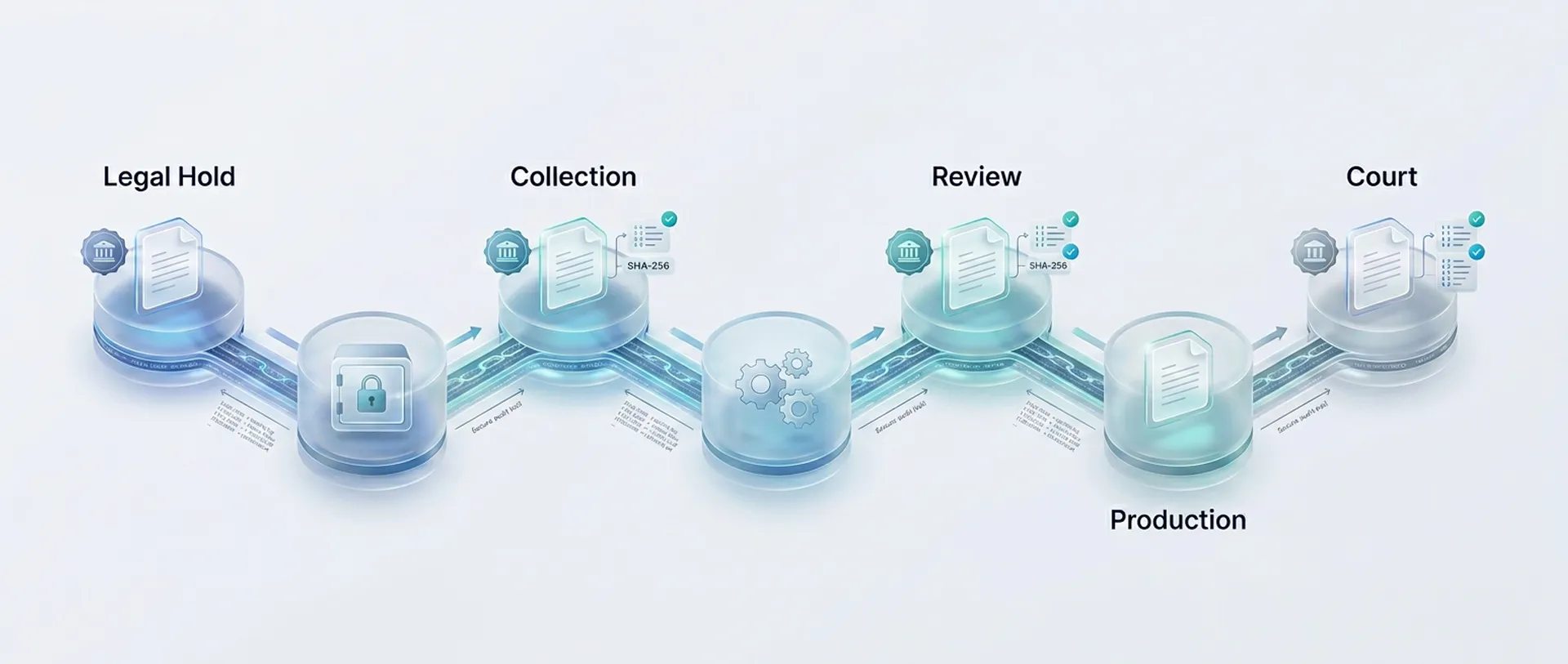
What Is Chain of Custody in eDiscovery?
Chain of custody is the chronological record of everyone who collected, accessed, handled, stored, transferred, and produced a piece of evidence - along with when, how, and whether anything changed. Its purpose is to show that the evidence is authentic and substantially unchanged from the moment it was gathered.
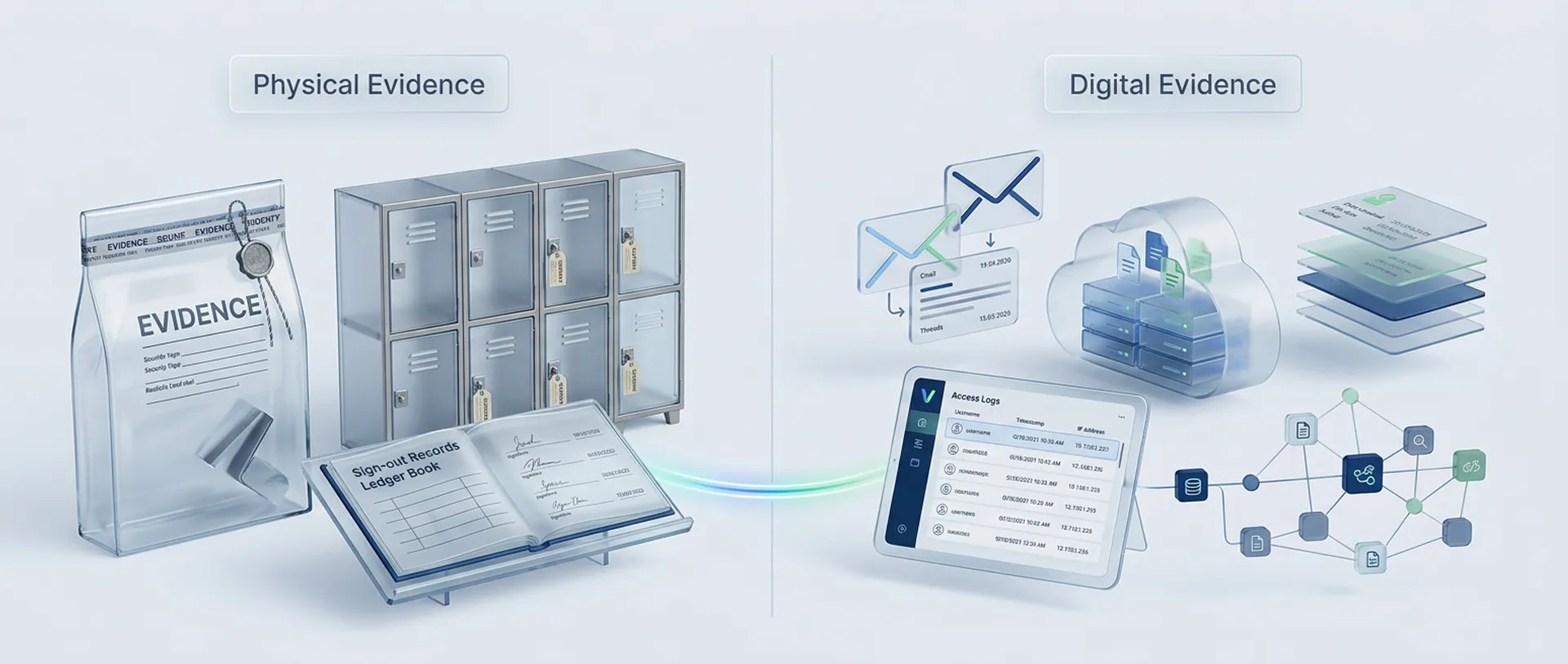
The concept comes from physical evidence, where you can lock an item in a sealed bag and log each person who signs it out. A digital chain of custody is harder, because data behaves differently. Electronic data can be copied, moved, or altered without any visible sign. Simply opening a file can change its metadata, including the last-accessed date. So custody for electronically stored information (ESI) shifts from guarding a physical object to tracking the data itself through the systems that touch it.
That tracking rests on three building blocks:
Metadata that shows when a file was created and modified
Access logs that record who interacted with it
Audit trails that follow the data from ingestion through production.
Why is the Chain of Custody Important
Let’s look closely at why chain of custody is important in every ediscovery process:
1. Admissibility
Under Federal Rule of Evidence 901, the party offering evidence must show it is what they claim it is. For ESI, a documented chain of custody is how you make that showing. Without it, opposing counsel has an easy argument: the data could have been altered, mishandled, or left incomplete. That doubt can lead a court to reduce the weight of the evidence or exclude it entirely.
2. Spoliation
Under Federal Rule of Civil Procedure 37(e), parties must take reasonable steps to preserve ESI once litigation is anticipated. Gaps that suggest data was lost or altered can trigger adverse inference instructions, monetary sanctions, or other remedies.
3. Cost and credibility
When custody is challenged, teams often have to reconstruct handling histories, re-collect data, or bring in forensic experts. The fight shifts from the merits of the case to the failures of the process, the last place you want to be.
The Overlooked Payoff: Self-Authentication Under FRE 902(14)
A clean chain of custody is not only insurance against challenges. It can also save you time and money at trial. Effective December 1, 2017, Federal Rule of Evidence 902(14) allows a digital copy of data to be self-authenticated. A qualified person certifies in writing that they verified the copy's hash value and that it is identical to the original.
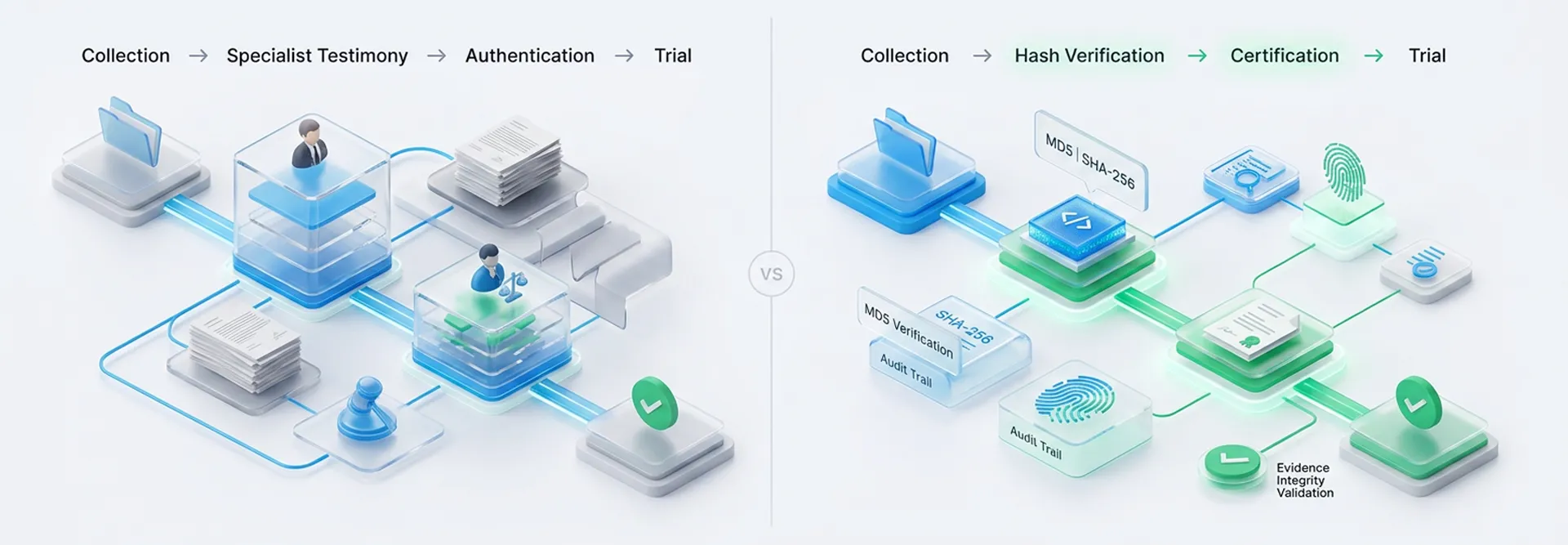
When that certification is in place, you no longer need a live foundation witness to testify about the collection before the evidence can be used. The Advisory Committee notes describe the hash value as a kind of digital fingerprint, in which identical values reliably indicate that two files are exact duplicates. In other words, a hash-verified custody record turns a defensive chore into leverage.
What a Defensible Chain of Custody Record Contains
Most guides describe the chain of custody without ever showing what the record contains. A complete chain of custody form captures the answers to who, what, when, where, and how for each piece of evidence. At a minimum, it records:
1. The matter and item identifier
2. The custodian or data owner who performed the collection, and their role
3. The date and time of collection
4. The original source and location of the data
5. The collection method or tool used
6. Where the data was stored afterward
7. A running log of every transfer and access that follows
8. The hash value, the one field that ties the whole record together
Want the form itself?
Hash Values: The Digital Fingerprint
A hash value is a string of characters produced by running data through an algorithm such as MD5 or SHA-256. The same input always produces the same hash, and changing even a single bit produces a completely different one. That property makes hashing the technical backbone of digital integrity.
You generate a hash at the moment of collection, then re-verify it at each later step. If the hashes still match, you can show the data has not changed. If they differ, you know something did. A custody record without hash verification is a story. A custody record with it is proof.
A practical note: MD5 is fast and still widely used to verify that a copy matches its source, but SHA-256 is preferred where stronger collision resistance matters. Whichever algorithm you use, the discipline is the same: record the value at collection and check it again at every step.
The Chain of Custody Steps Across the eDiscovery Lifecycle
Custody is not a single event. It is a continuous obligation that runs across the discovery lifecycle, which the Electronic Discovery Reference Model (EDRM) maps in stages. Here is what to document at each phase
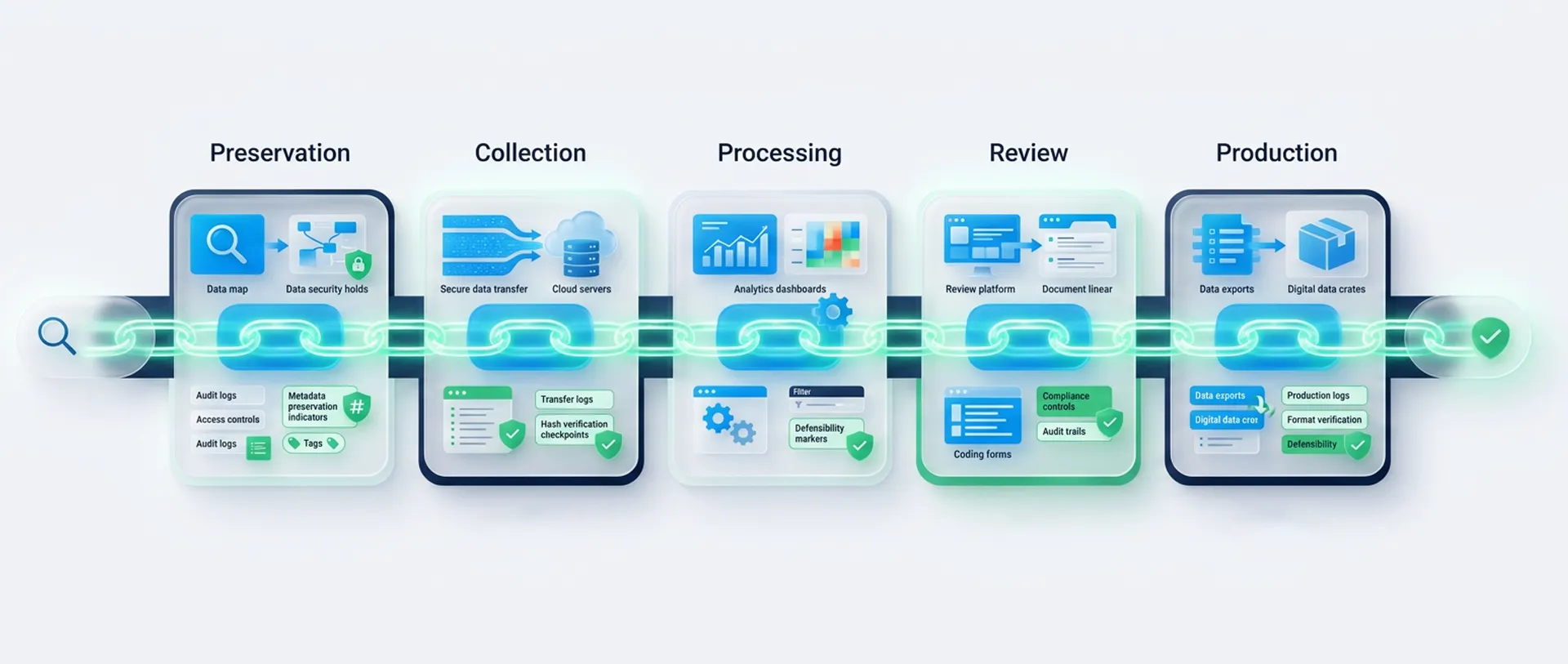
1. Identification and preservation: Issue the legal hold, track acknowledgments, suspend any automatic deletion that could touch relevant data, and document the scope of what you are preserving and why.
2. Collection: Use a forensically sound method and a qualified person. Generate a hash at the point of collection, record the source, date, time, method, and collector, and preserve metadata rather than overwriting it by opening files.
3. Processing: Re-verify hash values after ingestion, log every processing step and exception, and document the criteria used for de-duplication and filtering so the culling can be explained later.
4. Review and analysis: Apply role-based access controls, capture all access and actions in audit logs, and keep data inside controlled workflows so version discrepancies never appear.
5. Production: Make sure every produced item traces back to its source, document the production format and any redactions, run a final hash verification before delivery, and retain the production log with the matter file.
Chain of Custody Example: How the Chain Breaks in the Real World
To see how quietly custody fails, picture a common sequence. A custodian forwards a batch of emails to a paralegal, who saves them to a shared drive and later uploads them to a review tool. No hash was taken at the start, the forwarding changed the metadata, and no log records the moves.
The emails may be perfectly genuine, but the team can no longer prove it. At that point, the fight is about process, not facts, and that is a fight you can lose even with the truth on your side.
Where the Chain Breaks
Most custody failures are not dramatic. They are small, avoidable lapses that opposing counsel is happy to magnify:
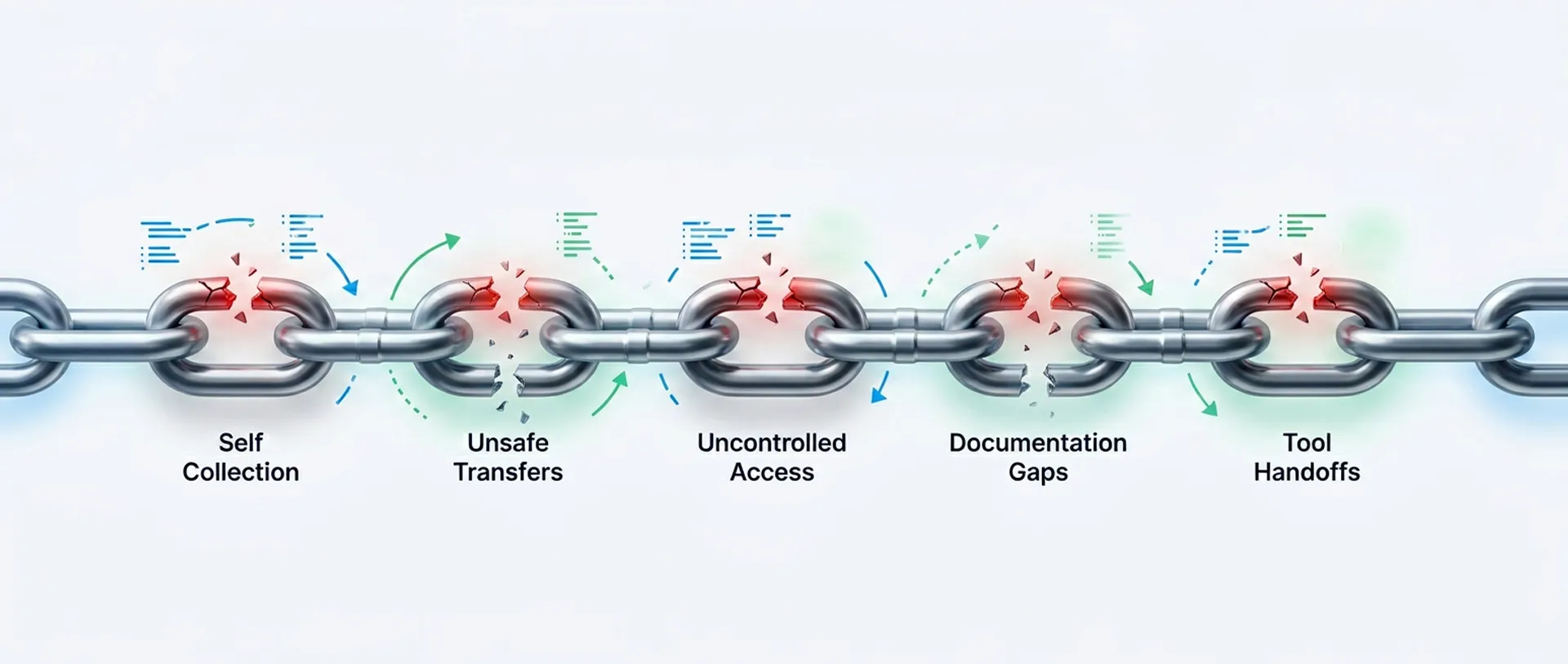
When custodians gather their own data without forensic guidance, metadata gets altered, and the collection is hard to certify. Most custodians will not meet the FRE 902(14) standard of a qualified person.
Unsafe transfers
Moving files via personal email or unsecured cloud storage invites the argument that the data was altered in transit or that the set is incomplete.
Handling outside controlled workflows
Every time a file is opened or edited off the record, you create version discrepancies that you cannot easily explain
Documentation gaps
A missing entry in the custody log is an opening for doubt.
The handoff problem
Every time data passes from one disconnected tool to another, that boundary is a place the chain can break, and a place you now have to document and re-verify.
Digital Forensics vs. eDiscovery Chain of Custody
see Digital Chain of Custody: Tracking Electronic Evidence.
How to Maintain a Defensible Chain of Custody
Defensible eDiscovery is less about heroics and more about discipline applied consistently. A few practices carry most of the weight:
1. Plan custody from day one. Define metadata requirements and handling rules in your ESI protocol before a single file is collected.
2. Collect forensically. Use a qualified person and a sound method, hash at the point of collection, and re-verify that hash at every step that follows.
3. Lock down access. Use role-based controls and capture everything in audit logs, so the record builds itself as the work happens.
4. Minimize handoffs. The fewer tools your data passes through, the fewer boundaries you have to document, and the fewer places the chain can break.
5. Document continuously, not from memory. A log written after the fact is exactly what invites a challenge.
6. Automate. Manual spreadsheets do not scale to modern data volumes or to ephemeral sources like Slack and Microsoft Teams, where custody is nearly impossible to track by hand.
The Role of a Unified Platform
Technology is what makes a defensible chain of custody realistic at scale, and the key is how it's structured. Recall the handoff problem: the risk lives at the boundaries between tools. A platform built on a single data layer, where legal hold, processing, review, and production share one system, removes those boundaries. There are no tool-to-tool handoffs to document a break, because the data never leaves the platform.
Venio is built this way. Its eDiscovery platform embeds metadata preservation and chain-of-custody tracking directly into a unified workflow, with audit trails, role-based access, and security standards including SOC 2 Type II and FedRAMP readiness. For the people who own the process, that means audit-ready defensibility from first notice to final production, rather than a record stitched together across systems after the fact.
Building a Chain of Custody You Can Defend
A defensible chain of custody is not paperwork for its own sake. It is what keeps your electronic evidence admissible, defends you against spoliation claims, and increasingly lets you authenticate evidence by certification rather than by live testimony.
The teams that get this right treat custody as a continuous record rather than a one-time form, and they hash at collection and re-verify at every subsequent step.
The rest comes down to discipline applied consistently. Know what to document at each stage of the discovery lifecycle, minimize the tool-to-tool handoffs where the chain so often breaks, and automate the tracking, because manual logs cannot keep pace with modern data volumes or ephemeral sources like Slack and Microsoft Teams.
Do those things, and your custody record stops being a liability you defend and starts becoming evidence that defends itself.
That is exactly what a unified platform is built to deliver. If you want to see an eDiscovery chain of custody tracked automatically from legal hold through production, with the audit trail built in rather than bolted on, contact Venio and bring your most complex matter. We will show you what audit-ready defensibility looks like when the record builds itself.
Frequently Asked Questions
What is chain of custody in eDiscovery?
Chain of custody in eDiscovery is the documented, chronological record of how a piece of electronic evidence was collected, handled, accessed, stored, transferred, and produced. It demonstrates that the evidence is authentic and substantially unchanged, which is what makes it admissible.
Why is the chain of custody important?
It supports admissibility under the rules governing authentication, helps defend against spoliation claims, and protects credibility. Without it, opposing counsel can argue that evidence was altered or incomplete, which can reduce its weight or get it excluded.
What Information Does a Chain of Custody Record Include?
A chain of custody record typically captures the matter and item identifier, the custodian who collected the data and when, the source and method of collection, where it was stored, a log of every transfer and access, and the hash value used to verify integrity.
What Happens if the Chain of Custody is Broken?
A broken chain can lead to challenges to admissibility, reduced evidentiary weight, increased judicial scrutiny, and, in preservation failures, spoliation sanctions. It can also force costly re-collection and shift attention from the merits of the case to the handling of the data.
Who is Responsible for Maintaining the Chain of Custody?
Responsibility is shared. Legal teams define the requirements, IT and collection specialists carry out forensically sound collection and preservation, and the eDiscovery platform records the audit trail. Clear roles and controlled workflows keep the record intact.
What is a hash value, and how does it support chain of custody?
A hash value is a unique string generated from a file's contents, often described as a digital fingerprint. Because any change to the data changes the hash, matching hash values at collection and at later steps proves the data has not been altered.
Discover the Power of Venio Cloud
Ready for enterprise speed without the infrastructure overhead? Launch your Venio Cloud environment today.