Generative AI in Document Review: Speed Is Easy, Defensibility Is Not

Ready to get started?
built for clarity, control, and scale.
Share
You are the one who signs off on the production, not the software and not the vendor. That single fact should shape every conversation your team has about AI in review. Generative AI can read a million documents before your team finishes its coffee. The harder question is whether you can defend how it reads them.
Speed always sells well upstairs, but defensibility is what you carry into a courtroom. The promise of legal document review AI is real, and so is the exposure that comes with it. The pages that follow work to separate the two, so you can claim the upside without inheriting the risk.
Why Manual Review No Longer Holds Up
Before any conversation about AI, it helps to be honest about why the review got this hard. These pressures now push manual review past its limits, and none of them are easing. Each one is a reason the old way struggles, and a reason teams are looking for something better.
- Data has simply outgrown the people reviewing it. A single custodian can generate email, chat threads, shared drives, and mobile messages in a single week. No review team scales in a straight line against growth like that.
- Deadlines keep shrinking while the stakes keep climbing. Courts and regulators now expect production in weeks, not months. A slow review is no longer just expensive, it has become a strategic liability.
- Human review is also inconsistent by its very nature. Ten reviewers will code the same document ten slightly different ways. That variation is precisely what opposing counsel probes when they challenge a production.
- The data itself is harder to read than it used to be. Short-form chat, emojis, and mixed languages strip away the context reviewers depend on. Meaning now lives between the messages, not inside a tidy memo. None of this means AI erases the pressure. It means something new gets to absorb it first.
Where AI in Document Review Stands Today
AI in document review is not new, it is simply entering a new phase. For more than a decade, technology assisted review in eDiscovery, known as TAR, has done the heavy lifting. TAR and predictive coding earned judicial trust the slow way, one case at a time.
In 2012, Da Silva Moore v. Publicis Groupe became the first opinion to approve predictive coding. Magistrate Judge Andrew Peck called it an acceptable way to search for relevant data. By 2015, Rio Tinto v. Vale went further and called it black letter law that judges will permit TAR.
That record matters, because it is the foundation generative AI does not have yet. Generative AI sits on top of this history rather than erasing it. Our guide on keyword search vs conceptual search explains how machine-driven search moved past simple terms.
TAR, CAL, and Generative AI: Which to Rely On, and When
Many teams blur these tools together, and that is how the wrong technology ends up on the wrong task. The table below separates them by purpose and by where they stand with courts. Use it as a quick reference before you commit a matter to any single method.

TAR 1.0 learns from a fixed seed set, while CAL (Continuous Active Learning) keeps learning from every reviewer decision. Generative AI works differently again, since you describe what you want in plain language. The model then classifies each document against that description, with no seed set required.
The real mistake is treating these as rivals when they actually work as a sequence. Keyword culling narrows the set, then TAR or CAL prioritizes what remains. Generative AI then reasons over the documents that matter most, where its strengths pay off.
Can You Really Trust an LLM's Judgment?
The uncomfortable truth about AI legal document analysis is that the model does not understand your case. A large language model predicts likely text and calculates probabilities at scale. It does not reason the way a trained lawyer does, and it never will.
That is not a reason to avoid the technology, but it is a reason to validate it. Reliability in review is not a feeling, it is a measurement you can produce on demand. EDRM is clear that there is no fixed recall standard to hit.
Validation is a project-specific assessment guided by reasonableness and proportionality under Federal Rules of Civil Procedure Rule 26. In practice, many teams target recall in the 75 to 80 percent range. They then defend that number with statistical sampling rather than guesswork.
So the question is never whether the AI is perfect, but whether the result is reasonable and proven. By 2025, multiple industry surveys placed more than a third of eDiscovery professionals among active users of generative AI. Adoption is no longer the real debate, validation is.
What a Defensible GenAI Review Approach Looks Like
A defensible approach to AI document review mirrors a well-run human review, with new discipline added on top. It starts with criteria rather than prompts, so subject matter experts define what each tag means. A clear definition of responsive or privileged becomes the foundation for everything that follows.
Write those tag descriptions in plain, explicit language, because ambiguity is the enemy of consistent output. The model takes your words literally, so loose instructions produce loose results. Spend your effort here, since this is the part that shapes everything downstream.
This is where ABA Formal Opinion 512 becomes practical for review teams. It says a lawyer may rely on AI review only after testing the tool's accuracy on a smaller subset. A qualified attorney still signs off at the end, every single time.
Platforms built for this, like Venio Review, surface the reasoning behind each call so reviewers can check the work. That same discipline carries into your privilege log, where every AI-drafted entry still needs attorney certification. The model can draft, but the lawyer still owns the call.
How to Validate AI-Assisted Document Review
Strong criteria get you a good first pass, but proving that pass was sound is a separate job. Validation is the part you can put in front of a court or opposing counsel when they push back. Think of it less as quality control and more as building an evidence trail.
- Start small, on a random sample rather than the full population. Have a few trusted reviewers code that sample by hand, then let the AI code the same documents. Where the two agree, your confidence grows. Where they split, you have found something worth understanding.
- Every disagreement is a clue, not a failure. Too many false hits usually means your tag is too broad and needs tightening. Too many misses usually means it is too narrow and needs a clear example added.
- Refine the instructions, then test again on a fresh sample the model has not seen. This second pass confirms you improved the criteria rather than simply fitting the first batch. Skipping it is how teams quietly talk themselves into false confidence.
- Three numbers turn this from a gut feeling into something defensible. Precision tells you how many flagged documents were truly relevant. Recall tells you how many of the relevant documents you actually found. Elusion measures the relevant material wrongly left in the discard pile, the number courts care about most.
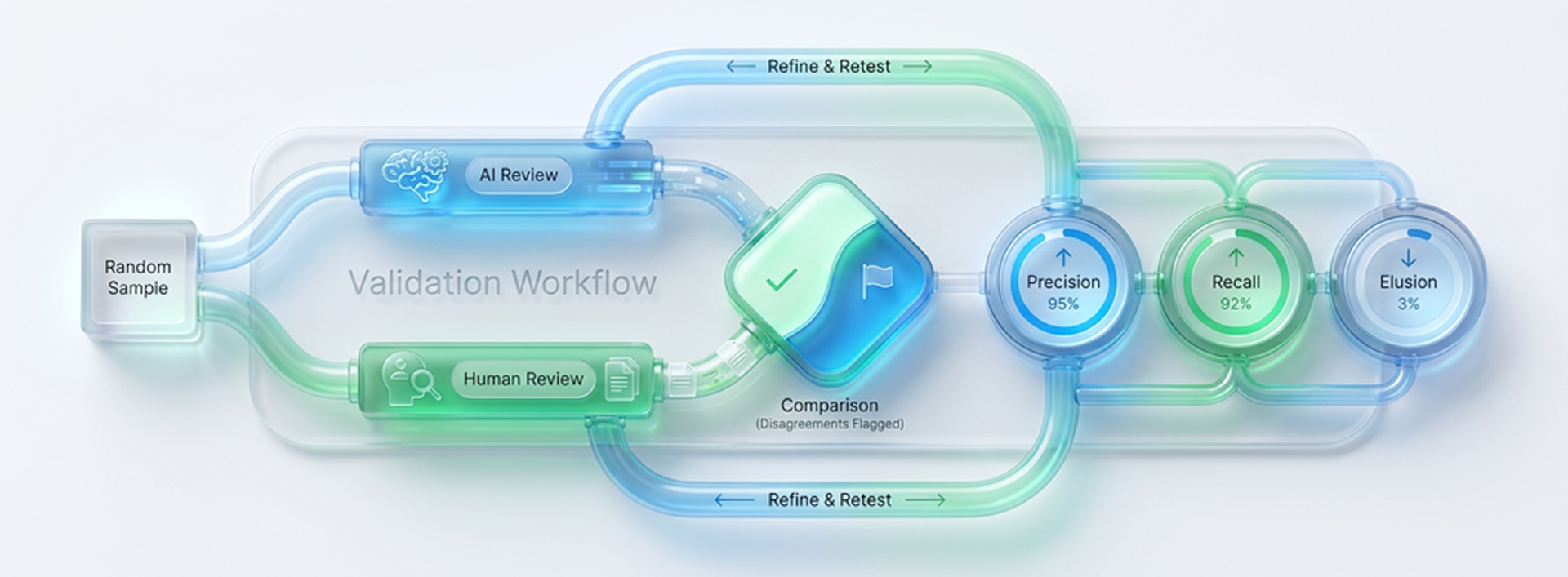
None of these numbers has a magic threshold, and that is rather the point. You stop when the result is reasonable and proportionate under Rule 26, not at an arbitrary score. Documented this way, your validation answers the only question that truly matters, can you defend it.
The Concerns That Actually Stop Adoption
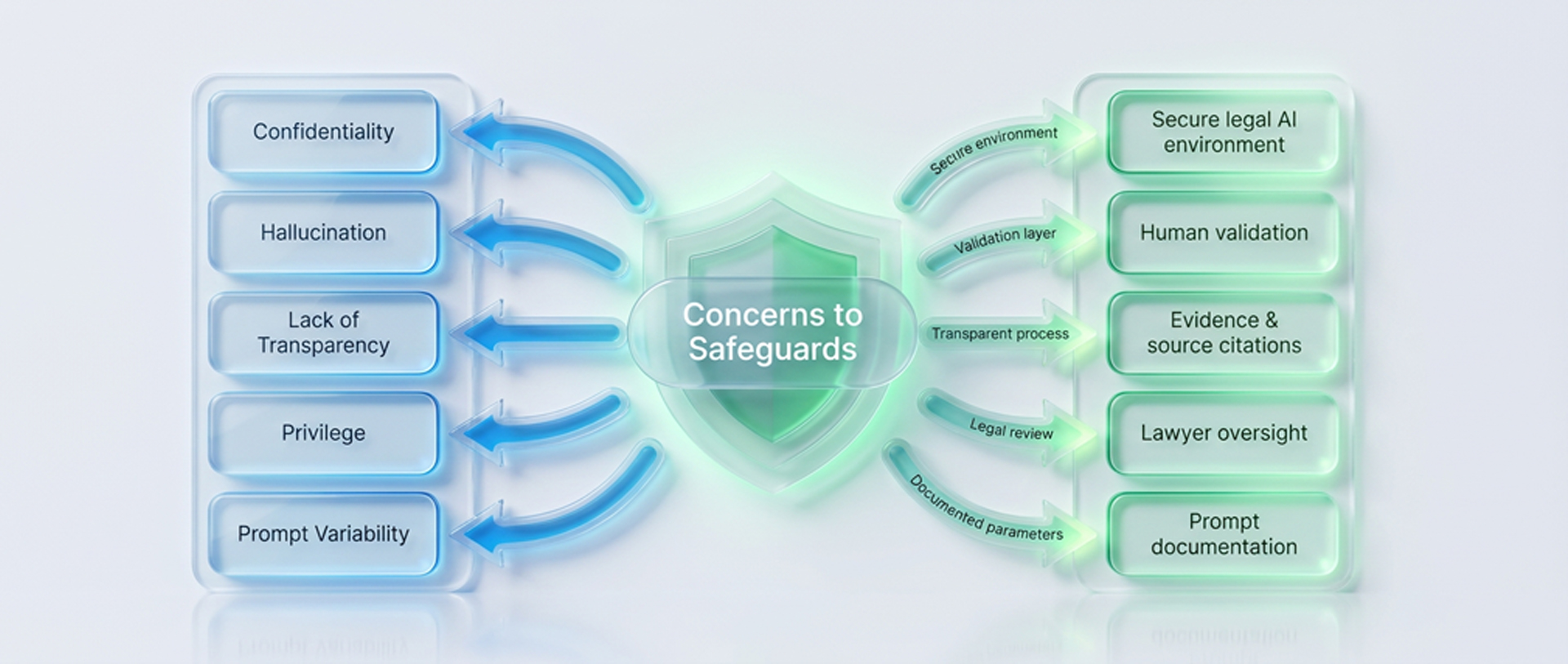
Most teams do not stall on the technology itself, they stall on real and specific worries. Each of those concerns deserves a straight answer rather than a sales pitch. The five below are the ones that come up most often in review rooms.
- Confidentiality almost always comes first, and the rule there is simple. Never feed privileged material into a public AI tool. ABA Formal Opinion 512 expects informed client consent before sensitive information enters many systems. Use a closed, secured environment built specifically for legal data instead.
- Hallucination is the second fear, and it is a fair one. A model can state something completely false with total confidence. That is exactly why outputs are verified before they go anywhere, never published on faith.
- Then there is the black box, since LLMs can be genuinely hard to explain. The fix for that is transparency rather than blind trust. Tools that cite the text behind each decision turn opacity into usable evidence.
- Some limits are worth naming plainly, especially around privilege. AI can flag a document as likely privileged, but it cannot reliably make the call. That judgment stays with a lawyer, and no current tool changes that.
- Prompts are the last concern, and a subtle one, because changing the wording can change the result. For that reason, prompts get documented and version-controlled as the review proceeds. It is the same discipline teams already apply to search terms today.
What's Changing in AI Review Right Now
The technology is moving fast, and it is moving mostly in the direction of trust. Citations and source identifiers now show which passage actually drove a decision. Reviewers can verify a call in seconds, instead of rereading the entire file.
Document summaries now compress long records into a few minutes of reading. AI-assisted legal document creation, like drafting privilege log entries, now produces a draft an attorney can simply refine. That turns hours of manual drafting into a quick review and edit.
The newest shift is agentic AI, which changes the texture of the work again. These tools reason in steps, search the data, and explain themselves as they go. Gen AI solutions like these increasingly sit inside mainstream review platforms, not in a separate sandbox.
Each of these upgrades points in the same direction. They move review toward something that can be inspected, not just trusted. That is the quality that will matter most as scrutiny increases.
Where AI Review Is Heading From Here
Look a few years out, and the ground shifts again in ways worth planning for. Today, courts allow AI in review, but tomorrow they may ask why you did not use it. Proportionality cuts both ways, and manual review of huge sets keeps getting harder to justify.
This shift is already visible at the industry's largest events. AI ran through the majority of the Legalweek 2025 agenda, and the opening AI session overflowed its room. By Legalweek 2026, the question had moved from whether to adopt generative AI to how to defend it. The center of gravity is moving from adoption to defensibility.
Expect the disputes to move as well, from search terms toward the prompts themselves. The wording that guides a model may become as contested as keyword lists are today. Some courts may even ask parties to disclose, or agree on, a set of core prompts.
The reasonableness of an AI instruction could be litigated much the way a search strategy is now. The workflow will keep merging too, as retrieval, review, and production converge in one environment. You can already see early signs in unified platforms like Venio eDiscovery. Early case assessment now starts the moment data lands.
The teams that build a defensible method now will be ready when that day arrives. The rest will be explaining themselves later, under far less comfortable conditions. The work you do today is what buys you that confidence tomorrow.
Building a Process You Can Defend
Generative AI is not coming for the lawyer's judgment, it is coming for the busywork. Used well, it gives you speed, consistency, and an earlier read on your own case. Used carelessly, it simply hands opposing counsel something new to attack.
The difference between those two outcomes is method, not magic. Define your criteria, validate your results, keep a human accountable, and document everything along the way. Do that consistently, and AI for legal document review stops being a risk and becomes an advantage.
The tool never signs the certification, you do, and that responsibvility does not move. The smartest move is to build the process that lets you sign with full confidence. If you are weighing how to bring defensible AI review into your matters, our team can help.
Frequently Asked Questions
How do you use AI to review documents?
You define each tag in plain language, then let the AI classify documents against that definition. Before relying on the output, you test it on a sample first. You compare the AI to human reviewers and refine until the results hold up.
What is the best AI for legal document review?
There is no single winner, and that is the honest answer. The best AI for legal document review is validated for your matter, transparent in its reasoning, and secure with sensitive data. Fit and defensibility matter far more than brand name.
Is AI document review defensible in court?
It can be, and the track record supports it. Courts have accepted TAR and predictive coding since 2012, beginning with Da Silva Moore. Generative AI is newer, so its defensibility rests on documented criteria, sampling-based validation, and clear human oversight.
Can AI decide whether a document is privileged?
Not on its own, and that limit is important. AI can flag likely privilege and draft a first-pass log entry for you. The final privilege determination is a legal judgment that stays with a qualified attorney.
Will AI replace human document reviewers?
No, but it does change the work rather than remove it. Reviewers shift away from reading every single page on a matter. Their time moves to defining criteria, validating results, and resolving the calls that need legal judgment.
Related Articles

What is eDiscovery Software?
In a world where business communication is overwhelmingly digital, these trails
Read Article
4 Proven Ways to Control eDiscovery Costs in Any Legal Case
eDiscovery continues to rank among the top cost drivers for legal departments,
Read Article
Discovery Objections: A Comprehensive List and How to Succeed
During the discovery process, an attorney attempts to obtain
Read Article