Privilege Logs in eDiscovery: A Complete Guide
Ready to get started?
built for clarity, control, and scale.
Share
In litigation, the documents you withhold can be just as consequential as the ones you produce. A privilege log is how you account for them, and how you keep attorney-client communications and work product out of the other side's hands. Done well, it protects your client and keeps discovery moving. Done poorly, it becomes the reason a court rules your privilege was waived.
This blog breaks down what a privilege log is, what it must include, the different types and when to use each, and what the December 2025 amendments to the Federal Rules of Civil Procedure change about handling privilege, with real examples and the case law that shapes best practice.
What is a Privilege Log?
A privilege log is a document that lists the materials a party withholds from discovery because it claims legal protection over them, usually attorney-client privilege or the work product doctrine, and describes each one in enough detail for the court and opposing counsel to assess the claim.
That last requirement is the balancing act at the heart of every privilege log. You have to say enough to justify withholding the document, but not so much that you give away the very thing you’re protecting. A log entry that simply reads “privileged email” tells the other side nothing and invites a challenge. An entry that quotes the legal advice in the email defeats the entire purpose.
You’ll also hear privilege logs referred to in shorthand as a “priv log.” The term is used interchangeably across litigation teams, eDiscovery vendors, and court filings. Whatever you call it, the function is the same: it’s the formal record of what you’re holding back, and why.
It helps to be clear about what a privilege log is not. It is not a production log (which tracks what you’ve produced), and it is not the same as a redaction. When you redact, you produce the document with the privileged portions blacked out. When you log, you withhold the document entirely and account for it on the privilege log. Many matters involve both.
What is a Privilege Log in Discovery?
In the discovery process, both sides exchange relevant information before trial. But "relevant" and "discoverable" are not the same thing. Some relevant material is shielded from disclosure by privilege. The privilege log is the mechanism that lets a party assert those protections transparently.
It signals to the opposing party: these responsive documents exist, we're withholding them, and here's the legal basis. Without that record, a court has no way to assess the claim and may simply assume the documents were withheld improperly.
Why Privilege Logs Matter More Than Most Teams Realize
It’s tempting to treat the privilege log as administrative housekeeping, a spreadsheet you generate at the end of review. In reality, it sits at the intersection of three high-stakes concerns, and a failure in any one of them can damage a case.
1. Avoiding Privilege Waiver
This is the big one. Privilege is not absolute, and it can be lost. If you fail to properly identify and describe withheld documents, a court can find that you’ve waived the protection entirely, meaning documents you intended to keep confidential become fair game. Inadvertent waiver is one of the most preventable and most painful mistakes in litigation.
2. Meeting Your Compliance Obligation
Federal and most state courts require parties to substantiate their privilege claims. A privilege log is the standard way to meet that obligation. Skip it, or do it carelessly, and you’re exposed to motions to compel, court sanctions, and orders to produce the very material you withheld.
3. Managing the Dynamic with Opposing Counsel
A clear, well-organized log reduces friction. It lets the other side understand and, ideally, accept your privilege assertions without running to the court. A vague or inconsistent log does the opposite. It breeds suspicion, invites challenges, and turns privilege into a satellite dispute that drains time and money from the actual case.
Former U.S. Magistrate Judge Andrew J. Peck captured how much the stakes have escalated. Speaking at Legalweek 2024, he recalled that when he took the bench in 1995, a privilege log in a typical case ran two or three pages with maybe 50 to 100 entries.
Today, he observed, those logs can run to 10,000 entries or more, are expensive to produce and, in his words, like “little novels” that are often of little use to the opposing party trying to work out what is or isn’t privileged. That tension between thoroughness and proportionality is exactly what modern privilege practice, and the latest rule changes, are trying to resolve.
What is Privilege Information? Understanding What You're Protecting
Before you can log a privileged document, you have to correctly identify privilege in the first place. This is where teams most often draw the line in the wrong place, either over-withholding documents that aren't actually privileged, or missing protections they were entitled to assert.
Privileged information is a category of confidential communication or material that the law shields from compelled disclosure. The two protections you'll encounter most in eDiscovery are:
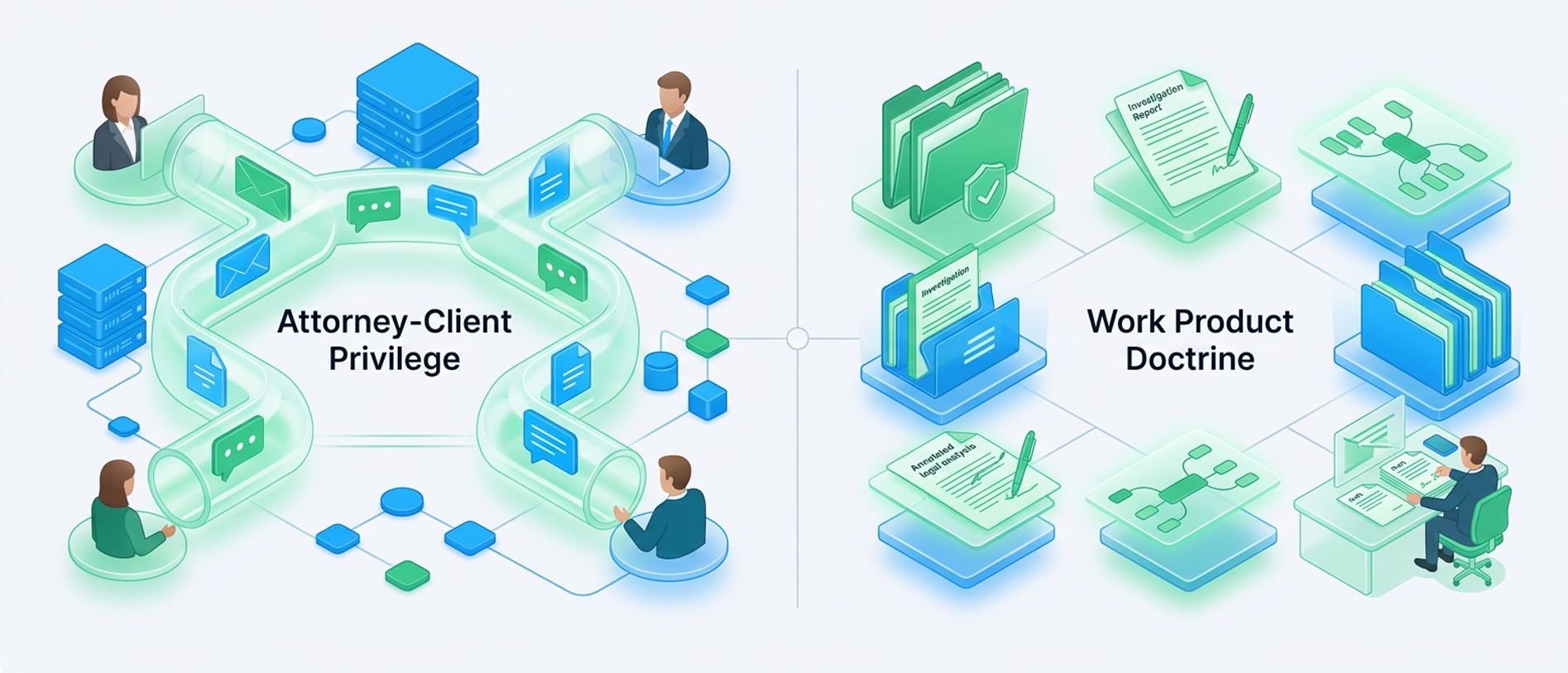
- Attorney-client Privilege: This protects confidential communications between a client and their attorney made for the purpose of seeking or providing legal advice. For example, an employee emails in-house counsel for legal guidance about a workplace incident. But it's narrower than people assume: it covers legal advice, not business advice, and it can be lost if shared with third parties who break the chain of confidentiality.
- Work Product Doctrine:This protects materials prepared by or for an attorney in anticipation of litigation, such as legal memos, case strategy notes, and an attorney's mental impressions. It can sometimes be overcome if the opposing party shows substantial need and an inability to obtain the equivalent elsewhere, though core mental impressions receive near-absolute protection.
Depending on the matter and jurisdiction, you may also need to account for other privileges, including common interest (or joint defense), doctor-patient, and accountant-client. Each has its own contours, and each should be clearly identified on the log when asserted.
A practical trap worth flagging is that attachments are not automatically privileged just because the email they're attached to is. A privileged email forwarding a non-privileged business spreadsheet doesn't make the spreadsheet privileged.
Each attachment has to be assessed on its own. Logging an entire document family as privileged because the parent email was privileged is a common way to end up over-withholding, and to raise a challenge.
What a Privilege Log Must Include
Here's a point that surprises many people new to eDiscovery: the Federal Rules of Civil Procedure never actually use the term "privilege log." The rules don't prescribe a format, privilege log template, or a required set of fields.
What the rules do require comes from FRCP Rule 26(b)(5)(A). When a party withholds information on the basis of privilege, it must (i) expressly make the claim, and (ii) describe the nature of the withheld documents, communications, or tangible things "in a manner that, without revealing information itself privileged or protected, will enable other parties to assess the claim."
Those two requirements, the express claim and the supporting description, are the foundation of every FRCP privilege log. The log itself is simply the practical, widely accepted tool for satisfying that requirement.
Because the rule describes a function rather than a form, the specific fields are largely a matter of practice and party agreement. That said, a defensible log almost always includes the following at a minimum:
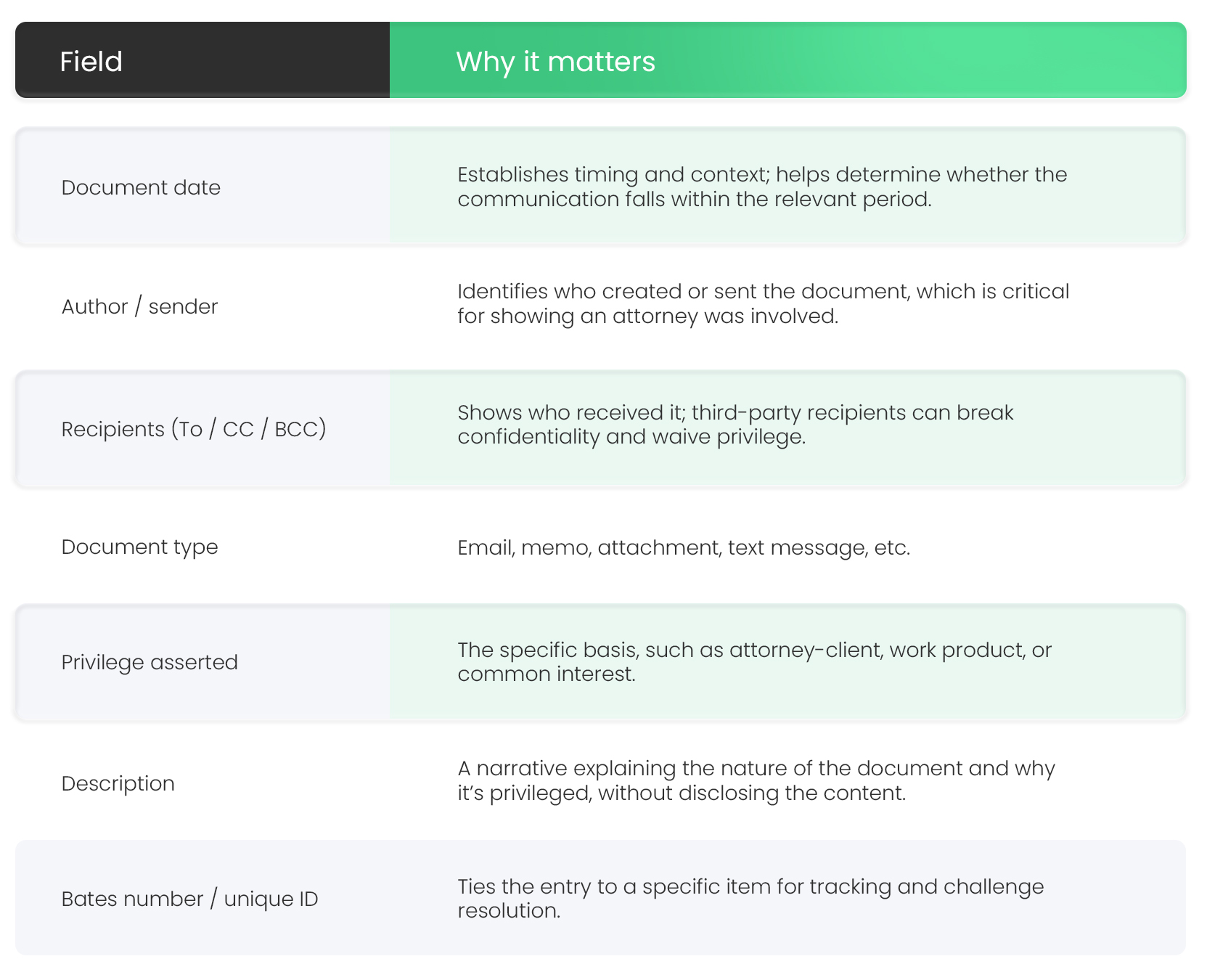
The hardest field to get right is the description. This is where waiver risk concentrates. The description has to do real work. “Email reflecting legal advice regarding the company’s response to the EEOC complaint” tells the other side meaningfully more than “privileged communication,” while still revealing nothing protected. Courts have repeatedly rejected logs full of generic, copy-paste descriptions.
In Chevron Corp. v. Weinberg Group, 286 F.R.D. 95 (D.D.C. 2012), the court criticized vague and inconsistent privilege log descriptions and underscored the need for clear justifications. In Ritchie Risk-Linked Strategies Trading (Ireland), Ltd. v. Coventry First LLC, 273 F.R.D. 367 (S.D.N.Y. 2010), the court found a log insufficiently detailed and ordered the party to provide additional information about the withheld documents.
A few other field-level practices that separate a professional log from an amateur one:
- Name normalization: Write each person's name the same way every time. "Andrew Smith," "A. Smith," and "asmith@company.com" should all resolve to one consistent identifier. Inconsistent naming makes a log hard to read and easy to attack.
- Flag the attorneys: Many teams mark attorney names (for example, with an asterisk) so the log makes clear, at a glance, that a lawyer was party to the communication.
- Log attachments separately: As noted above, assess and log each attachment on its own merits.
A privilege log example, annotated
Theory only goes so far. Here’s what a sample privilege log entry actually looks like in practice.
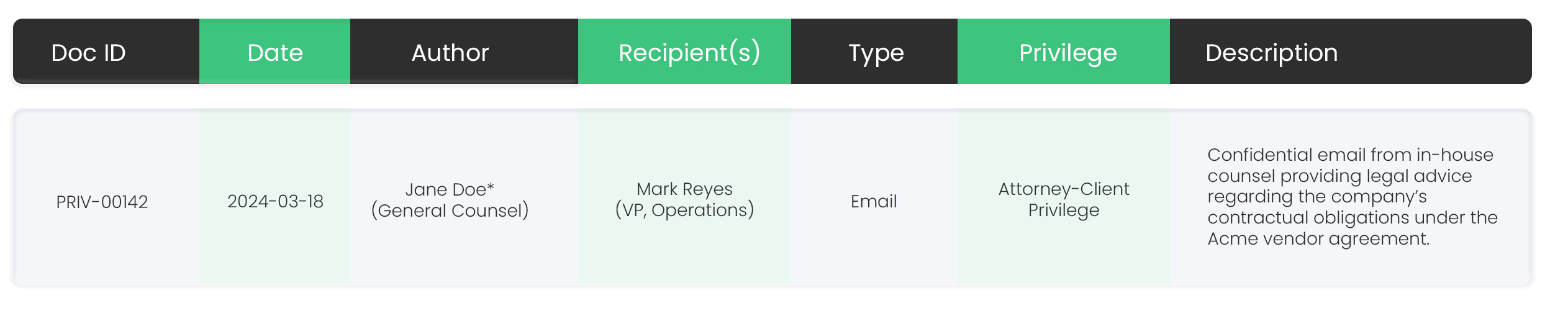
Notice what this entry does. It establishes that an attorney (Jane Doe, flagged with an asterisk) was the author. It shows a single internal recipient, so there's no obvious third-party waiver problem. It names the privilege specifically. And the description identifies the subject of the legal advice, the Acme vendor agreement, without quoting or summarizing what the advice actually was. A reviewer on the other side can assess the claim. They cannot reverse-engineer the legal advice.
The Four Types of Privilege Logs
Because the rules don’t prescribe a format, several types of privilege logs have emerged, each striking a different balance between thoroughness and burden. Choosing the right one for your matter is a strategic decision, not a clerical one.
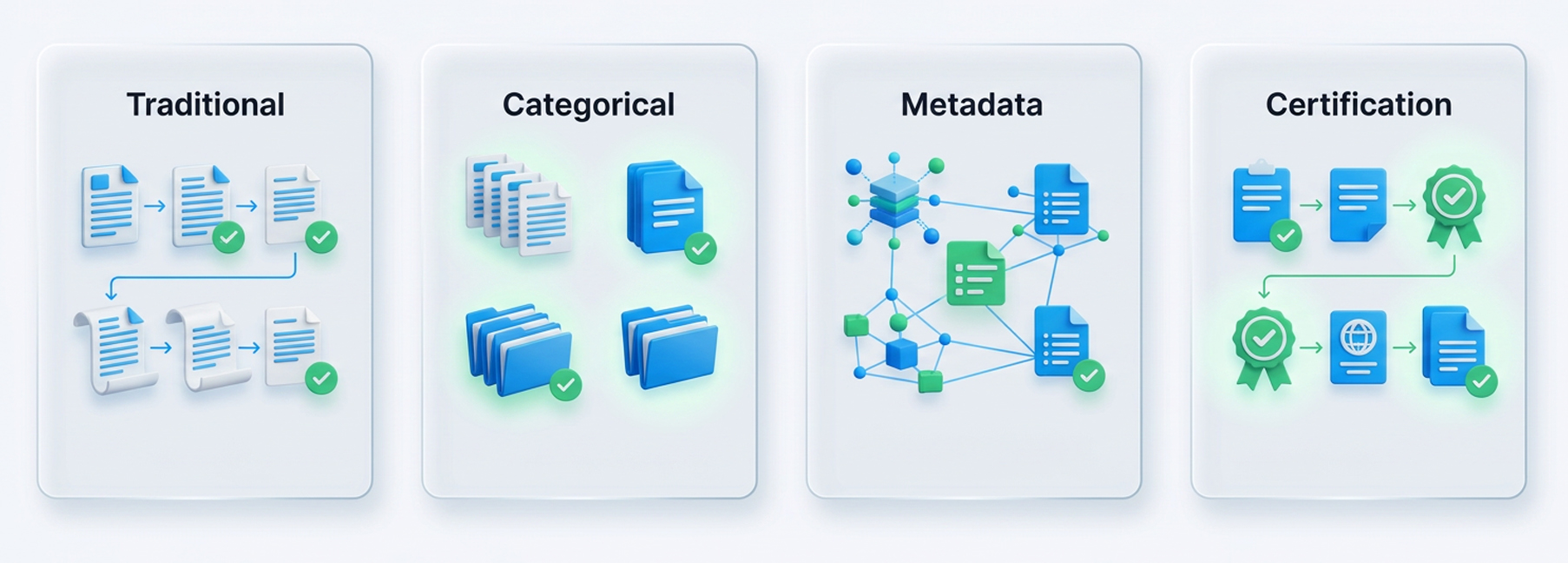
1. Traditional (Document-by-Document) Log
The most detailed and the most burdensome. Every withheld document gets its own line with full field-level detail. Sometimes called a Vaughn index in the FOIA context, it offers the most protection against challenge, but in a matter with thousands of privileged documents, it’s expensive and slow to produce. This is the historical default, and the source of the “little novels” critique that has driven recent reform efforts.
2. Categorical Log
Instead of logging each document individually, similar documents are grouped under a shared description, such as "all communications between in-house counsel and the executive team regarding the merger." It dramatically reduces burden in large-scale litigation and is increasingly favored, though each category still needs enough detail to justify the privilege. Some jurisdictions actively encourage it; New York state courts, for instance, promote categorical logging through local rules.
3. Metadata Log
This approach uses metadata fields already attached to documents, such as date, author, recipients, file type, and subject line, to satisfy the disclosure requirement, without a separate narrative description. It’s highly efficient because the data entry is largely automated, but the lack of a narrative can leave claims vulnerable when more context is needed. It typically requires agreement from opposing counsel and the court.
4. Certification Log
A newer, proportionality-driven approach in which a party certifies that withheld categories of documents are privileged, rather than logging them exhaustively. It's part of a broader push, reflected in recent commentary from organizations like The Sedona Conference and EDRM, to make privilege logging less of an arms race and more of a proportional exercise.
The right choice depends on the volume of privileged material, the complexity of the matter, the jurisdiction’s local rules, and, increasingly, what you negotiate with the other side at the outset.
Where Privilege Logs Break Down, and What It Costs
Most privilege log disasters are variations on a handful of recurring mistakes. Knowing them is the cheapest insurance you can buy.
- Producing no log at all: The most basic failure, and one the courts treat harshly. In Coker v. Goldberg & Associates P.C., 2024 WL 263121 (S.D.N.Y. 2024), the failure to produce a privilege log for withheld documents led the court to find privilege waived and to impose sanctions under Rule 37(b)(2). If you’re withholding, you have to account for it.
- Boilerplate descriptions: Logs filled with identical, contentless entries, such as “privileged communication” or “attorney work product” repeated hundreds of times. Courts read this as a failure to meet the 26(b)(5)(A) standard, as the Chevron and Ritchie decisions illustrate.
- Logging too late: Privilege logs are typically produced after the final document production, often on an agreed deadline of 30 to 60 days afterward. Rolling logs and last-minute logs create errors, omissions, and clawback headaches. Waiting until the deadline to start is how a sound privilege claim gets lost to a sloppy log.
- Over-withholding: Pulling too much into the privileged pile, such as logging non-privileged attachments, business communications, or documents merely copied to an attorney, invites challenges and proportionality fights, and erodes your credibility with the court for the claims that genuinely matter.
- Inadvertent production: The flip side: accidentally producing a privileged document. This is where Federal Rule of Evidence 502 matters. FRE 502(b) can protect against waiver when disclosure is inadvertent and the party took reasonable steps to prevent and rectify it, and FRE 502(d) lets a court enter an order that disclosure doesn’t constitute waiver in that proceeding, a clawback safeguard many teams now negotiate at the start of a case.
The 2025 FRCP Changes That Rewrote Privilege Log Timing
If you take one current-events item from this guide, make it this one.
On December 1, 2025, amendments to the Federal Rules of Civil Procedure took effect that changed how and when parties must address privilege logging. These are widely described as the most significant privilege log reforms in decades.
The amendments don't change Rule 26(b)(5)(A) itself. The underlying obligation to describe withheld documents is the same. What they change is timing. The amendments target what practitioners have long called the "privilege log problem": the tendency for logging disputes to erupt late in discovery, after enormous cost has already been sunk into document-by-document logs.
Specifically:
- Rule 26(f)(3)(D) now requires the parties' discovery plan to include their views and proposals on the method and timing for complying with Rule 26(b)(5)(A), including any agreements about privilege after production, such as FRE 502 orders.
- Rule 16(b)(3)(B)(iv) now permits the court to address that same timing and method in its scheduling order.
In plain terms, privilege logging has shifted from a late-stage chore to an early-stage negotiation. Litigants now need to come to the Rule 26(f) "meet and confer" ready to agree on how privilege will be handled, from categorical logging to acceptable metadata fields to FRE 502 protections, before the heavy review begins. Courts can fold these agreements into the scheduling order, and may even apply them to cases pending before December 1, 2025, where it's "just and practicable."
This is a meaningful win for proportionality. It gives teams the chance to agree, up front, that a categorical or metadata log is appropriate, avoiding the situation where one side spends months building a document-by-document log only to fight about it on the eve of the deadline.
Best practice under the new regime: treat privilege logging as a first-week conversation, not a last-week task. Document the agreed approach in writing, in an ESI protocol or privilege review protocol, and check your jurisdiction's local rules, which can still impose their own requirements.
How AI is Changing Privilege Logging in eDiscovery
For most of its history, privilege logging has been brutally manual. Attorneys review documents one at a time, code them for privilege, and a log gets assembled, often by hand, often under deadline pressure, often with the inconsistencies that invite challenges.
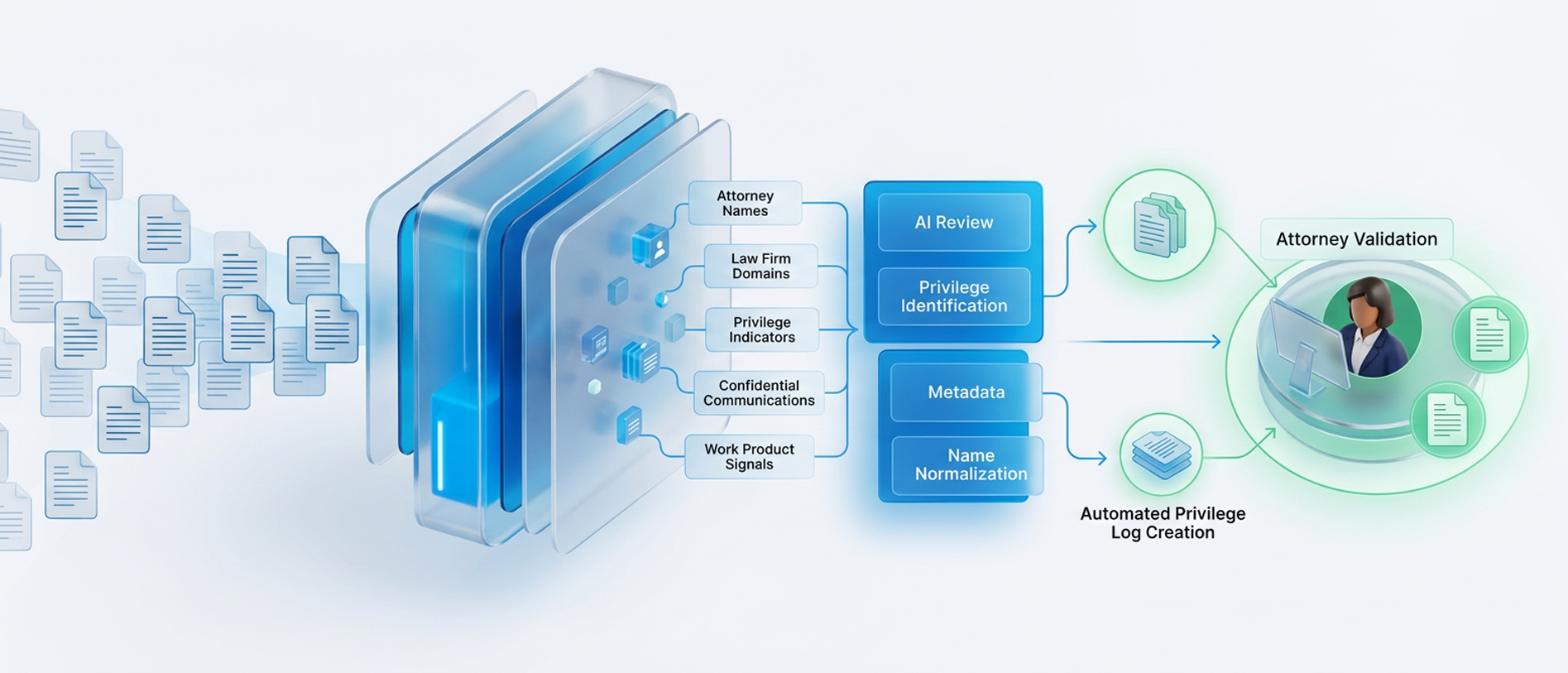
Modern eDiscovery platforms have changed the economics of that work. Technology now supports privilege logging in several concrete ways:
- AI-assisted identification: Search term lists, pattern recognition, and AI models can pre-flag potentially privileged documents, scanning for attorney names, law firm domains, and trigger phrases like "privileged and confidential," before attorney review begins. This shifts the workload from "review everything" to "review the flagged subset and confirm." Attorneys still make the call; the technology narrows the field.
- Consistent tagging at scale: Coding categories let reviewers apply privilege designations and reasons uniformly across an entire dataset, eliminating the inconsistency that boilerplate-weary courts dislike.
- Automated log generation: Once documents are coded, platforms can auto-populate log fields from metadata and generate the log in the agreed format, with name normalization applied consistently. What used to take days of manual assembly can be produced and revised in a fraction of the time.
The caveat that matters: technology supports attorney judgment; it doesn't replace it. A privilege determination is a legal judgment, and a defensible log is one where a qualified attorney has confirmed the calls. Automation removes the mechanical burden: the data entry, the formatting, the normalization. That frees attorneys to spend their time on the judgment work that actually requires them.
This is also where platform consolidation pays off. When identification, document review, redaction, and privilege logging all happen in one place, rather than across disconnected tools and exported spreadsheets, the log stays tied to the underlying documents, the metadata stays clean, and the risk of the kind of error that leads to waiver drops substantially.
What This Means for Your Next Matter
Strip away the procedure, and the case law, and the privilege log comes down to a few durable truths.
It's not housekeeping. It's the document that stands between your client's confidential communications and the other side. Treat it that way. Build it on specific, consistent descriptions rather than boilerplate. Choose the type of log, whether traditional, categorical, metadata, or certification, that fits the volume and complexity of your matter rather than defaulting to the most burdensome option. And under the December 2025 FRCP amendments, have the privilege conversation at the very start of discovery, not the end.
Most privilege waivers aren't the result of weak claims. They're the result of weak logs that are vague, late, inconsistent, or missing. The teams that take the privilege log seriously and back it with technology that keeps coding consistent and metadata clean are the ones that rarely have to fight about it.
Privilege logging shouldn’t be the task that puts your privilege at risk. The teams that handle it well start the conversation early, write specific and consistent descriptions, and lean on technology to keep coding consistent and metadata clean.
See how Venio brings privilege identification, review, redaction, and log generation into a single workflow, so your privilege log stays tied to clean, consistent data instead of last-minute exports. Contact us to see how Venio fits your privilege workflow.
Related Articles
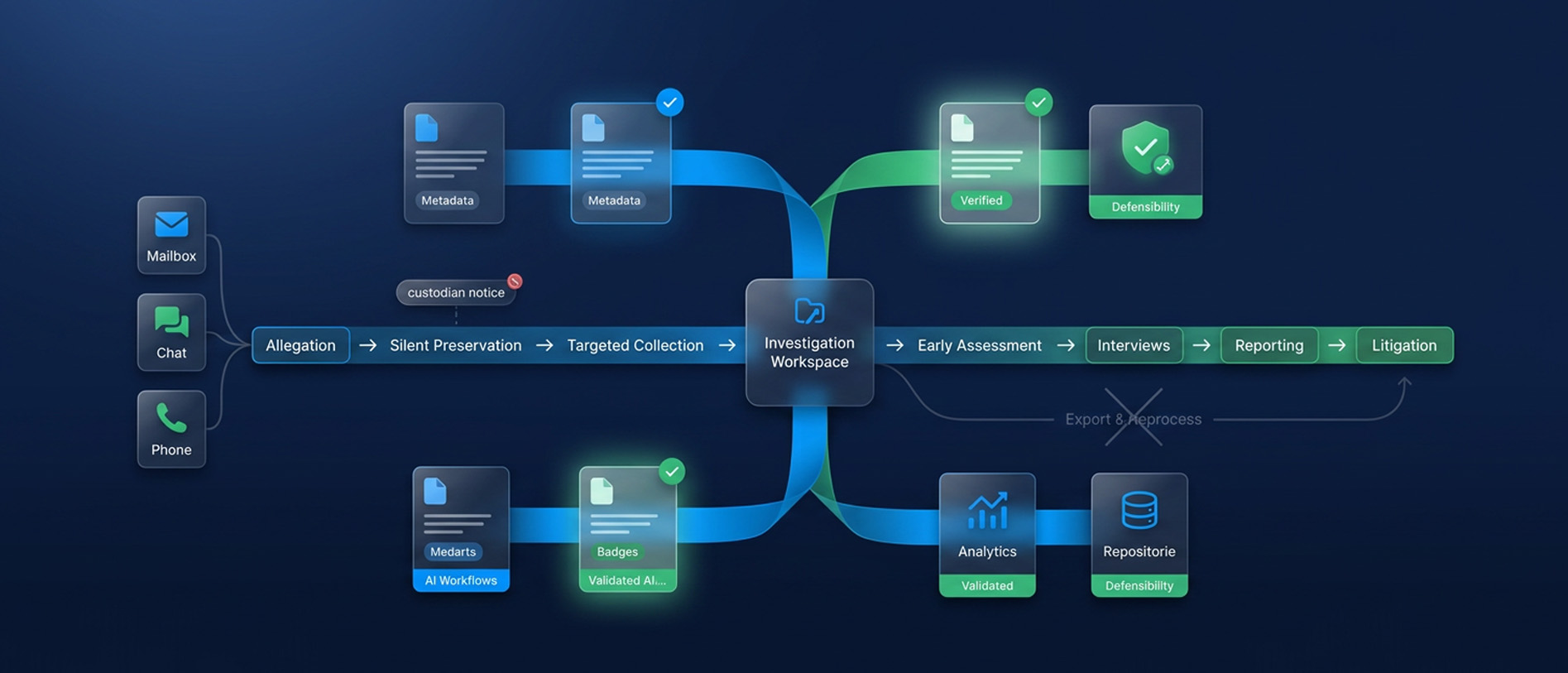
Internal Investigations: Getting the Facts Without Blowing the Matter Open
An internal investigation offers no court schedule and no second chance at prese
Read Article
eDiscovery Data Analytics & Visualization for Trial Preparation
Most litigation teams don’t lose at trial because they lack evidence. They lose
Read Article
What to Ask in an eDiscovery Demo Before You Sign
Twenty questions that make an eDiscovery vendor prove processing, AI, security a
Read Article