How to Release a Legal Hold Properly

Ready to get started?
built for clarity, control, and scale.
Share
Nobody gets sanctioned for holding data too long, and that one fact explains most of what goes wrong with legal holds.
The incentive runs in a single direction. Releasing a hold is a decision someone has to own and defend. Leaving it in place is a decision nobody has to make at all. So holds accumulate. A matter settles, the team moves on, and two years later custodians are still preserving data for a case that closed before half of them joined the company.
The cost of that doesn't show up as a sanction. It shows up as storage nobody budgeted for, as privacy exposure on data you no longer have a legal reason to keep, and as a bloated data footprint that gets swept into every future matter you defend.
Releasing a legal hold properly is the correction, and it is not an administrative step. It is a legal judgment about whether the duty to preserve has ended, and courts review that judgment the same way they review the decision to issue a hold. This guide covers the standard behind it, the endpoints that support release, the ones that look final but are not, and what a release actually costs to execute.
Release is the last phase of a longer sequence, and getting it right depends on how well the earlier phases were documented. If you are building the programme rather than closing a single matter, start with the full legal hold lifecycle - trigger, notice, implementation, maintenance and release - and treat this article as the detail on the final step.
What Releasing a Legal Hold Actually Means
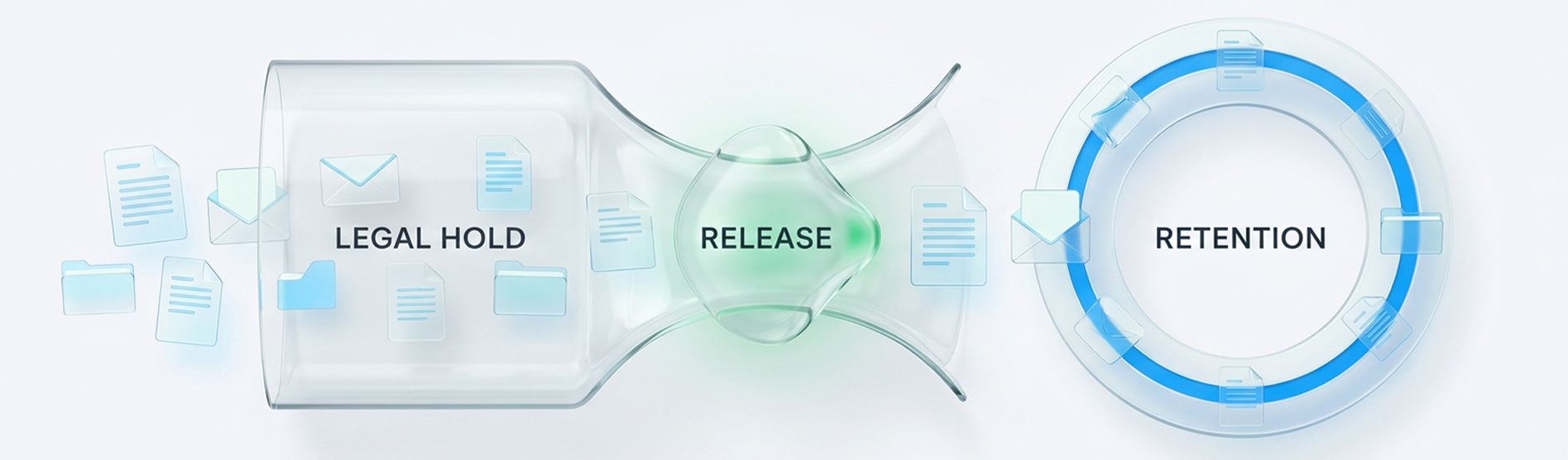
Releasing a legal hold ends the preservation obligation and returns the affected data to your normal retention schedule. Note what it does not do, it does not delete anything. Release lifts the suspension on routine disposition, and whatever your retention policy says then applies as usual.
That distinction matters more than it sounds. Preservation and retention are different duties, and lifting one does not settle the other. Data released from a hold may still be subject to tax, regulatory, HR, or privacy obligations that require keeping it, or in some regulated contexts, deleting it on a fixed schedule. A release decision that ignores the retention layer underneath it tends to surface later as either an unexplained gap or a compliance finding.
The Duty Doesn't End When the Case Does
The duty to preserve begins when litigation becomes reasonably anticipated. It ends by the same measure, running in reverse. Federal courts ask whether, at the moment the hold came down, the party could reasonably have concluded that litigation was no longer foreseeable. No rule sets a release date; FRCP Rule 37(e) governs what happens when preserved information is lost, not when the obligation expires.
The practical consequence is that release gets judged on reasonableness at the time, not on hindsight. That cuts in the releasing party's favor more often than teams expect. Courts have declined to sanction a company that released its hold after a dismissal with prejudice even though the same case was later reinstated. Because the decision was sound when it was made and a later revival did not retroactively make it unreasonable.
It also means the analysis is fact-specific rather than procedural. A matter can be formally closed while the duty still runs. A matter can remain technically open while the duty has already lapsed as to some custodians.
Six Endpoints That Support Release
Federal courts have upheld release after each of the following. None is automatic, and each turned on facts the court examined closely, but together they form the practical map:
1. Dismissal With Prejudice
The clearest endpoint, and the one with the most direct authority behind it. In Edwards v. Hearst Communications, a publisher released its hold after a joint dismissal with prejudice, and a different plaintiff filed the same claim three months later and moved for sanctions. The court found the release reasonable, but leaned heavily on there being no other suits under the same statute and no signals that more were coming. The dismissal carried the decision only because nothing else contradicted it.
2. Settlement Of The Underlying Matter
In a products liability MDL, a court refused to sanction a defendant for disposing of documents after settlement, and specifically rejected the argument that FDA adverse event reports and plaintiff-firm blog commentary should have kept the hold alive. Its reasoning was blunt and on that standard, pharmaceutical companies would sit in a permanent hold.
3. Resolution Through A Business Agreement
Where a patent dispute ended in a licensing agreement rather than a suit, a court found no preservation duty in the period between that agreement and the litigation that eventually followed. Reasoning that a party would hardly enter a business arrangement it expected to end up litigating.
4. A Government Investigation That Goes Dormant
In an antitrust matter, a court drew a line most teams miss. A duty owed to the DOJ under a civil investigative demand is not automatically a duty owed to private plaintiffs. It also mattered that the investigation had gone quiet for roughly five months, and that the defendant had kept its hold in place until the investigation actually ceased.
5. Judgment Or Summary Judgment, After Appeals Close
Final judgment ends the matter, but only once the appeal window has run. Releasing into an open appeal period is one of the more common self-inflicted wounds in the release process.
6. Expiration Of The Statute Of Limitations
Where no claim can any longer be brought, the foundation for anticipating litigation is gone. Worth confirming the limitations period covers every potential claimant, not just the one you dealt with.
Four Situations That Look Final But Are Not
The reverse matters just as much. Courts have been just as clear about when a hold survives a case that looks over.
1. Dismissal Without Prejudice
A dismissal ends the case, but the two versions of it are not the same. Dismissed with prejudice means the claim is gone for good and cannot be brought again. Dismissed without prejudice means the plaintiff can refile the same claim later, so the dispute is closed on paper but still live in practice.
Courts have granted dismissal without prejudice while ordering the defendant to keep preserving until the limitations period runs out. One word separates a safe release from a premature one, so read the order itself rather than the case status.
2. A Stay, Not a Resolution
A stay pauses a case rather than ending it. Courts issue them for all kinds of reasons, including a patent office review of the patent in dispute or an appeal in a related case that will shape the outcome of yours. The docket can sit quiet for a year or more, which makes a stayed case feel resolved to anyone not tracking it closely. It is not. The duty to preserve runs straight through the stay, and the case can resume on short notice.
3. Parallel or Copycat Claims
Some companies face the same type of claim repeatedly, from different claimants, over the same underlying conduct. Resolving one of those matters says very little about whether more are coming, and a court assessing your release will look at that broader pattern rather than the single case you closed. Settling with one claimant also does not necessarily end a duty triggered by a related claim someone else has already raised.
4. A Regulatory Inquiry After the Civil Case Closes
The same facts can produce two separate proceedings, a lawsuit and a regulator's investigation. They run on independent timelines and can end years apart, so the civil case concluding tells you nothing about the status of the regulatory one. Each carries its own preservation duty and needs its own release decision, documented separately.
Read as a single view, the pattern looks like this:
.png)
Get the Other Side to Agree You Can Release
Everything above is a judgment call made alone, months after the fact, and second-guessed by an opponent with hindsight. There is a way to take most of that risk off the table, and almost nobody writing about legal holds mentions it.
You can negotiate the end of the preservation duty into the document that ends the matter.
Parties do this in settlement agreements, consent decrees, injunctions, and dismissal orders. The provision states that as of the effective date, litigation is not reasonably foreseeable as to the matters covered, and that any party holding data under a litigation hold for those matters is no longer required to maintain it. Federal consent decrees and injunctions on the public record, in matters involving the DOJ, the CFPB, and others, contain exactly this kind of language.
The effect is significant. Instead of your counsel arguing years later that release was reasonable, you have the opposing party on record agreeing that it was, at the moment the matter closed. The cost is one clause and one conversation during a negotiation you were having anyway.
Add preservation release to the settlement checklist alongside confidentiality, non-disparagement, and payment terms. Its absence is rarely deliberate. Nobody raises it
What Resources Are Utilized When a Litigation Hold Is Lifted?
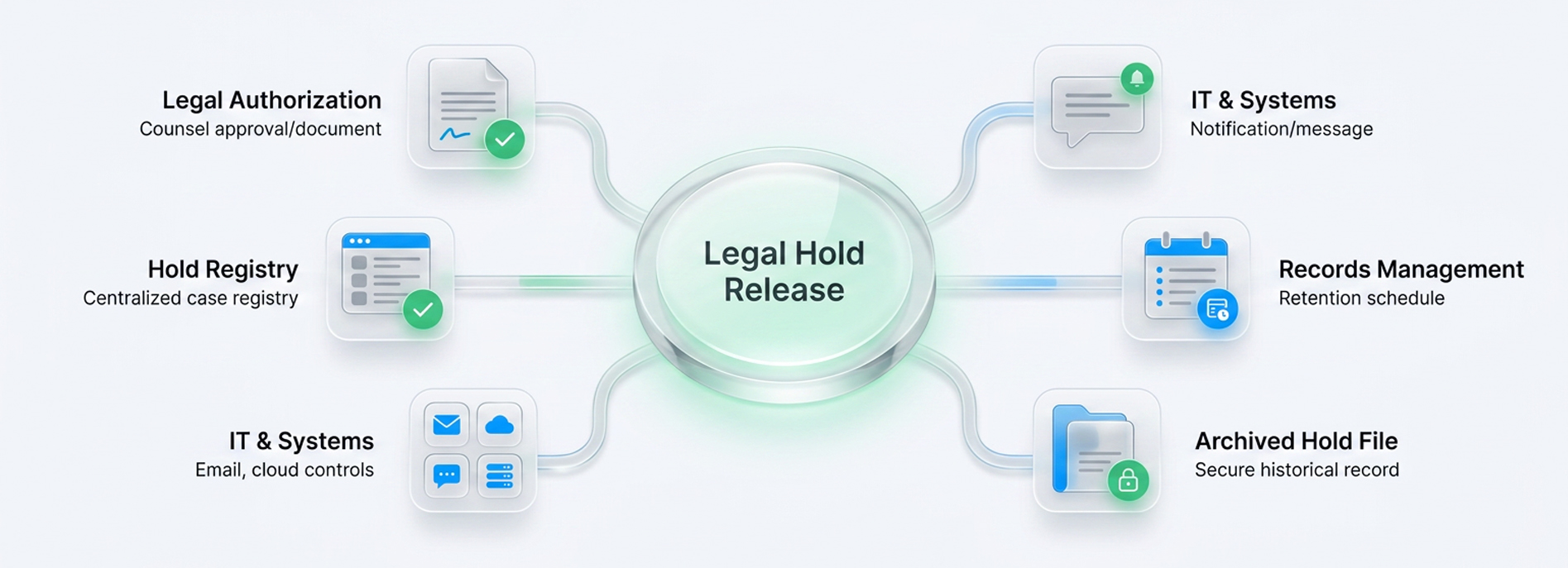
Lifting a litigation hold pulls in legal, IT, records management, and information governance. The coordination between them is where releases usually fail, because each team holds one piece and no single person sees the whole sequence. These resources carry the work:
- Legal Counsel's Written Authorization: The document that starts everything. It records who decided the hold was no longer needed, on what basis, and from what date. Without it, there is nothing to point to later.
- The Hold Registry: The list of every hold and every custodian on it. Check it before releasing anyone, to confirm the custodian and their data sources are not tied to another open matter.
- The Custodian Notification Channel: Email, a hold platform, or a custodian portal. This is how the release notice reaches every legal hold custodian, and how you log that it arrived.
- IT and Systems Administration: The team that removes preservation controls across mail, chat, cloud storage, shared drives, archives, and backups, then switches normal retention rules back on.
- Records Management: The team that assigns released data its correct retention period and confirms no separate regulatory, tax, or privacy obligation requires keeping it longer.
- The Archived Hold File: The complete record of the hold, kept after release. A defensible hold is only useful if its paper trail outlives it.
The Sequencing Failure Nobody Plans For
Order of operations is the underrated risk here. If IT reinstates automated deletion before legal has confirmed and documented that every affected custodian is clear of other holds, the organization can destroy data still under an active preservation duty, using its own release process to do it.
The fix is a hard gate rather than a habit. IT acts only on a written, matter-specific release from legal that names the custodians and systems in scope. Not a forwarded email, not a verbal all-clear during a status call.
Writing the Release Notice
A release notice deserves the same precision as the original litigation hold notice. The most common defect is a notice that announces the matter is over without ever telling the custodian what changes for them. A defensible legal hold notice releasing a custodian should state:
- Matter name and hold reference so the release attaches to one specific hold and not to preservation generally.
- Effective date the date normal retention resumes, which is the date a court would later ask about.
- The authorizing party named counsel or role, not simply “legal.”
- What changes for the custodian stated plainly, in the terms they were originally instructed in.
- Status on others holds explicit confirmation of whether they remain preserved for anything else. Silence here is how custodians release themselves from obligations that are still live.
- Contact for questions one named point of contact for custodians and IT.
Standing language, kept as a legal hold notice template rather than drafted fresh each time, is worth building into your litigation hold checklist. Consistency across releases is itself evidence of process, and the same principle applies at the other end of the lifecycle, as our guide on what to do when you get sued covers for the first hours of a matter.
Release Is Part of the Record
The organizations that get this right are not the ones with the most cautious instinct. They are the ones that treat release as a documented legal decision. Made against a standard, on a date, by someone with authority, with the reasoning written down while it is still fresh.
That record is the entire asset. A release holds up because the organization can explain what it knew when it let the data go. Six months later, nobody remembers. The file either says it or it does not.
Venio Legal Hold Software keeps issuance, custodian acknowledgment, registry cross-checks, and release in one system, so the decision and everything behind it stays on the record instead of in someone's sent folder. Book a demo to see how the full hold lifecycle runs in a single defensible workflow.
Frequently Asked Questions
What resources are utilized when a litigation hold is lifted?
Lifting a litigation hold involves legal counsel to authorize and document the release, the hold registry to confirm no overlapping matters apply, the notification channel used to issue release notices to custodians, IT to remove preservation controls and restore retention rules across email, chat, cloud, and backup systems, records management to reassign correct retention periods, and the archived hold file, which is retained after release.
When is it safe to release a legal hold?
Courts ask whether litigation was still reasonably foreseeable when the hold was lifted. Federal decisions have accepted release after dismissal with prejudice, settlement, resolution by business agreement, a government investigation that goes dormant, final judgment once appeals close, and expiration of the statute of limitations. Release is not safe after a dismissal without prejudice, during a stay, or where parallel claims of the same type remain foreseeable.
Does releasing a legal hold delete the preserved data?
No. Release removes the suspension on routine disposition and returns the data to your normal retention schedule. Whether anything is actually deleted depends on that schedule and on any separate regulatory, tax, or privacy obligations that still apply.
Can you release a legal hold while litigation is still ongoing?
Partially, yes. If the scope of a matter narrows, specific custodians or data categories can be released through a modified hold notice while the rest of the hold stays in force. This is a scope change rather than a release, and it should be documented as one.
Who has authority to release a legal hold?
Legal counsel, typically the general counsel or a designated administrator. Release should never originate from IT, records management, or a custodian, even where the matter is obviously resolved, because the authorization record is what makes the decision defensible later.
Related Articles

eDiscovery Data Analytics & Visualization for Trial Preparation
Most litigation teams don’t lose at trial because they lack evidence. They lose
Read Article
What to Ask in an eDiscovery Demo Before You Sign
Twenty questions that make an eDiscovery vendor prove processing, AI, security a
Read Article
Consolidating Your eDiscovery Stack Without Disrupting Active Matters
How to consolidate eDiscovery tools without disrupting live matters, and why a f
Read Article