Is AI Changing Legal Hold? What In-House Counsel Need to Know
Ready to get started?
built for clarity, control, and scale.
Share
In May 2025, a federal court ordered OpenAI to preserve every ChatGPT output log going forward, an order broad enough to threaten requiring the company to keep every conversation any user had ever had with the tool. By September, the same court narrowed it. But the finding underneath both rulings survived. Prompts and outputs from a generative AI tool are ESI, discoverable under Rule 34, and subject to the same preservation duty as an email or a Slack message.
That is not a footnote for AI companies to track. It is case law that applies the moment a custodian opens ChatGPT, Copilot, or Gemini to draft something connected to a matter.
So, is AI changing legal hold? Yes, though not the duty itself. The duty to preserve still triggers the moment litigation is reasonably anticipated, exactly as it always has. What has changed is nearly everything about how that duty gets executed once the relevant data is a conversation with a machine instead of a message between two people. This blog covers what courts have decided so far, where a standard hold notice fails to reach AI content, what the December 2025 FRCP amendments change about timing, and what an AI-ready hold notice needs to say.
What “Legal Hold” Means When the Data Is a Conversation With a Machine
A legal hold is a notice that suspends routine deletion once litigation becomes reasonably foreseeable, triggered by a demand letter, a whistleblower report, a regulator's inquiry, or any event that starts the clock. Venio's guide to ESI and legal holds covers that trigger and the mechanics of issuing a notice correctly.
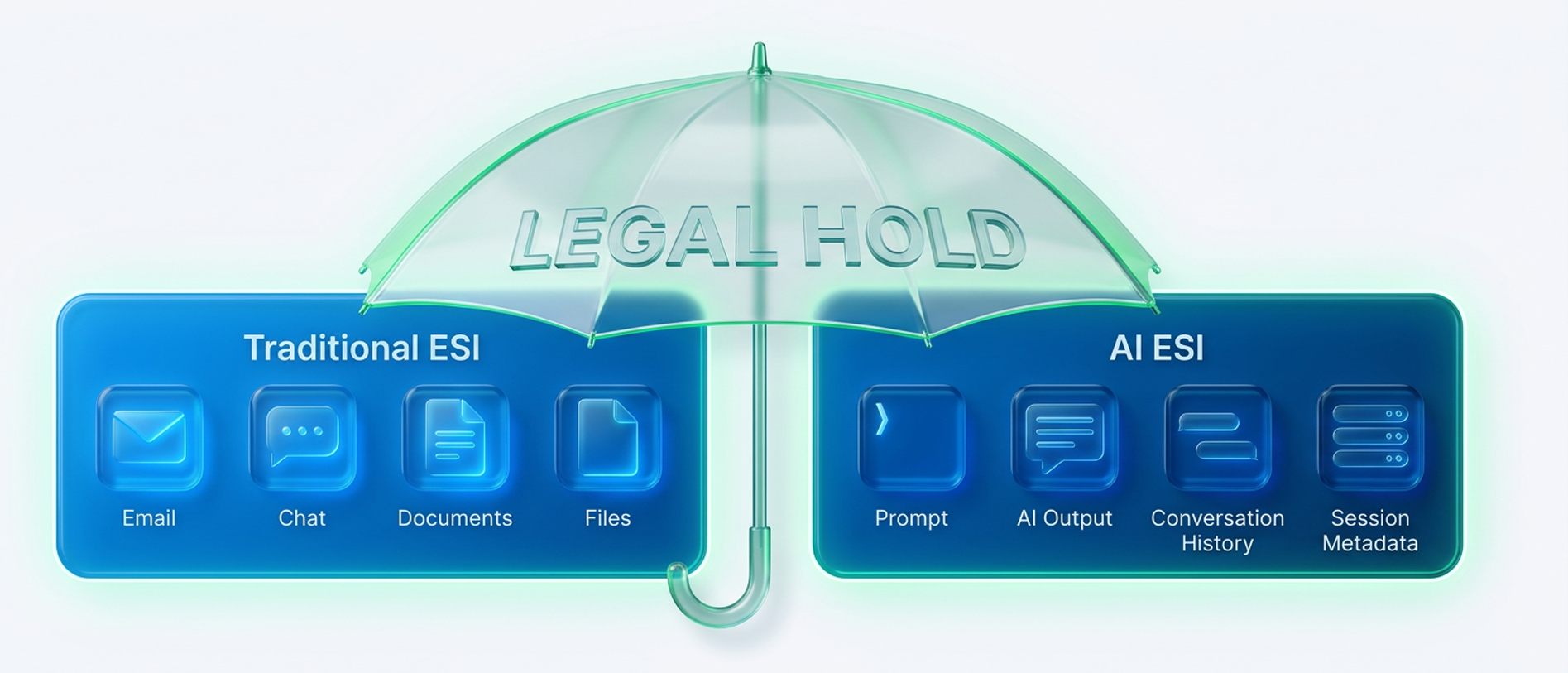
Generative AI has not changed any of that. What it changed is the category of ESI a hold now has to reach. A prompt is a document. An output is a document. The conversation thread connecting them is context a court can ask for. None of that was true, as a practical matter, three years ago, but all of it is true now.
What Courts Have Actually Decided
The In re OpenAI litigation is the clearest signal so far, and it came down in two parts. In May, the court ordered broad, ongoing preservation of ChatGPT output logs. In September, it narrowed that order, and later proceedings ended the going-forward preservation requirement entirely. Arnold & Porter's eData Edge team frames the throughline. Preservation obligations for AI content must be targeted and defensible, not a mandate to keep every interaction indefinitely.
Why the Ruling Matters Beyond OpenAI
For legal ops, the takeaway is not about one company. It is that the hold does not need to cover every AI interaction any custodian has ever had. It needs to cover the interactions connected to the claims or defenses at issue, from the custodians whose work is relevant, for the period that matters, the same relevance and proportionality test that already governs everything else under Federal Rule of Civil Procedure 37(e). AI did not lower that bar. It added a new category of ESI that has to be cleared.
Where a Standard Hold Notice Breaks Down for AI Content
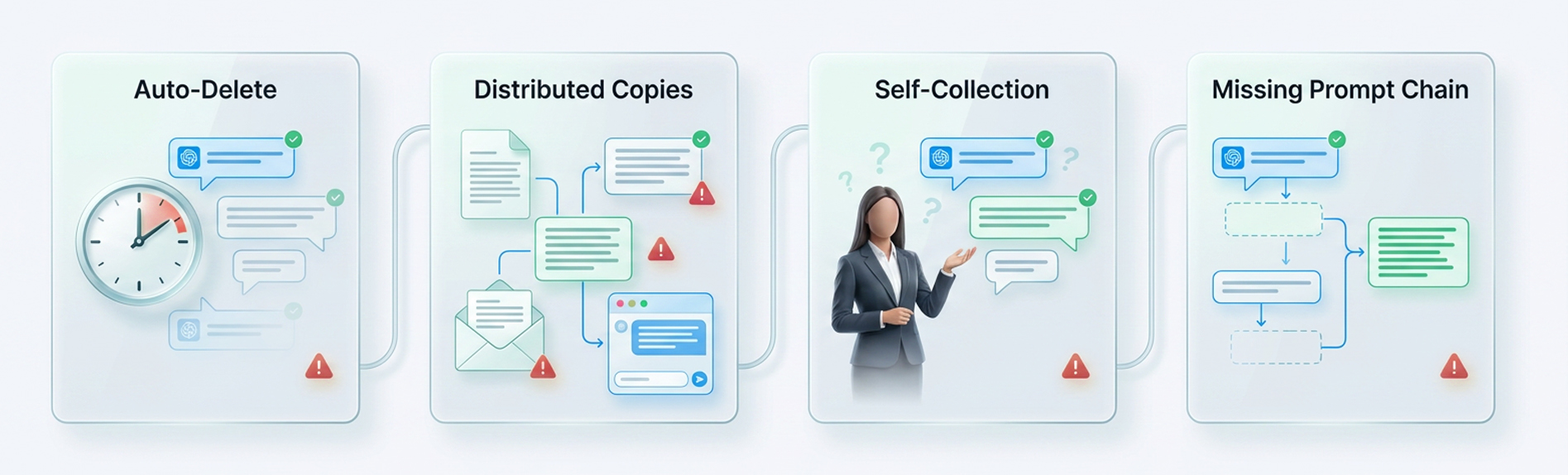
A hold notice built for email and shared drives does not automatically reach a chatbot. Four gaps show up consistently once AI tools are in scope.
1. Auto-Delete Runs on the Platform's Clock, Not the Hold's
Many generative AI tools clear conversation history on their own schedule, sometimes as short as thirty days, independent of anything a litigation hold says. Enterprise settings can extend or disable that cycle, but only if IT is specifically told to do it, and told at the same time the hold notice goes out. A notice that reaches custodians a week before IT reaches the platform settings has already lost data by the time anyone collects.
2. The Data Lives in More Places Than the Hold Notice Names
An AI interaction rarely stays in one place. The exchange itself may sit in the platform's own logs. The output might get pasted into a document on a shared drive, summarized in a Slack channel, or forwarded in an email. Each of those is a separate copy with its own preservation exposure, and a hold that names the shared drive but not the AI platform captures the copy while missing the record of how it was produced.
3. Custodians Cannot Self-Collect What They Cannot Identify
Self-collection is already a weak backstop for familiar data sources. For AI content, it barely functions at all. Most custodians cannot tell which of their own prompts and outputs are relevant to a matter without guidance that assumes they already understand the hold's scope, and a manual copy-paste export strips the timestamps and session data that make an interaction usable in review.
4. An Output Without Its Prompt Chain Is Hard to Authenticate
A single AI-generated paragraph, separated from the prompts that produced it, is difficult to place in context and easy for opposing counsel to challenge. The evidentiary value sits in the full exchange, what was asked, how the model responded across turns, what was revised. A hold that preserves only the final output leaves a record with a hole in the middle of it.
The December 2025 FRCP Amendments Move the AI Conversation Earlier
The amendments to Rules 16 and 26, along with new Rule 16.1, took effect December 1, 2025. They are not written about AI. Rule 16.1 addresses multidistrict litigation management. Rule 26(f)(3)(D) now requires the parties' discovery plan to include their views and proposals on the method and timing for complying with privilege disclosure under Rule 26(b)(5)(A). Rule 16(b)(3)(B)(iv) now permits the court to fold that same timing and method into its scheduling order, as Nixon Peabody's summary of the December 2025 rule changes lays out. Worth being precise about that, since it is easy to overstate.
What the amendments reinforce is a shift toward resolving discovery mechanics at the Rule 16(b) scheduling conference and the Rule 26(f) meet-and-confer, rather than deferring them. That is the natural moment to put AI data sources on the table alongside privilege methodology and everything else, before a dispute over scope turns into a motion. A hold process built around waiting for that fight to happen later is now working against where the rules are heading, not with them.
What an AI-Ready Litigation Hold Notice Needs to Say
Extending an existing hold process to AI content does not require rebuilding it. It requires a few specific additions at the points where AI behaves differently from other ESI.
- Name the Tools, by Name: ChatGPT, Copilot, Gemini, Claude, whatever is licensed or known to be in use. “Electronic communications” does not put a custodian on notice that a chatbot session counts.
- Instruct Against Auto-Delete, Explicitly: Tell custodians not to clear conversation history, and confirm IT has disabled auto-delete on enterprise platforms for named custodians, in parallel with the notice going out, not after.
- Ask About Personal and Browser-Based Accounts: Custodians using a personal ChatGPT account for work tasks are still under the hold. The notice has to ask, because IT's asset inventory will not surface on its own.
- Document the Scope Decisions Made: Which tools, which custodians, which date range, and why. That record is what makes a targeted hold defensible instead of merely convenient.
Venio's legal hold best practices guide walks through the full five-phase lifecycle these additions plug into, from trigger to release. This is also where a proper custodian interview earns its keep asking directly whether a custodian has used AI tools for anything connected to the matter. It is one of the fastest ways to surface a source a hold notice alone would miss.
Shadow AI Needs Its Own Line in the Hold Notice
More than 90 percent of workers surveyed for MIT's 2025 State of AI in Business report said they use personal AI tools for job tasks even when their employer has not sanctioned any, a pattern researchers call the “shadow AI economy.” The figure is approximate and worth verifying against the primary report before citing it in anything filed with a court, but the practical implication holds regardless of the exact number. A custodian can follow every instruction in a hold notice to the letter and still sit on unpreserved, relevant AI content, because the notice never named the tool they actually used.
Most hold notice templates were not written with that gap in mind. Three additions close it, and none of them require new software, only a template that names the risk instead of assuming “preserve all relevant data” already covers it.
- Personal Tool Disclosure: State explicitly that preservation extends to any AI tool used for matter-related work, including personal or free-tier accounts, regardless of whether the tool is licensed or sanctioned by the organization.
- Non-Deletion Instruction, Named Explicitly: Instruct custodians not to clear, delete, or allow to auto-expire any conversation history, chat session, or saved prompt connected to the matter, on any platform, personal or enterprise.
- An IT Coordination Trigger: Give custodians a named contact and a short deadline to flag if they are unsure whether an AI tool's retention settings comply with the hold, so uncertainty surfaces in days, not after the platform has already purged the data.
Venio's legal hold best practices guide covers how to build additions like these into a reusable notice template rather than drafting them fresh under deadline pressure for every new matter.
Where to Start Before Your Next Matter Forces the Question
The preservation duty has not changed, and the proportionality standard has not changed. What changed is the number of places relevant evidence can now hide, and building a process for that is faster to do now than during an active matter. Three starting points do most of the work.
- Run an AI Tool Inventory, Not Just an IT Asset List: IT's licensed-software report will show an enterprise Copilot or ChatGPT plan. It will not show a paralegal using a personal Claude account to draft summaries. Closing that gap means asking, directly, which is exactly what a custodian interview is built to surface, alongside the chat platforms and personal devices it already asks about.
- Update the Template Once, Not Per Matter: Add the shadow AI language above to the standard hold notice template now, so it is not drafted from scratch under deadline pressure during the next matter.
- Confirm Auto-Delete Controls Before Hold: Ask IT now whether your organization's AI platforms even support disabling auto-delete for named custodians, and how long that change takes to propagate. Finding out the answer is “five business days” in the middle of an active matter is how data gets lost.
Venio Legal Hold Software automates custodian notices, tracks acknowledgments, and keeps an audit trail across every data source in scope, so extending a hold to AI tools is a configuration decision rather than a rebuild. Book a demo to walk through how it applies to your current hold process.
Frequently Asked Questions
Is AI changing legal hold?
Yes, though not the duty itself. The trigger for a legal hold is unchanged, litigation reasonably anticipated, but generative AI has expanded the type of ESI a hold now has to reach.
Does a standard legal hold notice cover AI tools?
Not reliably. A legal hold, also called a litigation hold, only reaches what its notice names, and most templates predate common AI use, so they don't name AI platforms as a covered source or ask custodians to disclose personal accounts used for work.
What is shadow AI, and why does it matter for legal hold?
Shadow AI refers to employees using personal or unsanctioned AI tools for work tasks without IT's knowledge. It matters because a custodian can follow every instruction in a hold notice and still sit on unpreserved, relevant content if the notice never named the tool they actually used.
How does AI governance affect legal hold obligations?
AI governance, the policies defining which AI tools are approved and how usage is logged, directly shapes how defensible a legal hold can be. An organization with a documented governance policy already knows which tools to name in a hold notice; one without has to reconstruct that inventory custodian by custodian once a matter arrives.
What role does AI in eDiscovery play in preservation and collection?
AI in eDiscovery, including eDiscovery AI tools used for early case assessment and analytics, is applied mostly downstream, once data has already been preserved and collected. It can help identify likely custodians faster, but it does not replace asking custodians directly whether they used an AI tool for anything connected to the matter.
What happens if a custodian deletes AI chat history after a hold is issued?
It can be treated the same as deleting any other preserved ESI, a potential spoliation issue under Rule 37(e), with sanctions turning on whether the loss was avoidable and whether the party intended to deprive the other side of the evidence.
Related Articles

eDiscovery Data Analytics & Visualization for Trial Preparation
Most litigation teams don’t lose at trial because they lack evidence. They lose
Read Article
What to Ask in an eDiscovery Demo Before You Sign
Twenty questions that make an eDiscovery vendor prove processing, AI, security a
Read Article
Consolidating Your eDiscovery Stack Without Disrupting Active Matters
How to consolidate eDiscovery tools without disrupting live matters, and why a f
Read Article