Cloud vs. On-Premise Security: Which eDiscovery Model Works Best for Government?
Ready to get started?
built for clarity, control, and scale.
Share
With adoption accelerating six times faster than traditional on-premises deployments, cloud is no longer the open question in commercial eDiscovery. However, in the government sector, cloud-based eDiscovery remains an open question, and for good reason.
Over the past decade, document processing, legal review, and AI-assisted analytics have steadily moved to vendor-hosted platforms. Today, most software providers build their roadmaps, pricing, and newest capabilities around off-site infrastructure first.
Government agencies have watched this shift with more caution than enthusiasm. Their data, mandates, and public accountability make the trade-offs of cloud-based eDiscovery harder to accept at face value.
That caution is now being tested as more vendors steer customers toward cloud-only options. For federal agencies, enterprise legal teams, and IT leaders, cloud vs. on-premises security has moved from a long-term debate to a near-term planning priority.
This blog answers the most critical question: which environment actually guarantees the absolute data sovereignty public sector teams require? It compares both models control by control, maps each to government compliance requirements, and weighs long-term cost for public sector budgets.
Why eDiscovery Deployment Is a Security Decision for Government Agencies
For a government agency, choosing where eDiscovery runs is not an IT preference. Their deployment must align with rigid frameworks like FedRAMP, CJIS, DoD Impact Levels, and StateRAMP while remaining defensible under intense court scrutiny.
That is why the on-premises vs. cloud-based eDiscovery debate looks different inside the government. Agencies carry five concerns that most commercial buyers never face:
- Data That Cannot Leave Agency Control
Classified material, criminal justice information, and controlled unclassified information come with rules about where they may be stored. Furthermore, sealed investigative files and grand jury material governed by Federal Rule of Criminal Procedure 6(e) often demand physical air-gapping or strict localized data residency that multi-tenant cloud architectures struggle to guarantee.
- Accountability That Cannot Be Outsourced
While an agency can outsource its underlying infrastructure to a third-party vendor, it cannot outsource its legal obligations. The agency remains responsible for chain of custody, FOIA deadlines, oversight inquiries, and court orders.
- Proof of Who Accessed the Evidence
Defensibility depends on a complete audit trail. Under directives like OMB Memorandum M-21-31, agencies must maintain strict event logging and threat-detection capabilities. In a vendor-hosted platform, that trail heavily relies on third-party logging.
- Compliance Rules Changing Mid-Contract
Regulatory requirements shift rapidly during multi-year procurement cycles. For example, the FBI's CJIS Security Policy 5.9.5 and modernization frameworks require strict data isolation, while a vendor's current FedRAMP authorization may not reflect its compliance status in future fiscal years.
- Budgets Fixed by Appropriation
Government agencies operate within fixed annual appropriations rather than flexible corporate operational budgets (OpEx). Unpredictable, usage-based cloud billing that spikes during a massive, unexpected investigation can severely strain a public budget finalized over a year prior.
The Catalyst: Vendor-Driven Cloud Migration
These security and cost concerns have become critical because of aggressive shifts in vendor roadmaps. Major industry providers are sunsetting localized options; notably, Relativity has announced that starting in 2028, all new matters and workspaces must be hosted in its cloud platform, RelativityOne. This forced transition gives public sector IT leaders less time to balance cloud efficiencies with strict rules.
Is Cloud More Secure Than On-Premises for Government eDiscovery?
Neither model is secure by default. Cloud vs. on-premises security comes down to one question: who controls the keys, the logs, the network, and the people who can touch the data? Understand the distinction through this visual representation:
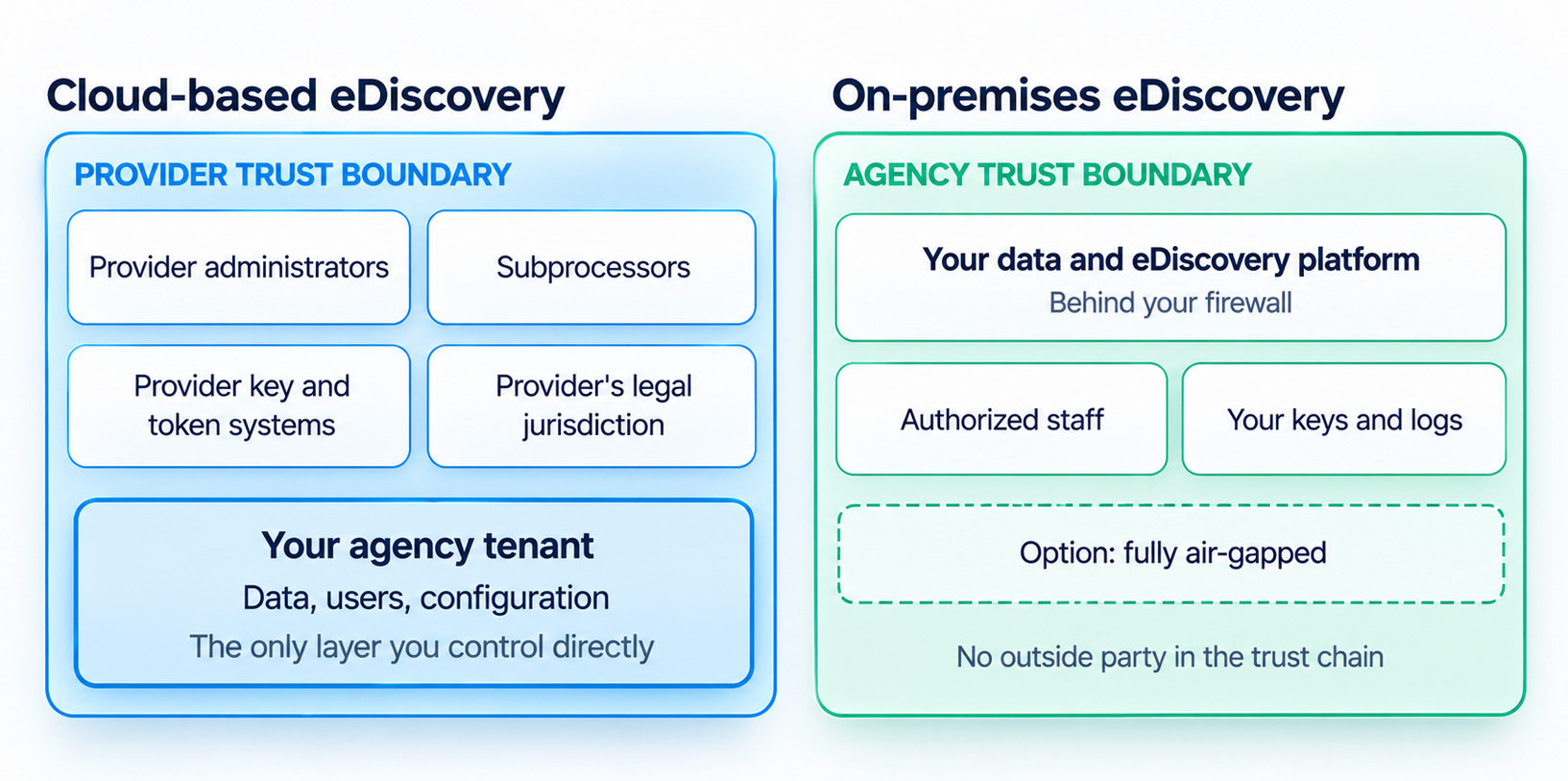
Cloud-based eDiscovery trades custody for capacity
A FedRAMP-authorized provider is assessed against a standard control baseline, monitored continuously, and staffed for security operations at a scale few agency data centers can match. The provider handles patching, hardware refresh, and surge capacity. The cost is that you inherit the provider's failures and cannot fix them.
Practical Example:
In summer 2023, the China-linked group Storm-0558 used a stolen Microsoft signing key to forge authentication tokens and reach Exchange Online mailboxes at 22 organizations, including senior US government officials.
The Cyber Safety Review Board concluded the intrusion was preventable and pointed to a chain of avoidable errors at the provider. The weakness sat in the provider's own key and token infrastructure, which no agency tenant could inspect or harden.
Although this breach targeted email rather than an eDiscovery platform, email underpins most discovery collections. For public sector eDiscovery teams, the lesson is clear: in the cloud, your ability to prove what happened to evidence depends on the vendor's logging and, sometimes, your license tier.
On-premises trades capacity for custody
The trust chain stays short: your infrastructure, your authorized staff, your login keys, with an air-gapped option for the most restricted matters. The price is accountability. An agency running eDiscovery on-premises also owns patching, hardening, physical security, and staffing.
Cloud vs. On-Premises Security Comparison Summary:
Two rows decide most government procurements: authorization path and legal jurisdiction. Each is backed by a set of rules that a deployment model either satisfies or must work around.
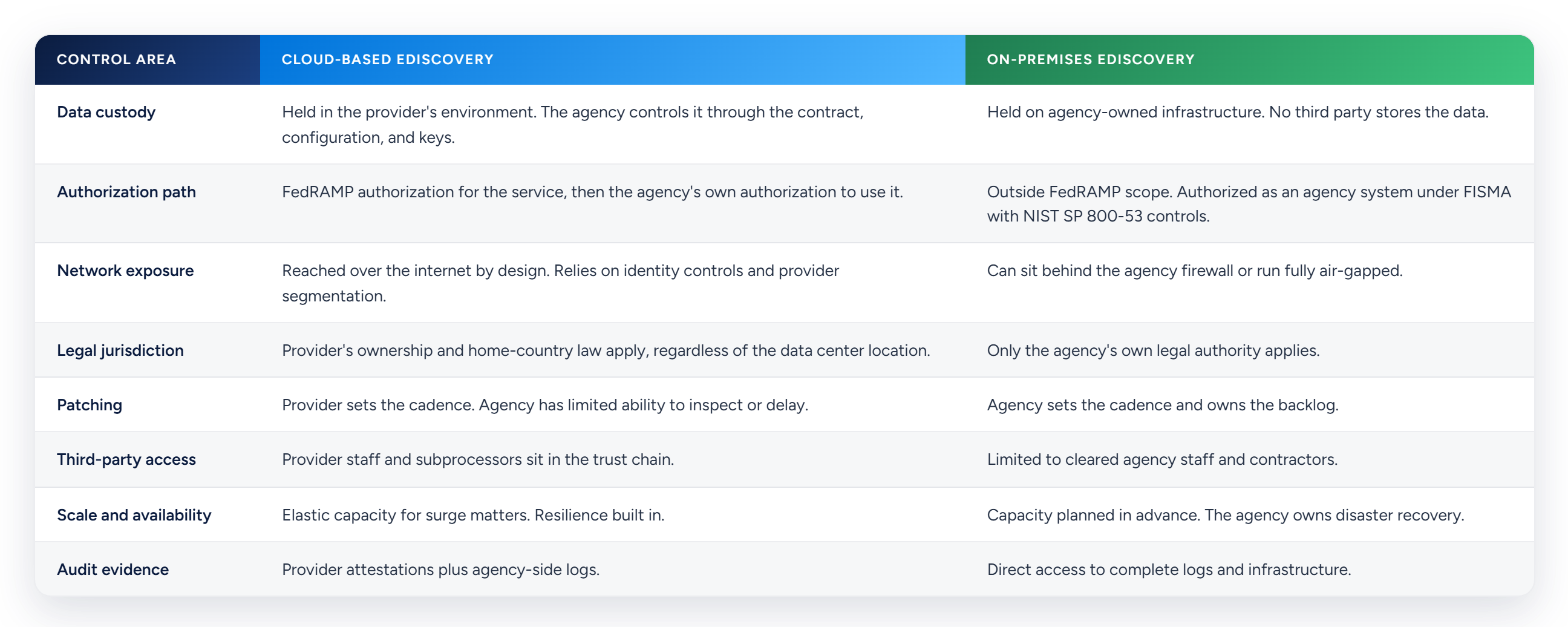
Compliance and Security Requirements for Government eDiscovery Solutions
Government eDiscovery solutions must satisfy the framework tied to the data, not the one tied to the vendor's marketing. Here is how the two rows decide most government procurements:
1. FedRAMP governs the cloud path. It is required for cloud providers serving federal agencies and standardizes assessment, authorization, and continuous monitoring. FedRAMP categorizes cloud services into three main risk baselines based on FIPS 199 and NIST SP 800-60 criteria:
- Low: Applies to non-sensitive information where a loss of confidentiality, integrity, or availability has a limited adverse effect
- Moderate: Applies to sensitive, unclassified data. This is the most common baseline, covering roughly 80% of federal cloud workloads (such as standard agency CRM or operational tools)
- High: Applies to most sensitive unclassified and critical data, including law enforcement, emergency services, and defense systems. It requires strict multi-factor authentication, advanced logging, and enhanced incident response controls.
Moderate is the common baseline, but some law enforcement and defense customers require High authorization or supplementary controls.
Note: FedRAMP is not a guarantee of absolute security, and it does not cover on-premises solutions.
2. FISMA governs everything. It applies to all federal information systems, including on-premises ones, and FedRAMP builds on the same NIST SP 800-53 controls. An on-premises platform skips FedRAMP but goes through your own authorization process, so plan time for the security assessment and the evidence it demands.
Contracts extend the question outward. Under DFARS clause 252.204-7012, a defense contractor that uses an external cloud provider for covered defense information must ensure that provider meets the clause's requirements. State and local agencies add their own rules, such as CJIS requirements for criminal justice information.
Whichever model you choose, discovery demands legal holds, a defensible chain of custody, complete audit trails, and FOIA or public records workflows, with logs showing who touched which document and when.
The jurisdiction row is where cloud procurement most often goes wrong, because it hides a distinction that contracts routinely blur.

Under the US CLOUD Act, US authorities can reach data held by US-based providers regardless of where the servers are, and other jurisdictions have comparable tools.
Meeting all of this has a price, and it is paid differently under each model. That is where cost comes in.
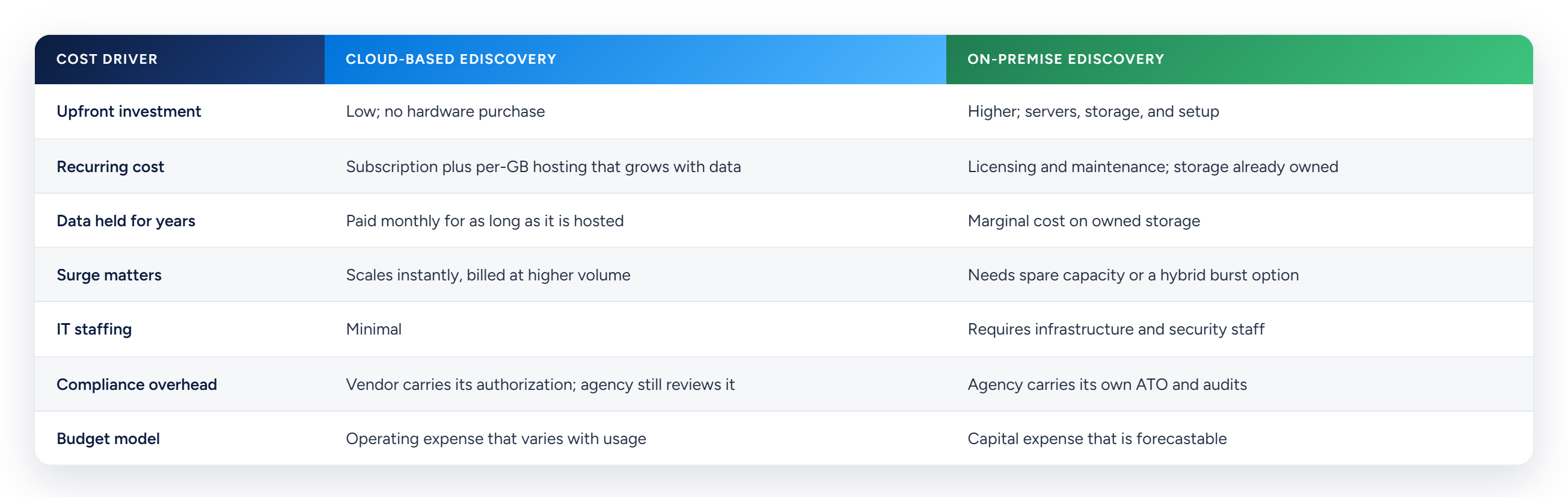
Cloud vs. on-premises cost comparison: the shape matters more than the rate
Cloud-based eDiscovery turns capital spend into recurring charges: monthly per-GB hosting, ingestion and processing, user licenses, and production fees. On-premises front-loads the spend on hardware, network, licensing, and staff, then adds matters at low marginal cost until capacity runs out. The two curves cross at a point set by your own data.
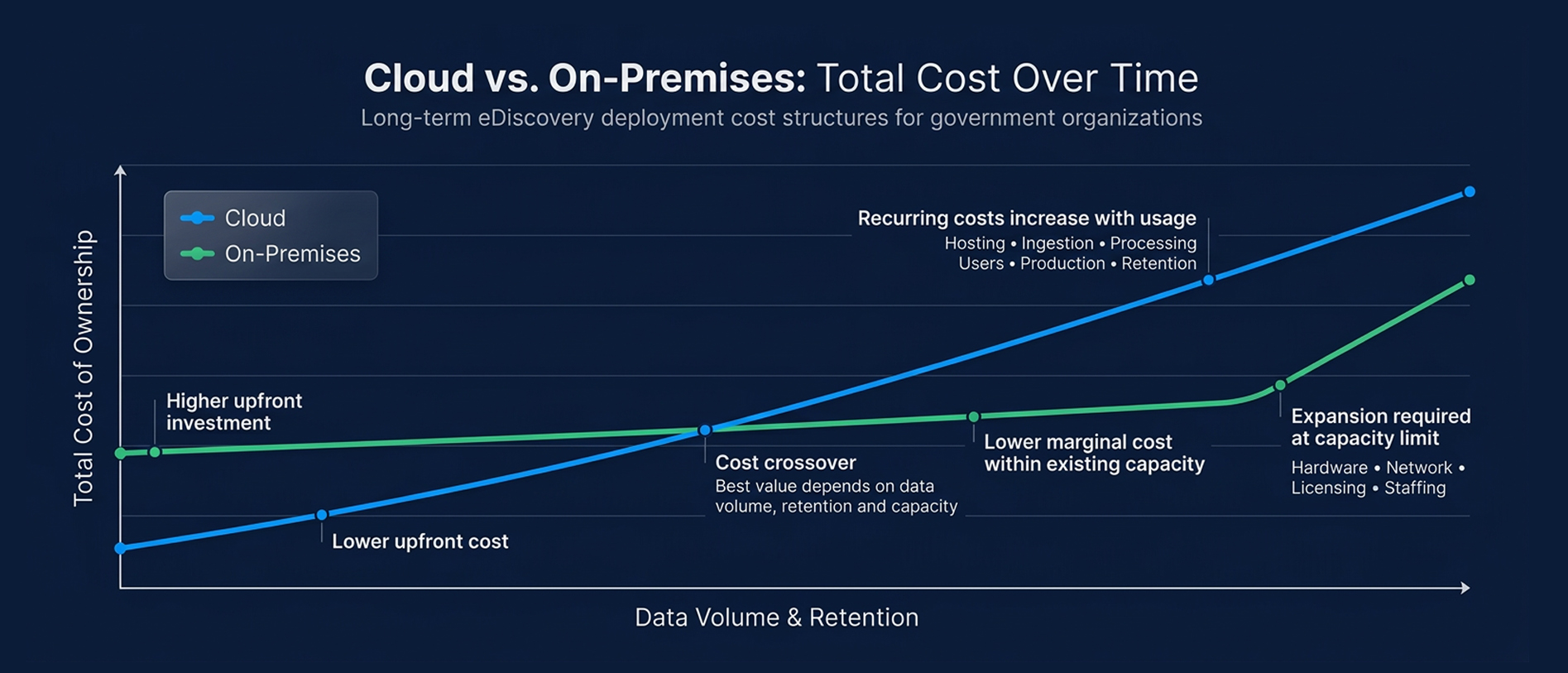
The cost curves differ in shape. Where they cross depends on your volume, retention period, and user count.
A fair cloud vs. on-premises cost comparison looks at five to seven years, not the first invoice. Cloud usually wins on entry cost, while on-premise often wins on predictability for steady, high-volume caseloads.
Why Retention Changes the Math for Government Agencies
Government matters, investigations, and records obligations often run for years. In a per-GB cloud model, agencies are forced to pay perpetual "rent" on terabytes of dormant, cold data. While on-premises deployments absorb these long-term archives into sunk infrastructure costs, cloud environments keep generating compounding monthly charges for data that must be legally preserved but is rarely touched.
How Venio Ensures Absolute Data Sovereignty for Government
Venio gives agencies a choice the market is quietly removing. The same eDiscovery platform runs inside agency infrastructure, in a vendor-managed cloud, or across both, so the data class decides the deployment.
- Every Byte of Data Stays Inside Your Infrastructure
With Venio On-Premises solution, processing, storage, indexing, and review all run within agency infrastructure. Nothing is routed through external services, and the agency's own IT team manages the environment.
- Air-Gapped and Restricted Networks
Venio supports deployment inside isolated networks where external internet connectivity is prohibited. That matters for classified enclaves, sensitive investigations, and law enforcement evidence systems.
- Your Identity, Storage, and Security Stack
Venio authenticates through Active Directory and LDAP, connects directly to existing SAN and NAS storage, and feeds agency SIEM tools. Firewalls, network monitoring, and encryption standards remain the agency's own.
- You Decide When the Platform Changes
IT teams control when and how updates deploy, in line with internal change management. No vendor push alters an evidence environment in the middle of a matter.
- No Capability Penalty for Choosing Control
Venio’s on-premise platform runs the same codebase, AI models, and workflows as its cloud platform. Agencies do not trade AI-assisted review for sovereignty.
- Choose Hybrid Deployment When It is Needed
Venio on-demand/hybrid solution keeps sensitive investigations on-premise while bursting large, lower-sensitivity matters to the cloud. ECA, review, production, and legal hold stay on one platform throughout.
- Built for Public Sector Workflows
Venio's government eDiscovery solution supports FOIA and public records response, legal holds, investigations, and litigation from one auditable system
Frequently asked questions
1. Can cloud-based eDiscovery deliver data sovereignty for the government?
It can, but data residency alone is not enough. Confirm who owns the provider, which legal orders it must obey, where its support staff are located, and whether your agency holds the encryption keys.
2. Can classified data be processed in cloud-based eDiscovery?
Only in a dedicated classified environment authorized at the right level. Under the DoD Cloud Computing SRG, SECRET data falls under Impact Level 6, which requires dedicated classified infrastructure rather than commercial multi-tenant cloud.
3. What should agencies look for in government eDiscovery solutions?
Look for deployment choice, agency-controlled encryption keys, full audit logs, support for restricted networks, and defensible FOIA and litigation workflows. Confirm each vendor's authorization status against the framework governing your data.
4. Can an agency use both cloud and on-premise eDiscovery?
Yes. A hybrid model keeps sensitive matters on-premise and moves lower-risk, high-volume matters to the cloud. Venio supports this on a single platform.
Related Articles
From Testing to Trusted: The Open Questions on AI in eDiscovery
Where is AI used, who checks its work, do legal holds cover AI data, and is it p
Read Article
Legal Workflow Automation for Faster eDiscovery
Reduce discovery delays with legal workflow automation. Clarify ownership, resol
Read Article
A Buyer’s Guide to Government eDiscovery Security
Evaluate government eDiscovery security requirements, FedRAMP 20x and NIST contr
Read Article