Consolidating Your eDiscovery Stack Without Disrupting Active Matters
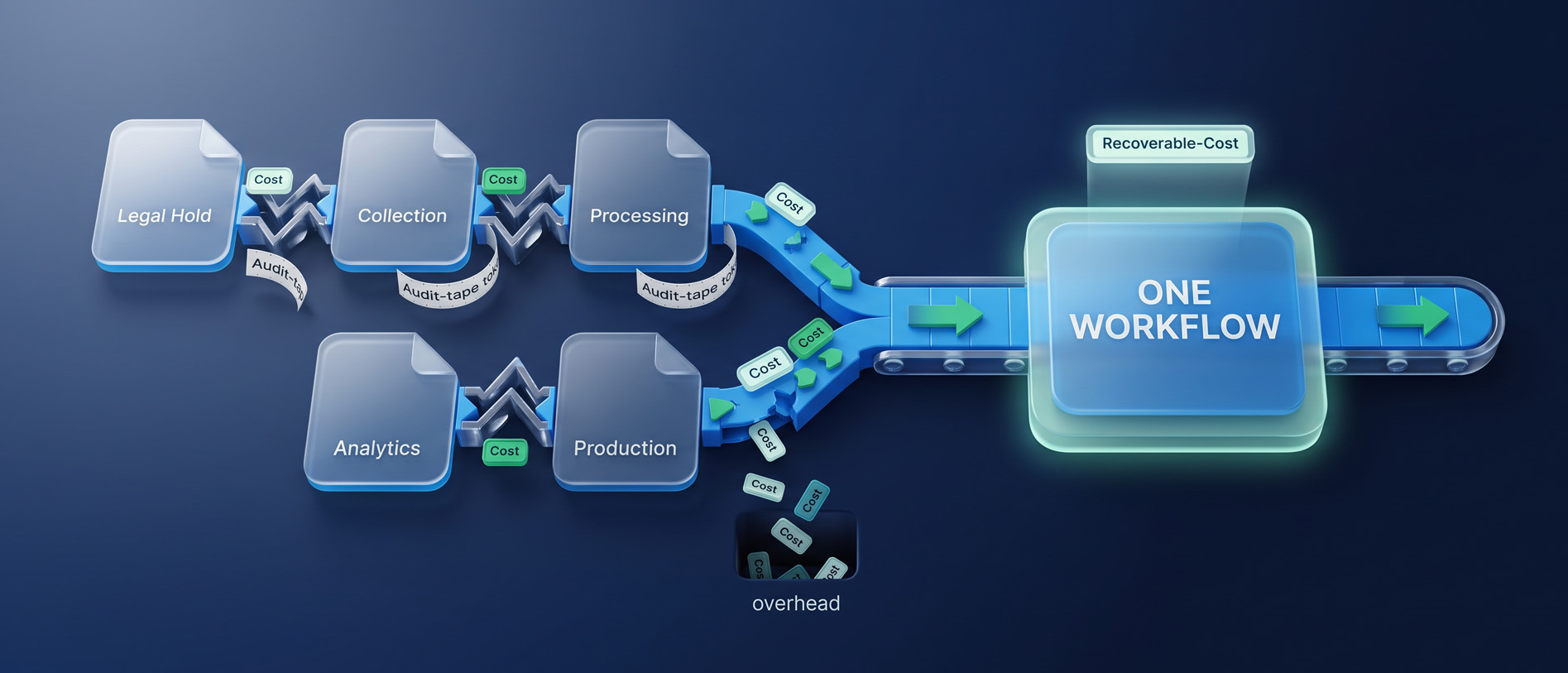
Ready to get started?
built for clarity, control, and scale.
Share
Most firms run discovery across four to six separate tools, each one added for a reason that made sense at the time. What stalls any move to consolidate is the risk to live work, and specifically what a platform change would mean for the matters already in review. That concern is entirely reasonable, and it explains why firms keep running a stack they quietly stopped defending years ago.
This blog answers both parts of that problem. It starts with what a fragmented stack actually costs, including the one cost most firms never see because it never reaches an invoice. It then walks through how firms move off that stack in waves, without an active matter ever missing a production deadline.
By the end you will have a defensible number for your current architecture, a test for separating genuine consolidation from a rebranded bundle, and a transition sequence that will survive scrutiny from a practice group leader.
Anatomy of a Fragmented Stack
Most fragmented stacks were assembled in roughly the same order. Legal hold sits in a compliance product bought after a preservation scare. Collection runs on a forensic utility IT already licensed. Processing belongs to a vendor engaged during a large matter years ago. Review happens on whichever platform a major client mandates, analytics is bolted alongside it, and production usually arrives attached to one of the others.
Between those systems, data moves by export, by load file, and occasionally by a script one person on the team understands. Each movement is a handoff, and the handoffs rather than the tool count are what the arrangement genuinely costs you. A firm running eDiscovery across separate silos pays those tolls on every matter that crosses the full lifecycle.
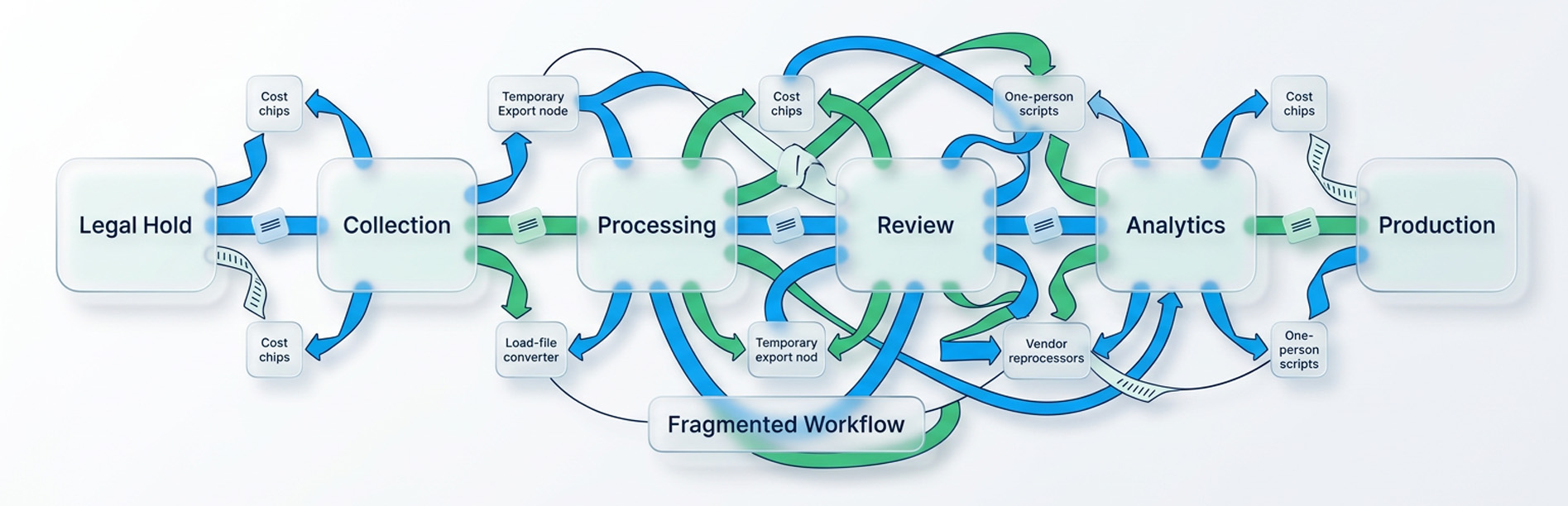
Map your own before going further. Write the six stages of discovery across a page, name the product performing each one beneath it, then draw an arrow wherever data has to leave one product and enter another. Most firms find three to five arrows, and the third is usually the surprise.
What the Handoffs Actually Cost
Handoffs cost a firm in three currencies, and the reason fragmented stacks persist is that only one of the three ever appears on a budget line where somebody can argue about it.
1. Specialist Hours Spent Moving Data
Every handoff involves an export, a field mapping exercise, a validation pass, and whatever troubleshooting the load requires. None of those steps begins the moment the previous one ends, because each waits in a queue behind whatever else that specialist is handling that week.
A matter crossing four tools commonly generates six to ten discrete handoff events across its life once re-exports and corrections are counted. The compounding cost is calendar time rather than hours, and a substantial share of a matter's elapsed duration is spent waiting between systems rather than working inside them.
That matters most at the front of a case, where speed to first insight determines whether your team is shaping strategy or reacting to somebody else's. It is also where eDiscovery managers lose the most visibility, because tracking progress across four systems means tracking it properly in none of them.
2. Paying For the Same Data Multiple Times
Point solutions often charge separately for processing, hosting, review, analytics, and data export. When these capabilities are split across several vendors, the same data can incur multiple charges as it moves through the workflow.
Add egress charges, overage bands, and the administrative burden of four to six renewal negotiations a year, and the effective rate across a fragmented stack runs materially above the headline figure in any individual contract. When a processing vendor ingests a collection and a review platform re-ingests it, you have paid twice for one set of documents, and no line on either invoice describes it that way.
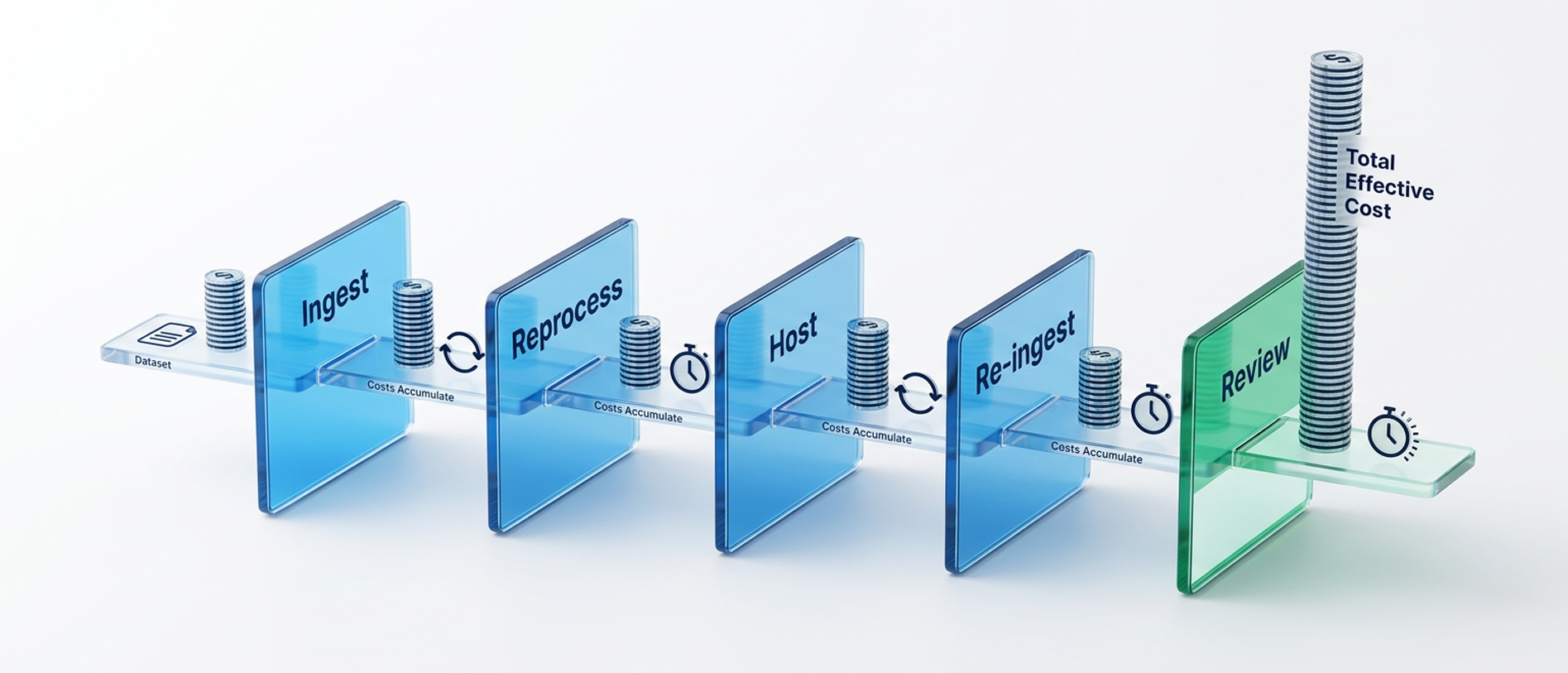
The largest lever is culling, which is where architecture and spend meet directly. When early case assessment sits behind a handoff, the full collection is processed and hosted before anyone knows what is relevant inside it. When assessment runs against the same database as everything else, the population shrinks before the expensive stages ever see it.
Early case assessment running natively has taken a 120 terabyte collection down to 34 terabytes, a 72 percent reduction, and an AmLaw 50 firm cut costs by 65 percent on the same principle.
Nothing reduces eDiscovery spend as reliably as not hosting, reviewing, or producing data you removed before hosting began. Firms that bring costs down durably do it at the front of the workflow rather than by negotiating harder on review seats at the back of it.
3. Seams in the Chain of Custody
The third cost only materialises when something goes wrong, which is precisely why it gets discounted during procurement conversations.
Every transfer between products is a point where document counts can drift, metadata can be rewritten by a different parser, and the audit log changes format. Each individual seam is defensible in isolation. The difficulty arrives when opposing counsel challenges a production and your team has to reconstruct a document's entire path across five separate systems.
eDiscovery chain of custody is only ever as strong as its weakest join, and a challenge is aimed at the joins rather than at the tools. Five partial audit trails, in five formats, held by five vendors under five retention policies, make a far harder thing to stand behind than one continuous record running through to production.
The point is worth stating plainly, because it is the one that moves a general counsel when cost arguments do not. eDiscovery chain of custody is not a property of any individual tool in your stack. It is a property of the path between them.
The Cost Your Firm Cannot Bill
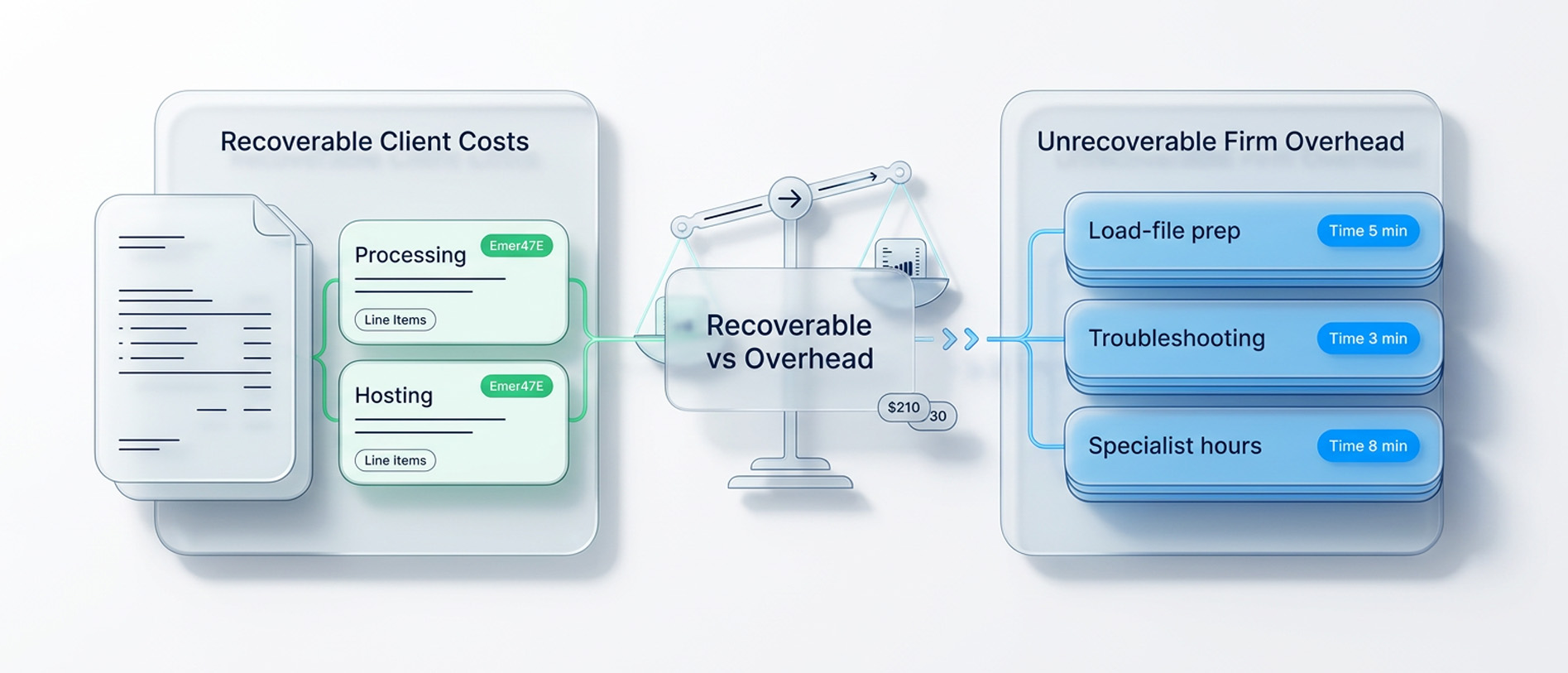
For a law firm there is a fourth cost, and it should decide the question. Discovery spend is either recoverable or it is not, and the architecture you run determines which.
Direct pass-through remains the dominant model, used by roughly 86 percent of firms, yet only about 20 percent recover their costs in full, and more than 70 percent face client pushback at least sometimes. The challenges firms cite most are unpredictable volume and recurring per-gigabyte hosting fees. Fragmentation makes both worse by spreading a bill that moves unpredictably across several invoices, which is the hardest thing to defend to a client.
The ethics framework draws the line. ABA Formal Opinion 93-379 separates general overhead from client-specific disbursements and in-house services, and Formal Opinion 08-451 confirms firms may charge for litigation support and eDiscovery services, provided the charges are reasonable.
This is what makes a fragmented stack expensive in a way that spreadsheets rarely capture. It does not only increase discovery spend. It converts recoverable spend into unrecoverable spend, quietly, matter after matter, because those hours disappear into salaried time rather than appearing on a bill anyone reviews.
The shift matters more now than it did a decade ago. Firms today perform roughly 79 percent of the discovery process in house, having moved deliberately to displace the vendor-dominant model and control costs. Once the work sits inside the firm, the inefficiency lands on the firm's own realization rate rather than on a vendor's margin.
Framed that way, eDiscovery platform consolidation stops being a technology argument. The question is how much of your discovery spend survives the billing cycle, and any honest cost of ownership model for a firm has to account for the portion that never reaches a client at all.
What Consolidation Actually Means
Before committing to a single platform, be precise about what consolidation covers, because every product with one logo now describes itself as unified.
The Load File Test
If moving data between two capabilities requires an export, a middleware script, or a load file, those capabilities are two tools wearing one badge.
A genuine end to end eDiscovery platform runs legal hold, collection, processing, early case assessment, review, and production on one database and one workflow engine, so data moves between stages without a load file or an export.
The test is easy to apply in a demo. Ask which load file format moves data between processing and review. A true end to end eDiscovery platform has nothing to describe. A suite assembled through acquisition will name a format or describe a sync process, and that answer tells you what you are buying.
Venio was built as a single code base rather than assembled through acquisition, so a document never moves between stages. Only its status changes. The same logic applies to legal hold and client portals. Add either as a separate product and you have reintroduced the handoff you were trying to remove.
What Consolidation Does Not Cover
All in one claims are often oversold, so it helps to name the limits.Matter management, e-billing, contract lifecycle tools, and document management are adjacent systems, not discovery stages, and they stay where they are.
A wider legal operations technology programme spans finance, knowledge management and practice systems over several years. eDiscovery platform consolidation is a single workflow with a defined start and end, and treating the two as one project gives a sensible proposal a scope nobody can approve.
Consolidation also does not remove a client's mandated platform. Where an institutional client requires review on its own system, consolidation reduces the handoffs your firm controls and leaves that boundary intact. Scoping this honestly keeps both the business case and your legal operations technology roadmap manageable.
Point Solution vs Platform
The point solution vs platform question deserves a straight answer, so here is the case for staying fragmented.
A point solution earns its place when a stage has exceptional demands, such as forensic collection from mobile and structured sources, a complex privilege workflow, multilingual processing, or a production format a regulator insists on. Where that applies, keep the specialist for the matters that need it.
The best of breed vs suite argument falls short when it treats handoffs as free. Most comparisons score each tool against its direct competitors and ignore the cost of connecting them. A specialist fifteen percent stronger at its own stage, sitting behind two handoffs that add queue time and a second processing charge, is not fifteen percent ahead across the whole matter. Settling best of breed vs suite properly means comparing total workflow outcomes, not stage scores.
So price the handoffs, not just the tools. If the specialist still wins, keep it and consolidate everything else around it. The point solution vs platform decision is rarely all or nothing, and a partial consolidation that removes three handoffs is a genuine result.
Migrating Without Disrupting Matters
Here is the part that decides whether any of the above actually happens. The objection that stalls consolidation is almost never doubt about the destination. It is the fear that switching platforms mid-stream will cost the firm a deadline it cannot afford to miss.
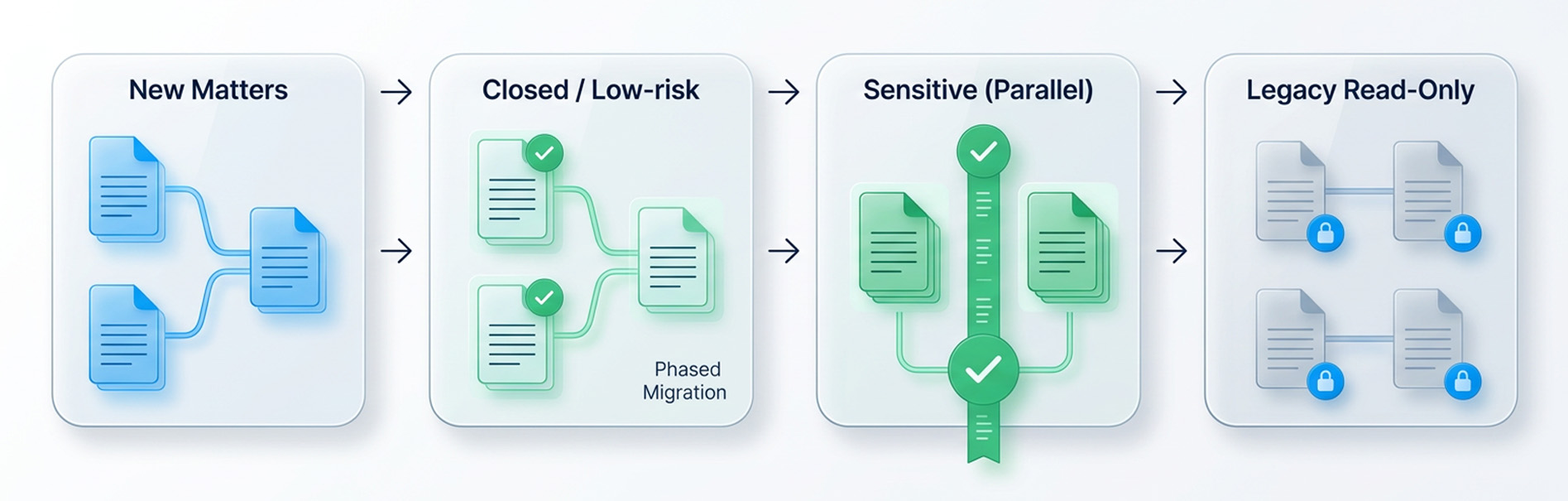
That fear is manageable, and the method rests on a single principle. You never migrate a live matter unless a deadline forces you to.
Let New Matters Lead
From the day the contract is signed, every new matter opens on the new platform while active matters finish where they started. This costs a period of overlapping licences, which is a real line item and should be budgeted openly rather than discovered later.
It also means your team learns the new workflow on low-stakes work before anything consequential depends on it, which is worth considerably more than the overlap costs. Firms that consolidate this way rarely report disruption, because nothing under deadline pressure ever moved.
Move Historical Data in Waves
List every matter, its stage, and the tools it currently touches, then group them into waves by risk, volume, and deadline proximity. Closed and low-volume matters move first. High-stakes, high-volume matters move last, once the team has evidence rather than assurances.
Test the eDiscovery data migration on one closed matter before committing the archive, and verify field mapping, tags, work product, and privilege calls against the source. An eDiscovery data migration validated on a closed matter is a documented process. One that has not been validated is a hope with a project plan attached.
Document the verification as you go, because a clean eDiscovery data migration record becomes part of your eDiscovery chain of custody rather than a gap in it. That is also the answer to the question a general counsel will eventually ask about whether the move itself was defensible.
Run Parallel for Anything Sensitive
For the most sensitive matters, run both platforms in parallel through the transition, compare outputs, and confirm productions match before cutting over. The short-term effort buys protection against an error that would cost far more in meet and confers or re-productions.
It also builds confidence among partners and outside counsel, which is usually what the decision genuinely hinges on rather than any technical consideration.
Time It Against Your Renewal Dates
Time the decision against your earliest renewal rather than your latest, because that is where negotiating leverage sits and where the overlap period costs least. Ask how you leave before you sign, in writing, including export format, timeline, and cost. The same applies to deployment, since a platform that cannot run where your institutional clients require is not a candidate whatever else it offers.
A Realistic Implementation Timeline
A credible timeline for a mid-size firm runs a quarter for the core transition and up to six months for the full archive, depending on volume and the number of active matters.
• Weeks One To Four: Onboarding for the litigation support team, workflow configuration, and new matters opening on the new platform while everything active continues where it is.
• Weeks Five To Eight: First migration wave covering closed and low-risk matters, validated against source on the first matter before the rest follow.
• Weeks Nine To Twelve: Second wave, parallel running for anything sensitive, and the first measurement of handoff hours against your pre-migration baseline.
• Month Four Onward: Legacy contracts wind down as renewal dates arrive, and legacy systems sit in read-only access until every active matter has transitioned.
Record handoffs per matter and hours per handoff before you begin, because without that baseline you will end up with a better workflow and no way to demonstrate it to the people who approved the spend.
The payoff typically appears in staffing rather than in software cost. One provider that consolidated onto a unified architecture increased data volumes by over 300 percent while reducing processing support headcount by 30 percent, which is what happens when the work of moving data between systems simply stops existing.
A Stack You Can Defend and Bill
Count your workflow steps, price them against your own rate card, and separate what you can pass through from what the firm absorbs. Most teams are less surprised by the size of that number than by the fact that nobody had ever calculated it.
This is the problem Venio was built to solve, which is why legal hold, collection, processing, early case assessment, AI review, and production all run against one database rather than across integrated modules. Processing runs at over ten terabytes a day, so consolidation does not mean trading throughput for tidiness, and deployment spans cloud, on-premises, hybrid, and air-gapped environments.
Pricing is forecastable rather than metered against every movement of your data, which addresses the one thing clients push back on hardest. In a fragmented stack your data volume and your bill are effectively the same variable, and predictable pricing is what breaks that link.
Consolidation is not the right answer for every firm, and this piece has been explicit about when it is not. But where three or more arrows sit between your stages, an end to end eDiscovery platform stops being a preference about tooling and starts being a question about margin.
Frequently Asked Questions
How Do We Calculate the True Cost of Our Current Stack?
List every tool and every fee type it charges, including processing, hosting, review seats, analytics, and egress, then add the fully loaded labour cost of every handoff plus an allowance for rework. For a firm, split that total into recoverable and absorbed spend, because the absorbed portion is what a consolidation business case is really addressing.
What Should We Ask to Test an All in One Claim?
Ask which load file format moves data between processing and review. A genuine end to end eDiscovery platform has no answer to give, because there is no internal transfer, whereas a suite assembled from acquisitions will describe a sync or a scheduled export. That single question separates real consolidation from a bundle faster than any feature matrix.
Is a Single Platform Always Cheaper Than Best of Breed?
No, and any vendor claiming otherwise is selling rather than advising. The best of breed vs suite calculation favors consolidation when you carry three or more handoffs, when the same data is processed more than once, and when assessment sits behind an export. Two tools with one clean handoff may not clear the switching cost.
Can We Consolidate Without Disrupting Active Litigation?
Yes, provided you let new matters lead and move historical data in waves. Avoid moving anything inside a critical production window or under a tight court deadline, run parallel processing for sensitive matters, communicate early with outside counsel, and keep legacy systems in read-only access until every active matter has transitioned.
How Long Does an eDiscovery Data Migration Take?
Most mid-size firms complete the core transition within a quarter and the full archive within three to six months. The first wave typically moves within four to six weeks, with subsequent waves every two to four weeks, and an eDiscovery data migration of that shape rarely touches a matter under deadline pressure.
How Does This Fit With Our Wider Legal Operations Technology?
Discovery consolidation sits inside a broader legal operations technology estate and does not replace it. Matter management, e-billing, and document management stay separate with their own integrations, and keeping this project distinct from a wider legal operations technology programme is what keeps the business case manageable.
What Should We Measure After Switching?
Handoffs per matter, handoff hours per matter, effective cost per gigabyte, cycle time from intake to production, rework rate, and the proportion of discovery spend actually recovered. That last figure is the one that answers whether the investment worked.
Related Articles
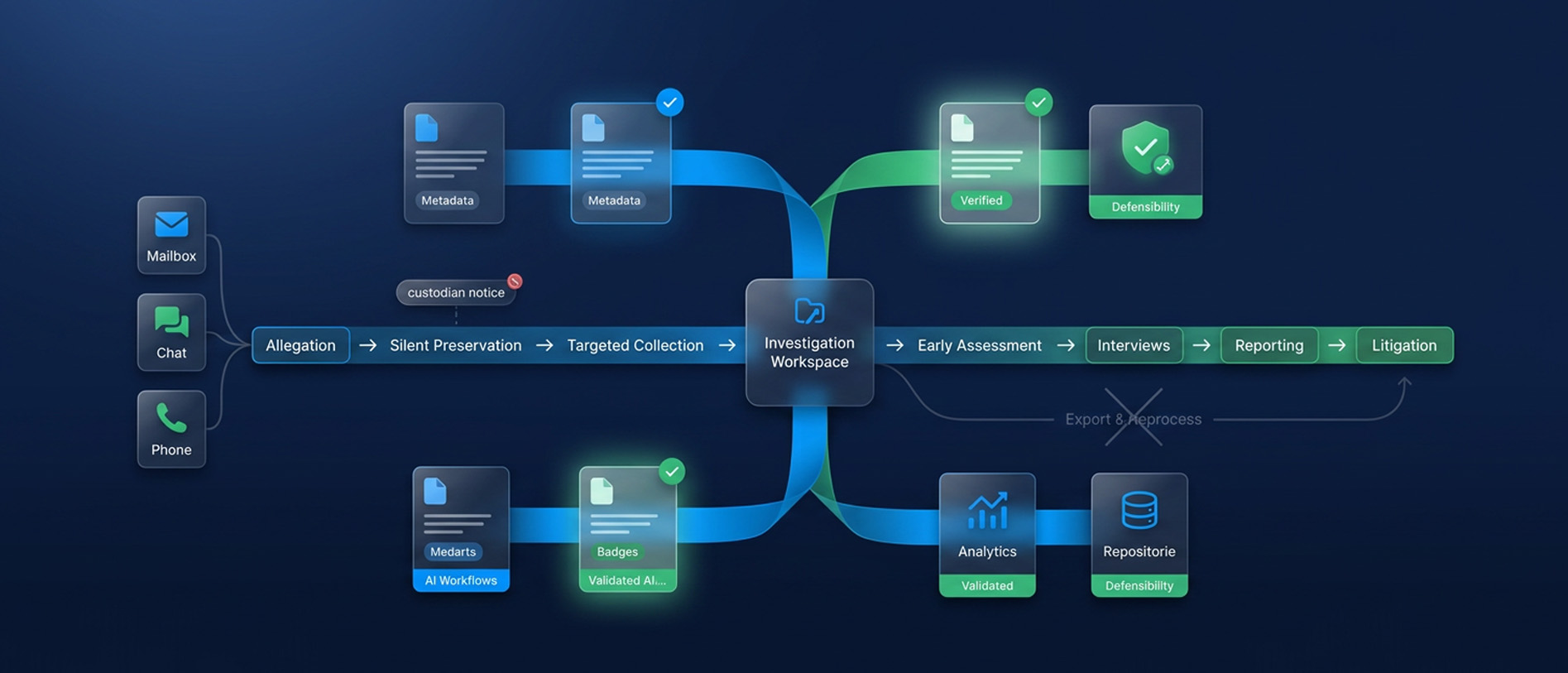
Internal Investigations: Getting the Facts Without Blowing the Matter Open
An internal investigation offers no court schedule and no second chance at prese
Read Article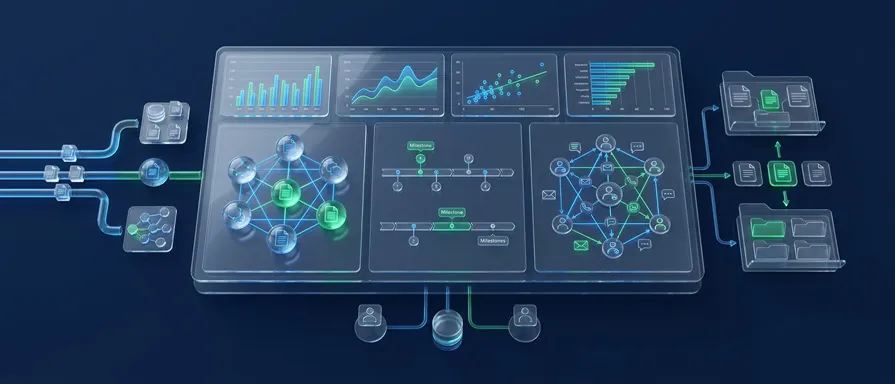
eDiscovery Data Analytics & Visualization for Trial Preparation
Most litigation teams don’t lose at trial because they lack evidence. They lose
Read Article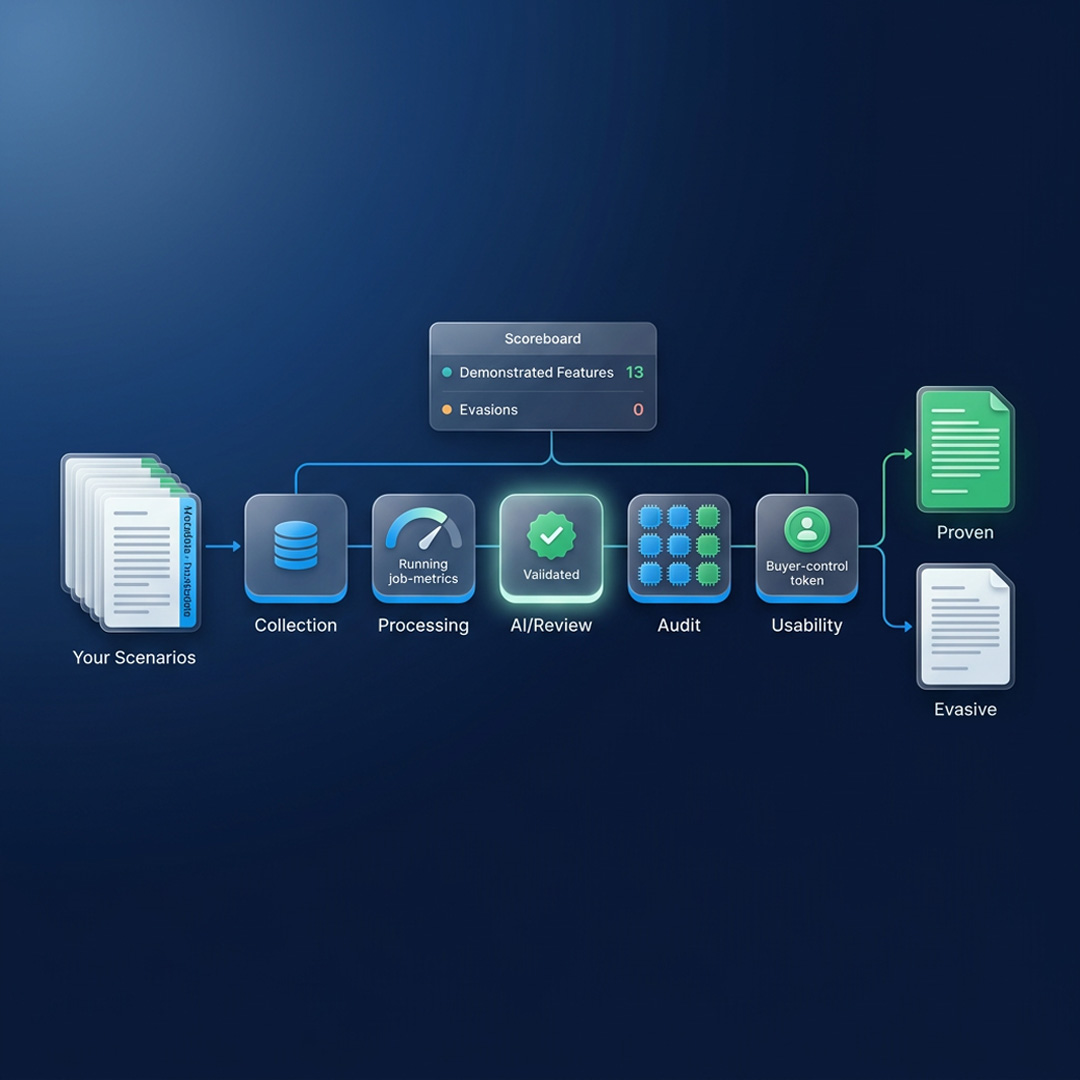
What to Ask in an eDiscovery Demo Before You Sign
Twenty questions that make an eDiscovery vendor prove processing, AI, security a
Read Article