The eDiscovery Vendor Shortlist Framework for Mid-Evaluation Teams
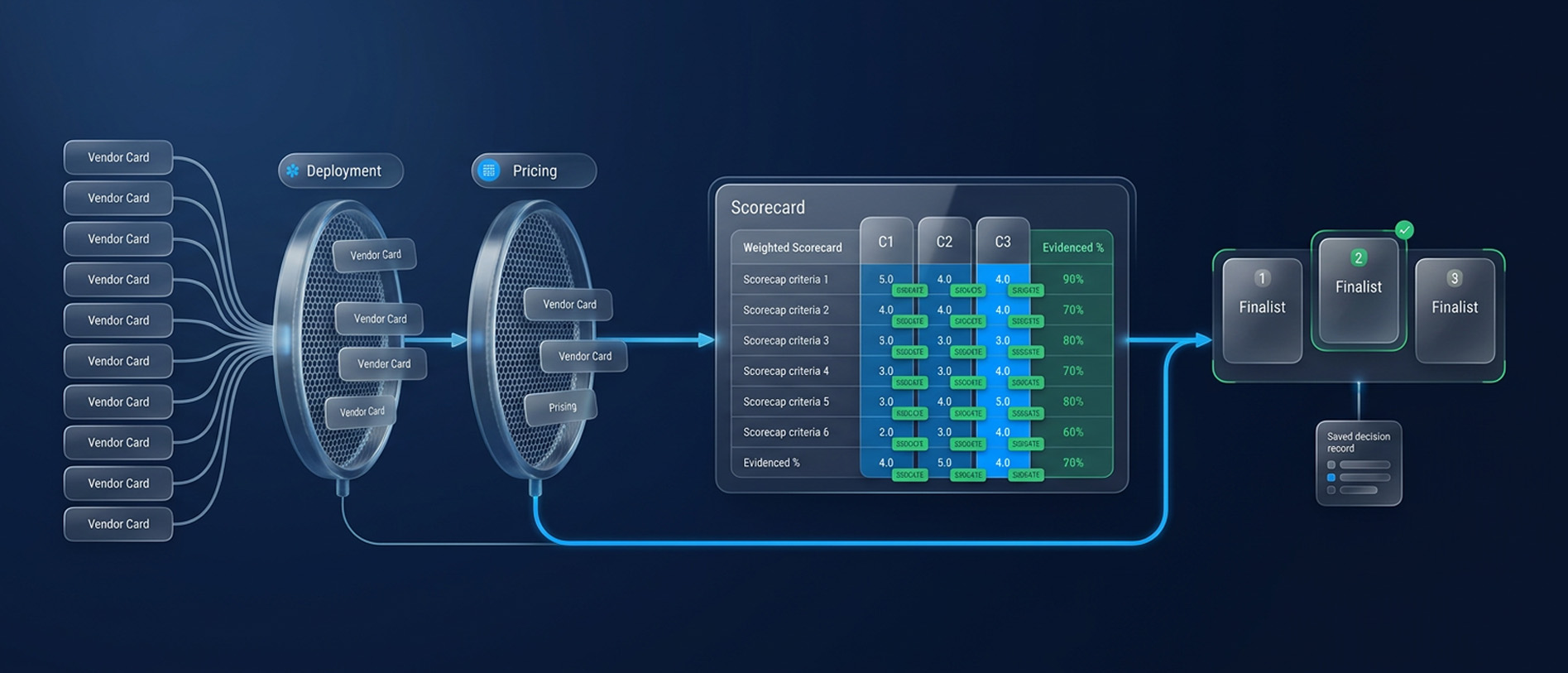
Ready to get started?
built for clarity, control, and scale.
Share
Choosing an eDiscovery vendor feels impossible when every demo looks the same, every pricing sheet is structured differently, and nobody will tell you what year three actually costs. You are not the first team to hit this wall. Most legal teams spend weeks comparing platforms against feature checklists that have very little to do with how their matters actually run, and only discover the real gaps once the contract has been signed.
This blog gives you a practical decision framework you can run in the middle of an evaluation, at the point where the longlist is already too long and the deadline is already close. You will get a structured method for cutting ten vendors down to three based on what genuinely separates platforms, including deployment flexibility, pricing predictability, workflow coverage, and long-term viability.
You will also get a downloadable eDiscovery Vendor Scorecard that ranks vendors side by side, with a column that forces every score to name the evidence behind it.
By the end, you will know exactly which vendors deserve a place on your shortlist, and which ones to eliminate before they cost you another week of evaluation time.
Why Most Vendor Shortlists Stall
If you have been evaluating eDiscovery software for more than a while, the pattern will be familiar. Vendors arrive with polished decks and feature matrices, demos show AI capabilities that look impressive but bear no resemblance to your actual workflows, and pricing sheets quote per-gigabyte rates that seem reasonable until you add the fees for exports, productions, analytics, and professional services.
The problem is not that vendors are hiding information from you. The problem is that the standard evaluation method asks the wrong questions in the wrong order, and by the time the right questions surface, three weeks of everyone's time has already been spent.
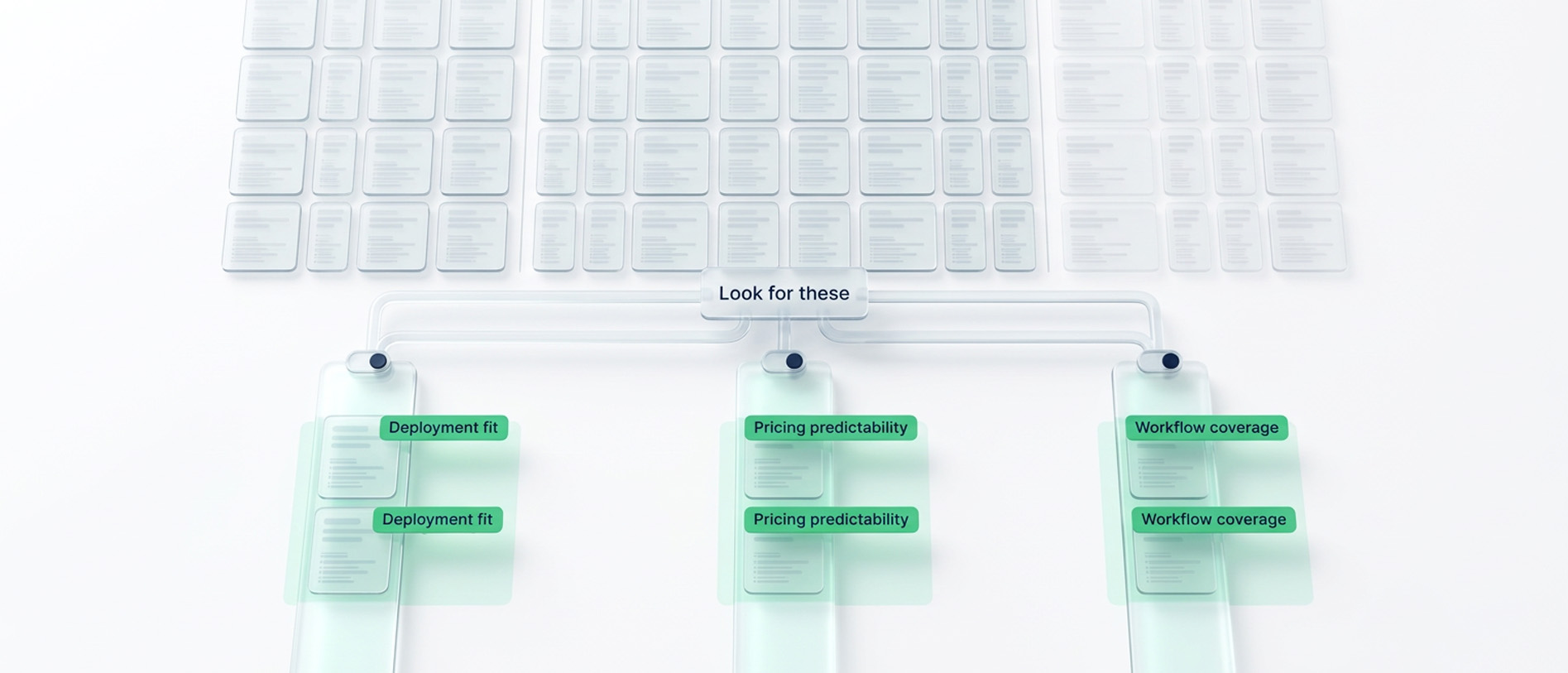
Most published guidance on how to choose an eDiscovery vendor pushes you toward the same three comparisons, and none of them separates one serious platform from another.
• Feature Checklists: Does it have technology assisted review, AI review, mobile collection. Every finalist will answer yes, because breadth is easy to claim and hard to disprove in a scripted demo.
• Per-Gigabyte Pricing: It looks like the simplest possible comparison, but a unit rate tells you almost nothing about what the platform will cost you once your data volumes move.
• Security Certifications: SOC 2 and ISO 27001 are table stakes for any vendor you would seriously consider, which makes them a filter you have already passed rather than a differentiator.
What that comparison never surfaces is whether the platform can legally run where your matter data has to live, whether your finance team can forecast the bill a year out, and how many systems your data has to cross between a legal hold and a production. Those three questions decide the outcome, and they deserve to be asked first rather than buried as rows twenty-eight, twenty-nine, and thirty.
The result is a shortlist of vendors who all look broadly similar on paper, when in reality several of them were never viable options for your organization at all.
The Six Criteria That Shape a Shortlist
Everything worth evaluating falls into six categories, and the most useful thing you can do is stop treating all six as equal. Two of them are gates, applied as pass or fail before any scoring happens, and the remaining four are weighted criteria applied only to whatever survives.
That sequence matters more than the criteria themselves. Gates are non-negotiable constraints that no amount of strength elsewhere can compensate for, so scoring a vendor that fails one is simply a way of spending time you do not have.
• Deployment Model, Gate: Cloud, on-premises, hybrid, or air-gapped, measured against the hardest requirement you can plausibly face during the contract term rather than the one you face today.
• Pricing Model, Gate: Not the price, the structure. The question is whether your finance team can forecast year three, not whether year one looks competitive.
• Workflow Coverage, Weighted: How much of legal hold, collection, processing, early case assessment, review, and production runs inside a single platform, and how many handoffs connect whatever does not.
• AI Maturity, Weighted: What is included against what is metered, whether AI is available in the deployment model you actually need, and how model decisions are logged for defensibility later.
• Scalability, Weighted: Processing throughput, multi-matter administration, matter templates, and an honest answer about what breaks when volumes rise tenfold.
• Vendor Stability, Weighted: Ownership, roadmap consistency, support model, and references from organizations shaped like yours, because you are selecting a partner for the next five years rather than a feature set for this quarter.
This six-category split is also what makes the framework portable. The same structure answers how to choose eDiscovery software for an in-house team and how to select a managed service provider, because an eDiscovery review platform has to clear the identical gates either way.
Teams comparing self service eDiscovery against a full-service provider often build two separate evaluation sheets, which quietly breaks the comparison. Self service eDiscovery changes who runs the workflow, not what the workflow has to produce, so both models belong on one scorecard with the same six categories applied.
Gate One, the Deployment Model
Deployment goes first because it is the one criterion nobody inside your organization can overrule, however much they might want to.
If a client, a regulator, or your own information security policy can dictate where matter data lives, then a platform without that deployment option is not a lower-scoring vendor that might still win on strength elsewhere. It is a vendor you are not permitted to buy, no matter how good the review interface looks in a demo.
The mistake most teams make is applying this gate against today's comfortable requirement rather than the hardest one they can plausibly face. The financial services client you are hoping to win next year counts now, because the contract you are signing will still be running when that work arrives. Document which deployment options your security team can actually defend, and record who signed off on that assessment.
In practice this single gate tends to cut a ten-vendor longlist close to half, because a substantial share of the market is cloud-only by architecture rather than by choice. That is not a criticism of those platforms, and it says nothing about their quality. It is a statement about your constraints, which is precisely what a gate is designed to test. Teams that later discover they need on-premises eDiscovery almost always discover it mid-contract, which is the most expensive possible moment to find out.
If you genuinely have no deployment constraint and expect never to acquire one, write that conclusion down along with the name of whoever made the call. A year from now, somebody will ask why the shortlist looked the way it did.
Gate Two, the Pricing Model
The second gate examines the pricing model rather than the price, and the distinction is where most eDiscovery budgets come apart.
A quote answers one narrow question, which is what year one will cost at today's volumes. The gate question is what year three will cost once your data has doubled, and that answer lives entirely in the structure of the model rather than in the number at the bottom of the page.
• Metered Models: Billing moves with volume, whether that is per gigabyte processed, hosted, or run through AI. These suit teams with small and genuinely stable matter profiles, and they are a budgeting hazard for anyone whose data is growing.
• Fixed Subscription Models: Billing holds flat as volume climbs, so the premium you pay over a metered quote at today's volumes is simply what predictability costs, which is often the cheapest insurance in the legal budget.
• The Tell: Ask every vendor what happens to the bill if your volume doubles halfway through the year. A vendor who cannot answer that in a single sentence has already answered it.
The gate passes any vendor whose model your finance team can forecast, and it is perfectly honest to pass a metered vendor when your volumes really are stable. What fails the gate is a model that nobody in the room can explain in plain language, because an unexplainable model is a budget overrun that has not happened yet. Most eDiscovery pricing models resolve into one of those two shapes once you ask directly, which is why this check moves fast and settles your eDiscovery cost ceiling before you have spent a single hour on scoring.
One practical note. Ask for the answer in writing, as a worked example at double your current volume, signed by somebody at the vendor who is authorised to price it. A verbal reassurance from a sales representative has no standing in a renewal conversation eighteen months later.
Score Only What You Can Source
Here is where almost every published scoring framework quietly falls apart, and it is worth slowing down for because fixing it is what turns a scorecard into something you can defend.
The more rigorous models in circulation ask buyers to rate a vendor's free cash flow, its annual employee turnover, or its overall defensibility. For a privately held eDiscovery vendor, the first two figures are not disclosed anywhere you can reach, and the third is a judgment rather than an input. So the evaluator makes an educated guess, types it into a cell, and the spreadsheet converts that guess into a number that carries exactly the same visual authority as a verified fact.
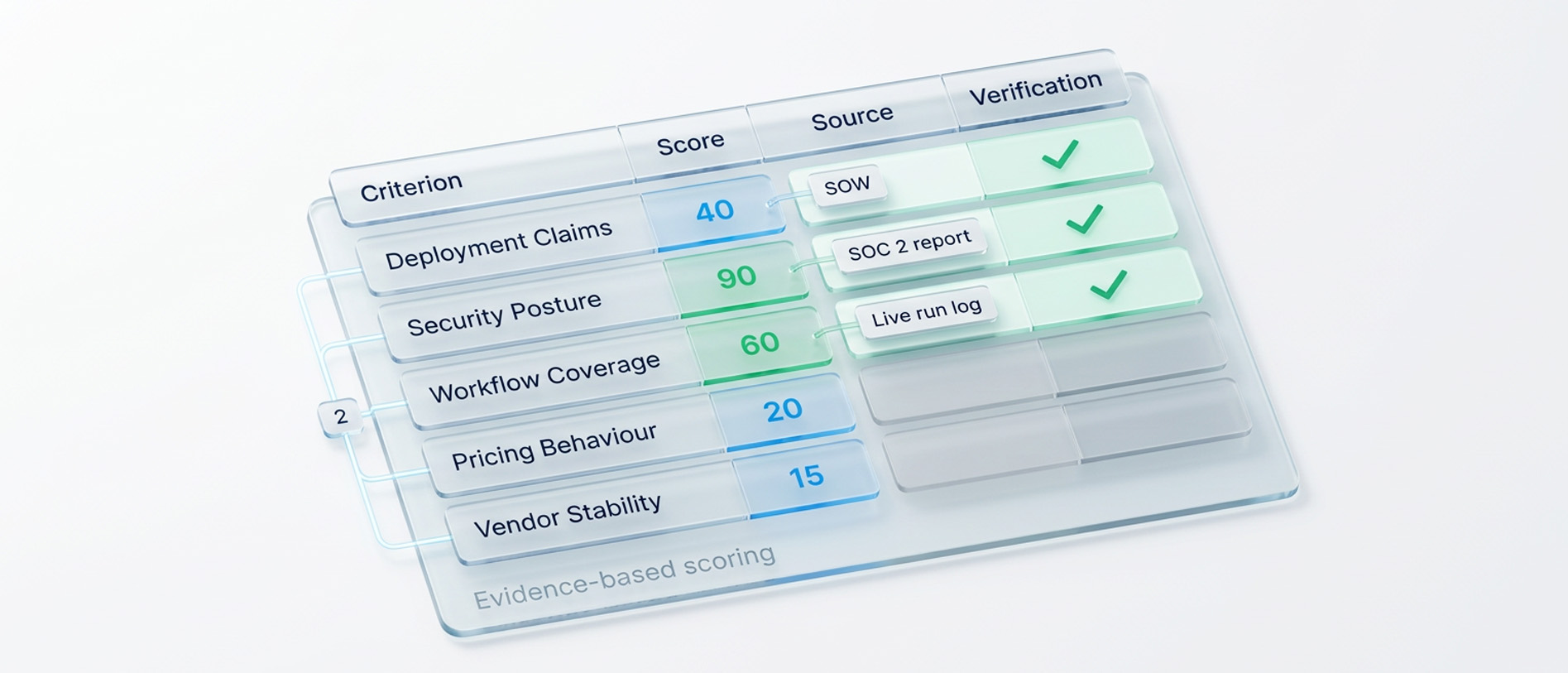
That is how a scorecard turns back into an opinion with arithmetic on top, and it is why so many weighted evaluations produce a ranking that nobody in the room actually believes.
One rule fixes it. A criterion only earns a score if you can name where the answer came from, and the evidence column sits directly beside the score so the gap is visible.
• Deployment Claims: Verified against a signed statement of work or the contract itself, never against a sales deck or a verbal assurance given during a demo.
• Security Posture: Verified against the current SOC 2 report, requested and actually read by somebody on your side, rather than the certification badge displayed on the vendor's website.
• Workflow Coverage: Verified by watching one matter run from legal hold through to production in a single uninterrupted session, counting the handoffs out loud as they happen.
• Pricing Behaviour: Verified against that written worked example at double your current volume, which is the only form of pricing evidence that survives a renewal negotiation.
• Vendor Stability: Verified through reference calls with two customers the vendor did not hand-pick for you, ideally from matters completed within the last twelve months.
Anything you cannot source does not get a score at all. It moves onto the proof of concept list, or it comes off the scorecard entirely, and both of those outcomes are better than a fabricated number that everybody later treats as evidence. A published competitor comparison chart is a reasonable starting point for the sourcing work, but it is not the source itself.
Applying this rule typically trims a twenty-criterion scorecard down to twelve or fourteen, and the shorter version is considerably more defensible, because every remaining cell points at something a sceptical third party could independently check.
How to Run a Proof of Concept
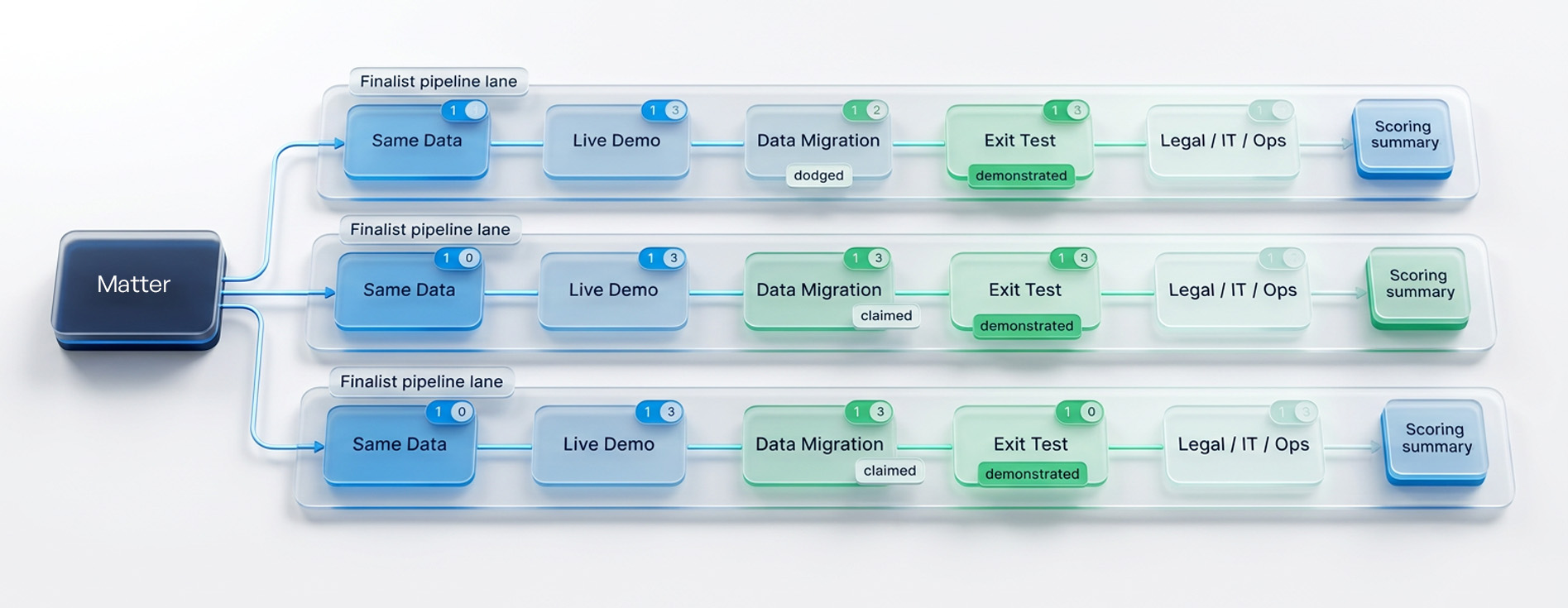
Weighted scoring gets you to three finalists, and at that point the scoring has done everything it usefully can. The last stretch of the decision runs on evidence you gather yourself rather than on anything a vendor tells you.
• Same Data, Same Script: Run one real bounded matter, or a sanitised copy of one, through every finalist in turn. The moment two vendors demonstrate on different datasets, you have stopped comparing them and started watching unrelated demos.
• Score What You Watched: Use a simple three-point scale of dodged, claimed, and demonstrated live, and award full marks only for the third. The gap between what a platform can do and what it can do in front of you is where most post-signature disappointment lives.
• Test The Exit: Have each finalist ingest a workspace export from your current eDiscovery review platform and show you exactly what survives the move, including field mapping, tags, work product, and privilege calls. eDiscovery data migration is where switching costs hide, and finding them now costs you an afternoon rather than a quarter.
• Ask How You Leave: Every vendor will happily explain how your data gets into their platform. Ask how it comes out, in what format, on what timeline, and at what price, because eDiscovery data migration on the way out is a contract term rather than a product feature.
• Split The Scoring: Legal scores defensibility, IT scores architecture and security, and operations scores administration and eDiscovery cost. Three perspectives filling in one shared scorecard removes the averaging argument that otherwise arrives at the end.
Keep this stage to three vendors rather than five or six. Beyond three finalists, scoring consistency degrades faster than the additional information improves the decision, and the evaluation starts to drift past the renewal date where your negotiating leverage sits.
A Scoring Template You Can Use Today
The scorecard runs the whole framework in a single workbook, and it is built so that a committee can use it together rather than one person filling it in and presenting a conclusion.
A gate sheet holds the longlist, with deployment and pricing-model checks for up to ten vendors and automatic elimination the moment either gate fails. A weighted sheet holds whoever advances, with the four weighted categories broken into twelve scored criteria and an evidence column beside every score. A summary sheet totals the weighted scores, reports how much of each vendor's score is actually evidenced, and ranks the field.
Set your weights before you look at a single vendor score. Weights chosen after scoring are not weights at all, they are a way of arguing for a vendor somebody in the room had already decided on, and everyone else can tell.
A Shortlist You Can Defend
What this framework produces is not just a winner. It produces a record, and the record is what makes the decision survive contact with people who were not part of the evaluation.
You end up holding a gate sheet showing exactly who was eliminated and against which non-negotiable, a weighted sheet where every score points at a named and checkable source, and a proof of concept log showing what each finalist actually demonstrated on your data rather than on a curated demo set. That is what turns a preference into a decision, and it is also what you hand procurement when they ask why the cheapest quote did not win.
Venio tends to reach the final three on shortlists built this way, largely because the gates are where the field thins. Deployment is a genuine choice across cloud, on-premises, and hybrid rather than a single fixed architecture, and pricing is a flat subscription, which means the volume-doubling question has a one-sentence answer that finance can plan around.
The workflow from legal hold through to production also runs inside one platform, so the handoff count is low enough that you can verify it yourself in a single session rather than taking anyone's word for it.
Frequently Asked Questions
How many eDiscovery vendors should we evaluate?
Start with a longlist of eight to ten drawn from analyst coverage and peer references, then gate-check that list down to five or six in an afternoon, since deployment and pricing model do most of the cutting on their own. Score the survivors down to three, and run demos and a proof of concept on those three only.
What matters most when choosing eDiscovery software?
Two criteria eliminate vendors outright, which is whether the platform can run where your data must live and whether your finance team can budget it a year ahead. Anyone working out how to choose eDiscovery software should settle both of those before scoring anything else, then weight workflow coverage, AI maturity, scalability, and vendor stability against their own matter profile.
How long should eDiscovery vendor selection take?
Allow roughly a quarter from start to finish, split into one to two weeks for the longlist and gate check, two to three weeks for scored evaluation and demos, and two to four weeks for a proof of concept with the finalists. Time the decision to land two to three months before your current contract renews, because that is where your negotiating leverage sits.
What is the difference between eDiscovery pricing models?
Metered models bill by volume, so your cost moves with your data, while subscription models hold flat, so your cost moves with your contract instead. Most eDiscovery pricing models are one or the other, and hybrids usually meter whichever component grows fastest, so ask which component is metered before you compare any two quotes side by side.
Is standalone document review software enough?
Only if the rest of your lifecycle is already solved and working well. Standalone document review software leaves you managing the handoffs into and out of review, and every handoff is both a cost line and a chain of custody question waiting to be asked. Score an integrated platform and a point solution on the same sheet, then count the handoffs each one leaves you holding.
Related Articles
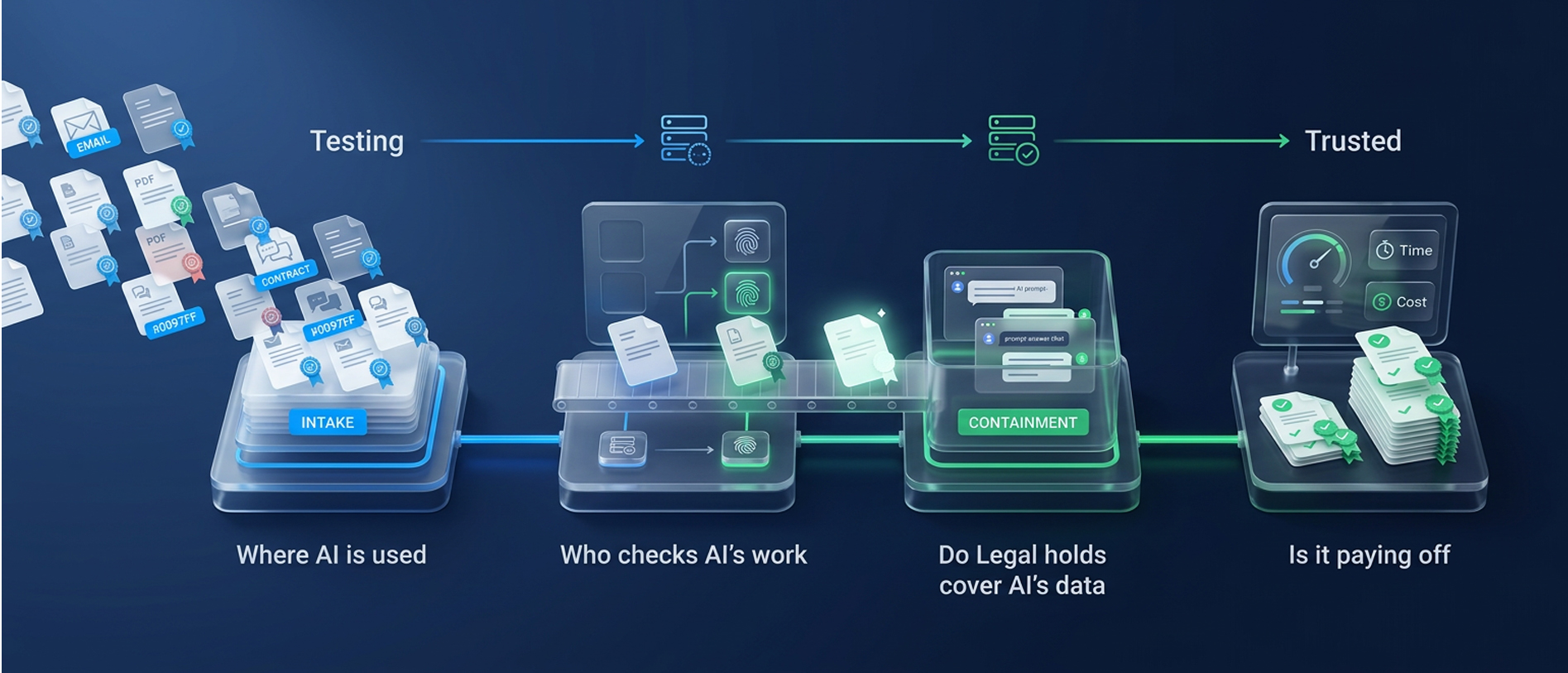
From Testing to Trusted: The Open Questions on AI in eDiscovery
Where is AI used, who checks its work, do legal holds cover AI data, and is it p
Read Article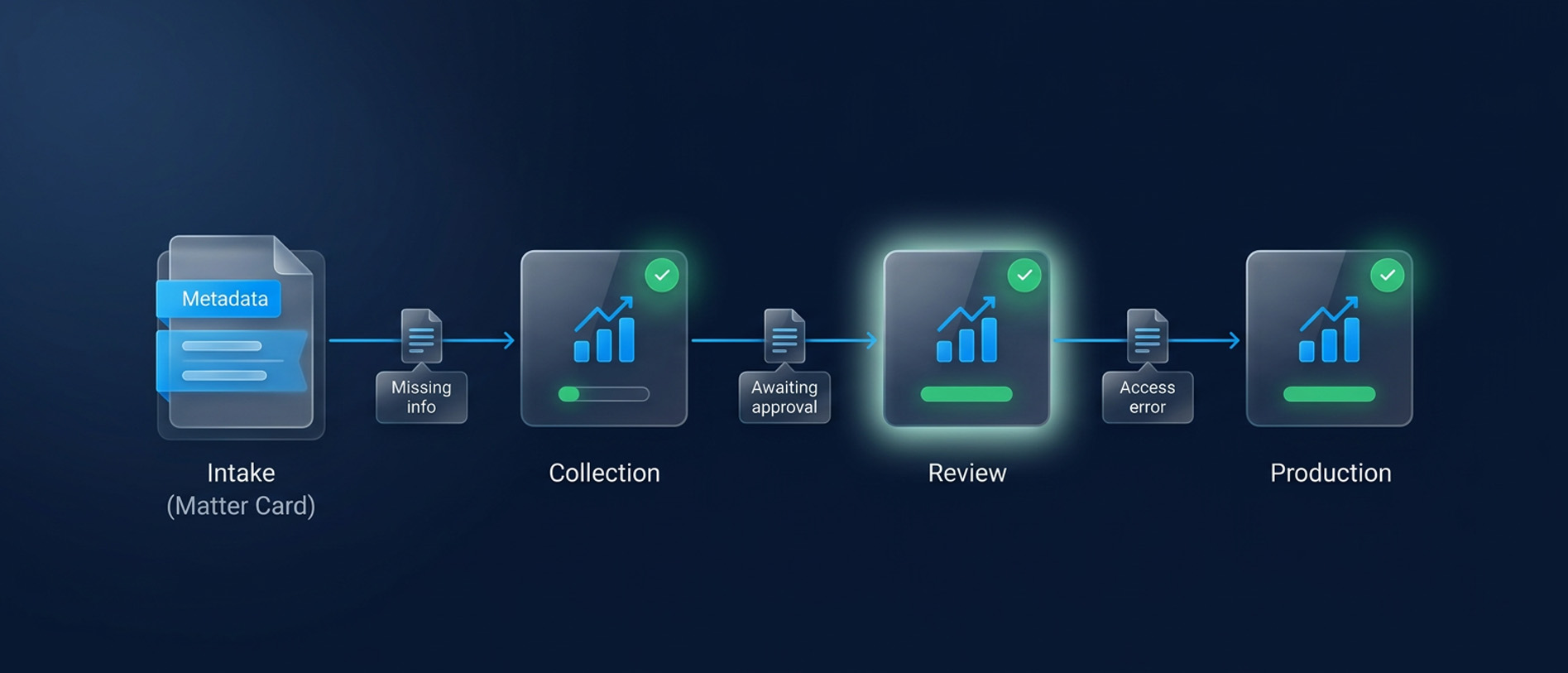
Legal Workflow Automation for Faster eDiscovery
Reduce discovery delays with legal workflow automation. Clarify ownership, resol
Read Article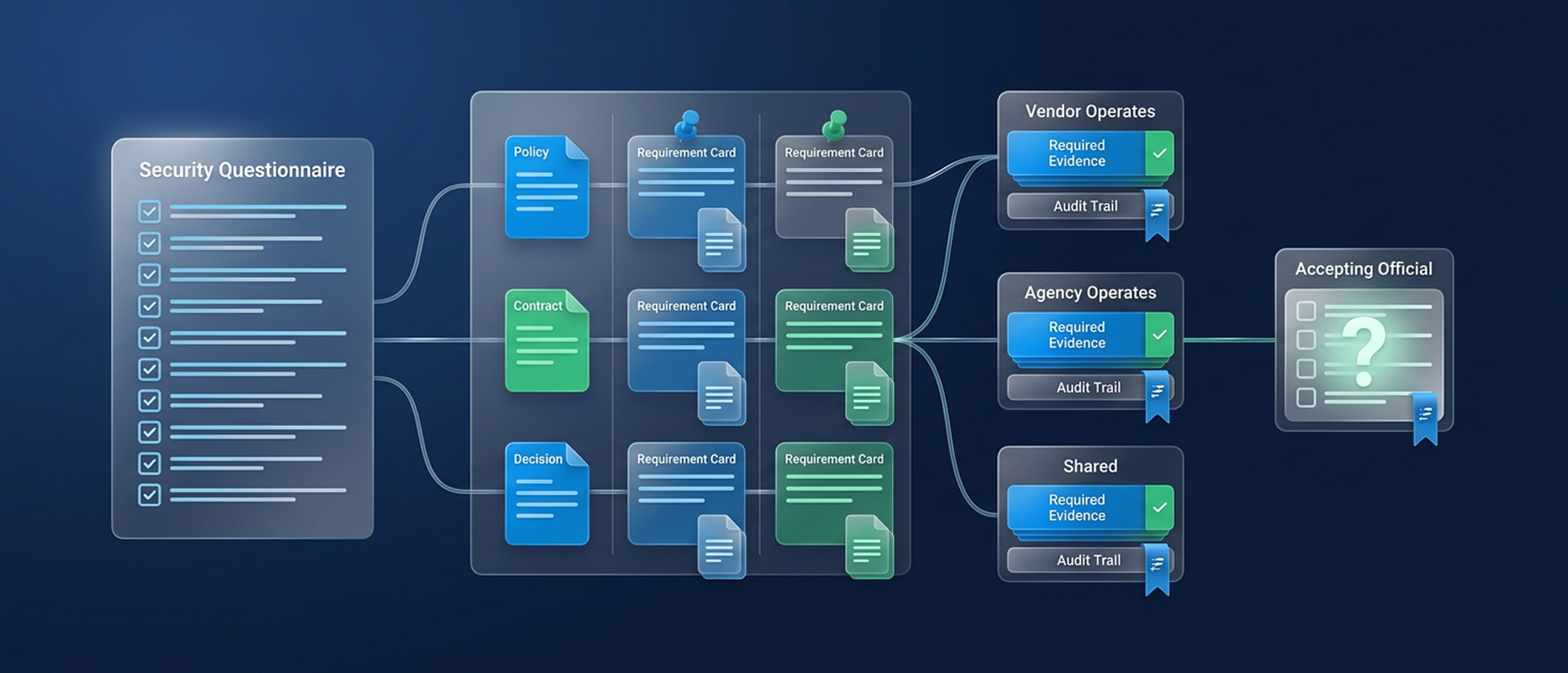
A Buyer’s Guide to Government eDiscovery Security
Evaluate government eDiscovery security requirements, FedRAMP 20x and NIST contr
Read Article