ILTACON 2026 Recap: What It Means for Your Next eDiscovery Platform

Ready to get started?
built for clarity, control, and scale.
Share
A litigation support manager leaves ILTACON 2026 with three vendor demos booked and a hard deadline waiting. The exhibit hall made one thing obvious this year. Almost every eDiscovery vendor now claims some form of agentic AI, meaning a system that plans, executes and checks multistep work with limited human prompting.
That claim stopped being a differentiator about twelve months ago. The harder questions moved elsewhere. They now sit in governance, in privilege, in training pipelines, and in who owns the audit trail when a model makes a call.
This recap covers the whole conference rather than the product news alone. It walks through every major announcement, the debates that run across the education sessions, and two federal privilege rulings nobody on the floor could ignore. For litigation support and legal ops teams evaluating ediscovery software this year, the real story is less about which vendor shipped the flashiest legal AI tools and more about which platforms can document how those tools reached a decision. It closes with the questions worth asking before you sign anything.
What Actually Happened at ILTACON 2026
ILTACON 2026 was the 46th annual conference, held August 23 to 27 at the Gaylord Opryland Resort in Nashville. ILTA expected more than 5,300 attendees across four and a half days of programming.
The education program ran to more than 80 sessions, selected from over 400 community-submitted proposals. Every session was peer-created and peer-led, which is the structural reason ILTACON content skews practical rather than promotional.
Two keynotes anchored the week. Former Major League pitcher Jim Abbott opened Monday with a talk on creativity, accountability and trust, drawn from a career played without a right hand. Dr. Kevin Fong, an award-winning doctor and former NASA physician, spoke midweek on expert judgment under extreme pressure.
ILTA also commemorated the anniversary of 9/11 during the conference, with a memorial, a wall of remembrance and a video presentation. Wellness programming ran alongside the technical agenda, including a daily Wellness Window and dedicated quiet spaces.

Every Major AI Launch, Grouped by What It Changes
The announcement cycle around ILTACON 2026 was relentless, and several launches directly affect how discovery work gets done. Here is what actually shipped.
Research and drafting models. Thomson Reuters launched Thomson, its first proprietary large language model, built in-house for a reported $40 million. It trains on Westlaw, Practical Law, Checkpoint and Reuters material, and lands first inside Tabular Analysis in CoCounsel Legal. LexisNexis went a different route, wrapping Protégé in a Legal Intelligence Engine that picks the models, agents and sources for a task rather than routing every request through a fixed workflow.
Discovery and fact investigation. DISCO made Advanced Research generally available, an agentic tool that applies multi-step reasoning across large evidence sets. It reviews its own findings, identifies gaps and launches further searches to refine results.
Knowledge infrastructure. NetDocuments introduced a legal context graph mapping relationships between every matter, document and communication in a firm. A benchmark report published days earlier found the graph cut the cost of a correct AI answer by 48 percent.
Business of law. Litera puts firm knowledge behind a conversational interface. Its new Firm AI Search runs through the Lito agent, so a lawyer can ask about past matters, clients or internal expertise without leaving Outlook. Separate growth intelligence features in Foundation 365 attach a monetary value to business development signals.
Interoperability. Three days before the conference opened, iManage and Thomson Reuters expanded their partnership around Model Context Protocol support, letting approved Thomson Reuters AI tools reason over governed iManage content while access controls, ethical walls and privilege boundaries stay intact. DeepJudge introduced an open Agent Handoff Protocol aimed at the same problem from the other side, so context survives when a lawyer switches between AI platforms.
Education. ILTA and BARBRI announced a multi-year partnership on 24 August. ILTA members now receive a 20 percent discount on ACEDS certification, training and membership. The two are also building a dedicated eDiscovery conference, with the first edition planned for Q2 2027 and a second in 2028.
The Trust Problem Sitting Behind the Launches
The defining theme of ILTACON 2026 was trust in AI output rather than raw AI capability. Speakers returned across three days to governance, validation and the danger of unexamined machine judgment.
One risk came up often enough to earn a name. Sessions described a confidence collapse among experienced practitioners who defer to model output. When specialists outsource nuanced judgment, their expertise and their distinctive professional voice erode together.
A related concern was volume without value. AI-generated filings have grown verbose and repetitive, and courts are absorbing the cost. Speakers were blunt that a flood of low-quality machine output creates a burden nobody budgeted for.
The consistent answer across sessions was a human checkpoint somewhere in every AI workflow. That should sound familiar to eDiscovery managers. Defensibility has always demanded documented human validation, and the rest of the industry is catching up to a standard discovery teams already meet.
What the Courts Just Ruled on AI and Privilege
Two federal courts ruled on AI and privilege the same week in February 2026 and reached opposite outcomes. Neither ruling made headlines outside legal circles, but both belong on your vendor checklist.
In United States v. Heppner, the Southern District of New York ruled on this exact question. A criminal defendant's chats with a public AI platform were not protected by privilege or work product. Judge Rakoff reasoned that sharing the material with a consumer AI tool waived privilege, because the platform's own data-use terms meant the exchange was never confidential to begin with. A separate part of his ruling denied work-product protection for the same documents, since Claude is not an attorney and was not directed by counsel to prepare them.
A different court reached the opposite result one week earlier. In Warner v. Gilbarco, a federal magistrate in Michigan protected a pro se litigant's ChatGPT-assisted drafting as work product. She had never disclosed it to an adversary.
Two rulings, on the same day, turned on a single variable. It came down to whether the AI interaction stayed inside a governed record. Sessions at ILTACON flagged an open question nobody has answered yet. AI watermarks may persist inside firm repositories and court filings, raising fresh questions about what a production actually reveals.
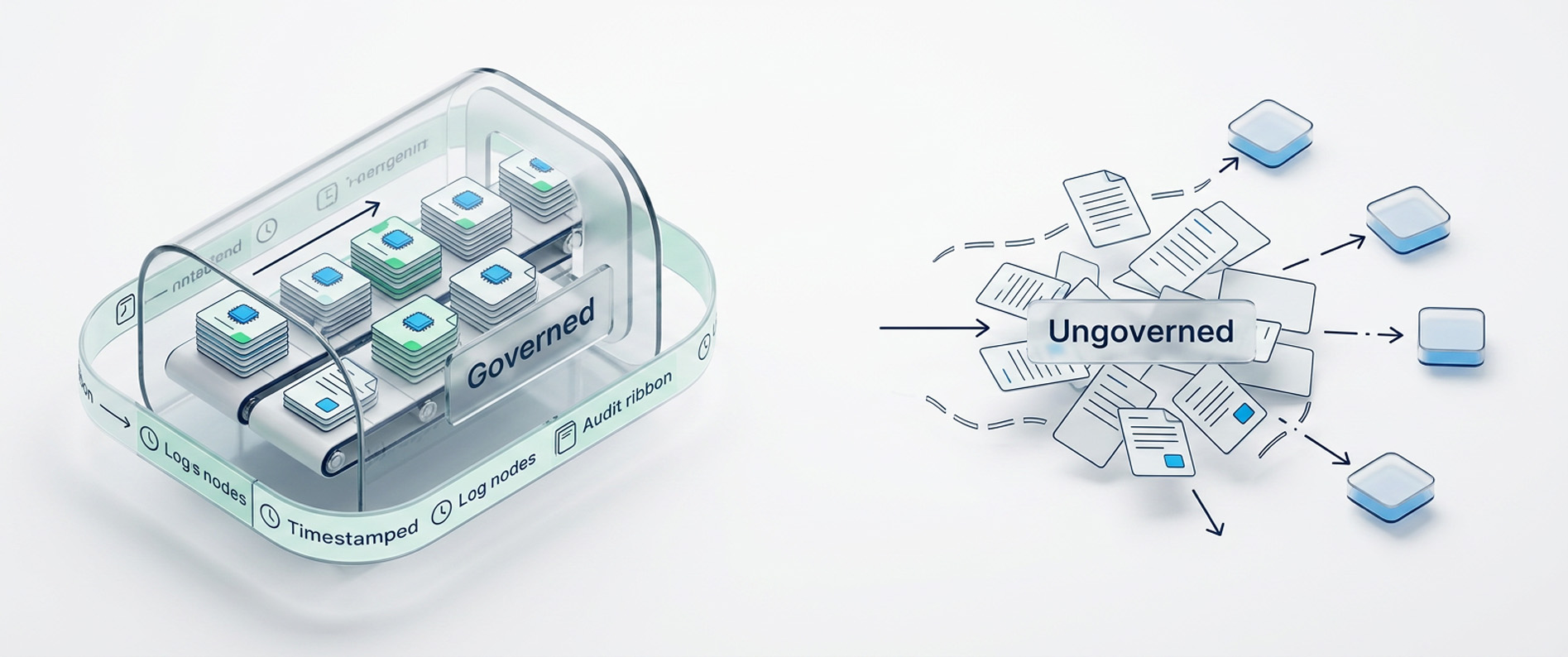
A platform that keeps legal hold, collection, review and production inside one governed record answers the privilege question by design. Venio Systems logs every access, every AI-assisted decision and every human override in one defensible chain. The Heppner question never has to become your discovery dispute.
The Access to Justice Debate Nobody Settled
ILTACON sessions were split on whether AI genuinely widens access to justice or simply widens the market. Both readings had serious advocates in the room.
The optimistic case is straightforward. AI lowers the cost floor for self-service legal help, bringing people into the system who previously had no realistic option. That expands the pro se market rather than shrinking it.
The sceptical case is equally grounded. Commercial incentives tend to outrun altruistic ones, and an already overloaded judiciary now absorbs a flood of AI-assisted filings. Expanding access and improving outcomes are not the same achievement.
For discovery teams the practical consequence is volume. More filings and more self-represented parties mean more matters where the opposing side's data hygiene is nobody's job. That pressure lands on the party with the better-governed system.
Who Trains the Next Generation of Lawyers
Law schools and firms are stuck on the same problem, and ILTACON gave it real airtime through sessions such as Building the Next-Gen Legal Training Ecosystem.
Law schools face a genuine paradox. Banning AI risks graduating lawyers unprepared for how firms actually work, while unrestricted use risks hollowing out core analytical reasoning. Some institutions ban it outright and others build AI literacy into the curriculum, which is producing a two-tier system.
Firms face the mirror image. Technology now automates much of the routine work that historically trained junior lawyers, so firms are hiring fewer juniors. Nobody at the conference had a settled answer for how the next generation gets built.
The ILTA and BARBRI partnership is one structural response. Expanding access to ACEDS certification gives eDiscovery professionals a credentialed path that no longer depends on osmosis from a shrinking pool of senior colleagues.
Foundation Models or Middleware, and Why It Matters
A live architectural debate ran through the vendor conversations all week. Sessions such as Platform Wars, Which AI Tools Do Lawyers Really Want, put it in front of practitioners directly.
One camp builds dedicated legal frontier models, which is exactly what Thomson Reuters and LexisNexis both announced. The argument is specialization, since a model trained on legal content should handle legal language better.
The other camp layers legal middleware over general-purpose models. The argument is nimbleness, since the underlying models improve faster than any single vendor can retrain its own.
Firms are hedging rather than choosing. Many now spread bets across multiple vendors and open-source options to manage supply chain risk and regulatory uncertainty. Some question sending confidential material to large proprietary models at all, which brings the conversation back to where your data actually sits. See how this weighs out against Relativity's approach on our vs. Relativity comparison page.
Why Every Vendor Arrived at the Same Answer
Even DISCO, a pure-play eDiscovery competitor, concluded this year that fragmented tools no longer work. DISCO folded its eDiscovery, Cecilia AI, deposition management and timeline tools into one all-inclusive platform in February 2026. CEO Eric Friedrichsen said standalone eDiscovery products can no longer keep pace with how fast generative AI moves.
DeepJudge reached a similar conclusion from a different angle. Its Agent Handoff Protocol exists so lawyers stop losing context every time they switch AI tools. That protocol is necessary because point solutions break continuity by design.
Every handoff between separate tools is a place where an audit trail can quietly fracture. Integration promises deserve scrutiny for that reason, since a connected ecosystem still moves data between systems that each keep separate logs.
Venio never had to bolt these pieces together after the fact. Legal hold, early case assessment, review and production already share one record. Nothing needs a handoff protocol for information that was never separated to begin with.
How to Use AI for Legal Discovery Without Losing Defensibility
Use AI for legal discovery by pairing automation with governance, clean data and scheduled human validation. ILTACON speakers repeatedly warned that promising tools fail when firms skip the unglamorous groundwork underneath them. Five practices came up across sessions all week, and each doubles as a question worth asking any vendor.
1. Define the Problem First: Map the specific workflow before evaluating vendors, since an agentic tool built for large-scale litigation can fail transactional due diligence.
2. Fix Your Taxonomy Before You Buy: Standardize what document types mean across custodians first. Clean taxonomy is what let NetDocuments cut AI answer costs by 48 percent, not the model alone.
3. Put Governance on a Quarterly Clock Treat AI governance as a recurring three-month review rather than a one-time signature. A tool judged safe at signing can still drift.
4. Ask Where Shadow AI Already Lives: Inventory the tools your team uses without approval, then decide what to sanction instead of assuming usage has stopped.
5. Demand Roof Against Your Own Data: Insist on a validation run against your team's actual review benchmarks, not a vendor's marketing deck.
Venio builds these controls into the platform itself, through audit trails, access controls and defensible workflows. None of it depends on a policy nobody reads. You can see how AI-powered eDiscovery performs when intelligence never has to leave one governed environment.
What AI Governance Actually Requires
Governance came up in nearly every ILTACON session touching AI, and the recurring point was that it is never finished. Firms treating it as a signed policy discover the gap only when something goes wrong.
- Review on a Cycle: Approved tools and policies need revisiting roughly every three months. Vendors ship features faster than annual reviews can absorb them.
- Surface Shadow AI Honestly: Unsanctioned tool use does not stop because a policy forbids it. Visibility, user education and controlled sanctioned options work better than a ban nobody enforces.
- Treat Metadata as Infrastructure: Data hygiene, tagging and taxonomy determine AI accuracy more than model choice does. This is the least glamorous work and the highest leverage.
- Map Your Regulatory Exposure: Firms handling government-related work face frameworks such as CMMC on top of ordinary confidentiality duties. That narrows which tools are usable at all.
- Assess Your Own Team Honestly: Deploying AI without the internal skill to validate it increases liability rather than reducing it. Capability assessment belongs in the procurement conversation.
Can AI Document Review Work for Legal Teams
AI document review works for legal teams when trained models rank documents and humans keep final relevance authority. ILTACON sessions on review technology returned constantly to hallucination risk and the cost of unverified output. Generative tools can fabricate confident answers, so accuracy testing belongs in a controlled evaluation plan rather than live matters.
Even agentic tools built for scale now compete on transparency, not just speed. DISCO markets Advanced Research partly on visibility into its own reasoning. A black box no longer clears a defensibility bar in court, which validates an approach eDiscovery review has used for years.
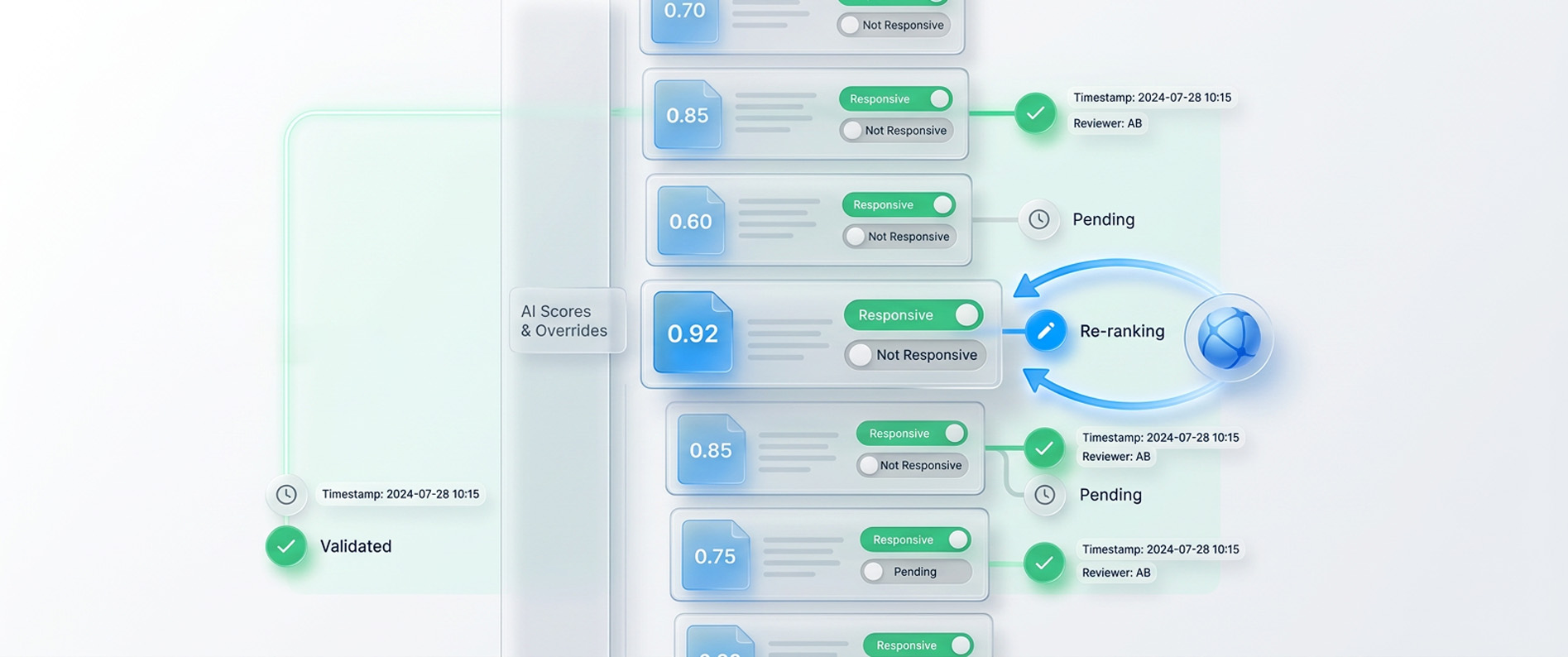
Continuous active learning takes that same defensible path, since it re-ranks documents after every reviewer decision. The model learns from your team's actual judgment calls instead of guessing from generic training data.
Venio applies that approach with predictive coding, clustering, sentiment analysis and native redaction inside the Review module. The generative layer, eDiscoveryAI, accelerates first-pass decisions while reviewers keep final relevance authority. Machines accelerate, humans stay accountable, and the record shows which did what.
Leadership and Inclusion Ran Through the Whole Program
A large share of the ILTACON 2026 program addressed leadership rather than technology, and those sessions drew real crowds. Leading in Every Direction, Women Shaping Legal's AI-Enabled Future, ran alongside a Women Who Lead reception on Wednesday.
The central concern was representation at the moment AI decisions get made. Women remain underrepresented in legal tech and AI leadership roles. Speakers framed this as systemic rather than as a simple gender conflict, noting that bias gets reproduced unconsciously by everyone, including women in senior roles.
Sponsorship drew a sharper distinction than mentoring. Mentoring is advice given privately. Sponsorship means using your own standing to put someone's name into the room where opportunities get decided. Speakers were clear that the second one moves careers.
Feedback quality came up repeatedly as a structural problem. High-performing women often receive personality-based critique rather than specific performance feedback, which leaves them nothing actionable to work on.
On leadership style, one idea recurred across sessions. The platinum rule asks leaders to treat people the way those people prefer, replacing the default of leading from your own preferences. Applied to technology rollouts, that means learning how each person absorbs change. One announcement is not a rollout plan.
Change management sessions extended the same point. Successful AI adoption depends on including everyone whose role shifts, meaning paralegals, assistants and support staff rather than only the lawyers. A dedicated session, Change Management for Legal Technology Transformation, took up exactly that problem.
The Real Cost of a Fragmented Discovery Stack
A typical eDiscovery stack now runs legal hold, ECA, review and production through separate vendors stitched together after the fact. Each handoff between those systems is a place where cost, risk and defensibility quietly break down.
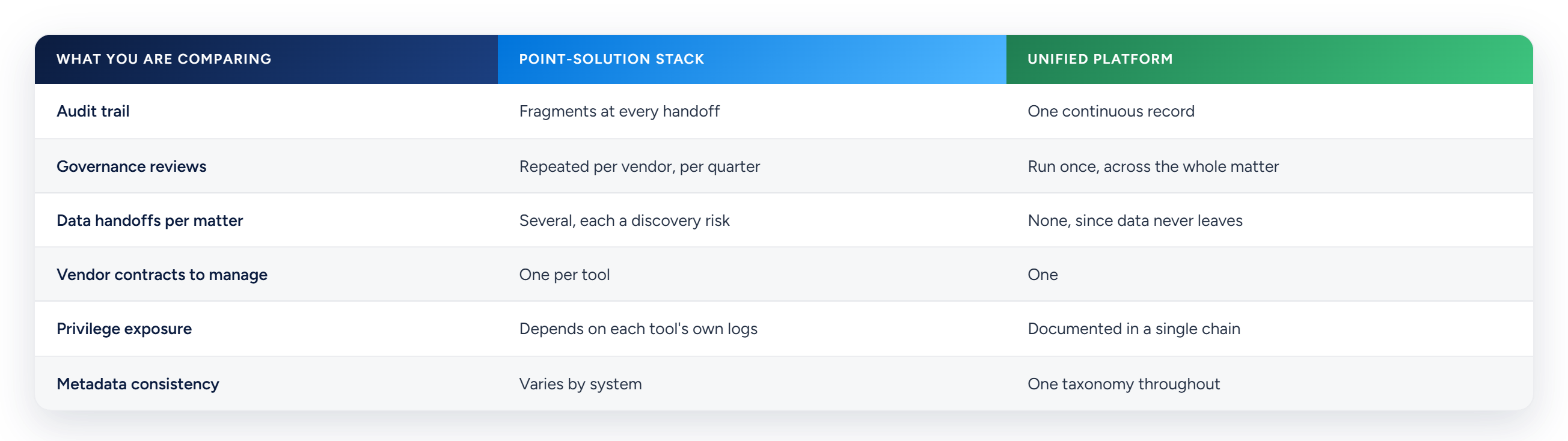
That comparison is what a working eDiscovery manager already suspected walking the exhibit hall this year. The unified model is not new to Venio. It is the reason the platform was built around one governed environment rather than a suite of acquisitions.
Where Venio Fits After ILTACON 2026
Every unnecessary handoff is a cost line, a security questionnaire and a future defensibility argument. The firms that impressed in Nashville were the ones that fixed foundations before chasing features.
Before your next contract renews, ask four questions. Does legal hold, collection, review and production live in one auditable record, or do documents move between separate systems along the way? Can the vendor show you, not just tell you, how the AI reached a specific relevance call? What does the quarterly governance review actually look like, and who signs off? If a court asked for the full chain of custody on an AI-assisted decision tomorrow, how long would that take?
Venio runs legal hold, early case assessment, document review, AI-assisted analysis, redaction and production on one platform, deployed in cloud, on-premises or hybrid from a single codebase. One ingestion carries a matter from preservation through to production, with scoping decisions and coding rationale on a single audit trail the whole way.
Your eDiscovery platform should do more than accelerate review. It should give your team one governed, defensible workflow from legal hold through production. Book a Demo to see how Venio can help eliminate fragmented workflows, strengthen oversight, and keep every discovery decision accountable.
Frequently Asked Questions
When and where was ILTACON 2026 held?
ILTACON 2026 ran from August 23 to 27, 2026 at the Gaylord Opryland Resort in Nashville, Tennessee. It was the 46th annual conference, and ILTA expected more than 5,300 attendees across four and a half days.
What were the biggest announcements at ILTACON 2026?
Thomson Reuters unveiled its own frontier model and LexisNexis launched a Legal Intelligence Engine. DISCO shipped Advanced Research, NetDocuments introduced a legal context graph, and Litera released Firm AI Search. ILTA and BARBRI also announced an eDiscovery education partnership.
What was the main theme of ILTACON 2026?
The main theme was trust in AI output rather than raw AI capability. Sessions across three days returned to governance, validation and the risk of unexamined machine judgment in legal work.
Does using AI waive attorney-client privilege?
It depends on how the AI is used and where the interaction is recorded. Two federal courts split on this on the same day in February 2026. Public consumer AI tools carry real waiver risk, while work kept inside a governed system with a documented audit trail is far better protected.
How often should AI governance be reviewed?
ILTACON speakers consistently recommended a review roughly every three months. Vendors ship new features faster than an annual policy review can absorb, so a tool judged safe at signing can drift within a quarter.
Is AI document review defensible in court?
AI document review is defensible when a human reviewer keeps final relevance authority and the system records how each decision was made. Continuous active learning, which re-ranks documents after every reviewer call, is the most established defensible approach.
What is agentic AI in eDiscovery?
Agentic AI describes a system that plans and executes multiple steps on its own, reviewing its own output and launching further searches rather than answering a single query. In discovery it is applied to fact investigation across large evidence sets, and it raises the same validation questions as any other AI output.
Related Articles
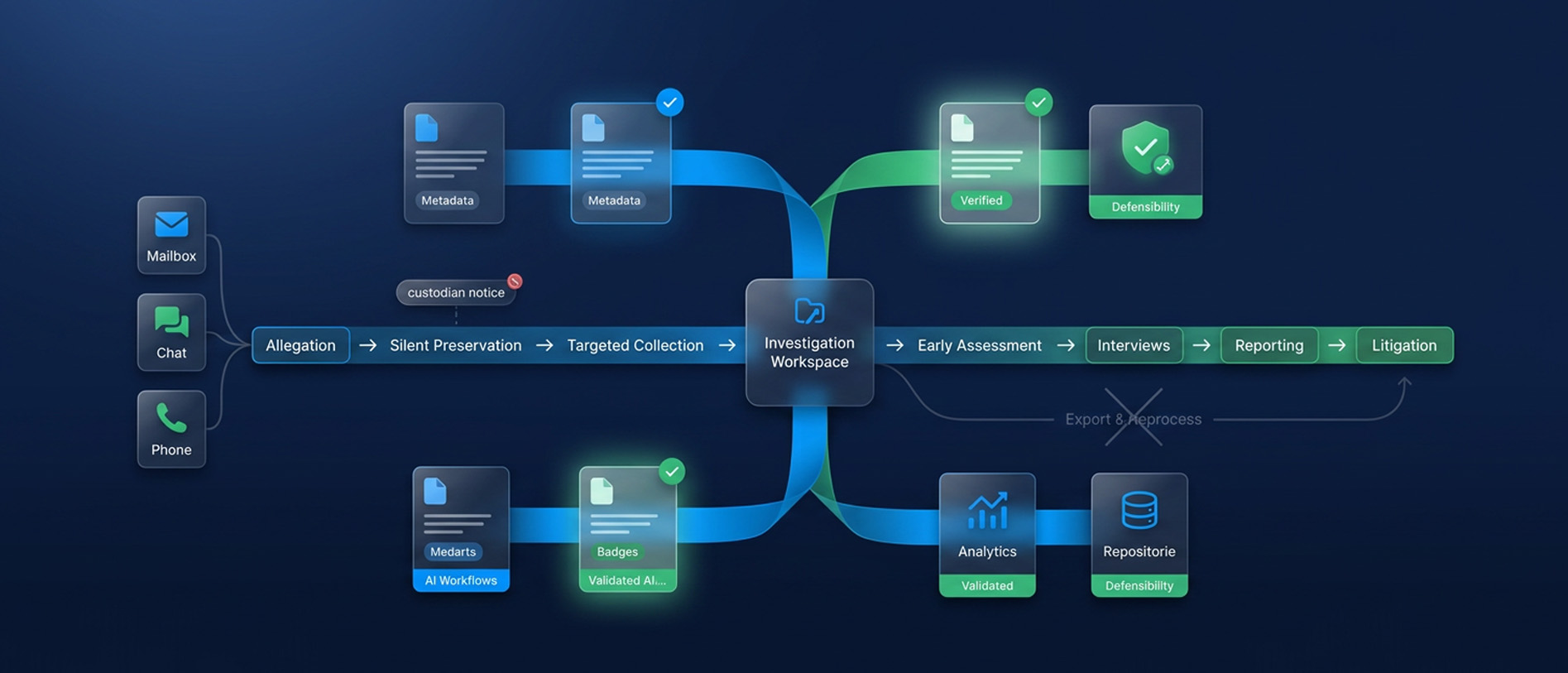
Internal Investigations: Getting the Facts Without Blowing the Matter Open
An internal investigation offers no court schedule and no second chance at prese
Read Article
eDiscovery Data Analytics & Visualization for Trial Preparation
Most litigation teams don’t lose at trial because they lack evidence. They lose
Read Article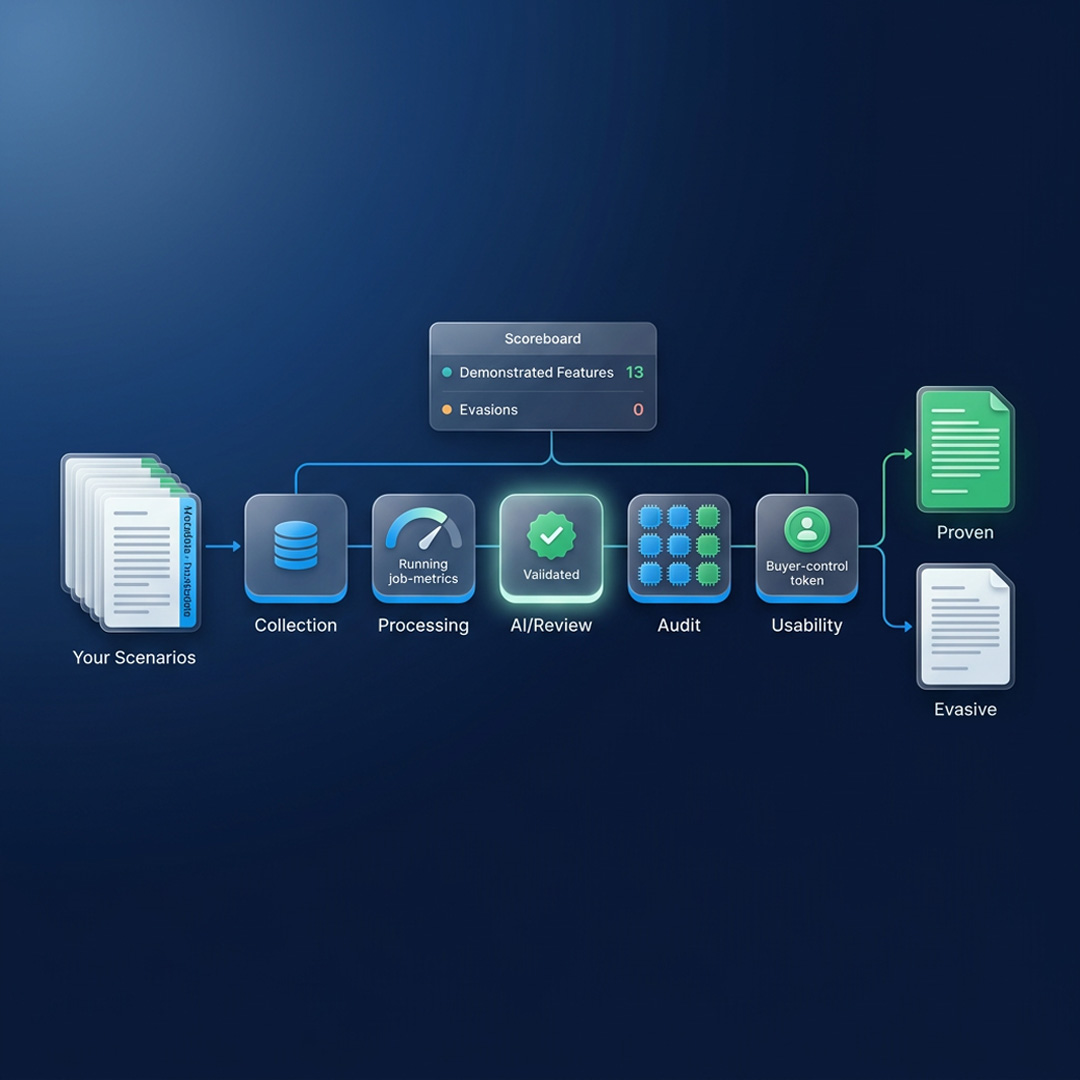
What to Ask in an eDiscovery Demo Before You Sign
Twenty questions that make an eDiscovery vendor prove processing, AI, security a
Read Article