Internal Investigations: Getting the Facts Without Blowing the Matter Open
Ready to get started?
built for clarity, control, and scale.
Share
There is one email that ends more internal investigations than any interview ever has. It is the legal hold notice, sent by the book, straight to the person under investigation.
By Friday the Slack messages are gone, the phone is wiped, and the subject has retained counsel. Nothing about that sequence broke your discovery playbook. The playbook itself was the problem.
An internal investigation runs with no court schedule, no opposing party, and no second chance at preservation. Most internal investigations guidance covers privilege, interviews, and who should lead, because law firms wrote it.
This guide covers the part they hand to you, the data workflow. It shows how to preserve, collect, and review without alerting anyone, and what mistakes cost in the litigation that follows.
Why Investigations Break Your Playbook
An internal investigation inverts the assumptions litigation discovery is built on. The safeguards you rely on, a judge's calendar and an adversary checking your scope, simply do not exist here. Every discipline the process needs, you have to impose on yourself.
The clearest way to see it is side by side.
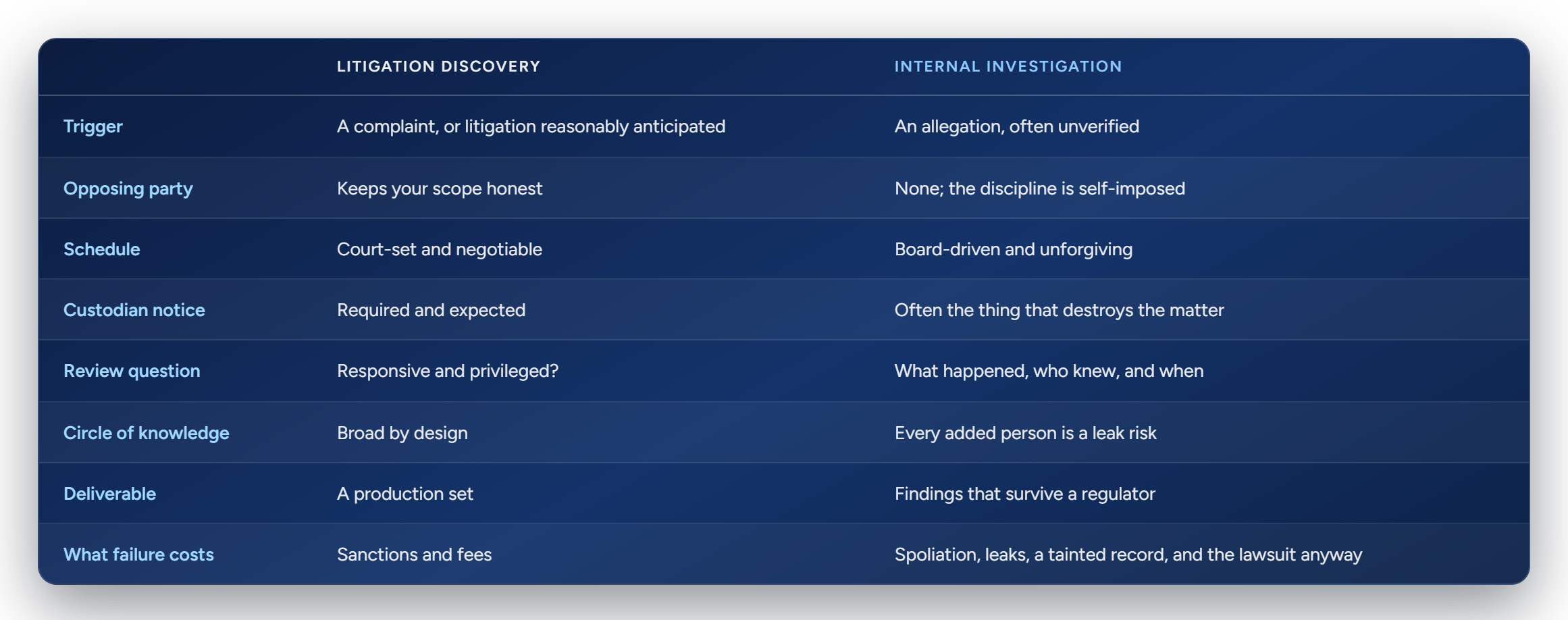
Read the custodian notice row twice. It is the one that runs against every reflex your discovery training built.
The guidance that ranks for this topic comes from law firms, and it handles privilege and interviews well. What it does not cover is the data workflow underneath, because outside counsel does not run that part. You do. Review platforms, meanwhile, treat an investigation as just another review project. It is not, and the differences all sit before review starts.
What Is an Internal Investigation
An internal investigation is a confidential, structured inquiry a company runs into suspected misconduct inside its own organization. It gathers documents, data, and testimony to establish facts before the company decides on discipline, remediation, or disclosure.
The term also covers police internal affairs inquiries, which is a different discipline entirely. This article covers the corporate internal investigation triggered by an HR complaint, a whistleblower report, or a regulator's letter.
The stakes have been clear for over four decades. The defining case on investigation privilege, Upjohn Co. v. United States, 449 U.S. 383 (1981), arose from exactly this work. A company investigated its own questionable payments through its general counsel, and the government demanded the file afterward. How you run the investigation determines what you can protect later.
Two audiences shape every choice inside it. The company needs facts fast enough to act on. A regulator or a court may later re-read every step for defensibility. Serving both at once is the entire craft.
How to Conduct an Internal Investigation
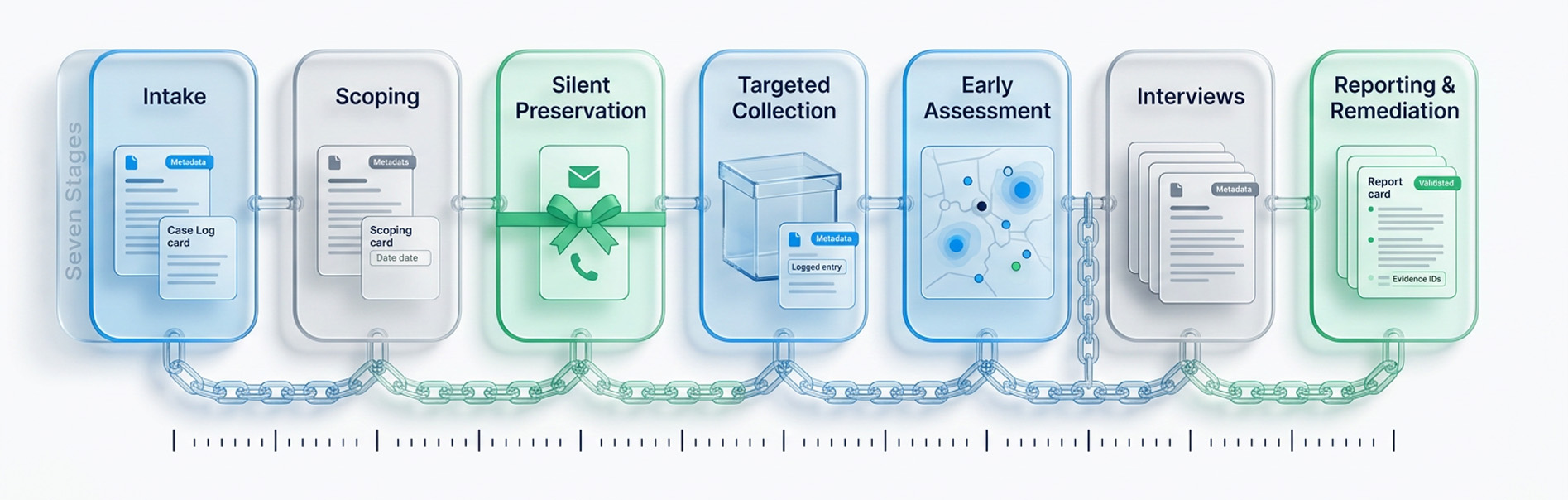
To conduct an internal investigation, move through seven stages: intake, scoping, preservation, collection, review, interviews, and reporting. Each stage feeds the next, and each has one mistake that quietly compromises everything after it.
- Intake and Triage: Log the allegation, assess credibility and severity, and decide whether a formal investigation is warranted. The failure point is delay, because the duty to preserve can attach before you feel ready. A dated decision record started today is worth more than a perfect one started next week.
- Scoping: Define the allegations, the custodians, the data sources, and the date range in writing. Scope creep is the failure point; every custodian added later widens the circle of people who know. Write the exclusions down too, because an undocumented exclusion reads as concealment later.
- Silent Preservation: Preserve the identified sources before anyone touches them, without notifying the subject. Retention policies and ephemeral messages do not pause for your investigation. This stage gets its own section below.
- Targeted Collection: Collect only what the scope defines, with chain of custody documented from the first byte. Over-collection slows review; under-collection forces a second pass that multiplies exposure. Personal devices add a consent layer, so get written authorization scoped to the matter first.
- Early Assessment: Cull and analyze before scheduling a single interview. Standard eDiscovery culling applies, driven by the allegation rather than by claims and defenses. Venio ECA runs this at ingestion, surfacing key people, events, and documents as processing completes. The map exists before anyone sits across a table.
- Interviews: Interview witnesses outward-in, ending with the subject, with documents sequenced for each session. A poorly run custodian interview can taint testimony or compromise privilege. You cannot recognize an evasive answer without the documents in hand.
- Reporting and Remediation: Document findings, decisions, and the basis for each, in a format that survives scrutiny. The failure point is treating the internal investigation report as an afterthought. It is the exhibit, as covered below.
The internal investigation process fails most often at the handoffs, when data moves between tools and teams. Running eDiscovery for internal investigations on one audited platform removes the handoffs entirely. The reason that matters more here than in litigation comes further down.
Preserving Without Tipping Anyone Off
The safest way to preserve evidence in an internal investigation is a silent, in-place hold. It suspends deletion at the system level without sending the custodian any notice.
A standard hold notice tells the custodian exactly what you are looking at. In an investigation, that notice can trigger the very deletion it exists to prevent. Silence is not a shortcut here. It is the defensible design.
Here is the part that catches teams off guard. The duty to preserve attaches when litigation becomes reasonably foreseeable. Courts have placed that moment well inside the internal phase. In Zubulake v. UBS Warburg, 220 F.R.D. 212 (S.D.N.Y. 2003), the duty attached months before any charge was filed. The matter was still an internal employment dispute at the time. Your investigation is often itself the evidence that litigation was foreseeable. The clock is running by the time you open the file.
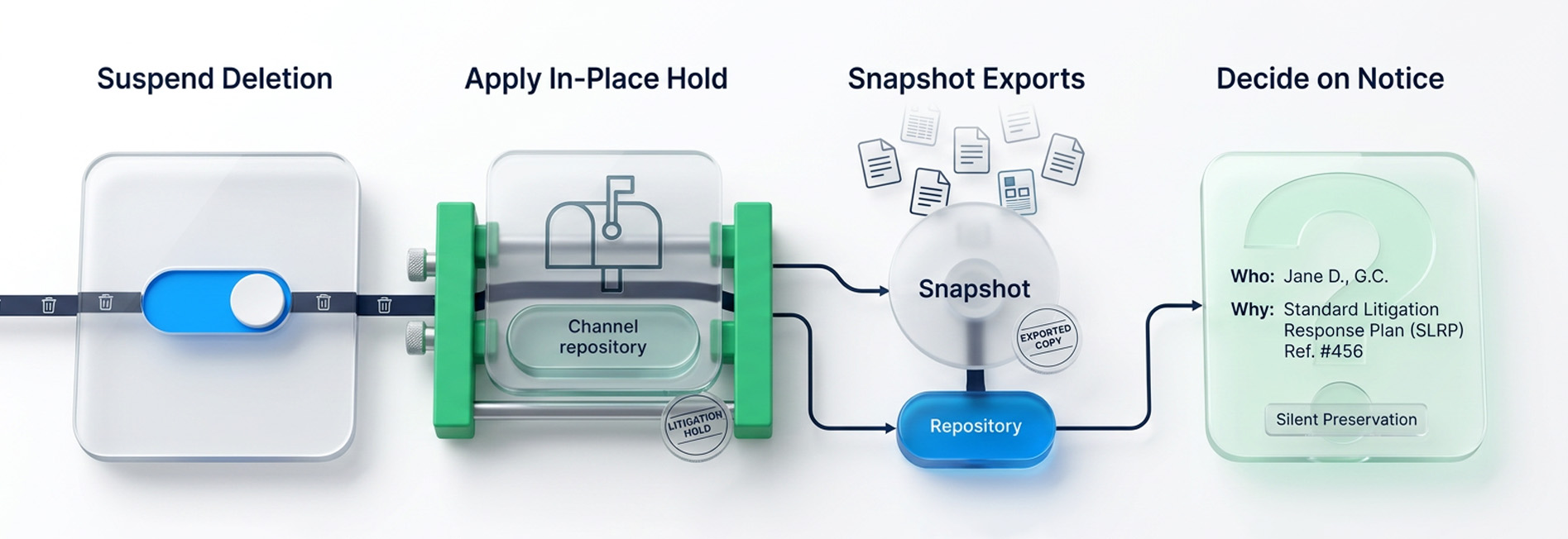
Work the preservation sequence in this order.
- Suspend Automated Deletion: Pause retention rules and auto-delete jobs for every in-scope source the day scoping ends. A 90-day purge cycle does not know your investigation exists.
- Apply In-Place Holds: Lock mailboxes, channels, and drives at the system level, silently, before any interviews begin.
- Snapshot What Cannot Be Held: Export sources that lack a hold capability before they change, and log the export.
- Decide on Notice Deliberately: Notify custodians only when silence stops being defensible, and record who made that call and why.
Two sources deserve particular paranoia. Chat platforms edit and delete continuously, and the hold mechanics differ by tool. Our guide to defensible legal holds for Slack and Teams walks through each one. Departing employees are the other risk. Standard IT offboarding wipes devices and deletes accounts on a schedule that ignores your matter. If the distinction between the obligations feels blurry, start with legal hold vs preservation vs collection.
If evidence that should have been preserved is lost, FRCP 37(e) governs what follows in the litigation. Prejudice invites curative measures, and a finding of intent invites severe sanctions. Venio Legal Hold automates preservation, tracking, and compliance across custodians, with an audit trail behind every action. The investigation workspace assigns roles and permissions per matter, so access stays as small as the matter list.
Your Investigation File Is the Exhibit
Everything written during an internal investigation should be written for an audience that includes opposing counsel. Privilege over investigation materials is real, but it is earned by structure, not granted by routing emails through legal.
Upjohn protects communications made so counsel can advise the company, and that protection reaches employees well below the executive floor. It does not convert scoping spreadsheets, IT tickets, and casual reviewer notes into protected material. Courts look at why a document was created, and an investigation generates hundreds of documents that exist for business reasons.
One structural choice does most of the protective work. Separate the factual findings from the legal advice, in two documents with two purposes. The factual report may end up produced or shared with a regulator. The advice memo, written by counsel for the company, is the piece privilege is built to protect.
Three further consequences land on the team running the data work.
- Interview notes and coding decisions stay on facts, never on fault, causation, or blame.
- Scoping decisions, search criteria, and exclusions get documented with dates while the work happens. Reconstructing them later from memory and email never survives scrutiny.
- Every finding in the internal investigation report cites its evidence by identifier. Our chain of custody example shows the custody trail doing the same job.
This is where a platform stops being a convenience. Venio keeps scoping decisions, search criteria, and coding rationale inside one audit trail. Its relevance classifications attach a per-document explanation to every tag applied. A regulator, a board, and a plaintiffs' firm will each ask you to justify those judgments, sometimes years later. A record that assembled itself as the work happened beats one rebuilt from eighteen months of email.
When the Investigation Becomes Litigation
Here is the cost nobody models at intake. The serious investigations do not end with the report. They end in a termination dispute, a regulatory referral, or the lawsuit the allegation predicted. The investigation dataset is now evidence.
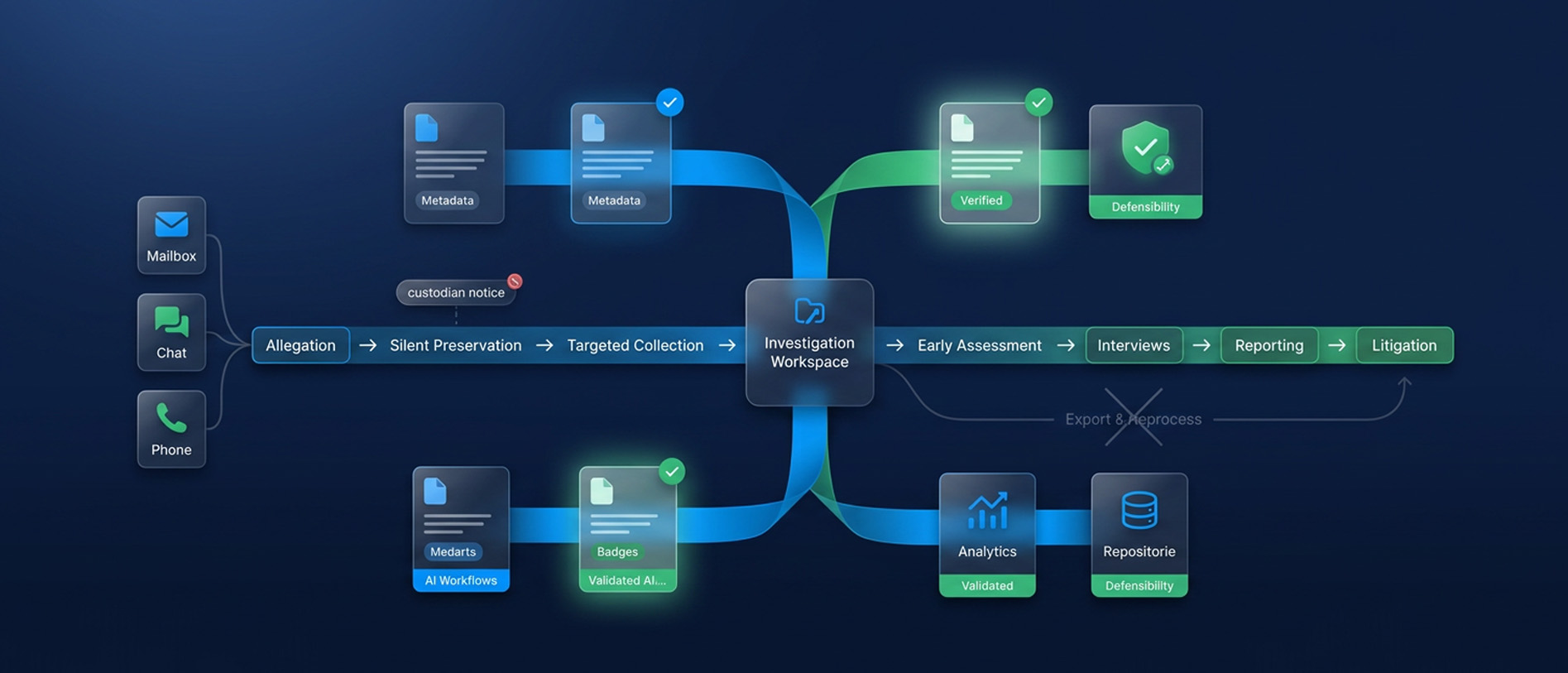
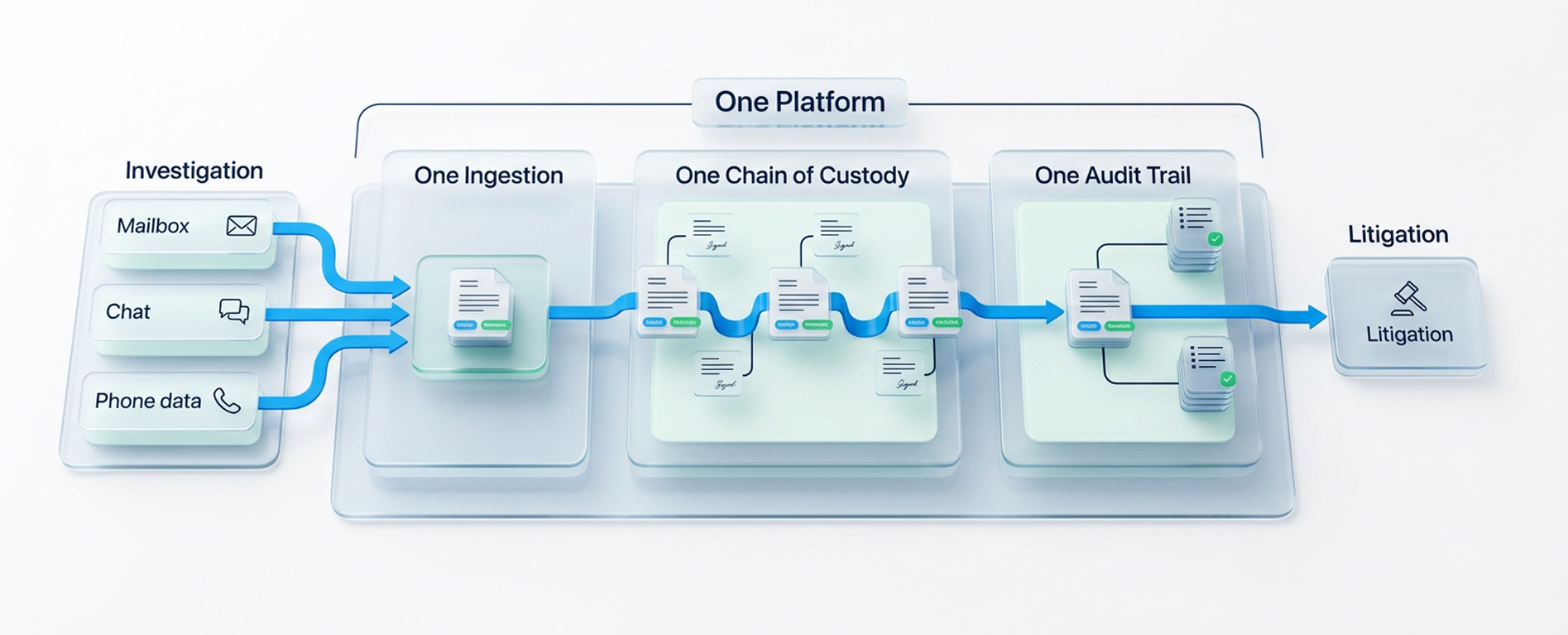
If the investigation ran in a standalone tool, that dataset gets exported and reprocessed in the litigation platform. The chain of custody now has a handoff in the middle, on a second contract. You pay processing twice on the same gigabytes and rebuild coding work that already exists. The legal hold attaches to an export instead of the environment where the work happened.
The alternative is to run the investigation in the platform the litigation will live in. One ingestion, one chain of custody, and one audit trail carry the matter from silent hold to production. Nothing is lost at a handoff, because there is no handoff.
There is a second reason platform choice is sharper here than anywhere else in eDiscovery. Investigation data is the most sensitive data the company holds: executive mailboxes, HR complaints, and sometimes a whistleblower's identity. Plenty of organizations cannot place that in shared cloud infrastructure, for regulatory reasons or their own security posture. Venio runs the same platform across cloud, on-premises, or hybrid deployment from a single codebase. Where this matter's data sits becomes a configuration decision. Most platforms competing for investigation work are cloud-only, which turns that question into a dealbreaker rather than a setting.
Image: Investigation-to-litigation data journey: one ingestion, one chain of custody, and one audit trail carrying data from investigation through litigation.
A Five-Person Circle and 40 GB of Slack
Put it together. A harassment complaint names a regional manager. The relevant data spans two mailboxes, one Slack workspace export, and one company phone, roughly 40 GB. The board wants findings in three weeks, and nobody outside a five-person circle can know the matter exists.
Day one, before anyone is interviewed, retention rules pause and silent holds go on every source. The phone is collected the same week under a written protocol. A mid-matter resignation would otherwise put it on the offboarding wipe schedule. Forensic collection with hash verification takes two days and produces a custody record that never needs explaining.
Email threading does more work here than on a typical matter. Internal mailboxes are dense with chains repeating the same content forty times over. Culling and classification shrink the review population before a human reads anything. The review that remains confirms flagged hits instead of reading 40 GB linearly. By day five, analytics have mapped who messaged whom, when, and how often. The interview list writes itself from that map instead of from guesswork. Interviews start in week two, outward-in, subject last, with documents sequenced per session. The report cites evidence identifiers for every finding, and remediation gets logged with owners and dates.
Two traps sit in this scenario, and neither is volume. The first is interviewing before the documents are assessed, which burns your one clean shot at each witness. The second is adding custodians casually mid-matter, which is how a five-person circle becomes a fifteen-person rumor.
Where Venio Fits in an Investigation
Investigation readiness and litigation readiness are the same muscle. The teams that keep matters quiet already know their data map, custodians, and duty to preserve. When something goes wrong, they run the investigation on the same rails the litigation will use.
Venio's investigation workspace runs silent preservation, early case assessment, document review, and reporting end to end. Intelligent filtering and pattern detection surface communication patterns, timelines, and hidden connections across the dataset. Role-based permissions restrict the matter to the people on the matter list, and activity tracking logs every action. The whole trail carries through unchanged if the matter becomes litigation.
Better still, learn what your current stack does with 40 GB and a five-person circle before finding out live. If an allegation is on your desk right now, Book a Demo and walk it through with our team.
Frequently Asked Questions
What is an internal investigation?
An internal investigation is a confidential, structured inquiry a company conducts into suspected misconduct within its own organization. It establishes facts through documents, data, and interviews before the company decides on discipline, remediation, or disclosure. In the workplace, the same structure applies to harassment, discrimination, retaliation, and policy violations.
What are the steps in the internal investigation process?
The internal investigation process runs seven steps: intake, written scoping, silent preservation, targeted collection, early assessment, interviews, and reporting. Most internal investigation best practices compress into one habit behind those steps. Decide in advance, then document as you go.
How long do internal investigations take?
There is no fixed timeline. A contained single-custodian matter can close in weeks, while regulatory-facing matters run months. Every open week widens the circle of people who know, so review speed doubles as a confidentiality control.
Can you investigate an employee without telling them?
You generally can during the fact-finding phase, and often you should, because notice can trigger deletion. Preservation can run silently through in-place system holds. Whether and when to notify is a judgment for counsel. Document that decision with a date and a rationale.
When does the duty to preserve begin?
The duty begins when litigation becomes reasonably foreseeable, which is frequently the moment a credible allegation arrives. In Zubulake, the duty attached while the dispute was still internal, months before any external filing. Preserve first and debate the trigger afterward; the reverse order is how spoliation happens.
Can an eDiscovery platform run an internal investigation?
Yes, provided it supports silent preservation, per-matter access control, and a complete audit trail. Running the investigation in the platform the follow-on litigation will use avoids processing the dataset twice. It also keeps one chain of custody across both matters.
Related Articles
eDiscovery Data Analytics & Visualization for Trial Preparation
Most litigation teams don’t lose at trial because they lack evidence. They lose
Read Article
What to Ask in an eDiscovery Demo Before You Sign
Twenty questions that make an eDiscovery vendor prove processing, AI, security a
Read Article
Consolidating Your eDiscovery Stack Without Disrupting Active Matters
How to consolidate eDiscovery tools without disrupting live matters, and why a f
Read Article