eDiscovery Training: How to Start and Get Certified

Ready to get started?
built for clarity, control, and scale.
Share
The demand for eDiscovery training has never been greater. With civil litigation on the rise and digital data volumes exploding, the global eDiscovery market is projected to grow at a CAGR of 10.7% from 2024 to 2030. Legal teams, corporations, and compliance professionals are under mounting pressure to make electronic information discoverable, defensible, and ready for courtroom use.

This growing demand has created new opportunities for those pursuing eDiscovery certification. Organizations increasingly rely on certified eDiscovery specialists, professionals trained to collect, organize, and present electronically stored information (ESI) while staying compliant with federal regulations and court procedures.
In this article, we’ll explore why formal eDiscovery certification programs matter, the value they bring to legal teams, and how to get started. We’ll also highlight some of the best eDiscovery certifications available today to help you take the next step in your career.
How to Pursue eDiscovery Certification
You might be wondering why eDiscovery training wasn’t a bigger part of your education or early career. The reason is simple: electronic discovery is still a relatively new field. The term itself was first introduced in the 2006 amendments to the Federal Rules of Civil Procedure (FRCP), and since then, the demand for expertise has grown rapidly.
While law schools are gradually integrating eDiscovery certification programs, many are still in the early stages of offering structured courses. As a result, most aspiring professionals turn to private organizations and industry groups for practical training and the best eDiscovery certifications.
Whether you’re entering the legal industry for the first time or working within an established firm, pursuing a certified eDiscovery specialist credential can be a game-changer. Not only does it build credibility, but it also ensures you and your team stay aligned with the latest practices, tools, and even the best eDiscovery software used in the field.
Why eDiscovery Training and Certification Is Important
There’s no legal requirement mandating professionals to complete eDiscovery training or pursue eDiscovery certification. However, doing so comes with clear advantages that can set you apart in the legal industry. Here’s why it matters:
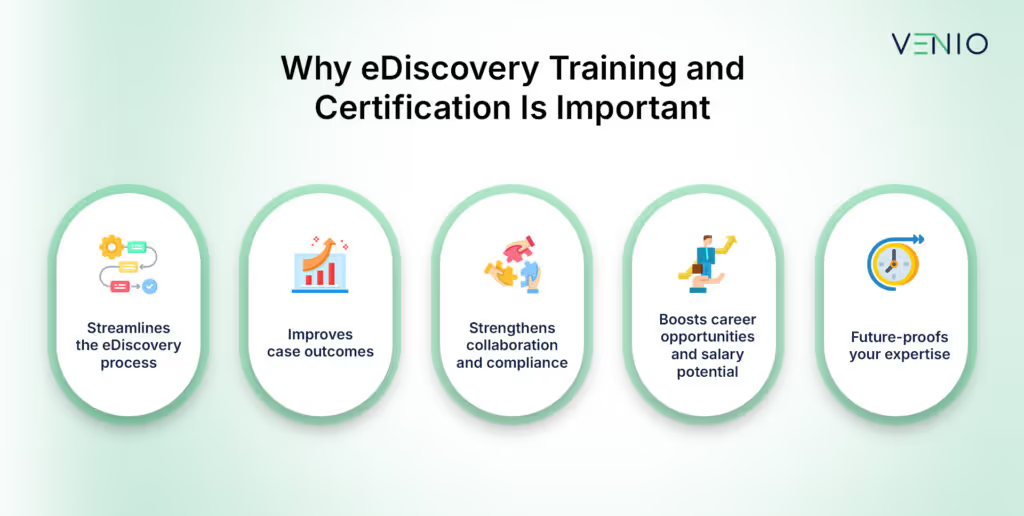
1. Streamlines the eDiscovery process
Certified professionals can move faster through each stage of the eDiscovery lifecycle, from data identification and collection to eDiscovery data processing and production. This efficiency is critical when responding to litigation deadlines.
2. Improves case outcomes
Electronic information often makes or breaks a case. Having the right eDiscovery certification programs under your belt ensures you know how to handle evidence defensibly, giving your team a stronger chance of winning.
3. Strengthens collaboration and compliance
A certified eDiscovery specialist brings consistency to workflows, making it easier for legal, compliance, and IT teams to stay aligned. This helps avoid costly mistakes while staying compliant with federal regulations.
4. Boosts career opportunities and salary potential
With demand for eDiscovery certification growing, professionals who hold the best eDiscovery certifications often command higher salaries and better career prospects, especially in litigation-heavy practices.
5. Future-proofs your expertise
As data volumes and technologies evolve, eDiscovery training ensures you remain ahead of industry trends, tools, and even the best eDiscovery software, keeping your skills relevant long-term.
How to Become a Certified eDiscovery Specialist
Thinking about pursuing a career in eDiscovery? Getting started can feel overwhelming, but breaking it into steps makes the process manageable. Here’s a practical roadmap to becoming a certified eDiscovery specialist:
1. Define Your Goals
- Before diving in, think about what eDiscovery training means for you.
- Are you looking to strengthen your current role in litigation support? Or do you see yourself transitioning into a dedicated eDiscovery position?
- Knowing your goals will help you choose the right eDiscovery certification programs that align with your career path.
2. Research Certification Programs
- Explore the best eDiscovery certifications offered by trusted organizations.
- Popular options include:
- The Certified E-Discovery Specialist (CEDS) credential by the Association of Certified E-Discovery Specialists.
- University-based certificate programs, like Cleveland-Marshall College of Law’s eDiscovery professional track.
- Training programs offered by professional associations such as the National Federation of Paralegal Associations (NFPA).
- The Certified E-Discovery Specialist (CEDS) credential by the Association of Certified E-Discovery Specialists.
- Compare requirements, costs, and formats (online vs. in-person) to find what fits your needs.
3. Commit to Training
- Certification isn’t just about passing a test, it’s about learning the eDiscovery process in real-world scenarios.
- Look for programs that include hands-on practice with eDiscovery software, covering areas like data collection, review workflows, and early case assessment.
- The more interactive the program, the stronger your foundation will be.
4. Stay Current with Industry Trends
- eDiscovery is constantly evolving, with new rules, tools, and best practices emerging regularly.
- After earning your certification, keep learning – attend workshops, follow legal tech updates, and explore the best eDiscovery software to stay competitive.
5. Build Experience Alongside Certification
- Pairing classroom knowledge with practical experience makes all the difference.
- Volunteer for eDiscovery projects at your firm, or seek internships that allow you to apply certification skills to live cases.
- This combination of training + hands-on exposure strengthens both expertise and career opportunities.
Top eDiscovery Certifications You Can Pursue

1. Certified E-Discovery Specialist (CEDS) — ACEDS
Offered by the Association of Certified E-Discovery Specialists (ACEDS), the CEDS certification is a globally recognized credential for eDiscovery professionals. The exam covers the full eDiscovery lifecycle, including areas such as legal hold, data processing, review, production, and international discovery ethics ACEDS+1.
- The exam includes 145 scenario-based, multiple-choice questions, developed by a panel of 40 expert practitioners under psychometric standards ACEDS.
- The certification is vendor-neutral, designed to objectively assess knowledge and skills across legal and technical domains ACEDS.
- Once achieved, CEDS holders join a global network and can recertify every two years by earning continuing education credits ACEDS+1.
2. Certified E-Discovery Practitioner (CEDP) — Cleveland-Marshall College of Law
The CEDP is an ABA-accredited professional certificate from Cleveland-Marshall College of Law. It blends theoretical knowledge with practical skill in management, technology, and legal aspects of eDiscovery Credly.
- The curriculum includes 30 hours of video-based training, covering analytics, project management, document workflows, and ESI concepts Credly.
- Candidates must pass assessments with a minimum 70% score and receive their certification and digital badge through Credly upon completion Credly.
3. eDiscovery Executive Certificate — ACEDS (eDEx)
ACEDS also offers the eDiscovery Executive Certificate (eDEx) – a self-paced, foundational course designed for legal professionals, paralegals, and IT specialists entering the eDiscovery field ACEDS.
- The certificate includes 12+ hours of online training, covering ethics, international discovery, data management, predictive coding, litigation holds, and other core topics ACEDS.
- Graduates earn a digital badge and ACEDS membership, helping them establish foundational knowledge of the entire eDiscovery process ACEDS.
4. eDiscovery Advanced Certificate (eDAdv) — ACEDS
For professionals who already understand the basics, ACEDS offers the eDiscovery Advanced Certificate (eDAdv). This course provides deeper exploration into practical eDiscovery delivery and advanced methodologies ACEDS.
- It includes 11 lecture modules, online self-study, and knowledge checks to reinforce learning ACEDS.
- Completion earns participants a certificate and a digital badge, signaling their advanced professionalism in managing comprehensive eDiscovery workflows ACEDS.
Ready to Put Your eDiscovery Training Into Practice?
Earning an eDiscovery certification is an excellent way to strengthen your expertise and stand out in today’s legal landscape. But training is only half the equation, the real impact comes from applying your skills with the right eDiscovery software.
That’s where Venio Systems comes in. Our unified eDiscovery platform empowers certified eDiscovery specialists and legal teams to streamline every stage of the process from early case assessment (ECA) to review and production with speed, accuracy, and defensibility.
Whether you’re just starting your journey or are a seasoned professional, pairing your eDiscovery training with Venio ensures you can put your certification to work effectively in real-world litigation.
Explore how Venio can enhance your eDiscovery workflow today.
FAQs About eDiscovery Training & Certification
What is the Cost of the CEDS Exam?
The Certified E-Discovery Specialist (CEDS) exam typically costs around $995 to $1,495, depending on membership status with the Association of Certified E-Discovery Specialists (ACEDS). The fee usually covers the application, study materials, and the exam itself. Always check the official ACEDS site for the latest pricing.
Which is the Best eDiscovery Software?
The best eDiscovery software depends on the organization’s needs. Leading platforms are those that combine end-to-end eDiscovery solutions from data processing to review and production while ensuring compliance, speed, and cost efficiency.
What Are the Key eDiscovery Trends for 2025?
By 2025, eDiscovery trends are expected to focus on:
- AI and automation for faster data review.
- Growing reliance on cloud-based eDiscovery software for scalability.
- Stronger emphasis on data privacy and compliance (GDPR, CCPA, HIPAA).
- Expanded use of advanced analytics to improve early case assessment.
- Increased demand for certified eDiscovery specialists to handle complex litigation.
Related Articles
What is eDiscovery Software?
In a world where business communication is overwhelmingly digital, these trails
Read Article
4 Proven Ways to Control eDiscovery Costs in Any Legal Case
eDiscovery continues to rank among the top cost drivers for legal departments,
Read Article
Discovery Objections: A Comprehensive List and How to Succeed
During the discovery process, an attorney attempts to obtain
Read Article