Data Breach Investigation: What Your eDiscovery Playbook Misses
Ready to get started?
built for clarity, control, and scale.
Share
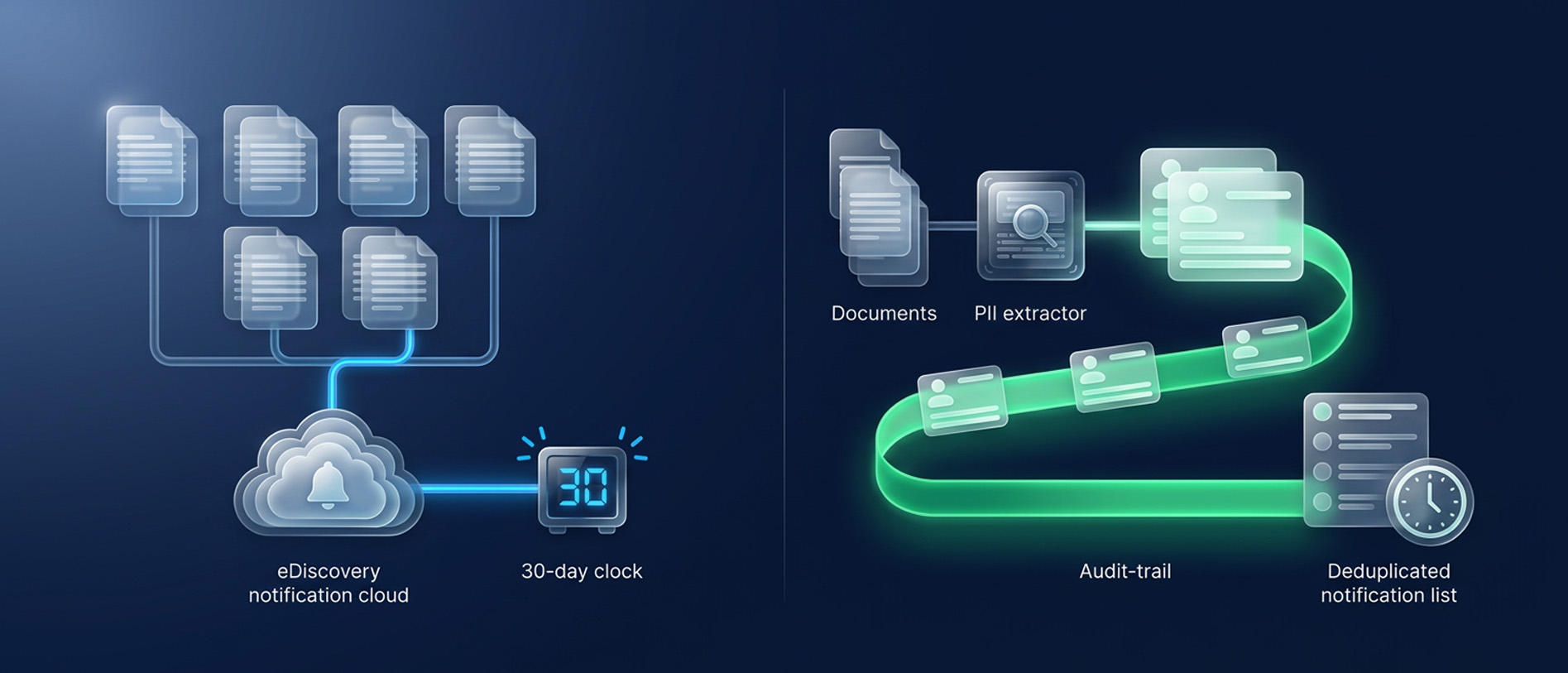
In a litigation review the unit of work is the document, and in a breach review it is the person. That sounds like a technicality, but it explains why breach reviews miss deadlines and overrun budgets. It is also why they quietly enlarge the lawsuit that arrives a few months later.
Once the question shifts from responsiveness to whose data a document holds, familiar habits behave differently. Families, deduplication, search terms and the definition of finished all move in ways your playbook does not anticipate. Your team still knows how to review at volume, but the target has changed underneath it.
You have 30 days to get this right, and that deadline comes from statute rather than a scheduling order. The list you publish at the end is the same list a plaintiffs' firm will work from. Every name on it that did not belong there is a person the class action can count.
Why Breach Review Breaks Your Playbook
A data breach investigation asks whether a document contained personal information and whose it was. A litigation review asks whether a document is responsive and privileged. That single difference reorders almost every downstream decision.
The clearest way to see it is side by side.
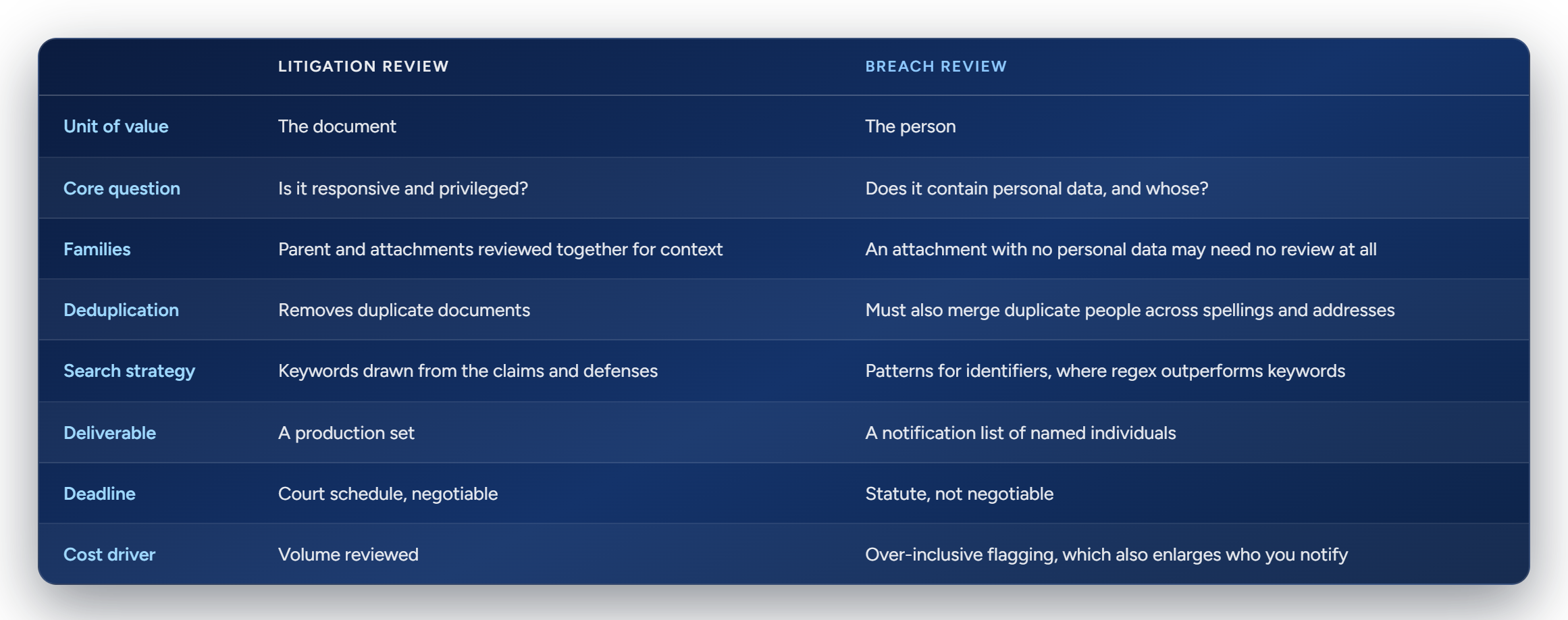
Read the last row twice, because it is the one that turns into money later.
Cyber-native vendors make a fair criticism of eDiscovery tooling here. Search logic tuned for responsiveness over-flags on breach data, pushing large volumes of clean documents into a review that is already racing a deadline. They are right about the symptom. Their conclusion, that you should move the work to a separate platform, creates a different problem covered further down.
What Is PII and How It Differs From PHI
PII, or personally identifiable information, is any data that identifies a specific person, either on its own or when combined with something else. PHI, protected health information, is the narrower category of health data held by a HIPAA covered entity or business associate.
The PII vs PHI distinction is not academic on a breach matter. Every piece of PHI is PII, and the reverse is not true. A dataset holding both triggers two compliance analyses on two different deadlines against one review population.
State statutes also define the covered set differently, and several have widened it recently to include biometric data and government identifiers. That is why the notification analysis depends on where each affected person lives, not on where your company is incorporated.
Settling what is PII for this specific dataset is the first real decision of the investigation. Define it too broadly and you inflate the population you notify, which is a mistake that gets expensive further down this page.
How a Data Breach Investigation Runs
A data breach investigation has two halves. Forensics establishes how the intrusion happened, and review establishes who was affected. The review half, sometimes called post-breach data mining, runs in four stages.
1. Scoping to the Confirmed Intrusion Window
The date range comes from the window forensics confirms, not from a complaint. This is the single highest-leverage decision on the matter, and the most common place teams lose money by moving too early. Standard eDiscovery culling techniques apply, driven by exposure rather than by claims and defenses.
2. PII and PHI Identification
Pattern matching and entity extraction locate identifiers across the surviving set. Classification handles the first pass, reviewers confirm hits, and poor scans fall back on OCR. Precision at this stage is not a quality metric. It decides how many people end up on the list.
3. Entity Consolidation
This stage has no eDiscovery equivalent, and it is where timelines slip. Every extracted data element has to attach to a real person, and every duplicate version of that person has to merge into one record. A payroll file, an email signature and a scanned intake form may all point to one individual under three spellings.
4. The Breach Notification Letter
The output is a deduplicated list of affected individuals, the specific data elements exposed for each, and their state or country of residence. The breach notification letter is then drafted against that mapping, because content requirements differ by jurisdiction. Several states dictate what the breach notification letter must say and when the attorney general receives a copy.
State Data Breach Notification Laws
State data breach notification laws set the clock, and there is no single federal deadline sitting above them. Data breach notification requirements attach under the law of every jurisdiction where an affected person lives, which means you plan to the shortest clock in the set.
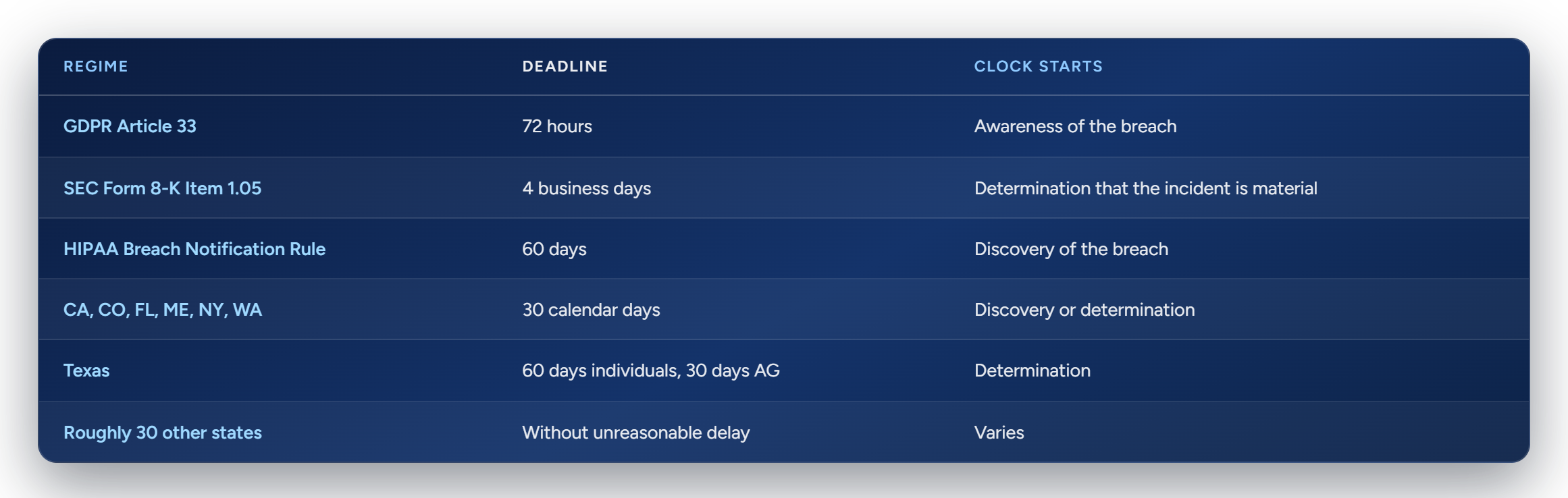
As of January 2026, California, Colorado, Florida, Maine, New York and Washington all run 30 calendar day deadlines. Around twenty states set a fixed number and the rest use a without unreasonable delay standard, which offers less comfort than it sounds like. The 50-state survey from Privacy Rights Clearinghouse tracks the current spread, and the HIPAA Breach Notification Rule governs the health side.
A national employer with one exposed HR database is planning to 30 days. Hold that against your own intake and processing times. On plenty of litigation matters, 30 days does not get you to first-pass review. Data breach compliance here is not a scheduling problem you can solve with overtime. The work has to be compressed at the front end or the deadline is already gone.
This is the first place platform choice shows up as a timeline decision rather than a procurement one. Venio ECA culls the compromised population before review starts, and Early Case Intelligence runs at ingestion rather than as a separate project, surfacing key people, events and documents as soon as processing completes. On a 30-day clock, the difference between insight at ingestion and insight after a manual assessment pass is most of your remaining runway.
Your Notification List Is the Class List
The notification letter is not the end of the matter. It is the recruitment document for the next one.
A data breach class action commonly follows within weeks of letters going out, because the notice tells plaintiffs’ counsel exactly how many people were affected and what was exposed. Most states publish attorney general filings on searchable portals, so a data breach lawsuit is often built from that public record rather than from a client walking through the door. The number you certify becomes the number in the complaint, and the population you notified becomes the putative class.
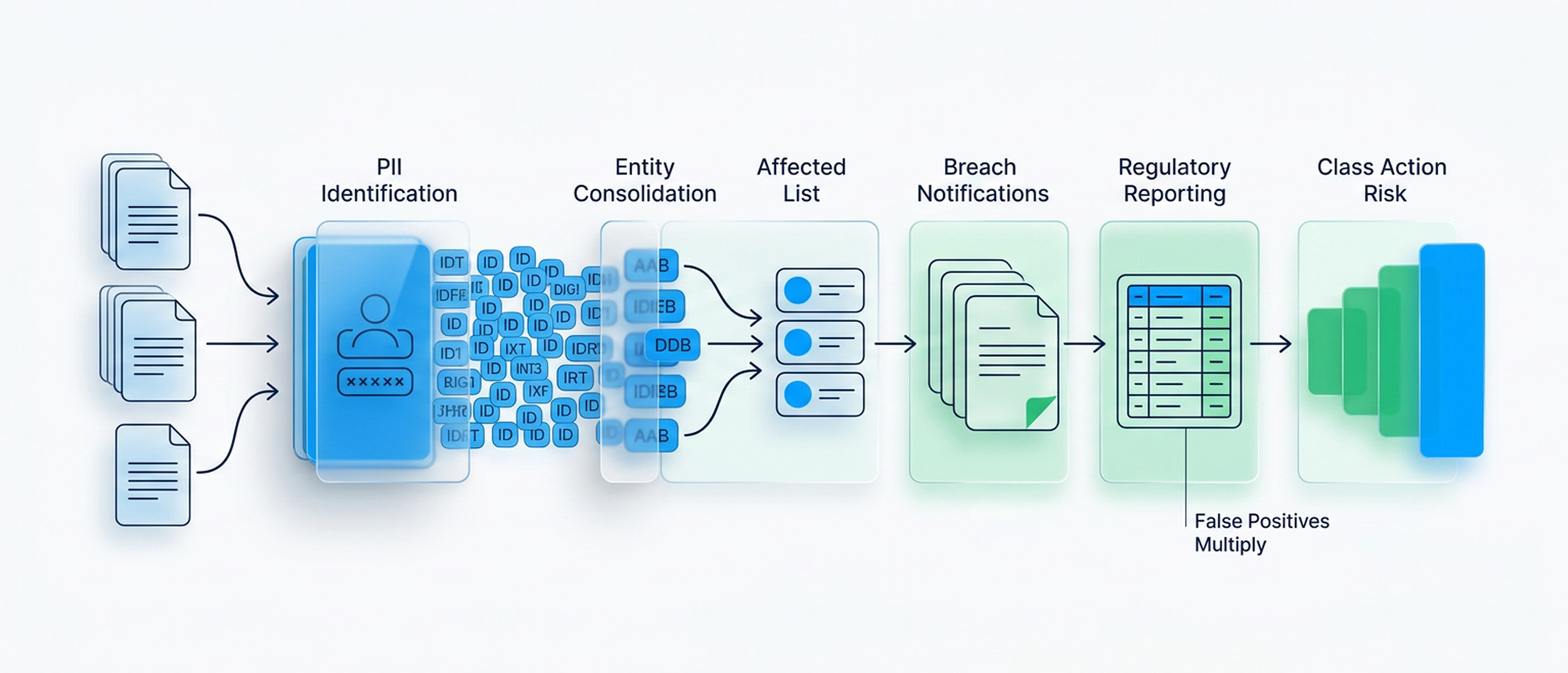
Now go back to that last row in the comparison table. An over-inclusive PII review does not just cost more per document. It puts people on the notification list whose data was never actually exposed, and every one of them is a person the class action can count.
That reframes precision entirely. In a litigation review, a false positive costs you a reviewer’s time. In a breach review, a false positive costs you a reviewer’s time, a notification letter, a credit monitoring enrolment, and a named member of the class suing you. The same imprecision is charged four times.
It also cuts the other way, and this is the tension nobody resolves for you. Under-notify and you face regulatory exposure and a second round of letters that reads as concealment. The only defensible position is a review that is accurate rather than conservative, which is precisely what a keyword-driven, over-flagging workflow cannot deliver.
This is where purpose-built classification stops being a convenience. Venio’s AI-powered PII identification and extraction runs in the Review module once ingestion completes, flagging personal information across the document set so the review starts from a map instead of a manual hunt. Relevance classification attaches a per-document explanation to every tag it applies. On a breach matter that explanation is not a nice-to-have, because the scoping decisions behind your notified population are the ones a regulator and a plaintiffs’ firm will both ask you to justify.
Where Privilege Quietly Breaks
Routing the investigation through counsel does not automatically protect the work product. Courts have said so repeatedly.
In re Capital One Consumer Data Security Breach Litigation (E.D. Va. 2020) held a forensic report discoverable despite counsel’s involvement. Wengui v. Clark Hill, PLC (D.D.C. 2021) reached the same result even though the firm argued it had run a two-track investigation. In re Rutter’s (M.D. Pa. 2021) followed both.
The reasoning is consistent. If the report would have been created anyway for business and remediation purposes, privilege is hard to sustain. A two-track structure is not a label applied afterwards. It has to be real, and the record has to show it.
Three consequences land on the review team rather than on counsel.
- The forensic track and the litigation track need separate vendors, scopes and deliverables, documented while the work happens rather than reconstructed later.
- Review notes and coding decisions should stay on the notification question and off causation, fault or what should have been patched.
- Everything written during the review should be written for an audience that includes opposing counsel in the follow-on data breach litigation.
The engagement structure is not your call. The record is, because your team generates most of it. A platform that keeps scoping decisions, search criteria and coding rationale inside one audit trail is the difference between producing a defensible record in the data breach litigation that follows and reassembling one from email eighteen months later.
The Second Ingestion Nobody Budgets For
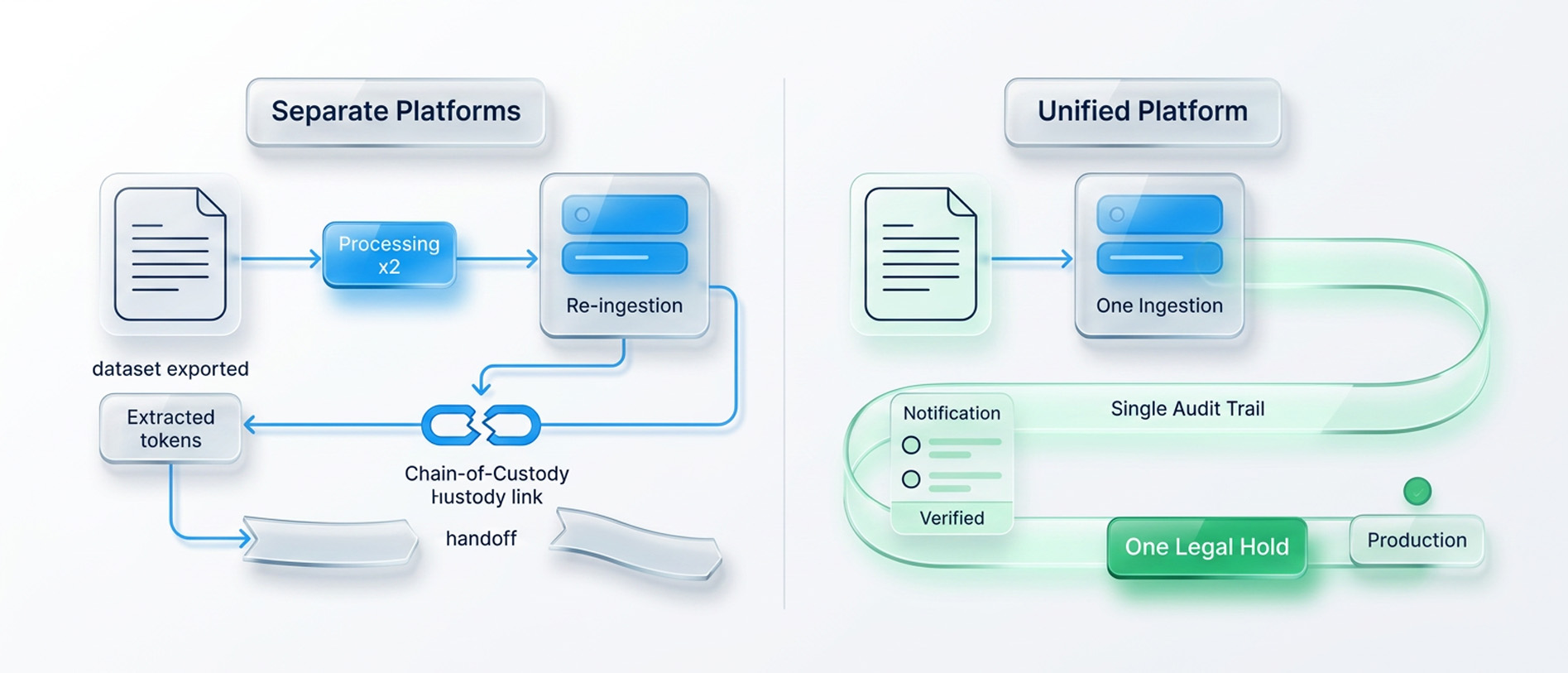
Here is the cost nobody models at the start of an incident. The same dataset gets processed twice.
The breach review runs first, usually in a cyber-native platform, billed against the incident response budget or the cyber policy. Then the class action arrives, and that dataset is now evidence in litigation. It gets exported, re-ingested and reprocessed in a different platform, on a different contract, with a chain of custody that now has a handoff in the middle of it.
You pay processing twice on the same gigabytes. You rebuild search and coding work that already exists. And the two environments disagree, because the breach review codes for personal data while the data breach litigation review codes for responsiveness, so nothing transfers cleanly except the raw files.
The alternative is to run the breach review in the platform the litigation will live in. That means one ingestion, one chain of custody, one audit trail from the notification list through to production, and a legal hold that attaches to the same environment rather than to an export of it.
There is a second reason this matters on breach data specifically. A compromised dataset is live, unredacted personal information, and some organizations cannot put it in shared cloud infrastructure while an incident is active, whether for regulatory reasons, insurance reasons or their own security posture. Venio runs the same platform on cloud, on-premises or hybrid deployment from a single codebase, so where the data sits is a configuration decision rather than a vendor change. Most of the platforms competing for this work are cloud-only, which makes that question a dealbreaker rather than a setting.
A 30-Day Clock and 400 GB of Mail
Put it together. Four compromised mailboxes, roughly 400 GB, an intrusion window of eleven days confirmed by forensics, and affected individuals in California, Colorado and Texas.
Your controlling deadline is 30 days. The 60 days Texas allows for individual notice is irrelevant to your plan.
Scoping narrows to the eleven-day window plus attachments, then strips system files, newsletters and marketing mail. Classification flags documents carrying identifiers, and reviewers confirm hits rather than reading everything, working attachment-first wherever attachments hold structured data such as payroll or claims files. Entity consolidation then collapses tens of thousands of extracted records into a much smaller list of unique individuals.
Email threading does more work here than on a typical matter, because compromised mailboxes are dense with internal chains that repeat the same content forty times over. One thread reviewed once is the difference between a review that fits and one that does not.
Two traps sit in this scenario, and neither is volume. The first is starting review before forensics confirms the window, which drags in documents the threat actor never touched and that you then pay to review. The second is accepting a broad classification pass to save time, which quietly adds people to the list you will be sued over.
Where Venio Fits in Breach Response
Breach readiness and litigation readiness are the same muscle. The teams that survive a 30-day window already know their data map, their custodians and their duty to preserve before anything goes wrong, and they handle the privacy request workload that follows on the same rails.
Venio runs early case assessment, document review, AI PII identification, redaction and production on one platform, deployed in cloud, on-premises or hybrid. One ingestion carries the compromised dataset from the notification list through to the class action, with the scoping decisions and coding rationale on a single audit trail the whole way.
If you are working a live incident, or you want to know what your current stack would do with 400 GB and a 30-day clock before you find out the hard way, Book a Demo and walk a breach population through the workflow with our team.
Frequently Asked Questions
What is a data breach investigation?
It is the process of examining a compromised dataset to establish what was exposed, whose personal information it was, and what must be disclosed. Forensics answers how the breach happened. Review answers who was affected and produce the notification list.
What is PII, and how is it different from PHI?
PII is any information that identifies a specific person, alone or combined with other data, such as a name paired with a Social Security number, financial account number or date of birth. PHI is health information held by a HIPAA covered entity or business associate. All PHI is PII, but most PII is not PHI, and the two carry different notification deadlines.
How is a data breach investigation different from eDiscovery?
eDiscovery reviews documents for responsiveness and privilege and produces a document set. Breach review searches for personal data and produces a list of people. Family review, deduplication and search-term strategy all work differently, and over-inclusive flagging carries a liability cost that has no litigation equivalent.
How long do you have to notify people after a data breach?
It depends on jurisdiction. GDPR requires notice to a supervisory authority within 72 hours. HIPAA allows up to 60 days from discovery. California, Colorado, Florida, Maine, New York and Washington set 30 calendar days, so multi-state incidents are planned to a 30-day deadline. Public companies also file a Form 8-K under Item 1.05 within four business days of a materiality determination.
Does a data breach lead to a lawsuit?
Frequently. Notification letters and public attorney general filings tell plaintiffs’ counsel how many people were affected and what was exposed, and a data breach class action is often filed within weeks. Preservation obligations usually attach before the letters go out, so the compromised environment should be held rather than released.
Is a post-breach forensic report protected by privilege?
Not automatically. Several courts have ordered forensic reports produced where the report would have been created for business or remediation reasons regardless of litigation. A two-track investigation can help, but only when it is genuinely implemented and documented as it happens.
Can an eDiscovery platform handle a breach review?
Yes, provided the protocol is rebuilt for the task and the classification is precise rather than broad. Running it in the platform the follow-on litigation will use also avoids processing the same dataset twice and keeps one chain of custody across both matters.
What goes in a breach notification letter?
Requirements vary by state. Most statutes ask for a description of the incident, the categories of information involved, the date or date range, what the organization is doing in response, and what recipients can do to protect themselves. Several states also require a copy to the attorney general above a resident threshold.
Do state data breach notification laws override each other?
No. They apply in parallel. An incident affecting residents of several states triggers each state’s data breach notification requirements independently, so compliance is set by the shortest deadline and the strictest content rules in the affected set.
Related Articles
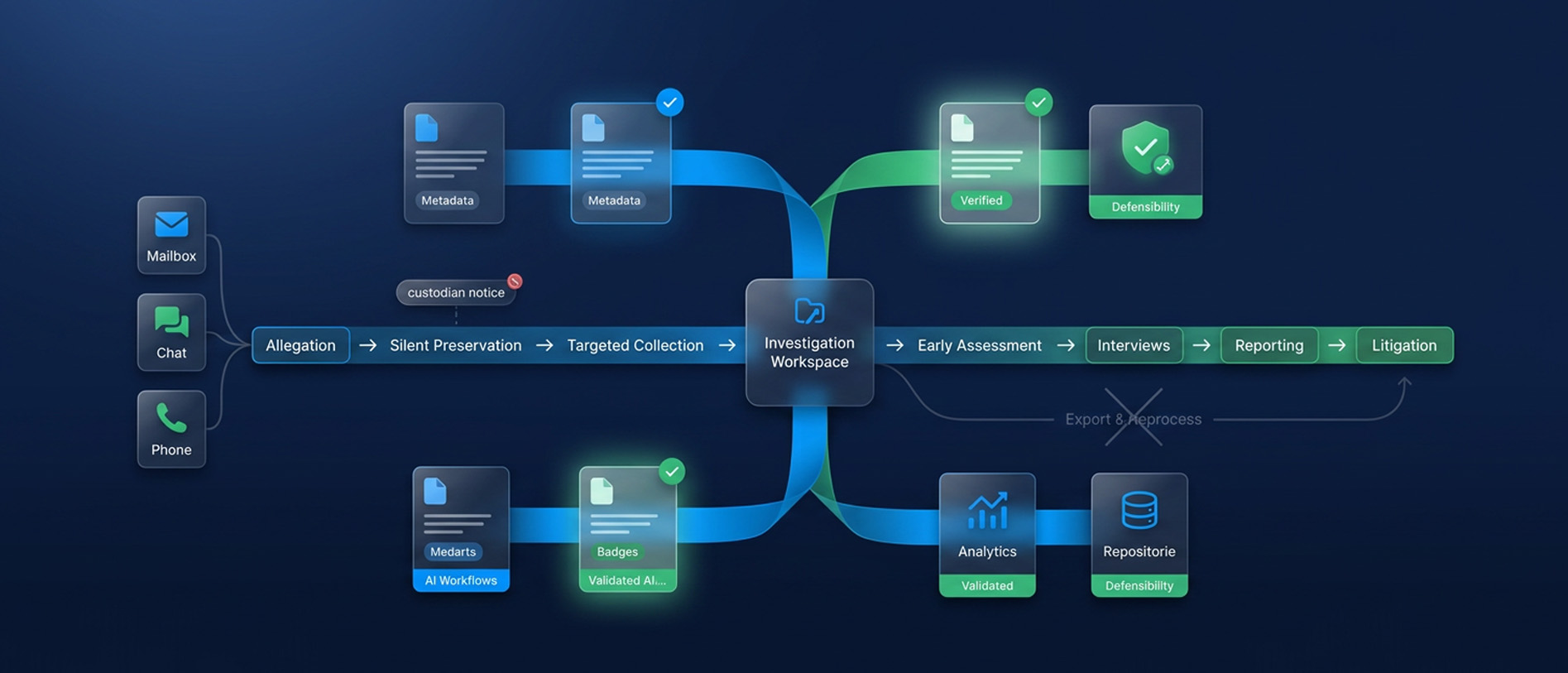
Internal Investigations: Getting the Facts Without Blowing the Matter Open
An internal investigation offers no court schedule and no second chance at prese
Read Article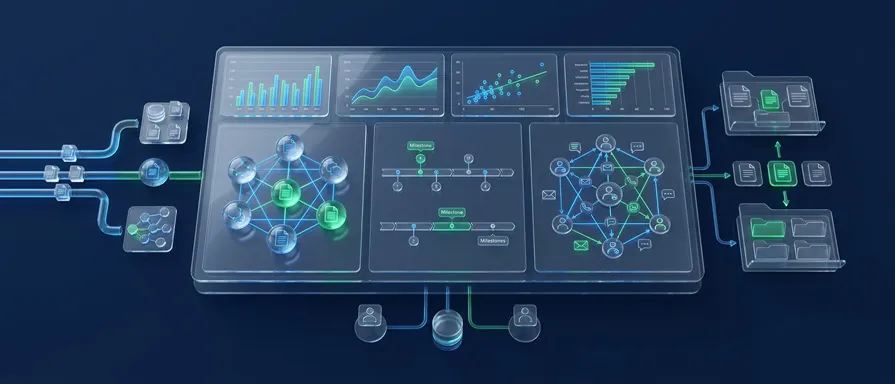
eDiscovery Data Analytics & Visualization for Trial Preparation
Most litigation teams don’t lose at trial because they lack evidence. They lose
Read Article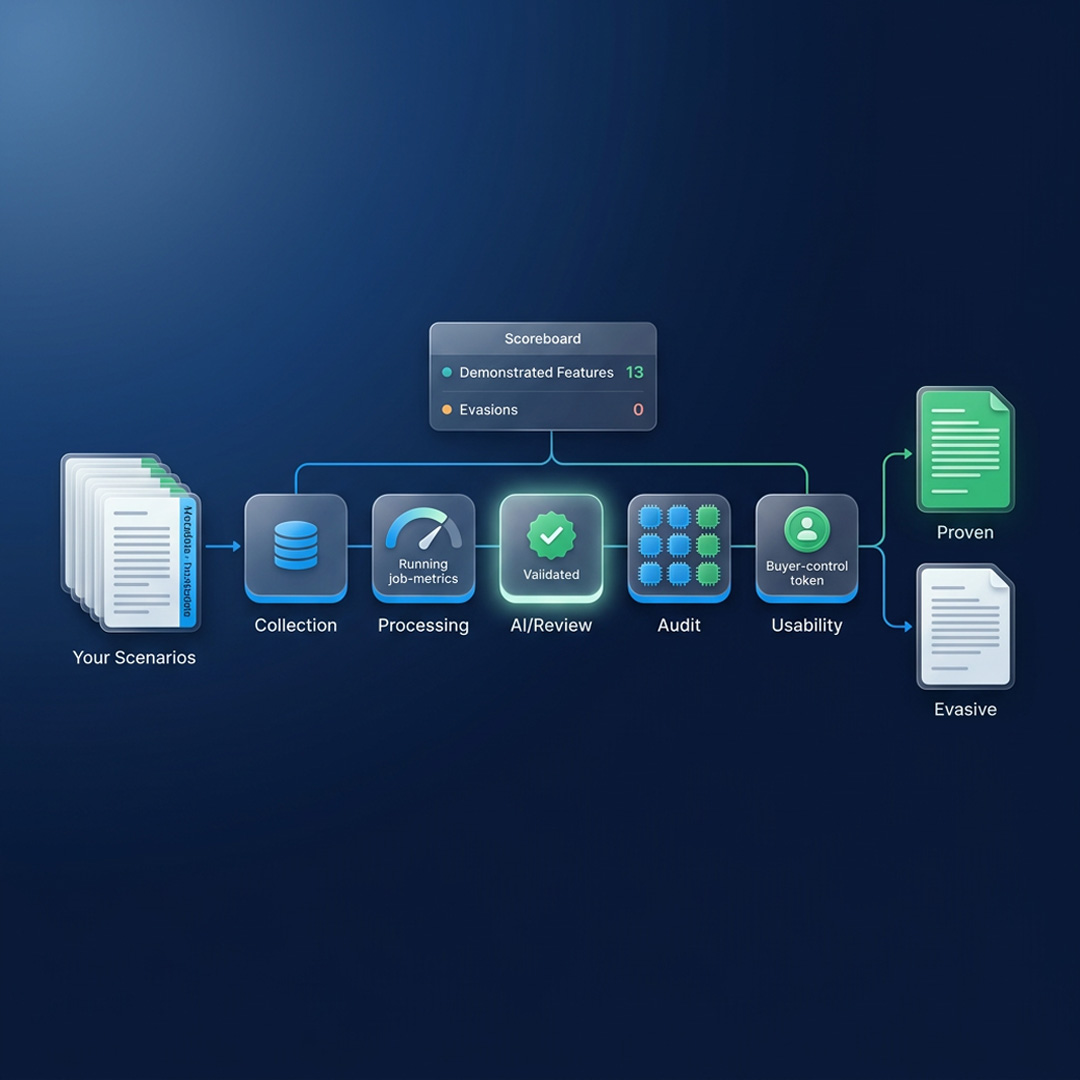
What to Ask in an eDiscovery Demo Before You Sign
Twenty questions that make an eDiscovery vendor prove processing, AI, security a
Read Article