Data Sovereignty vs Data Residency in eDiscovery

Ready to get started?
built for clarity, control, and scale.
Share
Every eDiscovery evaluation produces a document saying where your data will be stored. Almost none produce one saying who can reach it. The distance between those two documents is the distance between data residency and data sovereignty, and it is wider than most contracts suggest.
The practical question behind data sovereignty vs data residency is how many of those documents you actually need. Matter data lives in six places during a case, a hosting commitment covers one of them, and the other five rarely come up unless somebody asks for them by name.
This blog gives you the distinction in simple terms, then the six questions that close the gap and the evidence to request against each one. By the end you will have a set of questions for any platform vendor, a standard for judging the answers, and a clear view of which deployment model fits the data sovereignty compliance obligations you carry.
Data Sovereignty vs Data Residency
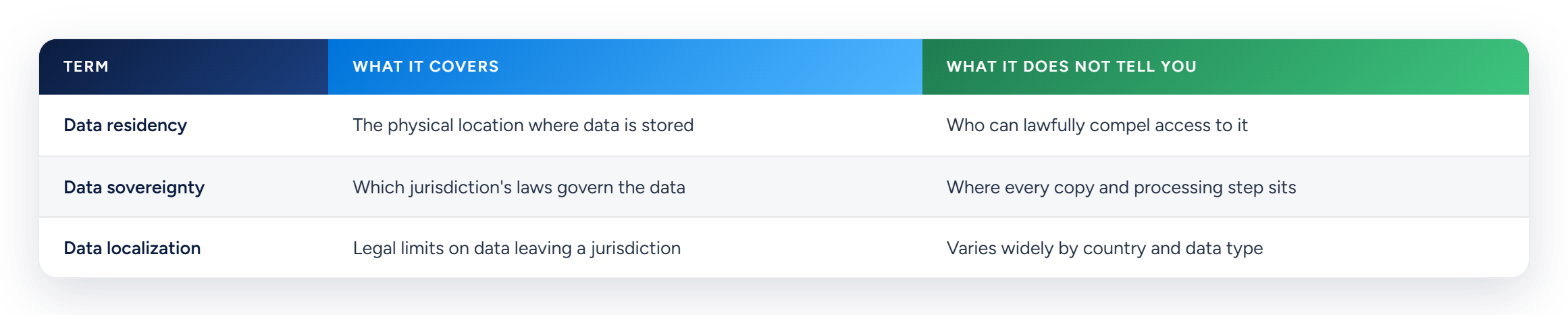
Data residency is where your data is physically stored. Data sovereignty is which country's laws govern that data and who can lawfully compel access to it. The two frequently align, and they are not the same guarantee, which is why a hosting commitment satisfies some obligations and leaves others untouched.
Data sovereignty vs data residency matters most when the two come apart. Data can sit on a server in one country while the entity controlling that server answers to the courts of another, and a residency commitment on its own tells you nothing about that second relationship.
The Third Term Buyers Run Into
Data localization sits alongside the other two and gets flattened into the idea that data cannot leave the country, which is accurate for some regimes and misleading for most. Localization requirements run across a range, from an obligation to retain a copy inside the country while permitting transfer, through sector specific restrictions on particular data categories, to genuine prohibition on export.
For a discovery team, that range is the whole point. A requirement to keep a local copy is an architecture question your platform can answer, while a genuine export prohibition changes what is reviewable and where, and that needs to surface during evaluation rather than during a live matter.
Where Your Data Goes After Storage
A hosting location answers one of six questions your obligations will eventually put to you. The other five concern processing, access, backups, third parties, and what happens to the data when you leave, and none of them is settled by naming a region.
The legal reason is worth stating precisely, because it is widely repeated in a form that overstates it. Under the US CLOUD Act, a covered provider must respond to lawful government demands for information within its possession, custody, or control, irrespective of where that information is stored. The obligation attaches to the provider relationship rather than to the server location, which is why storage geography alone does not resolve the question.
What this does not mean is that regional hosting is pointless or that a provider with a US parent is automatically noncompliant. Regional hosting satisfies genuine data residency requirements, supports transfer rules, and often matters to clients contractually. It simply answers a narrower question than most buyers assume, and the remaining five need their own answers.
The practical consequence is that data sovereignty requirements and data residency requirements get written into the same contract clause and then verified as though they were one thing. Providers are investing heavily in regional structures, and AWS launched its European Sovereign Cloud with a dedicated region in Germany in January 2026, but no amount of market investment tells you how your particular platform handles your matter data.
Where Does Matter Data Actually Go
Matter data is stored, processed, accessed, backed up, passed to subprocessors, and finally exported or deleted. Hosting covers the first of those six, and a worked example shows what the other five look like in practice.
Consider a company running an internal investigation with custodians in Germany and the United States. The platform is hosted in a German region, which satisfies the residency commitment written into the client's data processing agreement. Review runs from a team in two countries, analytics processing routes to a shared cluster, nightly backups replicate to a second region for resilience, and a translation subprocessor touches a subset of documents. Five of the six control points sit outside the one commitment anybody verified.
Six Questions to Ask Your Vendor
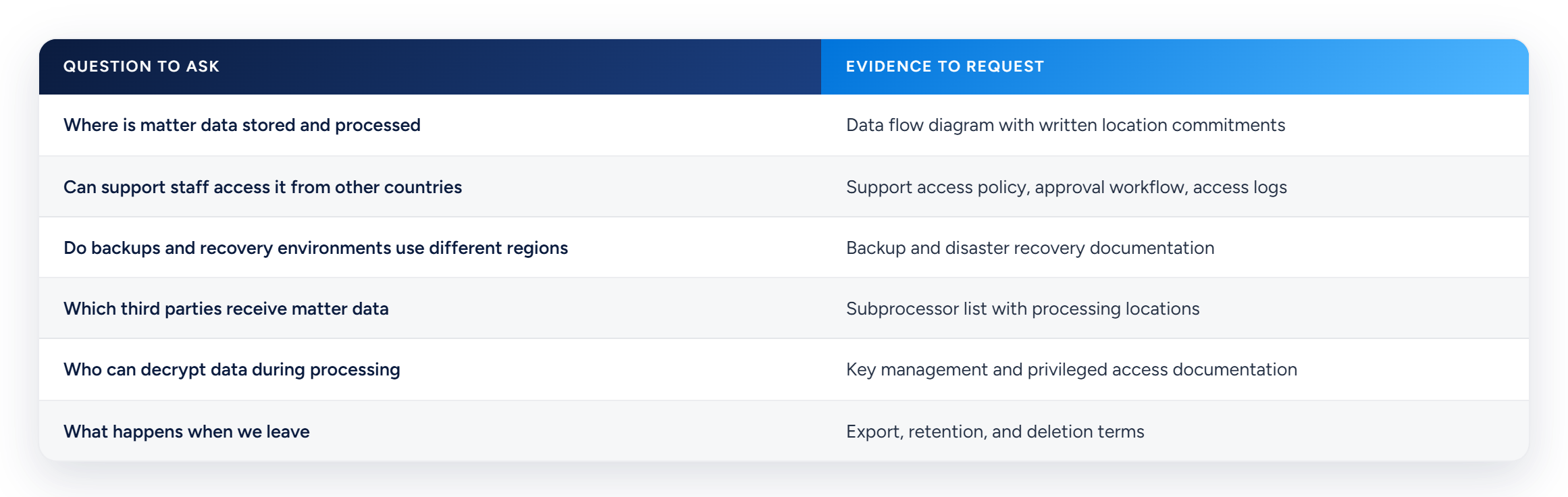
Each of the six control points converts into a question, and each question has a document behind it. Asking the question gets you a position, and requesting the evidence gets you something you can put in front of your own compliance team.
Start by writing down the data sovereignty requirements you actually carry, since those determine which answers are acceptable. A GDPR transfer obligation, a client contractual commitment, a sector regulator's expectation, and a government contract requirement all produce different thresholds, and vendors cannot guess which applies to you. This is also the point where eDiscovery managers and IT security need to be in the same conversation, because the answers land across both remits.
What Counts as a Sufficient Answer
Two things separate a useful response from a reassuring one.
Commitment Versus Control: A contractual promise that data stays in a region and a technical control that prevents it leaving are different things, and they are often presented in the same sentence. Ask which of the two you are being offered, because the first is enforceable after the fact while the second prevents the event.
Sufficiency Versus Disclosure: Vendors routinely share security documentation under an NDA, through a trust portal, or in redacted form, and that is normal practice rather than evasion. The test is whether what you receive lets you evaluate your specific requirement, so if a redacted document still answers your question, it has done its job.
Run this early. These questions reshape a shortlist, and discovering at contract stage that a platform cannot meet your data sovereignty compliance obligations is an expensive way to learn it. The same logic applies to the broader set of proof points worth demanding before signing, which the Venio guide on what to ask in an eDiscovery demo covers in detail.
Evaluating Deployment Options
Deployment model determines how many of the six questions you answer yourself rather than relying on a vendor to answer for you. That is the practical lens for choosing one, and it is more useful than comparing the models on cost or setup speed alone.
1. On Premises
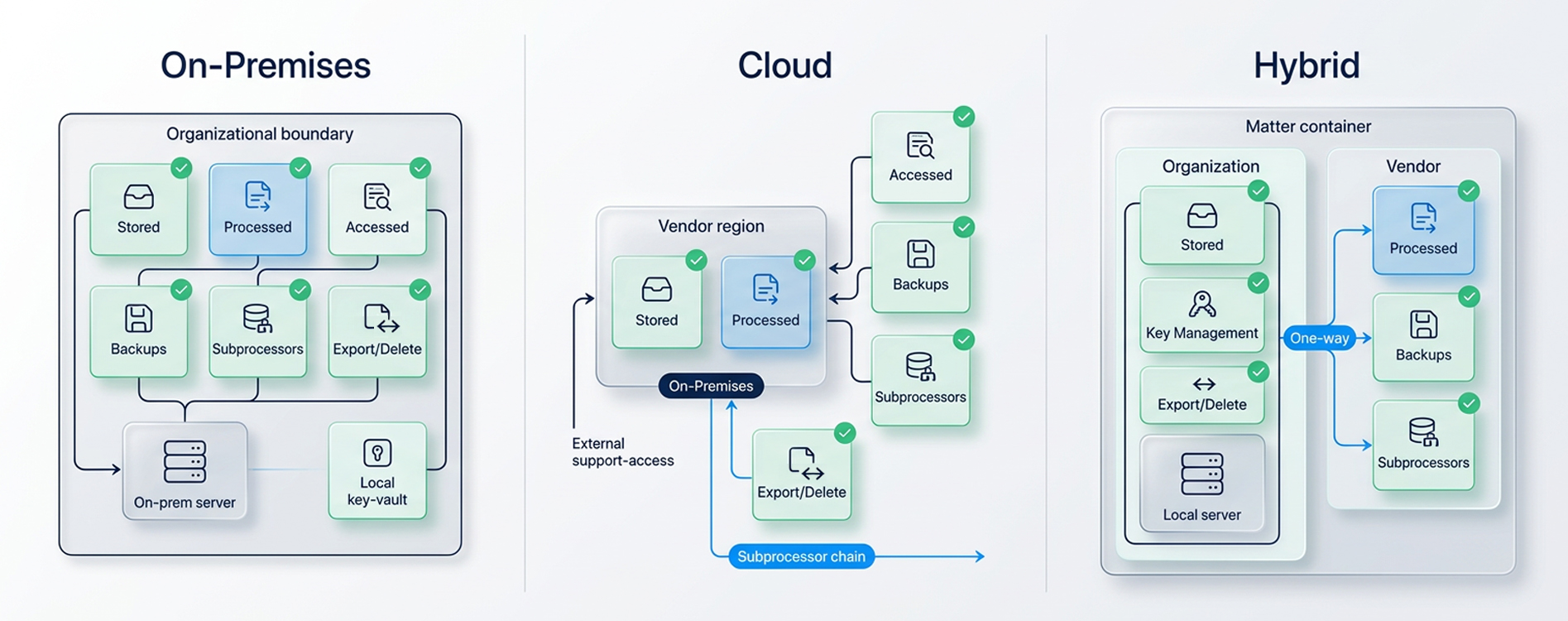
The platform runs behind your firewall on your infrastructure, so storage, processing, access, backups, and keys all sit inside your control. You answer the six questions from your own documentation rather than requesting anyone else's, which is why on premises deployment is the common choice for government agencies, law enforcement, and financial institutions. The trade is that your IT team carries the infrastructure, and implementation typically runs four to six weeks rather than days.
2. Cloud
The vendor manages the infrastructure and you gain speed and elasticity, with data residency control handled on a regional basis. The six questions still apply and you are asking rather than answering them, which makes the evidence trail more important rather than less. Cloud deployment suits distributed review teams and matters that need to start immediately, and a single tenant environment is worth specifying so your data is never commingled with another client's. Cloud data sovereignty rests on the quality of those six answers rather than on the region label alone.
3. Hybrid
Sensitive matters stay on your own infrastructure while high volume work bursts into the cloud, managed from one platform. Hybrid deployment lets you set the control level per matter rather than once for the whole portfolio, which fits organisations whose obligations genuinely differ across their caseload.
The mistake worth avoiding is treating cloud data sovereignty as a single setting you select at purchase. It is a set of six answers, and the deployment model changes who provides them rather than removing the need for them. The Venio deployment decision guide works through the criteria that separate the three models if you are weighing them against your own data sovereignty requirements.
Where Venio Lands on the Six
Venio is built so those six answers exist in every deployment model. The same code base runs on premises, in the cloud, and across hybrid environments, and the platform is SOC 2 Type II certified and GDPR compliant, with encryption at rest and in transit, role based access controls, multi factor authentication, and audit trails covering every action.
On premises keeps every byte inside your own infrastructure, cloud offers dedicated single tenant environments with region based data residency control, and hybrid lets you set the level per matter. On the sixth question, when a matter closes you decide whether to delete, export, or retain, with audit trails recording the action either way, which is the kind of eDiscovery data security evidence that belongs in the contract rather than the renewal conversation.
Evidence Instead of Assurance
The useful answer to that later question is not a better hosting line. It is six answers with documentation behind each one, and a deployment model chosen because it fits your obligations rather than because it was the default. Our broader view on where control sits across the discovery lifecycle is set out in the Venio guide to data sovereignty in eDiscovery, and the deployment options overview compares the three models side by side.
Bring your residency obligations, your access requirements, and the questions your security review has started raising, and we will walk through how each one is handled across on premises, cloud, and hybrid. Book a Demo and we will work through your six answers together.
Frequently Asked Questions
What Is the Difference Between Data Sovereignty and Data Residency?
Data residency is the physical location where data is stored, while data sovereignty is the question of which jurisdiction's laws govern that data and who can compel access to it. A vendor can meet a residency commitment by hosting in a named region, and that commitment on its own does not settle the sovereignty question, which depends on the provider relationship as well as the storage location.
Does Hosting Data in the EU Make Us GDPR Compliant?
Regional hosting supports several GDPR obligations and does not satisfy all of them on its own. Transfer rules, access controls, subprocessor disclosure, and retention and deletion terms each carry separate requirements, so a hosting location answers part of the picture while the rest needs its own evidence from the vendor.
What Are Data Residency Requirements in eDiscovery?
Data residency requirements are obligations that specify where matter data must be stored and processed, arising from privacy regulation, sector rules, client contracts, or government mandates. They sit alongside data sovereignty requirements, which govern whose law applies and who can compel access, and in a discovery context both apply across the lifecycle rather than at storage alone.
Can We Meet Data Sovereignty Compliance Using a Cloud Platform?
Yes, provided the platform gives you regional control and the documentation to evidence it. Cloud data sovereignty rests on how the vendor handles storage, processing, access, backups, subprocessors, and exit, so ask for each of those in writing and confirm whether a dedicated single tenant environment is available for your matters.
Which Deployment Model Gives the Most Control?
On premises gives the most direct control, because the platform runs on your own infrastructure and your team answers every question from its own documentation. Cloud and hybrid shift some of those answers to the vendor in exchange for speed and elasticity, which is a reasonable trade when the evidence behind the answers is solid.
What Should We Ask About eDiscovery Data Security During Evaluation?
Ask who can decrypt matter data during processing, which countries support and engineering staff connect from, and how access is logged and reviewed. Strong eDiscovery data security shows up as documentation rather than assurance, so request the key management policy, the support access workflow, and a sample of the audit trail.
What Happens to Our Data When the Matter Closes?
That depends entirely on the contract, which is why export, retention, and deletion terms belong in the evaluation rather than the renewal. Confirm the export format, the timeline, any associated cost, and how deletion is evidenced, since a platform that is difficult to leave becomes a sovereignty problem of its own over time.
Related Articles
From Testing to Trusted: The Open Questions on AI in eDiscovery
Where is AI used, who checks its work, do legal holds cover AI data, and is it p
Read Article
Legal Workflow Automation for Faster eDiscovery
Reduce discovery delays with legal workflow automation. Clarify ownership, resol
Read Article
A Buyer’s Guide to Government eDiscovery Security
Evaluate government eDiscovery security requirements, FedRAMP 20x and NIST contr
Read Article