How to Preserve Ephemeral Messaging in eDiscovery
Ready to get started?
built for clarity, control, and scale.
Share
Most legal teams already have a legal hold process that works well on ordinary matters. You identify the custodians, issue the notice, track acknowledgments, and document every step. On paper, ephemeral messaging is just one more source on that list.
In practice, it rarely is. Every other source waits for you, because a mailbox sits on a server until somebody collects it. Ephemeral data leaves on a schedule that started before you knew a matter existed, while your hold notice still travels at the speed of drafting and legal review.
Ask Christopher Pable, who lost his own case in July 2025 before a jury heard a word of it. He had used Signal to discuss the events behind his claim against the Chicago Transit Authority. Those messages were gone by discovery, and the Seventh Circuit affirmed dismissal as a Rule 37(e)(2) sanction, plus over $149,000 against Pable and his attorney.
Cases like that get filed under bad faith, which is comforting and misleading. Most ephemeral data loss happens inside competent teams running reasonable processes, where the mechanism is arithmetic rather than misconduct. When your evidence expires on a timer, a defensible process is not simply thorough. It is fast enough to arrive before the deletion does.
What Is Ephemeral Messaging
Ephemeral messaging is communication built to delete itself automatically, without user action, after a set interval. The trigger may also be an event, such as the recipient opening it.
That definition carries real legal weight, because the law cares a great deal about who did what. A person deleting a message has taken an act, while an ephemeral message expiring is simply a setting that nobody touched.
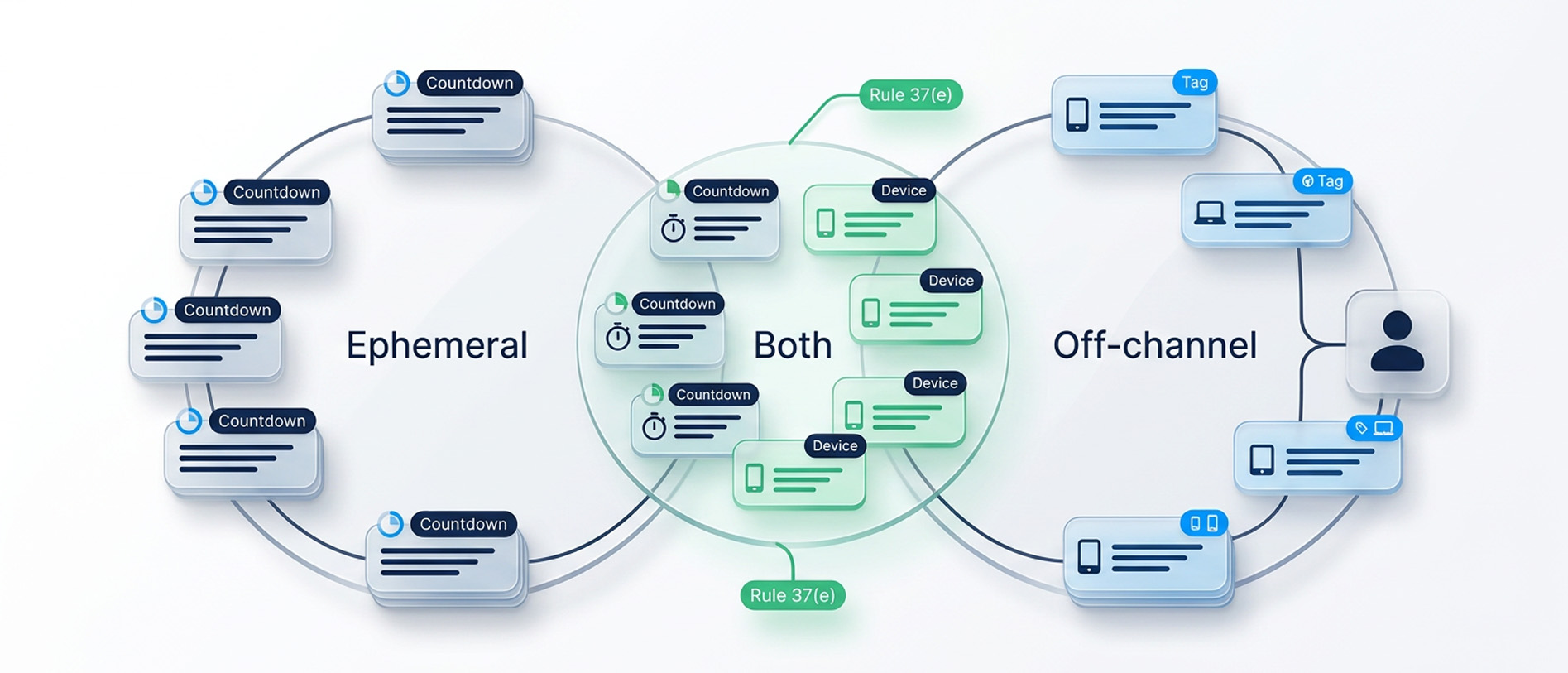
Rule 37(e) treats those two situations differently, and your workflow should draw the same distinction. The rule asks first whether reasonable steps were taken to preserve the information, not whether the loss was technically avoidable.
Two terms get used interchangeably in this area, and keeping them apart will save you an argument later. Ephemeral data describes how information behaves, meaning that it deletes itself on a schedule. Off-channel communications describe where information travels, meaning outside the approved and archived systems your organization controls.
A WhatsApp thread on a sales director’s personal phone is both at once, which is why it causes so much trouble. A Teams channel with disappearing messages enabled is only the first of the two. The distinction matters because each raises a separate obligation of its own. The preservation framework both sit inside is covered in our guide to ESI and legal hold.
1. Map What Is Disappearing
You cannot preserve a source you have not identified, and ephemeral sources rarely announce themselves during scoping. This is where most preservation failures quietly begin, long before anyone realises there is a problem.
Separate the Three Ways Data Expires
Not all ephemeral data behaves the same way, and those differences change what you can realistically still recover. Sorting your sources into these three categories tells you where preservation is still possible and where the window has already closed.
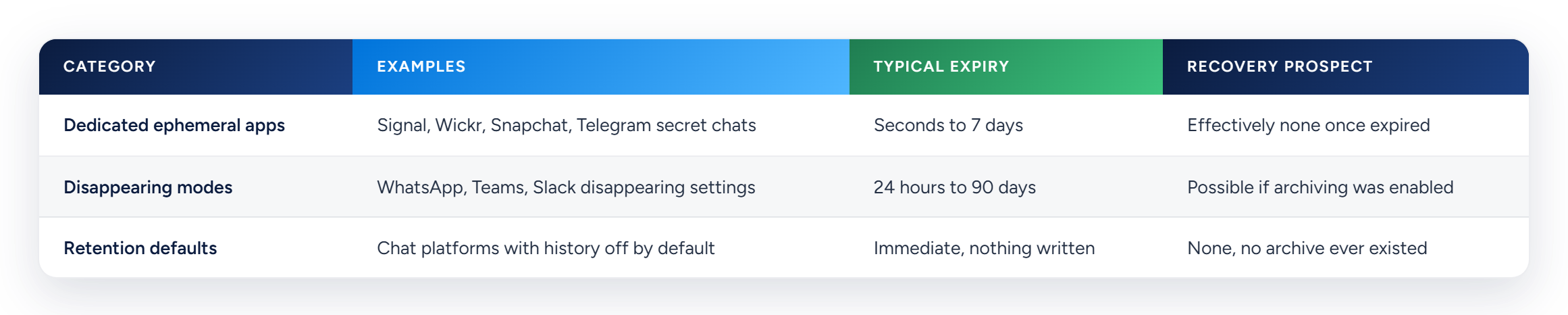
The third category causes the most damage, and it is also the hardest to explain to a court. There is no app to point at and no bad actor to blame, only a default setting that quietly guarantees nothing survives.
Capture Retention Settings at Notice Time
The custodian is usually the only reliable source for what a given app on their phone is actually set to do. An admin console shows you the organizational policy rather than the individual override sitting underneath it.
Most legal hold processes ask custodians to confirm receipt and stop there. Very few ask which apps auto-delete and on what interval, at the exact moment the notice lands in the inbox.
That question belongs in the hold itself, not in a custodian interview three weeks later. A hold platform with built-in custodian questionnaires captures the answer while the data still exists. Our guide to running a custodian interview covers how to probe those answers further.
Treat Personal Accounts as In Scope
Off-channel communications live on devices your organization does not own and cannot directly control. That fact does not remove them from discovery, however inconvenient the arrangement becomes in practice.
The controlling question is one of possession, custody, or control over the information itself. That turns on your policies and employment agreements rather than on who happened to pay for the phone.
2. Close the Timing Gap
The gap between when a preservation duty attaches and when preservation actually takes effect is where ephemeral data disappears. Lay your own two clocks side by side and the problem becomes hard to miss.
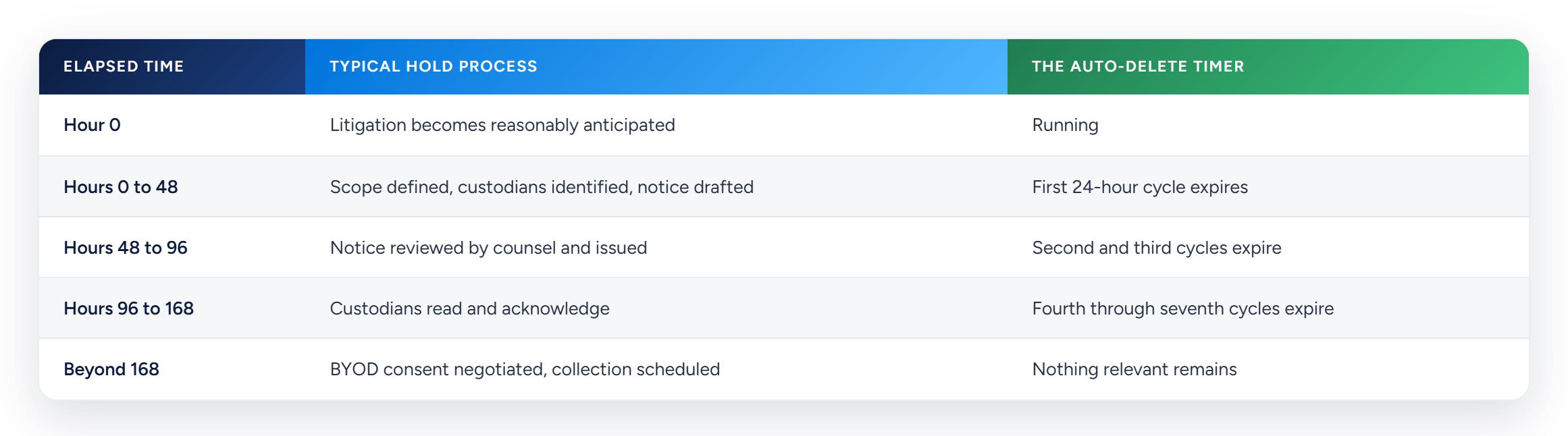
Measure Your Time to First Notice
Most teams have never actually measured this number, and it is the single most predictive metric in ephemeral messaging eDiscovery. Work backward through your last three matters and calculate it properly, counting the hours from trigger to delivered notice rather than to draft notice. A draft still sitting in legal review preserves precisely nothing at all.
If that number sits above 48 hours, no downstream technology will recover what expired in the interval. Pre-approved notice templates and directory-synced custodian lists compress it, because both remove drafting from the critical path.
Write a Hold That Actually Preserves
A notice that tells custodians to preserve, without also telling them to disable auto-delete, does not actually stop the deletion from happening. This was the central failure in DR Distributors, LLC v. 21 Century Smoking, Inc. Judge Iain Johnston found that a hold failing to instruct disabling auto-delete is "not much of a litigation hold".
Defendants and their former counsel were both sanctioned under Rules 26(g) and 37 for that failure. The court expected the resulting fees and costs to exceed seven figures once everything was tallied.
Every hold notice touching modern communications should name the specific action required rather than gesturing at preservation generally. Tell custodians to disable disappearing messages, turn off automatic deletion, and continue using the channels they already use.
Send the Stop-Delete Instruction First
A formal hold notice needs legal review before it goes anywhere, and that review takes real time. A one-line instruction telling custodians to disable auto-delete needs nothing of the kind.
Send that instruction to your highest-risk custodians within hours, well ahead of the formal notice. It can be a text message, and in an ephemeral matter that is often exactly what it should be.
Then log that you sent it, with a timestamp and the list of recipients attached. That single log converts a later argument about intent into a documented reasonable step under Rule 37(e).
3. Solve BYOD Access in Parallel
BYOD eDiscovery is the work of preserving and collecting business communications from devices your organization does not own. It adds a legal delay on top of a technical one, and the two compounds.
Understand Why Consent Takes Weeks
You cannot imagine a device you do not own without either consent or a court order compelling it. Obtaining either one takes time that the auto-delete timer has no intention of giving you.
- Consent Negotiation: The custodian must agree to surrender a phone holding family photos, health data, and private messages.
- Scope Agreement: Counsel defines what gets collected and what gets filtered, sometimes with separate representation.
- Privacy Review: Employment and data protection constraints apply, and they vary by jurisdiction.
- Forensic Scheduling: A qualified examiner must be available, and the custodian surrenders the phone throughout.
Each of those four steps is entirely reasonable when you look at it alone. Taken together they routinely consume two to four weeks, which is the entire available window in mobile device eDiscovery.
Track Consent Alongside Acknowledgment
Acknowledgment tells you only that a custodian has read the notice you sent them. It tells you nothing at all about whether their device is actually reachable for collection.
For BYOD custodians those are two separate states, and only one of them is usually tracked anywhere. A dashboard showing acknowledged, pending, and declined across every custodian surfaces stalled consent on day two rather than in week three. Scope all of this in your ESI negotiation rather than in the collection room, and our ESI protocol checklist covers full device image versus targeted collection.
Preserve Partially Rather Than Not at All
Waiting for a clean forensic image is, more often than teams expect, exactly how they end up with nothing at all. For the highest-risk custodians, arrange same-day capture of the current threads even when the method is imperfect. Screenshots carrying metadata will always beat an empty collection and an explanation of why nothing exists.
Partial preservation also defeats a total-loss argument before the other side can make it. More practically, it changes the prejudice analysis under Rule 37(e)(1), which is the difference between a curative measure and something far worse.
4. Build a Record That Survives
Under Rule 37(e), the gap between a curative measure and a case-ending sanction is simply what you can prove. Assume every step you took will be read back to you in order.
Document Against the Reasonable Steps Standard
Assume the whole record will be read back to you in order, so build it to be read that way. Your preservation record should capture each of the following.
- Trigger Date and Basis: When the duty attached and what event created it.
- Ephemeral Exposure Identified: Which custodians used disappearing channels, and what each app was set to do.
- Instructions Issued: Every notice and stop-delete directive, with delivery timestamps.
- Custodian Response: Acknowledgment status, questionnaire answers, and consent status per device.
- Preservation Actions: What was captured, when, by whom, and by what method.
- Known Loss: Any data the custodian reported as already gone, recorded honestly.
That last item is uncomfortable to write down, and it is also the one you cannot afford to skip. In Pable, the shifting explanations ultimately did more damage than the underlying loss of the messages.
Keep One Audit Trail, Not Four
Many teams run holds in one tool, collection in another, and review in a third system entirely. Each of those produces its own log, in its own format, on its own timeline.
When the timing of every step gets questioned, you find yourself reconciling three exports under real deadline pressure. Gaps between your systems tend to read, to a court, as gaps in your diligence.
A unified platform keeps preservation, collection, and review on one record, so the timeline reconstructs itself. That is the same discipline behind the digital chain of custody.
Choosing a Workflow That Keeps Up
A preservation workflow built for mailboxes will not close a 24-hour window, however well documented that workflow happens to be. Use these questions to test whether your current process or platform can genuinely handle ephemeral data. They are worth asking of any vendor you happen to be evaluating, including us.
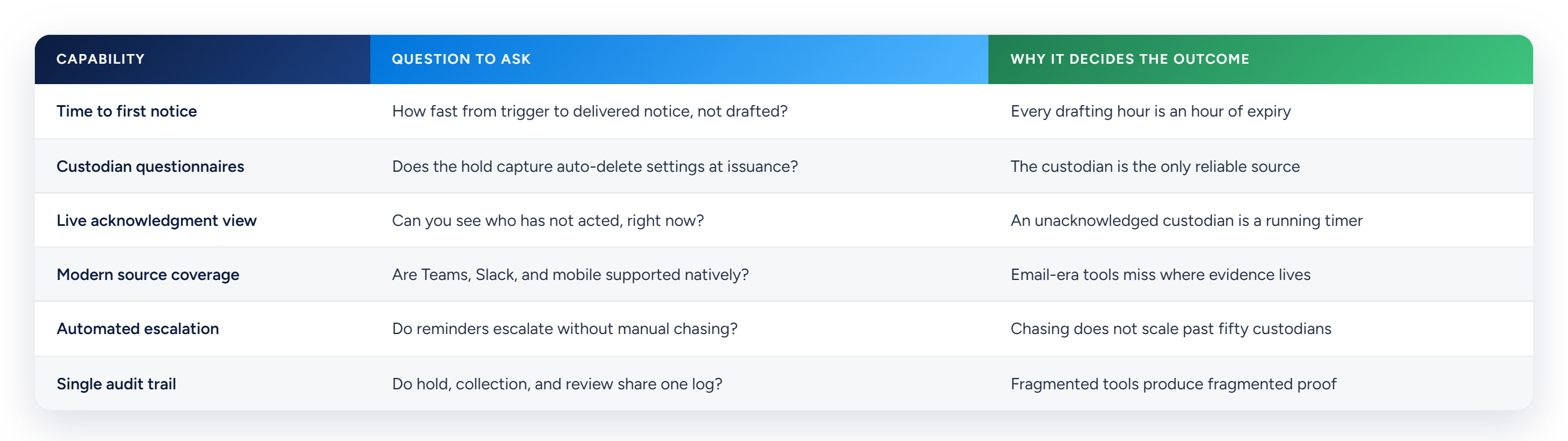
Venio Legal Hold was built against exactly those constraints rather than adapted to them afterwards. Pre-approved templates and Active Directory sync cut drafting time out of the critical path entirely.
Custodian questionnaires ride along with the notice, so auto-delete settings surface at hour one rather than at deposition. A live dashboard shows acknowledged, pending, and declined across every custodian, and reminders escalate on their own.
Hold, early case assessment, review, and production all run on one unified platform, so every action lands in a single timestamped record. When opposing counsel questions your timeline, you export one audit trail rather than reconciling four of them.
Make Preservation Fast with Venio
Preservation used to be a scope problem. The data sat on servers, and the only question was how much of it to keep. Ephemeral messaging inverts that on every matter, because the data is already leaving and the one variable you control is how fast you reach it.
The strongest programs are built for the moment somebody asks what you did and when. When did the duty attach? Which custodians were on disappearing channels? What were they told, and can you prove the date? The failure in Pable was never a shortage of technology, but a preservation step nobody took and a record nobody could defend.
Venio Legal Hold closes the distance between the trigger and the preservation that follows. Custodian questionnaires ride with automated notices, acknowledgment tracking, and a court-ready audit trail, so ephemeral exposure surfaces at hour one rather than at a deposition eighteen months later.
See what that looks like on a live matter. Book a Demo and walk through your own use case with our team.
Frequently Asked Questions
Is using ephemeral messaging illegal?
No, using disappearing messaging for business purposes is entirely lawful, and many organizations adopt it for legitimate security reasons. The legal risk arises when a preservation duty attaches and auto-delete simply keeps running underneath it. It also arises when a party switches channels after litigation has already become foreseeable.
Can deleted ephemeral messages be recovered?
Only rarely, and you should never build a preservation plan around the possibility. Most ephemeral apps delete permanently on both devices, with nothing retained on the provider servers at all. Forensic recovery occasionally surfaces fragments, but it is no substitute for preserving the messages in the first place.
Do we have to preserve messages on personal phones?
If relevant business communications live on those phones, then generally yes, they fall within scope. The controlling question is one of possession, custody, or control over the information itself. That turns on your policies and employment agreements rather than on who bought the device.
What is the difference between ephemeral data and off-channel communications?
Ephemeral data describes how information behaves, meaning that it deletes itself automatically without anyone acting. Off-channel communications describe where information travels, meaning outside the approved and archived systems your organization controls. A single message can fall into one category, the other, or both at the same time.
When does the duty to preserve ephemeral data begin?
It begins when litigation becomes reasonably anticipated, which is a lower threshold than most teams assume. In practice that is often a demand letter, a regulatory inquiry, or a contested termination. The duty routinely precedes a filed complaint by weeks or even by several months.
What must a legal hold notice say about auto-delete?
It must instruct custodians to disable automatic deletion on every relevant channel they use. In DR Distributors, a hold that omitted that instruction was treated by the court as inadequate. Sanctions followed against both the defendants and their former counsel under Rules 26(g) and 37.
Should we ban ephemeral messaging entirely?
A blanket ban is usually unenforceable in practice, and it tends to push communication further underground. Most organizations do better by defining approved channels and disabling disappearing modes on the platforms they manage. Auditing what people actually use will always beat relying on a prohibition nobody follows.
Related Articles
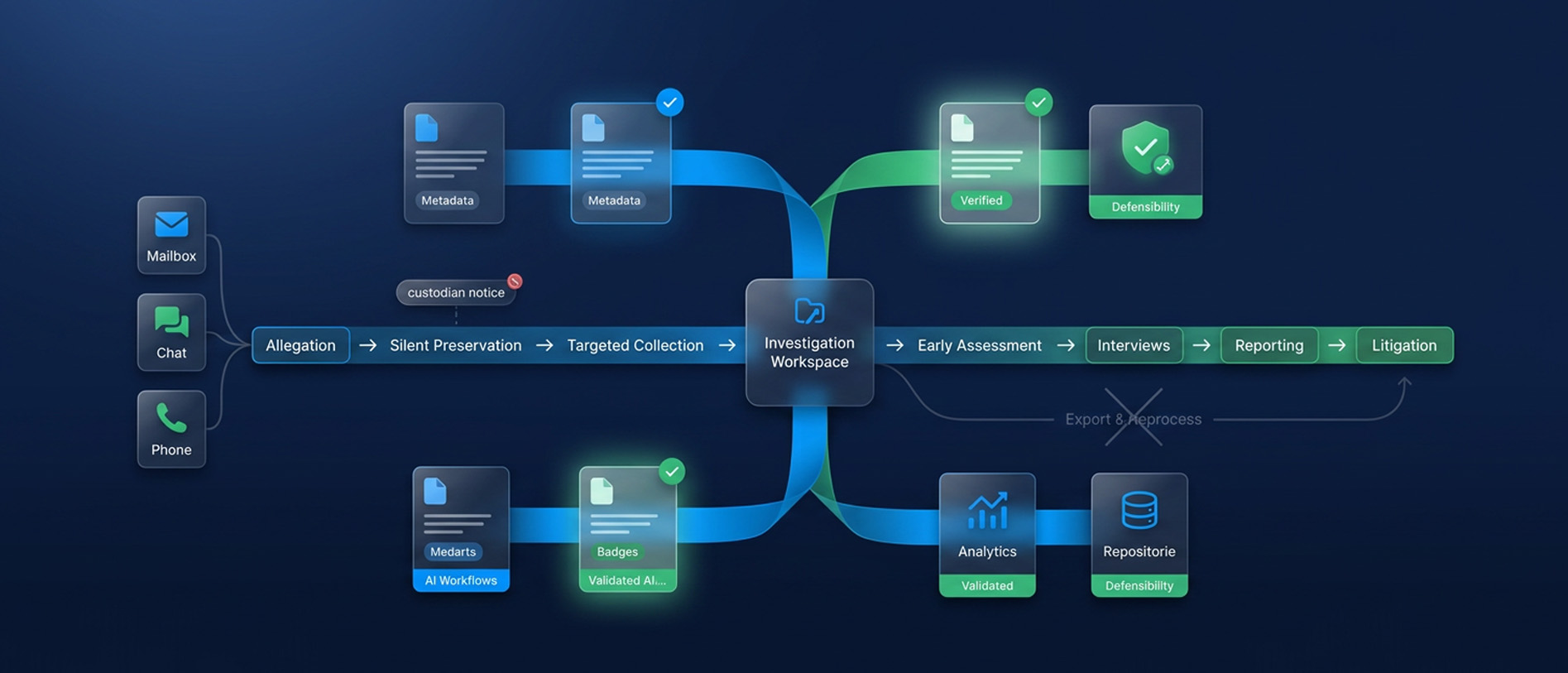
Internal Investigations: Getting the Facts Without Blowing the Matter Open
An internal investigation offers no court schedule and no second chance at prese
Read Article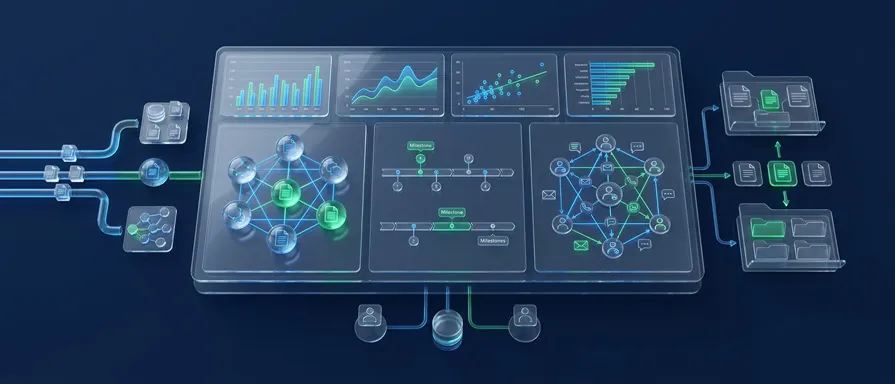
eDiscovery Data Analytics & Visualization for Trial Preparation
Most litigation teams don’t lose at trial because they lack evidence. They lose
Read Article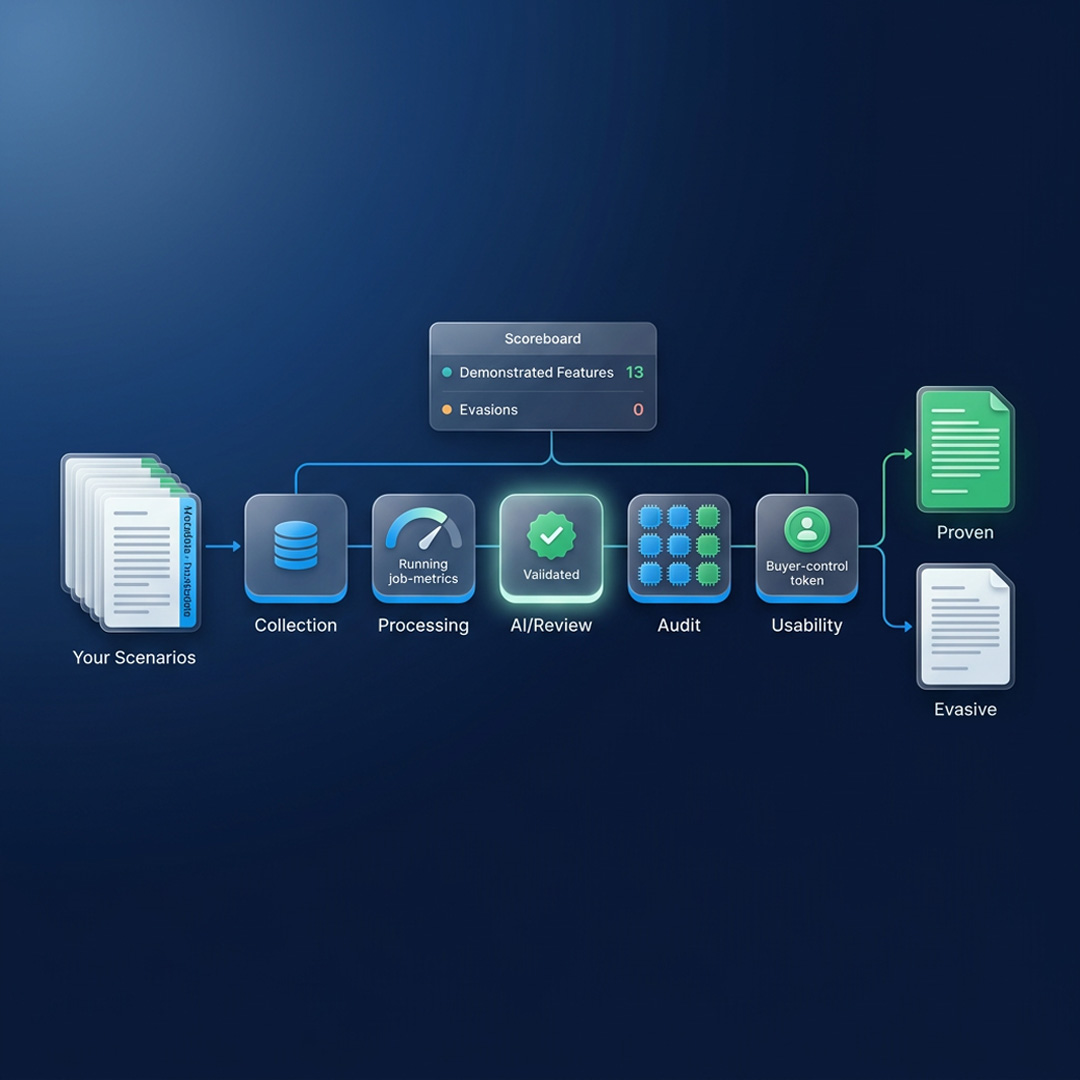
What to Ask in an eDiscovery Demo Before You Sign
Twenty questions that make an eDiscovery vendor prove processing, AI, security a
Read Article